First Focal Plane Reticles: The Long-Range Shooter's Guide
By Peter Makulek · Senior Optics Editor · · Live prices from UK retailers
If you have spent any time researching scopes for long-range shooting in the UK — whether for PRS-style competition, varminting at extended range, or stalking in open hill country — you will have encountered the term "first focal plane" (FFP). It refers to where the reticle sits inside the erector system of the scope, and it has profound implications for how you use your optic in the field. In a first focal plane scope the reticle is positioned ahead of the magnification lens group, which means the reticle scales up and down as you change magnification. The practical upshot is significant: your holdover and windage subtensions remain accurate at every magnification setting, not just one.
This matters enormously for long-range work. When you are holding 1.8 mils for a 600-yard shot on a steel plate, you need to know that 1.8 mils on the reticle genuinely corresponds to 1.8 mils in the real world — regardless of whether you are dialled to 10x or 25x. In a second focal plane (SFP) scope, the reticle subtensions are only true at one specific magnification, typically the maximum. Use the reticle at any other power for a holdover or range estimation and your corrections will be wrong unless you apply a mental conversion. For fast, intuitive shooting at distance, FFP eliminates that cognitive step entirely.
Below, we break down the technical detail, address common misconceptions, and offer concrete buying advice so you can choose the right FFP scope for UK long-range disciplines in 2026.
Top Picks — Live UK Prices

Nikko Stirling Diamond Long Range 30mm Tactical 4-16x50 IR Rifle Scope
via Uttings
£199.00

Hawke Sidewinder Tactical 6.5-20x42 - 1/2 Mil Dot | 17 110
via Livens
£372.90
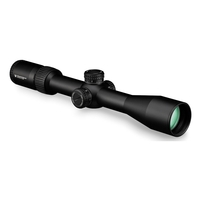
Vortex Diamondback Tactical FFP 4-16x44 Riflescope - MRAD
via Uttings
£429.00
Buying Advice
When choosing an FFP scope for long-range shooting, the first decision is your angular unit: MRAD (milliradians) or MOA (minutes of angle). Most UK PRS and NRL22 competitors now favour MRAD because the metric relationship is intuitive — 0.1 mil equals 1 cm at 100 metres — and turret adjustments in 0.1-mil clicks pair neatly with metric range cards. MOA remains popular among some target shooters and is equally precise (1 MOA ≈ 1.047 inches at 100 yards), so choose whichever you are willing to commit to and ensure your turrets, reticle and ballistic solver all speak the same language.
Optical quality at the low end of the magnification range deserves close scrutiny with FFP scopes. Because the reticle shrinks as you dial down, a thick or overly complex reticle can become almost invisible at 5x or 6x, while a fine reticle that is lovely at low power may obscure the target at maximum zoom. Look for reticles with an illuminated centre dot and sensibly graduated line thicknesses that remain usable across the full zoom range. Reputable makers such as Vortex, Nightforce, Kahles, Schmidt & Bender, Zero Compromise and Maven all offer well-resolved FFP reticles, and UK dealers increasingly stock the full range.
Finally, do not overlook mechanical features that complement a good FFP reticle. A reliable zero-stop prevents you from losing your 100-metre zero when dialling back after a long shot. Locking turrets guard against accidental adjustment during a stalk. Side-parallax adjustment — standard on scopes with 16x or higher magnification — is essential for removing parallax error at varying distances. Budget roughly £800–£2,500 for a capable FFP scope from a mid-tier to premium manufacturer in the UK market, though excellent options exist both below and above that bracket depending on your requirements.
Frequently Asked Questions
What is the difference between first focal plane and second focal plane?
In a first focal plane (FFP) scope the reticle sits in front of the magnification lenses, so it grows and shrinks with the image as you change zoom. This keeps all reticle subtensions accurate at every magnification. In a second focal plane (SFP) scope the reticle is behind the magnification group and stays the same apparent size regardless of zoom, meaning its subtensions are only correct at one nominated magnification — usually the highest.
Why do long-range shooters prefer FFP reticles?
Long-range shooting frequently demands quick holdover corrections using the reticle hash marks rather than dialling the turret. With an FFP reticle you can hold off at any magnification and know the subtension values are true, which saves time and reduces errors. This is particularly valuable in PRS-style competition where targets appear at varying distances in rapid succession.
Are there any downsides to first focal plane scopes?
The main trade-off is reticle visibility at low magnification: because the reticle shrinks with the image, fine lines can become hard to see at the bottom of the zoom range, especially in low light. High-quality illumination mitigates this considerably. FFP scopes also tend to cost more than SFP equivalents because the reticle etching tolerances are tighter.
Should I choose MRAD or MOA for my FFP scope?
Either system is equally precise for long-range work. MRAD is dominant in UK competition circles because 0.1 mil equals 1 cm at 100 metres, making mental arithmetic and range-card building straightforward in metric units. MOA (1 MOA ≈ 1.047 inches at 100 yards) is still widely used in some target disciplines. The crucial rule is to match your turret clicks, reticle markings and ballistic calculator to the same unit.
Can I use an FFP scope on a rimfire or air rifle?
FFP scopes work perfectly well on .22 LR rimfires for NRL22-style competition out to 200 yards or so. However, sub-12 ft/lb air rifles — the legal limit without a Firearms Certificate in England, Wales and Scotland — are only effective to roughly 50–75 yards, so the subtension-scaling advantage of FFP is largely unnecessary. A good SFP scope is usually more practical and cost-effective for airgun use.
How does parallax adjustment relate to FFP scopes at long range?
Parallax error occurs when the target image and the reticle are not focused on the same optical plane, causing the point of aim to shift as your eye moves behind the scope. At long range this can introduce meaningful aiming error. Most FFP scopes intended for long-range use feature a side-mounted parallax knob adjustable from around 25 metres to infinity, allowing you to eliminate parallax at your specific target distance before taking the shot.
Related guides
Expert UK guide to choosing the best scope for .22 long range shooting. Covers magnification, turrets, reticles, budget tiers in GBP…
Best Long-Range Scopes 2026: BDC Reticles vs Exposed TurretsDefinitive UK buyer's guide to the best scopes for long-range shooting in 2026. Compare BDC reticles vs exposed turrets for 300–1,000 yard shots…
Best Long-Range Scopes UK 2026: Mid-Budget Buyer's GuideDiscover the best scopes for long-range shooting in the UK for 2026. Our expert guide covers FFP vs SFP, MOA vs MRAD…
Best Long-Range Rifle Scopes 2026: Match Your Optic to Your CalibreOur 2026 UK guide to the best scopes for long range shooting. Learn how to match reticle, turrets and magnification to your calibre's ballistic profile…
Best Scopes for Ballistics-Matched Long-Range Shooting in 2026Our 2026 UK buyer's guide to the best long-range scopes with BDC reticles, ballistic turrets and calibre pairing for accurate shooting from 300 to 1,000…
FFP vs SFP Scopes: Which Suits Your Shooting?Confused by FFP and SFP rifle scopes? Our expert UK guide explains which reticle plane suits your discipline, from HFT to long-range PRS…
MOA vs MRAD: Which Should UK Shooters Choose?MOA or MRAD? Our expert guide helps UK shooters pick the right angular measurement system for their discipline…
Not sure which scope is right for you?
Try our AI-powered scope finder — answer a few questions and get personalised recommendations.
Find My Scope →Get a UK scope tip every day
Follow AiScopes on Facebook for daily buying guides, deals and gear advice.
Follow on Facebook