Best Long-Range Scopes Under £1,000 for UK Shooters
By Peter Makulek · Senior Optics Editor · · Live prices from UK retailers
Reaching out to 1,000 yards has never been more accessible for UK shooters. Whether you are shooting F-Class at Diggle, competing in NRL-style PRS matches at Orion or Bisley, or simply stretching a .308 Win or 6.5 Creedmoor on a Scottish hill permission, the optic sitting on top of your rifle is arguably the single biggest determinant of consistent hits at distance. The good news is that in 2026 the best scope for long-range shooting no longer demands a four-figure price tag. Glass quality, turret engineering, and reticle design in the sub-£1,000 bracket have improved dramatically, giving UK shooters genuine 1,000-yard capability without the financial sting.
This guide is written specifically for UK-based long-range shooters who want a rifle scope under £1,000 that genuinely tracks, holds zero, and delivers a clear sight picture in our often challenging light conditions. We have focused on scopes that are readily available from UK retailers—think Optics Warehouse, RUAG Ammotec dealers, Sporting Saint, and county gunshops—so you are not gambling on grey imports or uncertain warranty support. Every recommendation has been evaluated against the demands of real UK long-range shooting: variable weather, overcast skies, and courses of fire that reward dialling over holdover.
The key decisions you face when choosing the best budget long-range scope in the UK boil down to a handful of factors: first-focal-plane (FFP) versus second-focal-plane (SFP) reticle placement, MRAD versus MOA adjustment systems, magnification range, optical clarity in low light, turret feel and repeatability, and of course overall build quality at your price point. We break all of these down in detail below the product picks, so even if you are new to long-range shooting you will come away confident in what to look for and why it matters.
Below you will find our curated picks—scopes that we believe represent the best long-range optics under £1,000 available in the UK right now—followed by an in-depth buying-advice section and a comprehensive FAQ. Our aim is to make this the single most useful page on the topic, whether you are upgrading from a basic hunting scope or building your first dedicated long-range rig on a sensible budget.
Top Picks — Live UK Prices

Nikko Stirling Diamond Long Range 30mm Tactical 4-16x50 IR Rifle Scope
via Uttings
£199.00

Hawke Sidewinder Tactical 6.5-20x42 - 1/2 Mil Dot | 17 110
via Livens
£372.90
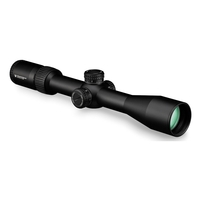
Vortex Diamondback Tactical FFP 4-16x44 Riflescope - MRAD
via Uttings
£429.00
Buying Advice
Start with the numbers that actually matter. For long-range shooting, you need enough magnification to resolve targets at distance—typically a scope topping out at 20× to 25× will serve you well to 1,000 yards, while anything above 30× often introduces more mirage shimmer than useful detail on a British range day. Your turrets should offer at least 25 MRAD (or roughly 85 MOA) of total elevation travel to dial for extreme drop without needing a canted rail. Remember that 0.1 MRAD clicks move your point of impact 1 cm at 100 metres (or roughly 10 cm at 1,000 m), while 1 MOA moves it approximately 1.047 inches at 100 yards. Most serious long-range shooters in the UK now favour MRAD because the metric maths is simpler in the field and matches the system used at most PRS-style events.
Think of the sub-£1,000 market in three broad tiers. Entry-level long-range scopes (roughly £300–£500) get you a usable FFP reticle, capped or exposed turrets with reasonable tracking, and decent glass—brands like Athlon Ares ETR or older Vortex Diamondback Tactical models sit here and are fine for club-level F-Class or informal steel shoots. The mid tier (£500–£750) is where value truly shines in 2026: scopes such as the Vortex Viper PST Gen II 5-25×50, Burris XTR III, and Bushnell Match Pro deliver genuinely repeatable tracking, zero-stop turrets, and ED glass that performs well even under flat grey UK skies. The premium end of the budget bracket (£750–£1,000) brings you into territory occupied by scopes like the Athlon Cronus BTR or higher-spec Vortex and Primary Arms models with top-grade coatings, stiffer erector springs, and better mechanical consistency over thousands of clicks.
Avoid the mistakes that catch out first-time long-range buyers. Do not fixate on maximum magnification at the expense of optical quality—a sharp 20× image beats a muddy 32× image every time. Do not buy SFP if you plan to use reticle holdovers at varying magnifications; the subtensions are only accurate at one power setting (usually maximum). Conversely, if you only ever dial your turrets and shoot on max, SFP can save you money and often delivers a finer reticle at high power. Also, resist the urge to skip a proper box test or tall-target test when your scope arrives: even premium turrets can have individual tracking errors, and confirming your scope returns to zero after dialling up and back down is essential before you trust it at distance.
UK-specific context matters more than many guides acknowledge. Firstly, you need a valid Firearm Certificate to own the centrefire rifles used for genuine long-range shooting—sub-12 ft-lb air rifles and springers are effective only to around 50–75 yards and are entirely unsuitable for this discipline. Popular UK long-range calibres include .308 Winchester, 6.5 Creedmoor, .284 Winchester, and increasingly 6 mm Dasher for competition, all of which demand a scope that can dial significant elevation. UK weather means you will frequently shoot under overcast skies with flat, low-contrast light, so glass quality and coating transmission are critical—look for scopes advertising 90%+ light transmission. Buy from an established UK dealer for warranty support; brands like Vortex offer a transferable lifetime VIP warranty honoured through UK distributors like Edgar Brothers, while Burris and Bushnell have strong UK service channels through Outdoor Sports Agencies and similar.
Match your scope choice to how you actually shoot. If you compete in PRS or NRL-style matches in the UK, prioritise an FFP MRAD scope with a feature-rich Christmas-tree reticle, a locking zero-stop turret, and a generous zoom range (5-25× is the sweet spot). If your primary interest is F-Class or benchrest at known distances, an SFP scope with fine crosshairs and target turrets in MOA can be perfectly effective and may offer better optical performance per pound. For those who split time between hunting and long-range practice, consider a versatile 4-16× or 5-25× scope with capped windage turrets to prevent accidental bumps in the field but an exposed, locking elevation turret for dialling on the range.
A brief brand landscape helps frame your choices. Vortex dominates UK mindshare in the budget long-range space thanks to the Viper PST Gen II line and its exceptional warranty—searching for a Vortex long-range scope in the UK returns dozens of positive forum threads for good reason. Burris has gained serious ground with the XTR III series, and the Burris vs Vortex debate is now a genuine conversation rather than a foregone conclusion; Burris glass can be slightly warmer-toned and some shooters prefer its turret feel. Athlon and Primary Arms offer outstanding value and are increasingly stocked by UK dealers. Meanwhile, brands like PARD are primarily known for digital night-vision and thermal add-ons rather than traditional day optics, but their growing UK presence in the optics market is worth noting if you are building a multi-role rifle. Whatever you choose, buy from a source that offers UK-based after-sales support and test your scope methodically before heading to the 1,000-yard line.
Frequently Asked Questions
What magnification range do you need for UK long-range shooting out to 1,000 yards?
For most UK long-range disciplines, a scope with a maximum magnification of 20× to 25× is ideal for engaging targets out to 1,000 yards. Higher magnifications such as 30× can be useful in calm conditions but often amplify mirage on British ranges, making the image less clear rather than more. A variable scope starting at around 4× or 5× also gives you a wide enough field of view for closer stages in PRS-style competitions. The sweet-spot specification for a versatile UK long-range scope in 2026 is 5-25×50.
FFP or SFP: which is better for long-range shooting on a budget?
First-focal-plane (FFP) scopes keep the reticle subtensions accurate at every magnification, which is a significant advantage if you use holdovers for wind or elevation at varying zoom levels—this is why FFP dominates PRS and practical long-range competitions. Second-focal-plane (SFP) scopes only have accurate reticle subtensions at one magnification setting (usually maximum), but they can offer a finer reticle and sometimes better glass for the same price. If you exclusively dial your turrets and shoot on max magnification, SFP can be a smart budget choice; for everything else, FFP is the safer long-range investment.
Which budget long-range scopes offer reliable tracking and zero-stop turrets under £1,000?
In 2026, the standout options with proven tracking and zero-stop mechanisms under £1,000 include the Vortex Viper PST Gen II 5-25×50, Burris XTR III 5.5-30×56, Bushnell Match Pro 6-24×50, and Athlon Cronus BTR 4.5-29×56. All four have been extensively tested by the UK long-range community and consistently return to zero after extended elevation runs. Always perform your own box test or tall-target test on arrival—individual samples can vary—and buy from a UK dealer so warranty claims are straightforward.
How do Vortex, Burris and other mid-price brands compare for UK long-range use?
Vortex remains the dominant budget long-range brand in the UK, largely thanks to its unconditional VIP lifetime warranty and the excellent Viper PST Gen II line. Burris has closed the gap significantly with the XTR III, offering slightly different glass characteristics and turret ergonomics that some shooters prefer—the Burris vs Vortex debate is now genuinely competitive. Athlon offers remarkable specifications for the price, particularly in the Cronus BTR series, while Bushnell's Match Pro punches above its weight in optical clarity. All are available through established UK retailers with proper after-sales support.
Can you shoot 1,000 yards competitively with a scope under £1,000?
Absolutely. Many UK PRS, F-Class, and long-range club competitors use scopes in the £500–£1,000 bracket and achieve excellent results. The limiting factor at 1,000 yards is more often the shooter's wind-reading ability, ammunition consistency, and rifle quality than the optic, provided the scope tracks reliably and offers sufficient adjustment range. Scopes like the Vortex Viper PST Gen II and Burris XTR III are regularly seen on the firing line at Bisley, Diggle, and other UK ranges in competitive use.
MRAD or MOA: which adjustment system should I choose for long-range shooting in the UK?
MRAD (milliradian) has become the de facto standard for UK long-range and PRS shooting because the metric mathematics are straightforward: 0.1 MRAD moves your impact 1 cm at 100 metres. MOA (minute of angle) is still popular in F-Class and among US-influenced shooters, where 1 MOA equals approximately 1.047 inches at 100 yards and many prefer the finer 0.25 MOA click values. Choose MRAD if you shoot PRS events or prefer metric calculations; choose MOA if your discipline or preference aligns with imperial measurements. The critical rule is to match your turret adjustment system to your reticle—never mix MRAD turrets with an MOA reticle.
Do I need a 34 mm tube for long-range shooting, or is 30 mm sufficient?
A 30 mm tube is perfectly adequate for most UK long-range applications up to 1,000 yards and the majority of scopes under £1,000 use this diameter. A 34 mm tube can provide more internal elevation travel and theoretically allows larger erector lenses for slightly better light transmission, but the real-world difference at this price point is marginal. The main practical consideration is that 34 mm rings and mounts are heavier and slightly more expensive. Unless you specifically need extreme elevation travel—for example, shooting very heavy subsonic loads at long range—30 mm is a solid, cost-effective choice.
What is parallax adjustment and why does it matter for long-range scopes?
Parallax is the apparent shift of the reticle against the target when you move your eye behind the scope. At long range, even small parallax errors translate into misses, so a side-focus or adjustable-objective parallax control is essential. Most scopes in this category offer a side-focus knob marked from around 10 yards to infinity, allowing you to eliminate parallax at your specific shooting distance. Always adjust parallax before each string of fire—set it so the target image is sharpest and the reticle does not appear to move when you shift your head slightly behind the eyepiece.
Are sub-12 ft-lb air rifles suitable for long-range shooting?
No. Sub-12 ft-lb air rifles and spring-powered air guns, which can be owned without a Firearm Certificate in the UK, are realistically effective only to around 50–75 yards due to their low muzzle energy and rapid velocity loss. Genuine long-range shooting at distances of 500 to 1,000 yards requires centrefire rifles in calibres such as .308 Winchester, 6.5 Creedmoor, or similar, all of which require an FAC. Never attempt to use air-rifle optics or air rifles for long-range centrefire disciplines—they are designed for entirely different energy levels and engagement distances.
How much should UK shooters expect to spend on a scope built for 1,000+ yard precision?
Realistically, a rifle scope capable of reliable performance beyond 1,000 yards will cost UK buyers from around £900 at the entry point of the mid-tier up to £3,500 or more for premium glass. Below £900 you can find functional optics, but turret tracking repeatability and coating quality often suffer — both of which are critical at extreme distance. The mid-range sweet spot of roughly £1,200–£2,000 delivers excellent value, with proven zero-stop turrets, ED glass, and the internal elevation travel needed for ELR work. Budget for quality mounts and a canted rail on top of the scope price.
Which reticle features matter most for holdover and wind correction at extreme distance?
At distances beyond 1,000 yards, a Christmas-tree or hash-marked reticle with clearly graduated subtensions in MRAD is invaluable. These reticles provide holdover dots or lines below the centre crosshair and wind-hold marks to the sides, allowing you to apply corrections visually without dialling the turrets — essential when conditions change rapidly. Look for reticles with subtension marks extending to at least 20 MRAD below centre and 5 MRAD either side. Illumination of the centre dot aids target acquisition against dark backgrounds but should not wash out the finer hash marks.
How much total elevation travel does a scope need for shooting beyond 1,000 yards?
The total elevation adjustment required depends on your cartridge and zero distance, but as a rule of thumb, you should look for at least 25 MRAD (approximately 86 MOA) of total internal elevation. A .308 Win zeroed at 100 metres may need 35 MRAD or more to reach 1,200 yards, while a 6.5 Creedmoor requires roughly 25 MRAD for the same distance. Using a 20 MOA (roughly 6 MRAD) canted scope base effectively adds to your usable come-up, which is why such bases are almost universal in the UK ELR community.
Are digital or thermal scopes like those from Pard suitable for extreme long-range precision?
Thermal and digital optics from brands such as Pard serve a different primary purpose — they excel at target detection in low light or darkness and are popular among UK shooters for legal night-time pest control under the appropriate FAC conditions. However, current-generation digital and thermal scopes generally lack the optical resolution, turret precision, and reticle subtension accuracy required for cold-bore hits at 1,000 yards and beyond. For dedicated extreme-distance precision in daylight, a high-quality traditional optical rifle scope remains the best tool. That said, a Pard thermal clip-on mounted ahead of your day scope can add significant night capability to an ELR rig without sacrificing daytime performance.
Related guides
Discover the best scopes for long-range shooting in the UK for 2026. Our expert guide covers FFP vs SFP, MOA vs MRAD…
.22 Long Range Scope Recommendations for UK ShootersExpert UK guide to choosing the best scope for .22 long range shooting. Covers magnification, turrets, reticles, budget tiers in GBP…
Best Long-Range Scopes 2026: BDC Reticles vs Exposed TurretsDefinitive UK buyer's guide to the best scopes for long-range shooting in 2026. Compare BDC reticles vs exposed turrets for 300–1,000 yard shots…
Best Long-Range Rifle Scopes 2026: Match Your Optic to Your CalibreOur 2026 UK guide to the best scopes for long range shooting. Learn how to match reticle, turrets and magnification to your calibre's ballistic profile…
Rimfire Scope vs Regular Scope: The Real Differences ExplainedWhat is the actual difference between a rimfire scope and a regular centrefire scope? We cover parallax, turrets…
Best Budget PRS Scopes for UK Shooters in 2026Find the best scope for PRS competition under £1,000 in the UK. Expert guide to FFP, MRAD turrets, magnification…
Read next
- long range optics UK
Long Range Optics UK: Best Hunting Scopes for 2026
Not sure which scope is right for you?
Try our AI-powered scope finder — answer a few questions and get personalised recommendations.
Find My Scope →Get a UK scope tip every day
Follow AiScopes on Facebook for daily buying guides, deals and gear advice.
Follow on Facebook