Rimfire Scope vs Regular Scope: The Real Differences Explained
By Peter Makulek · Senior Optics Editor · · Live prices from UK retailers
If you have ever searched for a scope for your .22LR and wondered whether you actually need a dedicated rimfire scope or whether a standard rifle scope will do the job, you are not alone. It is one of the most common questions UK shooters ask, and the answers online are often vague, contradictory or written for the American market. The difference between a rimfire scope and a regular scope comes down to a handful of optical and mechanical factors — parallax preset distance, turret travel range, reticle design and, to a lesser extent, recoil tolerance — but understanding why those differences matter is the key to making a smart purchase.
In the UK, rimfire shooting occupies a uniquely important niche. The .22LR is the backbone of club target shooting, farm pest control, and many shooters' introduction to firearms on a Section 1 certificate. Distances are typically short — 25 to 100 yards for most practical purposes — and the bullet's rainbow trajectory beyond 75 yards makes precise holdover or dialled elevation critical. A rifle scope optimised for centrefire cartridges can technically be mounted on a rimfire, but its factory parallax setting and turret range may fight you at every step. Understanding this saves frustration and, more importantly, money.
The UK market in 2026 offers more choice than ever at every price point, from budget-friendly options under £100 to premium optics with first focal plane reticles and exposed turrets purpose-built for precision rimfire disciplines like NRL22. Brands such as Pard are also pushing digital and thermal crossover optics into the rimfire space, blurring lines that were once clear. Before you spend a penny, it pays to understand exactly what separates a rimfire scope from a regular centrefire scope, what genuinely matters for accuracy, and what is just marketing noise.
This guide is written specifically for UK shooters. We cover the technical differences in depth — parallax, focal plane, adjustment granularity — then give practical buying advice across budget tiers, flag common mistakes, and answer the real questions we see in UK forums and club WhatsApp groups every week. Whether you are fitting glass to a CZ 457, a Ruger 10/22 or a Tikka T1x, read on before you buy.
Top Picks — Live UK Prices
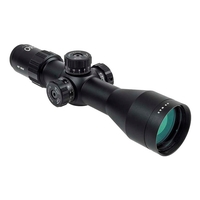
PAO HD MAX 4-16x44 SF FFP Ultra Compact Riflescope
via Uttings
£219.00
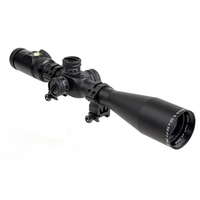
PAO F1 5-20x50 IR SF FFP Rifle Scope
via Uttings
£239.00

Wulf Tornado FFP 6-24x50 W-MIL3 Side Focus Rifle Scope
via BushWear
£249.99
Buying Advice
Start with the specs that actually move groups. The single most important specification on any rimfire scope is its parallax setting or adjustment range. A standard centrefire rifle scope is typically factory-set for parallax-free viewing at 100 yards (or 100 metres), which means at 25 or 50 yards — normal rimfire distances — you can have several MOA of parallax error if your eye is not perfectly centred behind the scope. A dedicated rimfire scope is either factory-set at 50 yards or, better still, features an adjustable objective (AO) ring or side-focus turret that dials down to 10 yards. If you shoot at varying distances, adjustable parallax is not a luxury; it is essential. Beyond parallax, check the total elevation travel: rimfire ballistics demand a lot of upward adjustment to reach 100+ yards, so look for at least 60 MOA or 18 MRAD of total internal travel. Remember that 0.1 MRAD clicks move the point of impact 1 cm at 100 metres, and 1 MOA clicks move it approximately 1.047 inches at 100 yards — either system works, but pick one and stick with it across your kit.
Budget tiers in the UK break down fairly clearly. Under £100, you will find serviceable scopes with fixed parallax at 50 yards, SFP reticles and capped turrets — perfectly adequate for plinking, basic pest control and club shoots out to 50 yards. In the £100–£250 bracket, expect side-focus parallax adjustment, better glass coatings, illuminated reticles and exposed turrets with reliable tracking. This is the sweet spot for most UK .22LR shooters who want a scope they will not outgrow quickly. Above £250, you enter territory where FFP reticles with Christmas-tree or hashed designs, zero-stop turrets, ED glass and rock-solid tracking become standard — aimed at competitive NRL22 shooters or anyone who demands centrefire-grade precision from their rimfire. Do not overspend relative to the rifle: a £500 scope on a £200 rifle is common in competition but questionable for casual use.
The most common mistake UK buyers make is mounting a spare centrefire scope on a .22LR without understanding the parallax mismatch, then blaming the rifle or ammunition when groups open up at 25 yards. The second mistake is buying a scope with too much magnification and too narrow a field of view — 3-9×40 remains one of the most versatile configurations for rimfire, and going beyond 16× only makes sense on a heavy-barrelled bolt-action shot from a bench or bipod. A third pitfall is ignoring eye relief: semi-automatic rimfire actions like the 10/22 can shuffle the rifle in your shoulder slightly, and anything under 80 mm of eye relief risks scope-eye on a cold morning when you are wearing extra layers and your cheek weld shifts. Finally, beware scopes marketed as "rimfire rated" that are simply low-cost centrefire models relabelled — check the parallax specification to verify.
UK-specific context matters more than many guides acknowledge. Under current legislation, a .22LR rimfire rifle requires a Section 1 Firearms Certificate, and your approved conditions may specify disciplines or land, which in turn dictates the distances and scenarios your scope must handle. Club target shooting at 25 and 50 yards is the bread and butter; farm pest control may extend to 80–100 yards on rabbits; and NRL22-style precision competition pushes rimfire to 200 yards and beyond, where bullet drop can exceed 20 MRAD. For sub-12 ft/lb air rifles — which do not require an FAC — effective range rarely exceeds 50–75 yards, and a rimfire scope set at 50-yard parallax can double as an excellent airgun optic. UK retailers such as RUAG, Optics Warehouse and John Rothery stock the widest rimfire-specific ranges; buying from a UK dealer ensures warranty support and correct VAT-inclusive pricing.
Matching the scope to your use case is straightforward once you know your primary discipline. For casual plinking and basic vermin control under 60 yards, a 3-9×40 or 4-12×40 with 50-yard fixed parallax will serve well, and there is no need to spend over £100. For club target shooting at marked distances, a side-focus model with a fine crosshair or mil-dot reticle and exposed, finger-adjustable turrets in the £150–£250 range gives you repeatable adjustments without guesswork. For NRL22 or precision rimfire, invest in an FFP scope with an MRAD reticle, 0.1 MRAD clicks, a zero-stop mechanism, and at least 20 MRAD of elevation travel — budget £300 and upwards. If you shoot at night or in low light, consider Pard's digital night-vision add-ons or their integrated digital scopes, which are gaining traction among UK lampers and pest controllers and pair well with rimfire calibres.
The brand landscape for rimfire scopes in the UK is broad. At the budget end, brands like Hawke, MTC and Nikko Stirling offer rimfire-specific models with correctly set parallax and are widely stocked by UK dealers. In the mid-range, Vortex (particularly the Diamondback Tactical and Crossfire II AO lines), Athlon and Primary Arms provide excellent value with solid turret tracking. At the premium tier, March, Nightforce and Sightron dominate competition benches. Pard occupies a unique space, offering digital and thermal optics that are increasingly popular for night-time pest control on rimfire platforms; their NV007 and TS series are well-represented in UK retail. Whatever brand you choose, verify that the scope's parallax range covers your shooting distances, that the turret system matches your reticle's unit of measure (MRAD scope with MRAD turrets, MOA scope with MOA turrets), and that the tube diameter suits your available ring or mount height — 1-inch tubes are standard on budget rimfire scopes, while 30 mm and 34 mm tubes are common on mid-range and premium models respectively.
Frequently Asked Questions
What is the actual difference between a rimfire scope and a regular centrefire scope?
The primary difference is the parallax preset distance: a rimfire scope is typically set at 50 yards (or offers adjustable parallax down to 10 yards), whereas a standard centrefire rifle scope is factory-set at 100 yards or more. Rimfire scopes may also offer finer elevation and windage adjustments suited to the smaller corrections needed at short range, and their reticles are often designed with holdover marks calibrated for the steep .22LR trajectory. Recoil tolerance is a secondary difference — rimfire scopes do not need to withstand the same forces as centrefire optics — but most quality scopes handle both without issue.
Can you use a standard rifle scope on a .22LR rimfire rifle?
Yes, you can physically mount a standard centrefire rifle scope on a .22LR, and many shooters do. The main drawback is parallax error at typical rimfire distances: if the scope is parallax-set at 100 yards and you shoot at 25 or 50 yards, your point of impact will shift depending on where your eye sits behind the scope. If the centrefire scope has adjustable parallax (AO or side focus) that dials below 50 yards, this problem is largely eliminated. Otherwise, you will need very consistent cheek weld to minimise the error, and your groups may still be larger than they should be.
Why do rimfire scopes have different parallax settings and does it matter for accuracy?
Parallax is the apparent shift of the reticle against the target when your eye moves off the optical axis. At close range, parallax error from a 100-yard-set scope can be several MOA — easily enough to miss a rabbit's head at 30 yards. Rimfire scopes are set at 50 yards or offer adjustable focus precisely because .22LR shooting happens at short distances where parallax has the greatest effect. For any shooting that demands consistent accuracy — pest control, target competition, or zeroing — correct parallax adjustment is not optional.
Do you need adjustable objective or side focus on a rimfire scope?
If you only ever shoot at one fixed distance — say, 50 yards on a club range — a scope with parallax factory-set at 50 yards will work perfectly and saves cost. However, if you shoot at varying distances, an adjustable objective (AO) ring on the front bell or a side-focus turret lets you eliminate parallax at each distance, giving you a sharper image and removing point-of-impact shift. Side focus is generally preferred because it is easier to reach from a shooting position without disturbing your hold. For most UK rimfire shooters, side-focus parallax is the single most worthwhile upgrade.
What is a good scope for a .22LR if you are on a budget under £100?
Several reputable brands offer a good scope for a .22LR under £100 in the UK. Look for models with 50-yard factory parallax, a 3-9×40 or 4-12×40 configuration, fully multi-coated lenses and a simple duplex or mil-dot reticle. Hawke's Vantage and MTC's Mamba Lite lines are frequently recommended in UK forums. At this price, you will get an SFP reticle and capped turrets, which is perfectly adequate for plinking, basic pest control and informal target shooting to 50–75 yards. Ensure the scope comes with a manufacturer warranty honoured by a UK dealer.
What is the difference between FFP and SFP on a rimfire scope and which should I choose?
In a first focal plane (FFP) scope, the reticle scales with magnification so the subtension marks (mil-dots or MOA hashmarks) are accurate at every power setting — ideal for dialling or holding over at varied distances without mental arithmetic. In a second focal plane (SFP) scope, the reticle stays the same apparent size and subtensions are only true at one magnification, usually the maximum. For casual rimfire use and fixed-distance target shooting, SFP is simpler and cheaper. For NRL22 or precision rimfire where you adjust magnification frequently and use reticle holdovers, FFP is strongly preferred.
How much elevation travel do I need in a rimfire scope for long-range .22LR shooting?
A .22LR bullet drops dramatically beyond 100 yards — roughly 10–12 MRAD (about 35–40 MOA) between a 50-yard zero and 200 yards, depending on ammunition. To dial this without running out of adjustment, you need a scope with at least 20 MRAD (roughly 70 MOA) of total elevation travel, and ideally a zero-stop so you can return to your base zero quickly. Many budget rimfire scopes have only 40–50 MOA total travel, which is fine for shooting to 100 yards but will limit you at longer distances. If you plan to compete at NRL22 events in the UK, prioritise a scope with generous elevation travel.
Are Pard digital scopes suitable for rimfire rifles in the UK?
Pard's digital and night-vision optics are increasingly popular among UK shooters for nighttime pest control with rimfire calibres. Models like the Pard NV007 clip-on or their dedicated digital rifle scopes work well on .22LR platforms because the minimal recoil is gentle on electronic components. They are legal to use for pest control on land where you have permission, though you must comply with your FAC conditions and any restrictions on night shooting. For daytime target or competition shooting, a conventional optical scope will still outperform any current digital alternative in image clarity and response speed.
Can I use a rimfire scope on a sub-12 ft/lb air rifle?
Absolutely — a rimfire scope with 50-yard parallax or adjustable parallax is an excellent choice for a sub-12 ft/lb air rifle, since both platforms operate at similar effective ranges of 25–75 yards. One caveat applies to spring-powered air rifles: the unique bidirectional recoil of a springer can damage scopes not rated for it, so check that the scope is springer-rated or use a recoil-dampening mount. Gas-ram and PCP air rifles do not produce this harsh recoil and are compatible with virtually any rimfire or centrefire scope.
Related guides
Struggling to find the right scope for your exact UK shooting scenario? Our 2026 guide matches niche requirements to real optics — FFP, SFP, thermal…
Scope Upgrade Ideas & Recommendations 2026Expert scope upgrade recommendations for UK shooters in 2026. Covers rifle, rimfire, thermal and spotting scopes, reticle choices, magnification tiers…
How Much Magnification Do You Really Need?Cut through the hype and find the right scope magnification for your shooting discipline. Practical UK advice covering air rifles, rimfire…
Best Budget PRS Scopes for UK Shooters in 2026Find the best scope for PRS competition under £1,000 in the UK. Expert guide to FFP, MRAD turrets, magnification…
Best .22LR Scopes for 100-Yard Precision in 2026The best 22 rifle scope for 100 yards and beyond — our UK 2026 .22LR rimfire guide covers magnification, FFP vs SFP, parallax, turrets and budget picks.
Not sure which scope is right for you?
Try our AI-powered scope finder — answer a few questions and get personalised recommendations.
Find My Scope →Get a UK scope tip every day
Follow AiScopes on Facebook for daily buying guides, deals and gear advice.
Follow on Facebook