Best Budget PRS Scopes for UK Shooters in 2026
By Peter Makulek · Senior Optics Editor · · Live prices from UK retailers
Precision Rifle Series–style competition has exploded in the UK over the past few years, with clubs from Scotland to the south coast now hosting regular matches that test marksmanship at distances from 100 to beyond 1,000 yards. The format rewards speed, accuracy, and the ability to read wind and elevation corrections on the fly, which places enormous demands on your optic. For most UK competitors, finding the best scope for PRS that delivers genuine match-grade performance without a four-figure price tag is the single most important gear decision they will make in 2026.
The good news is that the budget precision rifle scope UK market has matured dramatically. Brands like Athlon, Primary Arms, and the ever-popular Vortex now offer first-focal-plane optics with exposed, locking MRAD turrets, reliable tracking, and genuinely usable glass quality—all comfortably under £1,000. These scopes would have been unthinkable at this price point even five years ago, and they are now proving themselves on the clock at national-level PRS matches across Britain and Europe.
Choosing the right long range scope for PRS involves balancing several competing priorities: magnification range, reticle design, turret feel and repeatability, optical clarity in the dim conditions common across UK ranges, and physical robustness. This guide breaks down each factor in depth so you can make a confident, informed decision. We focus specifically on what matters for UK competition shooters—the calibres you are likely running, the distances typical of British PRS courses of fire, and where to buy with proper UK warranty support.
Below you will find our curated product picks followed by an in-depth buying-advice section covering specs, budget tiers, common mistakes, and a brand-by-brand landscape. Whether you are building your first PRS rifle on a .308 Win or upgrading from an entry-level optic on your 6.5 Creedmoor, this is the definitive UK resource for choosing a scope for PRS in 2026 without breaking the bank.
Top Picks — Live UK Prices

Nikko Stirling Diamond Long Range 30mm Tactical 4-16x50 IR Rifle Scope
via Uttings
£199.00
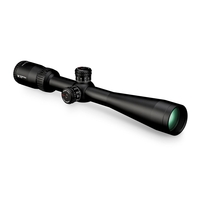
Vortex Diamondback Tactical 4-12x40 Riflescope - VMR-1 Reticle (MOA)
via Uttings
£299.00

Vortex Diamondback Tactical 4-12x40 VMR-1 Riflescope
via BushWear
£315.00
Buying Advice
Start with the numbers that genuinely matter on a PRS course of fire. Total elevation travel determines how far you can dial before running out of adjustment—look for at least 25 MRAD (roughly 86 MOA) of total internal adjustment, with the majority available above your zero. Turret clicks should be 0.1 MRAD per click, meaning each click shifts your point of impact exactly 1 cm at 100 metres (or about 0.36 inches at 100 yards). Repeatability—the turret returning to the same point of impact after being dialled up and back—is arguably more important than raw click value precision. A scope that tracks reliably to within 0.05 MRAD over a full revolution will outperform one with crisper clicks but inconsistent return to zero. Parallax adjustment is essential: at PRS distances you need a side-focus knob that goes down to at least 25 yards and up to infinity, allowing you to eliminate parallax error at every stage.
Budget tiers in the UK PRS scope market break down roughly as follows. Under £400 you will find capable optics from Primary Arms and Athlon's entry lines—solid glass, functional turrets, and FFP reticles, but with trade-offs in low-light transmission, turret feel, and consistency across temperature extremes. Between £400 and £700 sits the sweet spot for most UK competitors: this is where Vortex's Diamondback Tactical FFP, Athlon Ares ETR, and Primary Arms GLx lines compete, offering genuinely excellent tracking, zero-stop turrets, and ED glass. From £700 to £1,000 you approach the bottom of the premium tier—Vortex Viper PST Gen II, Bushnell XRS3, and occasionally discounted Athlon Cronus models—where optical clarity, colour fidelity, and mechanical precision start to rival scopes costing twice as much. At every tier, buy the best glass and tracking you can afford; features like illuminated reticles and throw levers are secondary.
The most common mistake UK PRS newcomers make is over-magnifying. A 5–25× scope sounds appealing, but most PRS stages are shot between 8× and 18×, and higher magnification narrows your field of view, exaggerates mirage, and slows target acquisition on positional stages. A 4–16× or 5–25× with a quality reticle will serve you far better than a cheap 6–36× with mediocre glass. Another frequent error is choosing SFP over FFP to save money. While second-focal-plane scopes are perfectly valid for hunting, PRS demands constant use of reticle hold-overs and wind holds at varying magnifications; an FFP reticle ensures your subtensions are accurate at every power setting, which is non-negotiable under time pressure. Finally, do not ignore the mounting system: a quality one-piece cantilever mount with 20 MOA of built-in cant will maximise your usable elevation travel and is just as important as the scope itself.
UK-specific context matters more than many guides acknowledge. British PRS matches typically run to 1,000 yards, with the bulk of stages set between 300 and 800 yards—distances where a well-zeroed 6.5 Creedmoor or .308 Win with correct BC data will keep you competitive. UK law requires your rifle and scope to be stored in a secure cabinet and transported in a locked case; scopes with capped or locking turrets offer a small practical advantage in transit, reducing the risk of accidental adjustment. Most serious UK PRS shooters buy from specialist retailers such as Sporting Saint, RUAG, or Optics Warehouse, all of whom offer UK warranty support—this is critical, because sending a scope back to the US for repair can take months. VAT is included in UK retail prices, but watch out for grey imports advertised at suspiciously low prices; these often lack UK warranty coverage and may not include the correct reticle or turret configuration.
Matching a scope to your specific use case requires honest self-assessment. If you are shooting monthly club-level PRS matches and the occasional national event, a scope in the £400–£700 bracket will not hold you back—your time and money are better spent on ammunition, a quality bipod, and dry-fire practice. If you are already placing consistently in the top third and competing at regional or national level, stepping up to the £700–£1,000 range will give you tangible gains in low-light clarity, turret confidence, and edge-to-edge sharpness that translate to faster target acquisition under pressure. For those who also shoot NRL Hunter or field-style disciplines, consider a scope with a versatile magnification range like 3–18× or 4–24× that handles close barricade stages as well as long-range steel. And if thermal or night-vision clip-ons are part of your setup—brands like PARD are increasingly popular in the UK for permissions-based shooting—ensure your chosen scope has sufficient eye relief and mounting space to accommodate a clip-on unit ahead of the objective bell.
The brand landscape for budget PRS scopes in the UK in 2026 is healthier than ever. Vortex remains the default recommendation thanks to their unconditional lifetime warranty, wide UK dealer network, and the proven Diamondback Tactical and Viper PST Gen II lines. Athlon has carved out a strong niche with the Ares ETR and Midas TAC offering excellent value and increasingly good UK availability. Primary Arms punches above its weight with the GLx and SLx ACSS reticle series, which are particularly well-suited to rapid hold-over calculations in PRS. Bushnell's XRS3 sits at the top of the budget bracket and delivers optical performance that embarrasses some scopes at twice the price. Newcomers like Maven and Arken are gaining traction but UK dealer support is still limited. Whichever brand you choose, prioritise a model with an established track record in PRS competition, verified turret tracking data from independent reviewers, and readily available UK after-sales support—those three factors will serve you far better than chasing the newest release or the shiniest spec sheet.
Frequently Asked Questions
What magnification range do you need for PRS-style competition in the UK?
Most UK PRS stages are shot between 8× and 18× magnification, so a scope in the 4–16× or 5–25× range covers the vast majority of scenarios. Higher magnification like 6–36× is rarely beneficial because it narrows field of view and amplifies mirage, which is already a significant challenge on British ranges in summer. A quality 5–25× FFP scope is the most popular all-round choice among competitive UK PRS shooters, offering enough top-end power for 1,000-yard stages while retaining usable low-end magnification for close positional work.
Is FFP or SFP better for PRS matches, and does it matter at this price point?
First focal plane (FFP) is strongly preferred for PRS because the reticle subtensions remain accurate at every magnification, allowing you to use hold-overs and wind holds without dialling back to a specific power setting. In time-pressured PRS stages, this eliminates a critical source of error. Even at budget price points, the FFP options available in 2026 from brands like Athlon, Primary Arms, and Vortex offer excellent reticle clarity. An SFP scope can work if you always dial your corrections, but for PRS-style shooting in the UK, FFP is the clear recommendation.
MOA or MRAD for PRS: which turret system suits UK competition shooters?
MRAD (milliradian) is the overwhelming standard in PRS competition worldwide, and the UK is no different. One click of 0.1 MRAD moves your point of impact exactly 1 cm at 100 metres, which is intuitive and pairs naturally with metric range estimation. MOA works perfectly well mathematically—1 MOA is approximately 1.047 inches at 100 yards—but almost all PRS reticles, ballistic solvers, and competition data cards are built around MRAD. Choosing MRAD ensures your reticle, turrets, and software all speak the same language, reducing errors under match pressure.
Can budget scopes like Athlon or Primary Arms genuinely compete with Vortex and Nightforce at PRS level?
Yes, within reason. Athlon's Ares ETR and Primary Arms's GLx series have proven themselves in PRS competition with reliable tracking, solid glass quality, and well-designed FFP reticles. They compete very effectively with the Vortex Diamondback Tactical and even approach the Viper PST Gen II in several performance areas. Where premium scopes like Nightforce ATACR pull ahead is in edge-to-edge clarity, chromatic aberration control, and mechanical durability over tens of thousands of clicks. For club and regional-level PRS in the UK, a well-chosen budget scope will not hold you back—your shooting fundamentals matter far more.
Do you need zero-stop turrets for PRS, and which affordable scopes include them?
A zero-stop is extremely useful in PRS because it gives you a positive mechanical reference point to return your elevation turret to your confirmed zero without looking at the dial. Under time pressure and in awkward shooting positions, this prevents the common error of being a full revolution off. Most competitive-grade scopes under £1,000 now include zero-stop as standard—the Vortex Viper PST Gen II, Athlon Ares ETR, Bushnell XRS3, and Primary Arms GLx 4-16×50 all feature user-settable zero-stop mechanisms. It is a feature well worth prioritising when choosing a budget PRS scope in the UK.
How much elevation travel do I actually need for PRS in the UK?
For typical UK PRS distances out to 1,000 yards with common calibres like 6.5 Creedmoor or .308 Winchester, you will need roughly 10–14 MRAD of elevation above your 100-metre zero, depending on your load and barrel length. A scope with 25 MRAD or more of total elevation travel, combined with a 20 MOA canted rail or mount, will give you ample adjustment. Always check how much elevation is available above centre, not just the total spec, because some scopes allocate travel symmetrically and leave you short at the top end.
What reticle design is best for PRS competition at this price point?
Look for a Christmas-tree or grid-style MRAD reticle with clearly marked hold-over and windage references in 0.5 or 0.2 MRAD increments. Popular choices include the Vortex EBR-7C, Athlon APRS6, and Primary Arms ACSS Athena. A busy reticle might seem overwhelming at first, but in PRS you regularly use both turret dials and reticle holds, so having fine subtensions across the field of view is invaluable. Ensure the reticle is in the first focal plane so those markings remain accurate regardless of your magnification setting.
Is it worth buying a used or ex-demo PRS scope to save money in the UK?
Buying used can be an excellent way to access higher-tier optics within a budget. Vortex's transferable lifetime warranty makes their scopes particularly attractive on the second-hand market. Check UK forums like TargetShooter.co.uk, Gunstar, and dedicated PRS Facebook groups for well-maintained examples. Always ask for proof of purchase, verify the turret tracking with a simple box test before committing, and inspect the lenses for scratches or coating damage. A well-cared-for Vortex Viper PST Gen II or Bushnell XRS3 bought used can save you 20–30% over new retail while delivering identical performance.
Do I need an illuminated reticle for PRS shooting in the UK?
Illumination is a nice-to-have rather than a necessity for UK PRS. It helps the centre dot or crosshair stand out against dark targets or in low-contrast lighting conditions—common on overcast British range days. However, it adds cost and battery dependency, and many top PRS shooters leave illumination switched off for most stages. If your budget is tight, do not sacrifice glass quality or turret reliability to get illumination. If the scope you like happens to include it, consider it a useful bonus for dawn and dusk stages.
Related guides
Honest 2026 comparison of Athlon, Arken, Discovery Optics & Bushnell R7 budget PRS scopes under $700.
Best .22LR Scopes for 100-Yard Precision in 2026The best 22 rifle scope for 100 yards and beyond — our UK 2026 .22LR rimfire guide covers magnification, FFP vs SFP, parallax, turrets and budget picks.
Best Night Vision for Foxing in the UK (2026 Guide)The best night vision for foxing in the UK for 2026: dedicated NV scopes vs clip-ons vs thermal, real ranges, IR wavelengths, the law, and what to buy.
Read next
- benchrest scopes UK
Best Budget Bench Rest Scopes Under £500 (UK 2026)
Not sure which scope is right for you?
Try our AI-powered scope finder — answer a few questions and get personalised recommendations.
Find My Scope →Get a UK scope tip every day
Follow AiScopes on Facebook for daily buying guides, deals and gear advice.
Follow on Facebook