Best Budget PRS Scopes Under £500 (UK 2026)
By Peter Makulek · Senior Optics Editor · · Live prices from UK retailers
Precision Rifle Series–style competition is booming in the UK, with more clubs than ever hosting matches that test shooters from 100 to 1,000 yards. For newcomers, the prospect of choosing the best scope for PRS without spending four figures can feel daunting. The good news is that optical quality in the sub-£500 bracket has improved enormously over the past two or three years. Glass coatings, turret mechanisms and reticle design that were the preserve of premium European brands a decade ago are now trickling down into genuinely affordable scopes, making 2026 a great year to enter precision rifle competition on a sensible budget.
This guide is written specifically for UK shooters. That means we consider the calibres you will actually use — typically .308 Win, 6.5 Creedmoor, .223 Rem or increasingly 6mm variants — the distances common at UK club-level matches (often 300–900 yards on MOD or private ranges), and the practical realities of buying optics in Britain, from VAT-inclusive pricing to retailer availability. We also account for the fact that many UK PRS beginners are stepping across from deer stalking or target rifle and may never have dialled a turret in their lives.
What separates a merely adequate long-range scope under £500 from one that will genuinely serve you in competition? Three things matter most: a first-focal-plane reticle with usable subtensions, tall turrets with reliable tracking, and enough magnification range to read wind and spot splash at distance. We will cover each in detail. We also address the FFP-versus-SFP debate head-on, explain why MRAD has become the de facto standard in PRS, and highlight the features that justify stepping from the £300 tier to the £500 tier.
Below you will find our curated product picks, followed by an extensive buying-advice section and a thorough FAQ. Whether you are shopping for your first precision rifle scope under £500 or upgrading from an entry-level SFP optic that is holding you back, this page is designed to be the most complete budget PRS optics UK resource you will find in 2026. We reference real brands with genuine UK availability — Vortex, Athlon, Primary Arms, Burris, PARD and others — and give honest context rather than hype.
Top Picks — Live UK Prices

Nikko Stirling Diamond Long Range 30mm Tactical 4-16x50 IR Rifle Scope
via Uttings
£199.00
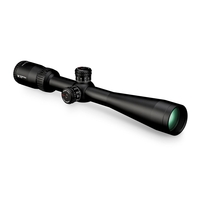
Vortex Diamondback Tactical 4-12x40 Riflescope - VMR-1 Reticle (MOA)
via Uttings
£299.00

Vortex Diamondback Tactical 4-12x40 VMR-1 Riflescope
via BushWear
£315.00
Buying Advice
Start with the specifications that genuinely matter for PRS. Magnification range should be at least 4–16× for club-level work, though 5–25× or 6–24× gives you more headroom at 800 yards and beyond. The reticle plane is critical: a first-focal-plane (FFP) scope keeps its subtension markings accurate at every magnification, which means you can hold over or range a target on any power setting without recalculating. SFP scopes are cheaper and optically brighter at the low end, but in a timed PRS stage the mental overhead of ensuring you are on the correct magnification before holding is a real handicap. For a budget PRS scope, FFP is strongly recommended. Turret travel should be at least 20 MRAD (roughly 70 MOA) of elevation to give you enough dial for .308 or 6.5 Creedmoor out to 1,000 yards without running out of adjustment.
Budget tiers in the UK market break down roughly as follows. Below £250 you can find entry-level FFP scopes from brands like Athlon (Argos BTR) and Primary Arms (SLx or GLx lines); these will get you started but may suffer from softer glass, less consistent tracking or limited turret travel. The £300–£400 tier is the sweet spot for a best budget scope PRS UK purchase: models such as the Vortex Diamondback Tactical FFP, Athlon Midas TAC and Primary Arms GLx sit here, offering exposed locking turrets, zero-stop or rev-indicator mechanisms, and good-quality ED glass. At £400–£500 you begin to touch the bottom of the Vortex Viper PST Gen II range and the Athlon Ares BTR Gen II — scopes with noticeably crisper glass, tighter turret clicks and features like tool-less zero-stop resets that save time in the field. The jump from £300 to £500 buys you measurably better mechanical repeatability and optical clarity in challenging light, which matters when you are reading mirage or spotting trace.
Common mistakes buyers make in this category include over-prioritising maximum magnification, ignoring turret tracking quality, and choosing MOA when the rest of their data ecosystem is metric. A 34 mm tube does not automatically mean better glass — it means more internal adjustment range, which is useful, but 30 mm tubes can be perfectly adequate if total elevation travel is sufficient. Another frequent error is buying a scope without a parallax-adjustment knob (side-focus); fixed-parallax optics set at 100 or 150 yards will show noticeable parallax error at 500+ yards, which directly costs you points. Finally, do not neglect the mount: even a superb scope will shoot poorly in a flimsy ring set. Budget for a quality one-piece Picatinny mount (Sportsmatch, Hawke or similar UK-available brands) with 20 MOA cant if your rifle does not already have a canted rail.
UK-specific context matters here more than many guides acknowledge. All centrefire rifles require a Firearms Certificate, and your ticket conditions or club rules may influence calibre choice, which in turn affects the scope's required turret travel. Most UK PRS matches are run on ranges with known distances, so laser-rangefinder reticle features are less important than clean, uncluttered mil-hash or Christmas-tree reticles for hold-overs and wind calls. VAT at 20% is included in all UK retail prices, so be wary of comparing US dollar prices without adding import duty and VAT — a scope listed at $350 in America often lands closer to £380–£420 once shipped to the UK. Buy from established UK dealers such as Optics Warehouse, RUAG, Sporting Services, Jackson Rifles or County Deer Stalking; you get proper warranty support and avoid customs headaches.
Matching the scope to your specific use case is the final piece. If you shoot only to 600 yards at your local club and want something light for positional stages, a compact 3–15×44 FFP in MRAD will serve brilliantly and keep weight down. If your ambitions include NRL-style matches or the UK PRS National Series with stages to 1,000 yards, stretch to a 5–25×56 with a 34 mm tube for maximum elevation range. Consider your rifle too: a heavy .308 bolt-action benefits from a larger objective for light gathering at dawn or dusk practice sessions, while a lightweight 6.5 Creedmoor build pairs better with a 50 mm objective to keep overall balance manageable. Think about your reticle preference — a Horus-style busy tree reticle gives fast hold-off data but can obscure small targets at high mag, whereas a simpler mil-dot or open-centre design stays clean. There is no single best scope for precision rifle competition; there is only the best one for your shooting programme.
The brand landscape in the UK budget PRS space is dominated by a few key players. Vortex arguably has the strongest UK presence thanks to generous warranty support and wide dealer stock — the Diamondback Tactical and Viper PST Gen II are benchmarks in their price brackets, making a Vortex PRS scope UK search almost inevitable. Athlon offers arguably the best value-for-money in FFP scopes, though UK availability can be patchier. Primary Arms impresses with proprietary ACSS reticles that integrate BDC and wind data. Burris has long been popular with UK deer stalkers and its XTR II line can sometimes be found discounted into budget territory. Keep an eye on PARD, a brand gaining UK traction for its digital and thermal offerings; while primarily known for night-vision, their expanding optics line may enter the PRS-adjacent space. Whatever brand you choose, prioritise confirmed UK warranty coverage and a local service path — sending a scope abroad for repair mid-season is a competition-killer.
Frequently Asked Questions
What magnification range do you need for PRS-style competition at club level in the UK?
For most UK club-level PRS matches, which typically run from 100 to around 800 yards, a scope in the 4–16× to 6–24× range is ideal. You need enough low-end magnification (around 4–6×) for fast target acquisition on close barricade stages, and sufficient top-end (16× minimum, 20–25× preferred) to read wind indicators and spot impacts at longer distances. Many competitive shooters find they actually shoot most stages at 12–18× rather than maximum power, so do not fixate solely on the highest number.
Can you use a budget FFP scope for PRS or do you need to spend over £1,000?
You absolutely can compete at club and regional level with an FFP scope under £500. Modern budget FFP scopes from Vortex, Athlon and Primary Arms offer tracking accuracy and glass quality that would have cost well over £1,000 just five years ago. The main sacrifices at the budget end are edge-to-edge sharpness, chromatic aberration control in difficult light, and the crispness of turret clicks. These matter less than solid fundamentals and practice — many UK PRS competitors have placed well with sub-£500 glass.
MOA or MRAD turrets for PRS competition: which is better for a beginner?
MRAD (milliradian) is the overwhelmingly dominant system in PRS worldwide and in the UK. Its advantage is simplicity when working with metric measurements: 0.1 MRAD equals exactly 1 cm at 100 metres, making mental arithmetic straightforward. MOA is perfectly functional — 1 MOA equals approximately 1.047 inches at 100 yards — but almost all PRS training material, ballistic apps and range communication use mils. A beginner choosing MRAD will find it far easier to follow spotters' calls and share data with squad-mates.
What features separate a £300 scope from a £500 scope for precision rifle matches?
At the £300 mark you typically get functional FFP reticles, exposed turrets and side-parallax adjustment, but glass clarity may soften at high magnification and turret clicks can feel slightly mushy. Moving to £500 generally buys you better extra-low-dispersion (ED) glass with improved contrast and colour fidelity, more precise and repeatable turret mechanisms, a proper tool-less zero-stop system, and often a larger objective lens or 34 mm tube for increased internal adjustment range. The mechanical repeatability improvement alone — turrets that return reliably to zero after extensive dialling — is arguably worth the extra spend for competition use.
Which budget-friendly brands like Vortex or Burris are competitive at UK PRS events?
Vortex is the most commonly seen budget brand at UK PRS matches, particularly the Diamondback Tactical FFP and Viper PST Gen II lines. Athlon (Midas TAC, Ares BTR Gen II) offers strong competition and often undercuts Vortex on price for comparable features. Primary Arms GLx scopes with ACSS reticles have a following among shooters who value integrated ballistic data. Burris XTR II models appear occasionally, especially among shooters who already owned one for hunting. Any of these brands can be genuinely competitive at club and regional level in the UK.
Do I need a 34 mm tube for PRS, or is 30 mm sufficient on a budget?
A 34 mm tube provides more internal space for the erector system, which typically translates into greater total elevation and windage adjustment range. For calibres like 6.5 Creedmoor or .308 Win shot to 1,000 yards, you may need 25+ MRAD of elevation, and 34 mm tubes make that easier to achieve. However, several excellent 30 mm FFP scopes offer 18–22 MRAD of elevation, which is adequate to 800 yards with most common calibres especially when paired with a 20 MOA canted rail. On a budget, a good 30 mm scope will outperform a mediocre 34 mm one.
Is a zero-stop essential for PRS competition?
A zero-stop is not strictly essential but it is extremely helpful. It provides a tactile and audible reference point so you can quickly return your elevation turret to your confirmed zero without looking, which saves precious seconds on timed stages. Some budget scopes offer a revolution indicator rather than a true zero-stop; this is an acceptable compromise at entry level. If your budget allows, prioritising a scope with a genuine zero-stop mechanism is one of the most practical upgrades you can make for competition efficiency.
What reticle style is best for a beginner entering UK PRS matches?
A mil-based Christmas-tree or hash-mark reticle is the most practical choice. These reticles feature graduated hold-over marks below the centre cross and wind-hold marks to the sides, allowing rapid corrections without dialling. For a beginner, a moderately detailed tree reticle (such as Vortex's EBR-7C or Athlon's APRS6) strikes a good balance between having enough data in the glass and not being so cluttered that you lose the target. Avoid plain crosshair or duplex reticles — they offer no hold-off references and will slow you down significantly in competition.
Where should I buy a PRS scope in the UK and what warranty should I expect?
Buy from established UK firearms-optics retailers such as Optics Warehouse, Jackson Rifles, Sporting Services, RUAG Ammotec UK or Viking Arms (Vortex UK distributor). These dealers offer UK-backed warranties and can handle returns without international shipping. Vortex provides an unconditional lifetime VIP warranty honoured in the UK through Viking Arms. Athlon offers a lifetime warranty in most markets. Always confirm UK warranty terms before buying from grey-market or overseas sellers, as importing scopes can add 20% VAT plus customs duty and may void manufacturer support.
Related guides
Our expert 2026 guide to the best scope for bench rest shooting UK. Compare precision optics under £500 with the magnification…
Urban Precision Rifle Optics: UK Buyer's GuideChoosing a scope for urban precision rifle shooting in the UK? Our 2026 guide covers magnification, reticle, turret specs…
Best PRS & Precision Rifle Scopes for UK Competitors in 2026Our expert UK guide to the best scopes for PRS and precision rifle competition in 2026. Covers FFP vs SFP, MRAD turrets, budget tiers…
Best Budget Thermal Scopes for Fox & Deer Shooting in the UKOur 2026 UK buyer's guide to the best thermal scopes under £500 for foxing and deer stalking. Compare PARD, Hikmicro and more — specs…
Best Budget Thermal Scopes Under £1,000 (UK 2026)Our expert guide to the best budget thermal scopes under £1,000 for UK fox and vermin shooting in 2026.
Best Long-Range Scopes UK 2026: Mid-Budget Buyer's GuideDiscover the best scopes for long-range shooting in the UK for 2026. Our expert guide covers FFP vs SFP, MOA vs MRAD…
Read next
- budget PRS scopes UK
Best Budget PRS Scopes for UK Shooters in 2026
Not sure which scope is right for you?
Try our AI-powered scope finder — answer a few questions and get personalised recommendations.
Find My Scope →Get a UK scope tip every day
Follow AiScopes on Facebook for daily buying guides, deals and gear advice.
Follow on Facebook