Best PRS & Precision Rifle Scopes for UK Competitors in 2026
By Peter Makulek · Senior Optics Editor · · Live prices from UK retailers
Precision Rifle Series competition is growing rapidly across the UK, with more clubs hosting PRS-format matches than ever before. Whether you are shooting at Diggle, Orion, or one of the newer long-range venues springing up on MOD land, the scope you bolt onto your rifle is arguably the single most important purchasing decision you will make. A well-chosen precision rifle scope lets you read wind corrections quickly, dial accurate elevation, and transition between targets at varying distances — all under time pressure. This guide is built specifically for UK-based competitors and those looking to enter the discipline in 2026.
Choosing the best scope for PRS involves balancing optical clarity, reliable tracking, reticle design, and mechanical durability — all within a budget that makes sense for you. The UK PRS scene typically sees engagements from 100 metres out to 1,000 metres or beyond, often on steel of varying sizes, meaning you need a scope that performs across a wide magnification range and offers precise, repeatable turret adjustments. Unlike benchrest shooting, where you may fine-tune on a single distance, PRS demands fast transitions and constant dialling, placing enormous stress on the turret mechanism and internal erector system.
In this long range scope UK buying guide, we break down exactly what to look for, explain the technical jargon in plain terms, and highlight the models that UK competitors are actually using and recommending in 2026. We also cover common pitfalls — such as buying an SFP scope when you need FFP, or choosing MOA turrets when the rest of your squad speaks MRAD — and give honest advice on budget tiers so you know precisely what you sacrifice or gain at each price point. Every recommendation factors in UK availability, realistic GBP pricing, and the specific demands of British PRS-format matches.
A quick note on discipline boundaries: this guide focuses squarely on centrefire precision rifle competition — typically chambered in 6.5 Creedmoor, .308 Winchester, or 6mm variants — shot from prone, barricades, and positional stages. If you are looking for the best scope for bench rest shooting in the UK, many of the optical qualities overlap, but benchrest scopes often prioritise extreme magnification and fine-focus reticles over fast-dialling turrets. And if you shoot sub-12 ft/lb air rifles, these optics are massive overkill; airgun scopes operate in a completely different weight, recoil-profile, and effective-range bracket (50–75 yards maximum). This guide is for the centrefire long-range competitor.
Top Picks — Live UK Prices

Nikko Stirling Diamond Long Range 30mm Tactical 4-16x50 IR Rifle Scope
via Uttings
£199.00
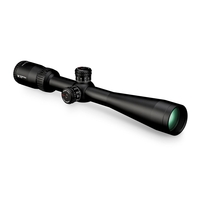
Vortex Diamondback Tactical 4-12x40 Riflescope - VMR-1 Reticle (MOA)
via Uttings
£299.00

Vortex Diamondback Tactical 4-12x40 VMR-1 Riflescope
via BushWear
£315.00
Buying Advice
Start with the key specifications. Magnification range matters: most UK PRS shooters settle on a 5–25× or 4–24× scope, giving enough low-end for close barricade stages and sufficient top-end for spotting trace at distance. The objective lens — typically 50–56 mm — governs light-gathering, but bigger is heavier. Tube diameter (34 mm is now standard for PRS) determines the total elevation travel available internally; you want at least 26–30 MRAD (roughly 90–100 MOA) of total travel so you can dial from 100 m to 1,000 m without running out of adjustment. Parallax adjustment should go down to at least 10 metres, and a side-focus knob is essential for speed. Finally, check the exit pupil at high magnification — anything below about 2 mm will feel dim in the overcast conditions the UK generously provides.
Budget tiers in the UK market break down roughly as follows. Entry-level PRS scopes — typically between £500 and £900 — include models from Athlon, Arken, and some PARD optics; they deliver surprisingly good glass and reliable tracking for club-level competition. Mid-range scopes in the £1,000–£2,000 bracket, from brands like Vortex, Bushnell, and Delta Stryker, offer noticeably better glass coatings, tighter QC on turret tracking, and more refined reticles. Premium scopes above £2,000 — think Nightforce, Kahles, Zero Compromise, and Schmidt & Bender — provide the ultimate in optical clarity, mechanical repeatability, and build quality that top-level UK competitors trust when every tenth of a mil counts.
Common buyer mistakes are worth flagging explicitly. First, buying an SFP (second focal plane) scope for PRS is almost always a regret: you need the reticle to scale with magnification so your holdovers and wind calls remain accurate at any zoom level, which means FFP (first focal plane) is the correct choice. Second, ignoring turret feel and click quality — vague, mushy clicks lead to dialling errors under time pressure. Third, over-prioritising magnification at the expense of field of view; a 10–60× scope sounds impressive but the razor-thin field of view makes target acquisition painfully slow. Fourth, skimping on the mount: a scope with 0.1 MRAD tracking precision deserves a quality one-piece mount torqued to spec.
UK-specific context shapes your decision in ways that differ from the American PRS scene. British weather means you will shoot in rain, fog, and low light far more often than in sunshine, so hydrophobic lens coatings and good twilight performance are not luxuries — they are essentials. UK firearms licensing means most PRS competitors hold a Section 1 FAC; your rifle and calibre are already specified on your certificate, so match the scope's elevation range to your specific cartridge's drop at the distances your club shoots. Retailers such as RUAG, Hannams Reloading, and specialist online dealers stock the major PRS brands; buying from a UK dealer ensures you have local warranty support and do not face unexpected import duty. Also consider that many UK ranges top out at 600–800 metres rather than the 1,200-yard stages common in the US, so you may not need quite as much elevation travel as American guides suggest.
Matching the scope to your specific use case is crucial. If you shoot mostly positional PRS with lots of barricade work, a lighter scope (under 900 g) with a forgiving eye box will serve you better than a heavy 1.1 kg monster, even if the heavier option has marginally sharper glass. If your matches are primarily long-range precision — 600 m and beyond with generous time limits — prioritise optical resolution and turret precision over weight savings. If you dabble in both PRS and F-Class or benchrest, look for a scope with a fine-detail reticle option alongside the standard Christmas-tree PRS reticle, or accept that you may need two scopes. Ultimately, the best scope for long range shooting is the one whose reticle you have memorised, whose turrets you trust, and whose weight you can handle stage after stage.
A brief brand landscape for UK PRS in 2026: Nightforce remains the most commonly spotted brand on the firing line, with the ATACR and NX8 lines both well-proven. Vortex's Razor HD Gen III continues to offer outstanding value in the mid-to-premium bracket. Kahles and ZCO dominate the premium tier for shooters who want the very best glass. At the entry level, PARD has been gaining mindshare in the UK market thanks to aggressive pricing and improving optical quality — worth a serious look if you are building a first PRS rig on a budget. Bushnell's XRS3 and the Delta Stryker HD occupy the competitive mid-range. Whatever you choose, buy from a reputable UK dealer, verify the warranty terms, and if possible try before you buy at a club or demo day — no spec sheet replaces five minutes behind the glass on a cold, drizzly British range.
Frequently Asked Questions
What magnification range do you need for PRS matches in the UK?
Most UK PRS competitors use scopes in the 5–25× or 4–24× range. The low end gives you enough field of view for close-in barricade stages (sometimes as near as 80–100 metres), while the upper end provides the resolution to spot impacts and read mirage out to 800–1,000 metres. Avoid the temptation to go higher than 25× — extreme magnification narrows your field of view and amplifies mirage, both of which slow you down under time pressure. A quality 5–25×56 is considered the sweet spot for the vast majority of UK PRS-format competition.
Do you need an FFP or SFP scope for PRS competition?
For PRS, first focal plane (FFP) is overwhelmingly the correct choice. In an FFP scope the reticle scales proportionally with magnification, so your mil-based holdovers and wind corrections remain accurate regardless of which zoom setting you happen to be on. PRS stages often require rapid magnification changes, and an SFP scope's reticle subtensions are only correct at one specific magnification — introducing a major source of error. Nearly every competitive PRS shooter in the UK runs an FFP scope, and course designers assume you can hold off the reticle at any zoom level.
What is the best budget scope for getting into PRS in the UK?
The best budget scope for PRS in the UK currently sits in the £500–£900 bracket. Models from Athlon (Ares ETR), Arken (EP5), and PARD offer 34 mm tubes, FFP MRAD reticles, and enough elevation travel for UK distances. At this price you sacrifice some glass clarity in low light, turret feel may be slightly less refined, and quality control is occasionally less consistent than premium options. However, these scopes track reliably enough for club-level PRS and allow a newcomer to compete seriously without a four-figure outlay on glass alone.
MOA or MRAD for PRS: which turret system do UK competitors prefer?
The overwhelming majority of UK PRS competitors use MRAD (milliradian) turrets with 0.1 mil clicks. Each 0.1 mil click shifts the point of impact by 1 cm at 100 metres, which is a clean, metric-friendly relationship that suits the metric range distances used across British and European competitions. MOA (minute of angle) works perfectly well mathematically — 1 MOA is approximately 1.047 inches at 100 yards — but because UK PRS is standardised around MRAD, using MOA can create communication difficulties when sharing data with squadmates. For a new PRS entrant in the UK, MRAD is the pragmatic choice.
How important is zero stop for PRS-style precision rifle shooting?
A zero stop is extremely important for PRS. It provides a mechanical hard stop at your chosen zero (typically 100 metres), so when you dial back down between stages you can feel and hear the turret hit your baseline without needing to look at the numbers. Under match pressure and time limits, this prevents the costly error of accidentally dialling below zero — a mistake that can cost you an entire stage. Virtually all serious PRS scopes from mid-range upwards include a user-settable zero stop, and it should be considered a non-negotiable feature for competition use.
How much elevation travel do I need in a PRS scope for UK competitions?
For typical UK PRS distances (100 m to 1,000 m), you want at least 12–15 MRAD of usable up-elevation from a 100 m zero, depending on your cartridge. A 6.5 Creedmoor, for instance, requires roughly 9.5–10.5 MRAD of elevation to reach 1,000 m at sea level. A scope with 26–30 MRAD of total travel in a 34 mm tube, combined with a 20 MOA canted base, will give you comfortable margin. If your club only shoots to 600 m, you need less — around 6 MRAD — so a 30 mm tube scope may suffice, but the 34 mm standard gives welcome headroom and future-proofs your setup.
Can I use my PRS scope for benchrest or F-Class as well?
There is significant overlap, but the ideal scope differs slightly between disciplines. PRS scopes prioritise fast turret dialling, wide-ranging zoom, and a Christmas-tree reticle for rapid holdovers. The best scope for bench rest shooting in the UK tends to emphasise extreme optical resolution, very high magnification (30×+), and fine crosshair reticles. A 5–25× PRS scope can absolutely be used for casual benchrest or F-Class, but dedicated benchrest competitors often prefer a fixed or high-magnification scope with finer reticle detail. If you compete seriously in both, two scopes is the most practical solution.
What reticle design is best for PRS competition?
The most popular PRS reticle type is the Christmas-tree or grid-style MRAD design — such as the Nightforce MIL-XT, Vortex EBR-7C, or Kahles SKMR4 — which provides horizontal and vertical hash marks at known mil intervals. This lets you hold off for wind and elevation corrections without dialling, saving critical seconds on multi-target stages. Look for a reticle with 0.2 or 0.5 mil sub-divisions that is complex enough to be useful but not so cluttered that it obscures small steel targets. Whichever reticle you choose, spend time studying its subtension chart and practising with it before your first match.
Is it worth buying a premium scope or should I spend more on ammunition and practice?
This is one of the most debated questions in UK PRS circles, and the honest answer is: both matter. A £500 scope on a competent rifle, paired with quality ammunition and regular practice, will outperform a £3,000 scope on a rifle that rarely leaves the cabinet. However, once you are shooting regularly and hitting the limits of your optic — poor tracking, dim glass in low light, or unreliable zero return — upgrading will yield tangible score improvements. A sensible strategy for a newcomer is to start with a well-reviewed mid-range scope (£1,000–£1,500), invest heavily in ammunition and match fees, and upgrade the glass once you have confirmed your commitment to the sport.
What is the minimum scope spec to be competitive at UK PRS matches without overspending?
To be genuinely competitive without overspending, look for a 34 mm tube FFP scope with at least 5-25× magnification, 0.1 MRAD clicks, a zero stop, at least 25 MRAD total elevation travel, and a tree-style or grid reticle. Glass quality should be good enough to read mirage confidently at 15–20×. In the UK market this specification starts at roughly £700–£900 for entry-tier brands and around £1,200–£1,500 for mid-tier options with better coatings and turret feel — either range can get you through club-level PRS matches respectably.
Does objective lens size matter much for UK PRS — 50 mm versus 56 mm?
A 56 mm objective is the most popular choice among UK PRS competitors because it provides a brighter image at higher magnifications, which helps in low-light conditions common on British ranges — early-morning starts and overcast winter days are the norm. A 50 mm objective can work and saves a little weight and mounting height, but the difference in exit pupil at 25× (2.24 mm versus 2 mm) is noticeable when you need to spot trace or read mirage. For dedicated PRS use, 56 mm is the safer choice.
Are there any UK legal considerations when buying a precision rifle scope?
Scopes themselves are not controlled items under UK firearms law — you can buy one without any licence. However, the rifle it sits on must be held on a valid Firearm Certificate (FAC) with an appropriate condition for target shooting or the relevant quarry species. Some ranges and PRS match organisers have specific equipment rules regarding maximum magnification in certain divisions, so check the match rules before investing. Importing scopes from outside the UK may attract customs duty and 20% VAT, making UK-based retailers the more straightforward purchasing route.
Related guides
Definitive UK buyer's guide to the best scopes for PRS competition in 2026. We cover FFP reticles, MRAD turrets…
Best PRS Competition Scopes: A UK Beginner's Guide for 2026Choosing your first precision rifle scope for PRS in the UK? Our 2026 guide covers reticles, turrets, magnification and budget tiers to get you…
Best Budget PRS Scopes Under £500 (UK 2026)Find the best scope for PRS and precision rifle competition under £500 in the UK. Our 2026 guide covers FFP vs SFP, MRAD turrets…
Best PRS Scopes UK 2026Top-rated scopes for PRS rifles and practical precision shooting in the UK. Compare FFP, MRAD and zero-stop options from Nightforce, Vortex…
Best Budget Night Vision Scopes Under £500 for UK ShootersOur 2026 buyer's guide to the best budget night vision scopes under £500 for UK hunters. Covers digital vs Gen 1, how cheap is too cheap, clip-ons…
Best Scopes for Springer Air Rifles in 2026Find the best scope for a springer air rifle in the UK for 2026. Expert advice on springer-rated optics, magnification…
Not sure which scope is right for you?
Try our AI-powered scope finder — answer a few questions and get personalised recommendations.
Find My Scope →Get a UK scope tip every day
Follow AiScopes on Facebook for daily buying guides, deals and gear advice.
Follow on Facebook