Best Long-Range Scopes UK 2026: Mid-Budget Buyer's Guide
By Peter Makulek · Senior Optics Editor · · Live prices from UK retailers
Connecting consistently at 600 to 1,000 yards demands more from a rifle scope than almost any other shooting discipline. At those distances, a single click of windage or elevation error translates into misses measured in feet, not inches, and optical clarity is the difference between reading mirage and staring at a blur. For UK shooters competing in PRS-style matches, F-Class, or simply pushing their centrefire rifles on MOD ranges and private ground, finding the best scope for long range that genuinely tracks and resolves detail is the single most important equipment decision after the rifle itself.
The good news for 2026 is that the £500–£1,000 bracket has never been more competitive. Advances in lens coatings, machining tolerances and reticle design have trickled down from premium tiers, meaning a rifle scope for long range in this price band can now deliver repeatable turret tracking, usable glass at 20× and above, and sophisticated Christmas-tree or hashed reticles that were exclusive to four-figure optics only a few years ago. UK retailers stock a broader selection than ever, and direct-import options have widened the field further.
Choosing the right optic still requires navigating a dense thicket of specifications: first focal plane versus second focal plane, MOA versus MRAD adjustment systems, objective lens diameter, tube diameter, parallax range, total elevation travel and zero-stop mechanisms. Each of these interacts with your chosen calibre's ballistic profile and the specific conditions you shoot in — British weather being famously unkind to optical performance. This guide exists to cut through the noise and help you make a confident, informed purchase.
Below, we present a curated selection of scopes available in the UK market right now that represent the strongest value between £500 and £1,000 for genuine long-range work. After the product picks, you will find our in-depth buying advice covering every technical consideration, common mistakes, UK-specific context and how to match a scope to your exact use case. Whether you are stepping up from a mid-magnification hunting optic or buying your first dedicated long-range scope, this is the definitive resource.
Top Picks — Live UK Prices
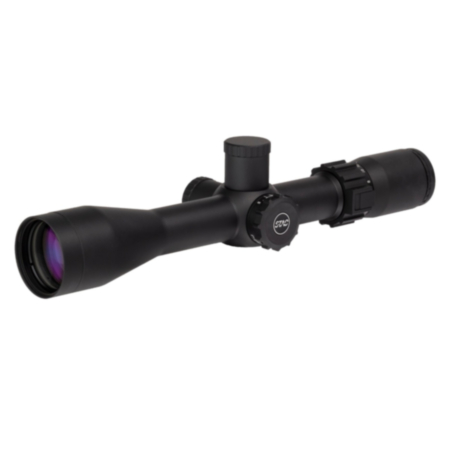
Sightron S-TAC 3-16x42 SFP SF Non IR MOA-3 30mm Rifle Scope
via Optics Warehouse
£369.99
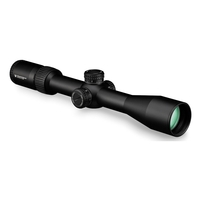
Vortex Diamondback Tactical FFP 4-16x44 Riflescope - MRAD
via Uttings
£429.00
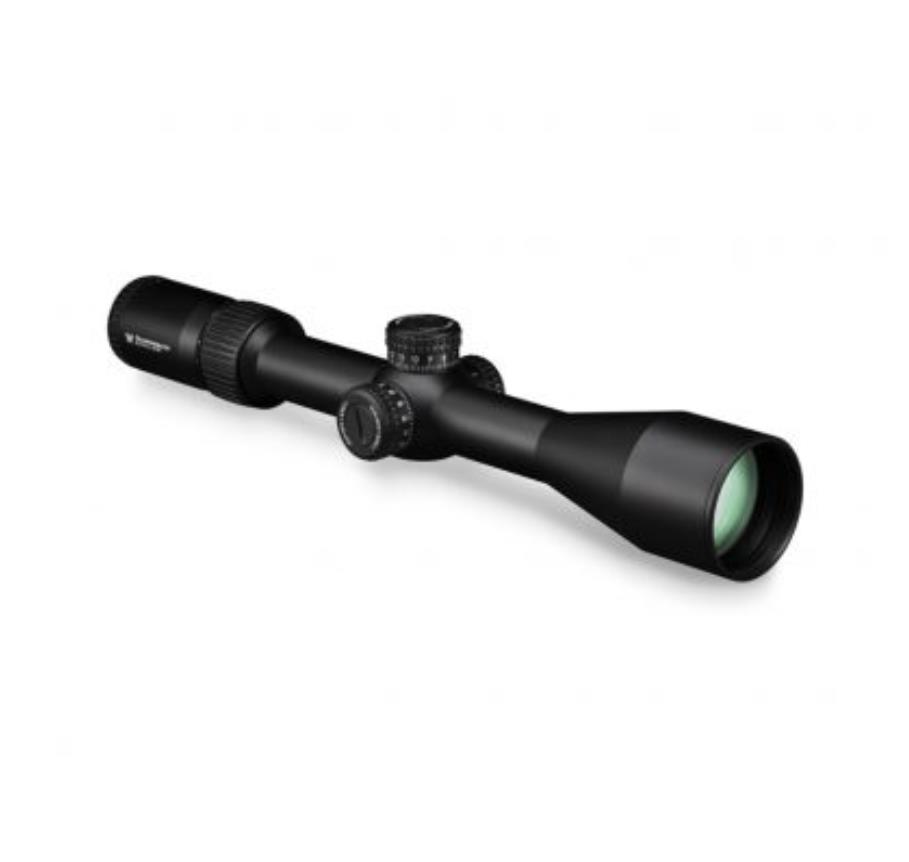
Vortex Diamondback Tactical 6-24x50 FFP MOA Scope
via Livens
£445.00
Buying Advice
Start with the specifications that matter most at distance. Magnification range is critical: for 600–1,000 yards, a scope topping out at 20× to 25× is a sensible minimum, and many shooters prefer models reaching 30× or higher for target identification and precise hold-off work. Total elevation travel determines whether your turret can physically dial enough correction for your cartridge's drop at extreme range — a .308 Winchester, for example, needs roughly 35–38 MOA (around 10–11 MRAD) of come-up to reach 1,000 yards from a 100-yard zero, so you want at least 20–25 MRAD or 70–80 MOA of total internal adjustment, ideally with a meaningful margin. Objective lens diameter (50 mm or 56 mm are common) affects light transmission and exit pupil size at high magnification, which matters on overcast British range days. Parallax adjustment down to at least 50 yards — and ideally 10 yards — ensures the reticle and target image stay on the same focal plane at every distance you will shoot.
Understanding budget tiers helps set realistic expectations. Below £500, you can find serviceable scopes for learning, but turret tracking consistency, optical coating quality and mechanical durability often fall short under the repeated heavy recoil of magnum calibres and the precise demands of 1,000-yard shooting. Between £500 and £1,000 — the sweet spot this guide targets — you gain access to genuinely repeatable turrets, markedly better edge-to-edge clarity, functional zero-stop mechanisms and well-designed FFP reticles with usable subtensions. Above £1,000, you enter premium territory where improvements become incremental: slightly sharper glass, tighter click tolerances, lighter weight and longer warranty terms. For most UK club-level and aspiring competitive shooters, a long range scope under £1,000 delivers performance that would have cost twice as much a decade ago.
Common mistakes cost time and money. First, buying excessive magnification at the expense of glass quality: a 50× scope with mediocre coatings will show you less detail at 1,000 yards than a sharp 25× optic in British haze. Second, ignoring total elevation travel — if your scope cannot dial the drop for your calibre, you are forced into hold-over, which is less precise and negates the purpose of target turrets. Third, mixing MOA and MRAD: if your turrets click in milliradians but your reticle is hashed in MOA (or vice versa), range-card calculations become an error-prone headache. Always match turret units to reticle units. Fourth, neglecting a box test or tall-target test before trusting the scope in competition — even quality optics occasionally leave the factory with tracking issues, and catching this early is far easier than diagnosing it at 800 yards.
UK-specific context matters more than many guides acknowledge. You need a valid Firearms Certificate to own the centrefire rifles typically used for 600–1,000 yard shooting, and your FAC conditions will specify approved calibres. Popular UK long-range calibres include .308 Winchester, 6.5 Creedmoor, .223 Remington (at the shorter end of this bracket) and various .300-class magnums. Availability of ammunition and components can fluctuate, so choosing a scope with enough elevation travel for a common, well-supported cartridge is prudent. Reputable UK retailers such as specialist online optics dealers, established gun shops and major auction sites offer warranty-backed purchases. Be cautious of grey-market imports: UK-specific warranties from manufacturers sometimes require purchase through an authorised dealer. For competitive disciplines like NRA-affiliated F-Class or the growing UK PRS scene, check whether match rules specify any optic restrictions.
Matching a scope to your specific use case is the final — and most personal — step. If you shoot primarily F-Class from a bench or bipod at known distances, a high-magnification SFP scope with fine target turrets may suit you well, since you will be dialling exact corrections rather than holding off. If you shoot positional PRS-style stages at varied distances under time pressure, an FFP scope with a Christmas-tree reticle becomes far more valuable, because subtension markings remain accurate across the entire zoom range, allowing rapid hold-offs without dialling. Consider your rifle's weight and balance too: a 34 mm tube, 56 mm objective scope adds significant mass forward of the action, which affects handling in positional stages. For pure target work this is less of a concern. Think about the conditions you shoot in — if you frequently shoot in low light or heavy overcast, prioritise optical transmission quality over raw magnification.
The brand landscape in the UK £500–£1,000 long-range segment is healthier than ever. Several well-known optics manufacturers now offer dedicated tactical and PRS lines that sit comfortably in this bracket, and a handful of newer entrants have disrupted the market with impressive feature sets at competitive prices. When evaluating brands, look beyond marketing and focus on verifiable turret tracking data, warranty terms valid in the UK, and availability of spare parts such as turret caps, throw levers and sunshades. Online communities — particularly UK-focused forums and social media groups for F-Class and PRS — are invaluable for real-world feedback on how specific models hold up over thousands of rounds and British seasons. The best long range scope 2026 buyers can acquire is ultimately the one whose specifications genuinely match their calibre, discipline and conditions, purchased from a retailer who will support them after the sale.
Frequently Asked Questions
What magnification range do I need for UK long-range shooting between 600 and 1,000 yards?
For consistent target identification and precise aiming at 600–1,000 yards, a scope offering at least 20× at the top end is a practical minimum, with many experienced UK long-range shooters preferring 25× or higher. A variable range starting around 5× or 6× at the low end provides enough versatility for closer work, zeroing, and scanning. Avoid chasing the highest magnification number at the expense of optical clarity — a sharp image at 25× is far more useful than a dim, soft image at 50× in typical British light conditions.
Should I choose MOA or MRAD turrets for long-range shooting at this budget?
Both systems work perfectly well for long-range shooting; the critical factor is consistency — your turrets and reticle must use the same unit. MRAD (milliradian) has become the dominant choice in UK PRS and tactical communities because the metric-friendly maths is straightforward: 0.1 MRAD (one click on most scopes) equals 1 cm at 100 metres. MOA remains popular in F-Class circles and among shooters who think in imperial units, where 1 MOA approximates 1.047 inches at 100 yards. Choose whichever system your shooting peers and ballistic software use, and commit to learning it thoroughly.
Which UK-available scopes between £500 and £1,000 offer the best glass quality and turret tracking for long range?
The specific models shift with each production year, which is why we display live, filterable product picks above rather than a static list that dates quickly. In general, look for scopes from established optics manufacturers with dedicated tactical or PRS product lines in this bracket. Key indicators of quality at this price are fully multi-coated lens systems, locking or zero-stop turrets with consistent click feel, and 30 mm or 34 mm main tubes providing sufficient internal adjustment range. Reading independent tall-target tracking tests and UK forum reviews is the best way to verify real-world performance before buying.
Do I need a first focal plane reticle for long-range shooting at this price point?
A first focal plane (FFP) reticle is strongly recommended if you use hold-offs at varying magnification — common in PRS-style shooting — because the reticle subtensions remain accurate across the entire zoom range. If you shoot F-Class or benchrest at known distances and always dial your corrections, a second focal plane (SFP) scope can work well and sometimes offers slightly better optical performance per pound spent, since the reticle is etched on a less optically demanding plane. For the best scope for long range UK versatility within a £500–£1,000 budget, FFP is the more future-proof choice.
How do I match a mid-budget scope to my calibre's ballistic profile for 600–1,000 yard shots?
Start by running your exact load data — bullet weight, muzzle velocity, ballistic coefficient — through a reliable ballistic calculator such as Applied Ballistics or Strelok Pro. This tells you the total elevation (in MOA or MRAD) needed to reach your maximum intended distance. Ensure your scope has enough internal elevation travel above its mechanical centre — after zeroing at 100 yards or metres — to dial that full correction with margin to spare. For example, a .308 Win firing 155-grain Palma bullets at around 2,950 fps needs roughly 10 MRAD of come-up to reach 1,000 yards, so a scope with at least 12–13 MRAD of usable travel above zero is wise.
What is a zero-stop and why does it matter for long-range scopes?
A zero-stop is a mechanical feature that prevents you from dialling your elevation turret below your chosen zero point — typically your 100-yard or 100-metre zero. After engaging at long range with many turns of elevation dialled in, a zero-stop lets you rapidly and confidently return to zero without counting clicks or revolutions. At 600–1,000 yards you may be dialling 8–15 MRAD or more of elevation, so the ability to spin back to a hard stop is both a time-saver in competition and a safety net against costly errors. Most quality scopes in the £500–£1,000 range now include a user-settable zero-stop.
Does tube diameter matter when choosing a long-range scope on a mid-range budget?
Yes. A larger main tube — 34 mm versus 30 mm — generally provides more internal adjustment range, which directly determines how much elevation and windage you can dial. For calibres with steep drop curves at 1,000 yards, or if you use a 20 MOA canted rail, a 34 mm tube can be the difference between having enough travel and running out. However, 34 mm scopes tend to be heavier and require specific rings, adding cost. A 30 mm tube is often sufficient for efficient cartridges like the 6.5 Creedmoor, while harder-dropping rounds like .308 Winchester at extreme range benefit from the extra travel a 34 mm tube provides.
Can I use a sub-12 ft/lb air rifle scope for long-range centrefire shooting?
No. Scopes designed for sub-12 ft/lb air rifles are engineered to handle the unique bi-directional recoil of spring-powered airguns but are not built for centrefire rifle recoil forces, which are dramatically higher and in a single rearward direction. Additionally, air rifle scopes typically lack the elevation travel, turret precision and optical quality required for genuine long-range centrefire work. Sub-12 ft/lb air rifles themselves are only effective to approximately 50–75 yards, so their optics are designed accordingly. Always use a scope rated for centrefire recoil and intended for long-range use.
How important is parallax adjustment for long-range shooting at 600–1,000 yards?
Parallax adjustment is essential. Parallax error occurs when the target image and the reticle are not on the same focal plane, causing apparent reticle movement as your eye shifts behind the scope. At 600–1,000 yards, even small parallax errors translate into significant point-of-impact shifts. A side-focus or adjustable-objective parallax knob lets you eliminate this error at your specific shooting distance. Look for a scope with a parallax range that covers at least 50 yards to infinity — most tactical and PRS scopes in this bracket offer 10 yards to infinity, which is more than adequate.
Related guides
Definitive UK buyer's guide to the best scopes for long-range shooting in 2026. Compare BDC reticles vs exposed turrets for 300–1,000 yard shots…
.22 Long Range Scope Recommendations for UK ShootersExpert UK guide to choosing the best scope for .22 long range shooting. Covers magnification, turrets, reticles, budget tiers in GBP…
Best Long-Range Rifle Scopes 2026: Match Your Optic to Your CalibreOur 2026 UK guide to the best scopes for long range shooting. Learn how to match reticle, turrets and magnification to your calibre's ballistic profile…
Best Long-Range Scopes Under £1,000 for UK ShootersOur 2026 UK buyer's guide to the best scopes for long-range shooting under £1,000. Expert picks, specs explained…
Best Budget Air Rifle Target Scopes Under £100 (2026)Our expert guide to the best scopes for air rifle target shooting under £100 in the UK for 2026. Covers HFT, FT and plinking — magnification, parallax…
Best Scopes for Foxing Under £500 in 2026Expert UK guide to the best scope for fox shooting under £500 in 2026. Covers day and night-ready optics for .223 and .243, illuminated reticles…
Not sure which scope is right for you?
Try our AI-powered scope finder — answer a few questions and get personalised recommendations.
Find My Scope →Get a UK scope tip every day
Follow AiScopes on Facebook for daily buying guides, deals and gear advice.
Follow on Facebook