Long Range Optics UK: Best Hunting Scopes for 2026
By Peter Makulek · Senior Optics Editor · · Live prices from UK retailers
The best long range optics for UK hunting in 2026 are first-focal-plane scopes topping out around 18-25x with exposed, repeatable elevation turrets and a mil or MOA reticle matched to those turrets. Magnification beyond that is rarely the limiting factor on a British hill - light, tracking and wind reading are. Most UK long-range stalking happens well inside 500 metres, so a scope that holds zero, returns to zero after dialling, and stays usable in poor light will outperform a higher-magnification optic that does none of those things reliably.
Long-range hunting in the UK has moved from a niche pursuit to a genuine discipline. Whether you stalk red deer on an open Scottish hill or manage foxes across wide East Anglian farmland, the ability to make a confident, ethical shot beyond 500 metres demands optics that are up to the task. In this guide we look at what really defines the best scope for long range hunting in 2026, focusing on the specifications, build quality and reticle designs that matter when every click of elevation counts and the margin for error is measured in centimetres.
The UK market presents its own challenges. Our weather is famously unkind to optics — salt-laden coastal winds, persistent drizzle, freezing Highland mornings — so a long range hunting scope used in the UK must be fully waterproof, fog-proof and robust enough to survive years of hard use in a slip or on a quad bike. Equally, UK stalkers tend to carry lighter rifles than their North American counterparts, often in .243 Win, 6.5 Creedmoor or .308 Win, which means understanding your bullet's ballistic coefficient and matching it to a scope's turret travel is essential for reaching out reliably.
Choosing the best scope for long range in a UK rifle also means navigating the FFP versus SFP debate, deciding between MOA and MRAD adjustment systems, and working out whether you genuinely need a Christmas-tree reticle or whether a simpler holdover design will serve you better in the field. We cut through the marketing noise and focus on the features that translate into practical accuracy for UK hunters who take their marksmanship seriously.
Below you will find our curated product picks — scopes we have handled, mounted and, where possible, shot through — followed by in-depth buying advice, budget-tier breakdowns and a comprehensive FAQ section that answers the real questions UK shooters are asking right now. If you are looking for a long range deer stalking scope or upgrading your optic for the 2026 season, this is the guide to bookmark.
Top Picks — Live UK Prices

Nikko Stirling Diamond Long Range 30mm Tactical 4-16x50 IR Rifle Scope
via Uttings
£199.00

Hawke Sidewinder Tactical 6.5-20x42 - 1/2 Mil Dot | 17 110
via Livens
£372.90
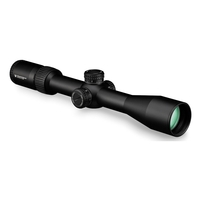
Vortex Diamondback Tactical FFP 4-16x44 Riflescope - MRAD
via Uttings
£429.00
Buying Advice
Start with the specifications that actually matter at distance. For a long range shooting scope in the UK, you want at least 5–25× magnification to cover both closer woodland shots and precision work beyond 500 metres. The objective lens should be 50–56 mm for adequate light transmission in dawn and dusk conditions typical of UK stalking. Look for at least 25–30 mils (or 80–100 MOA) of total elevation travel — without enough internal adjustment you simply cannot dial for drop at extended range. A side-parallax dial adjustable down to at least 50 yards is non-negotiable; uncorrected parallax at 600 metres can shift your point of impact by several centimetres. Finally, check the tube diameter: 34 mm tubes generally offer more internal travel than 30 mm, which matters when you are stacking elevation.
Budget tiers in the UK break down roughly as follows. Entry-level scopes — typically under £500 — can be surprisingly capable; brands such as Athlon, Element Optics and some MTC models offer MRAD reticles, zero stops and decent glass at this price point. If you are hunting for the best long range rifle scope under 500, focus on getting a reliable zero stop and a hash-marked reticle rather than chasing brand prestige. The mid-range tier, roughly £500 to £1,200, is where you find excellent all-rounders from Vortex, Bushnell and Delta Optical with ED glass, locking turrets and lifetime warranties. Premium scopes from Nightforce, Kahles, Schmidt & Bender and Swarovski occupy the £1,500-plus bracket and deliver noticeably better optical clarity, more precise tracking and bombproof mechanics — worthwhile if you shoot frequently or in extreme conditions.
Common mistakes buyers make include over-magnifying and under-specifying turrets. A 10–50× scope sounds impressive, but beyond about 30× atmospheric mirage in the UK renders extra magnification useless — you are better off investing in superior glass quality at a sensible magnification range. Another frequent error is buying a scope with capped turrets and no zero stop for long-range use; exposed, tool-less turrets with a positive zero stop let you dial confidently in the field and return to your confirmed zero without counting revolutions. Ignoring reticle subtension is equally costly — always check that your chosen reticle has enough holdover marks to cover your maximum intended range without dialling.
UK-specific context matters more than many guides acknowledge. Under current firearms legislation you must hold a valid Firearms Certificate for any centrefire rifle, and your ticket conditions will specify calibre and purpose. Most open-hill deer stalking in Scotland is done with .270 Win, 6.5 Creedmoor, 6.5 PRC or .308 Win — all of which are ballistically capable beyond 500 metres with quality ammunition. Note that sub-12 ft-lb air rifles and spring-powered airguns are effective only to around 50–75 yards and have no place in a long-range discussion. For purchasing, reputable UK dealers such as Sporting Saint, Optics Warehouse, Scott Country and RACS offer expert fitting advice and often hold demo stock. Pard, known primarily for digital night-vision and thermal add-ons, also supplies integrated digital day-night scopes that some UK hunters are now pairing with long-range setups for foxing at distance — worth investigating if you want dual-role capability.
Matching the scope to your specific use case is the final and most important step. A dedicated long range deer stalking scope needs enough magnification for positive species and sex identification at distance — 18× minimum is a sensible rule of thumb for red or sika beyond 400 metres. Fox and vermin control across open ground may favour a lighter, faster-handling 4–16× or 5–25× with an illuminated reticle for low-light work. If you compete in PRS or NRL-style matches as well as hunt, a first focal plane scope with a detailed Christmas-tree reticle and exposed turrets offers the most versatility. For the pure stalker who rarely dials beyond 300 metres but wants the option, a quality SFP scope with a BDC or simple mil-dot reticle on its highest magnification can be perfectly adequate and often lighter.
The brand landscape in the UK has broadened enormously. European heritage brands like Schmidt & Bender, Kahles, Swarovski and Zeiss remain the gold standard for glass quality and mechanical precision. American manufacturers — Nightforce, Vortex and Leupold — dominate the tactical and PRS crossover market and offer aggressive warranty programmes. Budget-conscious shooters are increasingly turning to Element Optics, Athlon and MTC, all of which have strong UK distribution. Pard occupies a growing niche with digital scopes and clip-on thermal units that appeal to night-shooting fox controllers. Whatever your budget, prioritise a scope with verified turret tracking, a usable reticle, and enough elevation travel for your intended cartridge and maximum range — those three factors matter more than any logo on the bell.
It is worth being clear about what long range optics actually covers, because the phrase gets used two ways and the difference costs people money. Narrowly it means the scope. In practice the shooters who hit consistently at distance treat it as a system of three parts, and the scope is only the first. The second is the mount: a 20 MOA inclined rail or mount tilts the scope down relative to the bore and hands back roughly 20 MOA of usable elevation at the top of the turret's travel, which is often the difference between dialling to 800 metres and running out of adjustment at 600 — for a fraction of what the glass costs. The third is the ballistic solution: a solver fed with a chronographed muzzle velocity, your measured scope height over bore and the current conditions, rather than the manufacturer's advertised figures. A premium scope on a flat rail with guessed data will lose to a mid-priced scope on a 20 MOA rail with real numbers every time. If you are pricing a long range setup, budget for all three rather than putting everything into the objective lens — our ballistic calculator will show you how much elevation your load actually needs before you choose the scope.
Frequently Asked Questions
What does long range optics include — just the scope?
In everyday use long range optics means the rifle scope, but a setup that works is three components rather than one, and treating it as one is the most common and most expensive mistake. The scope needs enough elevation travel and a reticle you can both hold and dial with. The mount matters nearly as much: a 20 MOA inclined rail or mount tilts the optic down relative to the bore and returns roughly 20 MOA of usable elevation at the top of the turret's range, typically for well under a tenth of the scope's price. The third part is the ballistic solution — a solver fed with a chronographed muzzle velocity, a measured scope height over bore and current atmospherics. Spending the whole budget on glass and mounting it on a flat rail with estimated data is how shooters end up unable to reach the distance the scope was bought for.
What magnification range do you need for long-range hunting in the UK?
For ethical long-range hunting beyond 500 metres, a scope offering at least 5–25× is ideal. The lower end gives you a wide field of view for closer or moving targets, while 20× and above lets you positively identify species and sex at distance — critical for legal compliance when deer stalking. Anything above 30× is rarely useful in UK field conditions because atmospheric mirage degrades the image.
Which reticle style is best for long-range hunting — MOA or MRAD holdover?
MRAD (milliradian) reticles are now the dominant choice for long-range work in the UK, largely because the metric system makes the maths intuitive: 0.1 mil equals 1 cm at 100 metres. MOA (minute of angle) works just as accurately — 1 MOA subtends approximately 1.047 inches at 100 yards — but most UK ballistic solvers and training courses default to MRAD. The key is to match your turret adjustment unit to your reticle unit; never mix MOA turrets with an MRAD reticle.
What is the best budget scope for long-range deer stalking beyond 300 metres?
If you are hunting for the best long range rifle scope under 500, look at models from Element Optics, Athlon and MTC that offer MRAD reticles, exposed turrets with a zero stop, and side-focus parallax. At this price point you sacrifice some optical clarity at dawn and dusk compared with premium glass, but the mechanical accuracy and reticle utility are more than adequate for confident shooting to 600 metres with a well-zeroed rifle.
Do you need a first focal plane scope for long-range hunting or will SFP work?
A first focal plane (FFP) scope keeps reticle subtensions accurate at every magnification, which is a real advantage if you use holdover points rather than dialling. A second focal plane (SFP) scope only reads true at one magnification setting — usually the highest. For dedicated long-range hunting where you have time to dial and typically shoot at maximum magnification, SFP is perfectly viable and often offers a finer, less cluttered reticle image. If you split time between hunting and competition, FFP is the more versatile choice.
How important is zero stop for a long-range hunting scope?
A zero stop is extremely important for any scope you intend to dial at distance. It provides a mechanical reference that lets you return your elevation turret to your confirmed zero without visually counting clicks or revolutions, which is invaluable when you are cold, tired or working in poor light. Without a zero stop you risk losing your zero entirely after dialling for a long shot and then forgetting to wind back accurately.
How much elevation travel do I need in a long-range hunting scope?
It depends on your cartridge, barrel length and maximum intended range. As a rough guide, a .308 Win with a 100-metre zero needs approximately 12–13 mils of elevation to reach 800 metres, while a 6.5 Creedmoor needs around 10–11 mils. Always choose a scope with more travel than your ballistic solver predicts you need, because a canted rail or 20-MOA base will consume some of that range. A minimum of 25 mils total travel is a sensible starting point.
Can I use a long-range hunting scope for UK PRS or NRL competitions as well?
Absolutely. Many UK shooters use the same scope for both disciplines. Look for an FFP model with an MRAD Christmas-tree reticle, exposed turrets with a reliable zero stop, and a magnification range of at least 5–25×. The crossover works well because PRS and field shooting share the same core demands: precise tracking, usable holdover marks and robust mechanics. Just be aware that competition-focused scopes can be heavier, which matters on a long hill stalk.
Does tube diameter really matter for a long-range scope?
Yes, though not for the reason many assume. A 34 mm tube does not inherently transmit more light than a 30 mm tube, but it does allow manufacturers to build in more internal adjustment range — crucial for dialling at extreme distance. If your cartridge and range demand more than about 22–24 mils of elevation, a 34 mm tube is strongly recommended. For moderate-range hunting out to 500 metres a 30 mm tube is usually sufficient and keeps weight and mounting costs lower.
Are digital scopes like Pard models viable for long-range hunting in the UK?
Pard and similar digital optic brands are gaining popularity for dual-role day and night use, particularly among UK fox controllers. Modern digital scopes offer built-in ballistic calculators, video recording and thermal or night-vision overlays. However, for pure daylight long-range precision, a quality optical scope still offers superior image resolution, zero latency and lighter weight. Digital units come into their own when you need night-capable optics or want to record your shots for review.
How does bullet drop compensation work on a hunting scope, and do I need a BDC reticle or dial turrets?
A BDC (bullet drop compensation) reticle has subtension marks or hash lines below the central crosshair that correspond to specific ranges for a given cartridge's trajectory. You hold the appropriate mark on the target instead of dialling the turret. This is fast but less precise, because the BDC marks are calibrated for one specific load and velocity—any deviation means the marks are approximate. Dialling turrets gives you exact compensation for any load, provided you have a reliable drop chart or ballistic calculator. For serious long-range work beyond 400 metres, most UK stalkers prefer dialling turrets with an MRAD or MOA reticle as a backup holdover reference.
Can I use a ballistic calculator app with my scope turrets for foxing and deer at extended range?
Absolutely, and it is highly recommended. Apps such as Applied Ballistics, Strelok Pro, and the free Hornady 4DOF calculator let you input your bullet's ballistic coefficient, muzzle velocity, zero range, and environmental conditions (temperature, pressure, humidity, altitude) to generate precise elevation and windage corrections in MRAD or MOA. You then dial these values on your turrets or use them as holdover references. For UK fox shooting at night, pre-calculated drop cards taped to the rifle stock are a practical backup when you cannot easily check a phone. Always verify app outputs against actual impacts on a range before relying on them in the field.
What is the practical maximum ethical range for deer and fox in the UK, and how does scope choice affect it?
There is no single legal maximum range, but ethical range is determined by your ability to consistently hit the vital zone—roughly a 20 cm circle on most UK deer species and 8–10 cm on a fox—under field conditions, accounting for wind, your shooting position, and the animal's potential movement. For many competent stalkers with a well-set-up rifle and quality long-range scope, 400–600 metres on deer is the practical limit; beyond that, wind reading and environmental variables dominate. Scope choice affects ethical range by determining how precisely you can dial corrections, how clearly you can resolve the target, and how confidently you can read wind through the reticle. A scope with poor tracking or inadequate magnification effectively shortens your ethical range.
Related guides
Expert UK guide to choosing a rifle scope for long-range hunting builds. Covers magnification, reticles, turrets, budget tiers in GBP…
.22 Long Range Scope Recommendations for UK ShootersExpert UK guide to choosing the best scope for .22 long range shooting. Covers magnification, turrets, reticles, budget tiers in GBP…
Best Long-Range Scopes 2026: BDC Reticles vs Exposed TurretsDefinitive UK buyer's guide to the best scopes for long-range shooting in 2026. Compare BDC reticles vs exposed turrets for 300–1,000 yard shots…
Best Rimfire Scopes for .22LR: UK Guide 2026Discover the best scope for 22lr rifle UK shooters can buy in 2026. Expert rimfire scope advice covering magnification, parallax…
Best PRS & Precision Rifle Scopes for UK Competitors in 2026Our expert UK guide to the best scopes for PRS and precision rifle competition in 2026. Covers FFP vs SFP, MRAD turrets, budget tiers…
Read next
- long range rifle scopes UK
Best Long-Range Scopes UK 2026: Mid-Budget Buyer's Guide
Not sure which scope is right for you?
Try our AI-powered scope finder — answer a few questions and get personalised recommendations.
Find My Scope →Get a UK scope tip every day
Follow AiScopes on Facebook for daily buying guides, deals and gear advice.
Follow on Facebook