Best Scopes for Getting Started in Long-Range Shooting
By Peter Makulek · Senior Optics Editor · · Live prices from UK retailers
Long-range shooting is one of the fastest-growing rifle disciplines in the UK, and it has never been more accessible. Whether you are drawn to Precision Rifle Series (PRS) competitions, long-range steel challenges, or simply want to stretch your .308 or 6.5 Creedmoor beyond 600 metres on a private range, the scope you mount is arguably the single most important equipment decision you will make. A poor optic turns every session into a frustrating guessing game; a well-chosen first time long range shooting scope gives you clear, repeatable feedback so your skills actually develop. This guide is written specifically for UK beginners looking to invest wisely in 2026.
The UK long-range community has exploded in recent years, with clubs across England, Scotland and Wales now hosting regular shoots out to 1,000 yards and beyond. Bisley, Diggle and Blair Atholl are household names, and smaller venues are popping up every season. That growth means the market is flooded with options — from budget-friendly models under £500 to premium European glass costing several thousand. Navigating magnification ranges, FFP versus SFP reticle planes, MRAD versus MOA turrets, and parallax adjustability can feel overwhelming when you are starting out.
In this guide we focus on what actually matters for a beginner long-range scope in the UK: optical clarity at higher magnifications, reliable and repeatable turret tracking, a useful reticle for holdovers and wind calls, and build quality that can withstand British weather. We also address the UK-specific factors — the calibres most commonly used on Home Office certificates, the disciplines you are likely to encounter first, and the practical realities of buying optics from UK retailers with proper after-sales support.
Below you will find our curated product picks drawn from the AIScopes database, followed by an in-depth buying advice section that covers budget tiers, common beginner mistakes, and how to match a scope to your exact use case. We have also compiled a thorough FAQ section that answers the real questions UK shooters are asking on forums and social media right now — from whether you can learn on a .22 LR to how far a budget scope can realistically take you. Let us get into it.
Top Picks — Live UK Prices

Nikko Stirling Diamond Long Range 30mm Tactical 4-16x50 IR Rifle Scope
via Uttings
£199.00

Hawke Sidewinder Tactical 6.5-20x42 - 1/2 Mil Dot | 17 110
via Livens
£372.90
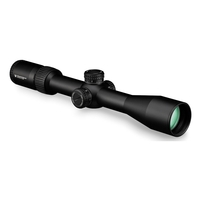
Vortex Diamondback Tactical FFP 4-16x44 Riflescope - MRAD
via Uttings
£429.00
Buying Advice
Start with the key specifications. For long-range shooting, you want a scope with a top-end magnification of at least 16× — most beginners find the 5-25× or 4-24× range ideal because the low end is still usable for closer work and target acquisition, while 20×+ lets you resolve impacts on steel at 800 metres and beyond. Look at the objective lens diameter: 50 mm is the sweet spot for brightness versus weight. Understand the turret system — MRAD (milliradian) turrets adjust in 0.1 mil clicks, where 0.1 mil equals exactly 1 cm at 100 metres, making metric range estimation straightforward. MOA turrets adjust in fractions of a minute of angle, where 1 MOA equals approximately 1.047 inches at 100 yards. MRAD is now dominant in UK PRS and long-range circuits, so we recommend beginners start there for community compatibility.
Budget tiers are worth understanding clearly. At the entry level — roughly under £500 — you can find capable scopes from brands like Vortex (the Diamondback Tactical line) and Burris (the Veracity and RT-25 lines). A long range scope under £500 will typically deliver decent glass clarity, exposed turrets with adequate tracking, and a first-focal-plane (FFP) reticle. Moving into the mid-range bracket of £500–£1,000, you gain noticeably better glass coatings, tighter turret tolerances, zero-stop mechanisms, and more refined reticle designs — the Vortex Viper PST Gen II and Burris XTR III are strong contenders here. Above £1,000 you enter premium territory: Zeiss, Swarovski, and top-tier Vortex Razor lines offer edge-to-edge clarity, bombproof mechanicals, and exceptional low-light performance.
Common mistakes plague beginners. First, over-magnifying: buying a 10-50× scope sounds impressive but delivers a narrow field of view, exaggerates mirage, and usually means poor glass quality at the price point. Second, ignoring the reticle plane: a second-focal-plane (SFP) reticle only subtends correctly at one magnification, which complicates holdovers at variable power. For long-range work, an FFP scope is strongly preferred because the reticle scales with magnification — your mil-dot or Christmas-tree holdovers remain accurate at any setting. Third, neglecting parallax adjustment: any scope used beyond 200 metres needs a side-focus parallax knob so you can eliminate parallax error at the distance you are shooting. Finally, skimping on the mount or rings to fund a slightly fancier scope almost always backfires; a solid 20-MOA Picatinny rail and quality rings are essential for maintaining zero.
UK-specific context matters enormously. You will need a Firearms Certificate (FAC) to own any centrefire rifle, and your certificate conditions will dictate what calibres and how many rifles you may possess. The most common beginner long-range calibres are .308 Winchester and 6.5 Creedmoor, both of which are readily available from UK dealers and have excellent ballistic data for dialling. If you are looking at what scope for 1000 yards shooting, your calibre choice and the scope must work as a system — a 6.5 Creedmoor needs roughly 7–8 mils of elevation at 1,000 yards depending on load and conditions, so check your scope has enough internal elevation travel (ideally 25+ mils total with a 20-MOA rail). Buy from established UK retailers such as Sporting Saint, RUAG, Optics Warehouse or your local RFD; this ensures proper warranty support and avoids post-Brexit import complications.
Matching the scope to your use case is the final step. If you plan to shoot purely from a bench or prone at known distances — the classic NRA-style long-range format — a heavier, higher-magnification scope with a large objective is perfectly appropriate because gun weight is less of a concern. If you are interested in PRS-style positional shooting, where you engage targets from barricades, rooftops and awkward stages, keeping total rifle weight reasonable becomes important, so a lighter 34 mm-tube scope in the 5-25× class may serve you better. For those wanting to start with long range shooting UK beginners' competitions like club-level mini-PRS, a mid-range FFP scope with an MRAD Christmas-tree reticle will cover virtually every scenario you encounter in your first two seasons.
The brand landscape for UK long-range shooters has a clear structure. Vortex dominates the entry-to-mid market and offers a transferable, no-fault lifetime warranty — the Vortex long range scope UK lineup from Diamondback Tactical through Viper PST to Razor HD Gen III covers every budget. Burris provides excellent value in the mid tier, and the Burris long range scope UK offering, particularly the XTR III, competes aggressively on turret feel and glass clarity per pound spent. At the premium end, Zeiss and Swarovski remain aspirational choices with superb optics and prestigious European manufacturing, though their tactical lines are less commonly seen in UK PRS compared to Vortex Razor or Kahles. Pard, Hikmicro and Yukon are better known for night-vision and thermal add-ons — useful accessories for foxing or deer management, but not primary long-range day-optic choices.
Frequently Asked Questions
What magnification and reticle type do I need for my first long-range scope?
A variable power scope in the 5-25× or 4-24× range covers the vast majority of UK long-range disciplines. This gives you enough magnification to spot hits on steel at 800–1,000 metres while retaining a wide enough field of view at lower settings for closer or positional work. Choose a first-focal-plane (FFP) scope with an MRAD-based Christmas-tree or mil-dot reticle — FFP ensures your reticle subtensions are accurate at every magnification, and MRAD is the standard across UK PRS and long-range circuits, making it far easier to follow coaching advice and share data.
Burris vs Vortex: which brand offers better value for a beginner long-range setup in the UK?
Both brands offer strong value, but they differ in focus. Vortex has a wider UK dealer network, a no-questions-asked transferable warranty, and a broader product range from sub-£300 Diamondback Tactical models through to the Razor HD Gen III. Burris competes particularly well in the mid tier — the XTR III is praised for its turret feel and optical quality at a competitive price. For a first-time buyer on a tight budget, Vortex's entry-level options and warranty edge often make it the safer bet; if you can stretch to the mid bracket, Burris deserves serious consideration.
Does gun weight really matter when choosing a scope for long-range shooting?
It depends on how you shoot. For bench-rest or prone-only formats, total weight is less critical and a larger, heavier scope with a 56 mm objective can actually help dampen recoil pulse. However, for PRS-style competitions where you shoot from barricades and unconventional positions, carrying a 7 kg+ rifle through a stage becomes physically demanding. Scope weight typically ranges from around 600 g for a compact 4-16× to over 1 kg for a 5-25×56 model, so it is worth factoring in if positional shooting is your goal.
Can I start long-range shooting with a .22 LR or do I need a centrefire calibre?
You can absolutely develop core fundamentals — trigger control, position building, wind reading — with a .22 LR, and several UK clubs run rimfire-specific long-range events out to 200–300 yards. Beyond that distance, .22 LR loses velocity rapidly and becomes extremely wind-sensitive, making consistent hits very difficult. For shoots at 600 metres and beyond, a centrefire calibre such as .308 Winchester or 6.5 Creedmoor on an FAC is essential. Starting on rimfire is a genuinely smart, cost-effective way to learn before committing to a centrefire setup.
How far can I realistically shoot with a budget scope — 500 metres, 800 metres, or beyond?
A well-made budget scope — say a Vortex Diamondback Tactical or similar in the sub-£500 bracket — can take you to 800 metres and potentially further, provided its turret tracking is repeatable and it has enough internal elevation adjustment. The practical limit is usually the shooter's skill, the rifle's accuracy, and environmental conditions rather than the optic alone. Where budget glass falls short is in optical clarity at high magnification (making spotting hits harder) and turret precision over many revolutions. For most UK beginners, a good budget scope is entirely adequate for the first season or two out to 1,000 yards.
What is the difference between FFP and SFP, and which is better for long-range shooting?
In a first-focal-plane (FFP) scope, the reticle scales proportionally with magnification, so holdover and windage values etched into the reticle remain accurate at any power setting. In a second-focal-plane (SFP) scope, the reticle stays the same apparent size regardless of zoom and is only dimensionally correct at one specific magnification — usually the maximum. For long-range shooting, FFP is strongly preferred because you frequently need to make quick holdover corrections without first confirming you are on the correct magnification. SFP scopes are still popular for hunting but are less practical for precision work at distance.
Do I need a 20-MOA rail, and what does it actually do?
A 20-MOA canted rail tilts your scope slightly downward relative to the bore, effectively borrowing elevation adjustment that would otherwise be used getting to a 100-metre zero and making it available at longer ranges. Without one, many scopes run out of internal elevation travel before you can dial to 800 or 1,000 metres — a common and frustrating problem for beginners. In the UK, 20-MOA Picatinny rails are widely available for most popular bolt-action platforms and typically cost between £30 and £80. It is one of the cheapest and most impactful upgrades you can make.
Should I choose MRAD or MOA turrets as a beginner in the UK?
MRAD (milliradian) is the dominant system in UK long-range and PRS shooting. One click of 0.1 mil equals exactly 1 cm at 100 metres, which meshes neatly with the metric range measurements used at most UK venues. MOA (minute of angle) adjustments — where 1 MOA equals approximately 1.047 inches at 100 yards — are still common in the United States and in some NRA target-rifle traditions. However, if you are attending UK long-range courses or competitions, MRAD will make communication with spotters and coaches far simpler. We recommend beginners commit to MRAD and learn the system thoroughly.
What scope magnification long range shooters actually use day-to-day in the UK?
On the firing point at known-distance ranges, most UK long-range shooters dial up to 18–25× depending on conditions and target size. Higher magnification amplifies mirage (heat haze), which is surprisingly common even in British summers, so experienced shooters frequently back off to 16–18× to get a cleaner image. In PRS-style matches, competitors often shoot entire stages at 12–18× to maintain a wider field of view and faster target acquisition. A scope maxing out at 24× or 25× is more than sufficient — anything beyond that in a sub-£1,000 optic usually compromises glass quality without adding real-world benefit.
Related guides
Expert UK guide to choosing the best scope for .22 long range shooting. Covers magnification, turrets, reticles, budget tiers in GBP…
Best Long-Range Scopes 2026: BDC Reticles vs Exposed TurretsDefinitive UK buyer's guide to the best scopes for long-range shooting in 2026. Compare BDC reticles vs exposed turrets for 300–1,000 yard shots…
Best Scopes for Ballistics-Matched Long-Range Shooting in 2026Our 2026 UK buyer's guide to the best long-range scopes with BDC reticles, ballistic turrets and calibre pairing for accurate shooting from 300 to 1,000…
Best Deer Stalking Scopes for Returning UK Hunters (2026)Returning to deer stalking after years away? Our 2026 UK buyer's guide covers the best scopes, key spec changes, illuminated reticles…
Best Night Vision Scopes for UK Hunting in 2026Our expert UK guide to the best night vision scopes for hunting in 2026. Covers digital vs intensifier, legality in England, Scotland and Wales…
Read next
- long range rifle scopes UK
Best Long-Range Scopes UK 2026: Mid-Budget Buyer's Guide
Not sure which scope is right for you?
Try our AI-powered scope finder — answer a few questions and get personalised recommendations.
Find My Scope →Get a UK scope tip every day
Follow AiScopes on Facebook for daily buying guides, deals and gear advice.
Follow on Facebook