Best Long-Range Rifle Scopes 2026: Match Your Optic to Your Calibre
By Peter Makulek · Senior Optics Editor · · Live prices from UK retailers
Choosing the best scope for long range shooting has never been more nuanced. In 2026 the UK market offers an extraordinary spread of optics — from purpose-built PRS competition scopes with exposed tactical turrets to ballistic-turret hunting models that let you dial your specific calibre's drop curve without a second thought. The challenge is no longer finding a good scope; it is matching the right scope to your rifle, your cartridge and the discipline you actually shoot. Get that match wrong and even a premium optic will leave you guessing at 500 metres and beyond.
For UK shooters the long-range conversation centres on a handful of proven calibres: .308 Winchester remains the workhorse, 6.5 Creedmoor has firmly established itself as the go-to for target work and increasingly for deer stalking, and .243 Winchester continues to serve fox and roe deer stalkers who want a flat-shooting, low-recoil option. Each cartridge has a different ballistic coefficient profile, a different drop curve and different wind-drift characteristics — and your scope's reticle subtensions or turret graduation must account for those differences if you want repeatable hits past 400 metres.
This rifle scope ballistics guide is written specifically for the UK market. We cover the practical magnification ranges that suit our typical engagement distances (which rarely exceed 800 metres even for target disciplines), the reticle and turret systems that make scope calibre matching straightforward, and the environmental factors — altitude, temperature and the relentlessly variable British weather — that shift your holdovers at extended range. Whether you are building a PRS rifle or looking for the best scope for long range hunting on Scottish hillsides, the decision framework is the same.
Below you will find our curated product picks for 2026, followed by in-depth buying advice and a comprehensive FAQ section that answers the exact questions UK shooters are asking right now. Our goal is simple: to make this the definitive UK resource so you can invest in the right long range rifle scope with genuine confidence.
Top Picks — Live UK Prices

Nikko Stirling Diamond Long Range 30mm Tactical 4-16x50 IR Rifle Scope
via Uttings
£199.00

Hawke Endurance 30 WA 1-4x24 IR (Tactical Dot 4x) Telescopic Sights
via BushWear
£251.10
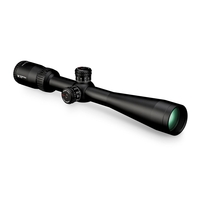
Vortex Diamondback Tactical 4-12x40 Riflescope - VMR-1 Reticle (MOA)
via Uttings
£299.00
Buying Advice
Start with the specifications that actually move the needle at distance. Total elevation travel determines how far you can dial before running out of adjustment — for a .308 zeroed at 100 metres you need roughly 12–13 MRAD (about 42–45 MOA) of 'up' travel to reach 800 metres, whereas a 6.5 Creedmoor with its flatter trajectory needs less. Check the advertised total travel, then subtract what you lose to a 100-metre zero (typically 4–6 MRAD on a 20-MOA rail). A zero-stop mechanism is essential so you can return to your confirmed zero by feel. Turret graduation matters too: most long-range shooters prefer MRAD (0.1 mil clicks, where 1 click equals 1 cm at 100 m) for its metric simplicity, though MOA (typically ¼ MOA clicks, each equalling roughly 0.7 cm at 100 m) remains popular. Whichever you choose, ensure your reticle matches your turret unit — mixing MOA turrets with an MRAD reticle is a common and costly mistake.
Budget tiers in the UK broadly break down as follows. Entry-level long-range scopes in the region of £300–£600 can deliver surprisingly good glass and tracking, though turret feel and consistency under repeated dialling may be less refined. Mid-range models from roughly £600–£1,200 typically offer significantly better mechanical repeatability, ED glass for sharper imaging, and locking turrets or tool-less zero-stop systems — this is the sweet spot for most UK club-level PRS and serious stalkers. Premium optics above £1,200 bring the tightest tolerances, the best low-light transmission (critical for Scottish dawn stalks), and features such as illuminated FFP reticles with very fine subtensions. Decide what you genuinely need before you buy: a stalker shooting to 300 metres has different optical demands from a competitor engaging steel at 1,000.
The most common mistakes we see UK buyers make centre on three issues. First, buying a scope with a BDC reticle calibrated for a cartridge or bullet weight they do not shoot — a BDC reticle scope designed around a 168-grain .308 load will not be accurate for a 140-grain 6.5 Creedmoor. If you want a BDC, verify the manufacturer's ballistic data matches your exact load or choose a scope with a custom-cam turret system instead. Second, choosing second focal plane (SFP) at high magnification without understanding that the subtensions are only correct at one specific power setting; for holdover shooting at varying magnifications, first focal plane (FFP) is far more forgiving. Third, neglecting parallax adjustment: any scope used beyond 200 metres should offer a side-focus or adjustable-objective parallax control to eliminate apparent reticle shift on target.
UK-specific context matters more than many guides acknowledge. Legally, you must hold the appropriate firearms certificate for any centrefire rifle, and your scope choice has no direct legal restriction — but practical considerations abound. If you stalk deer under Deer Act conditions, low-light performance is paramount because legal shooting times extend into deep twilight. For target disciplines such as NRL/PRS-style matches increasingly popular at UK ranges like Orion or Diggle, you want robust turrets that track precisely through dozens of elevation changes per stage. In terms of calibres, .308 and 6.5 Creedmoor dominate long-range target, .243 and 6.5 Creedmoor are popular for foxing and stalking, and .300 Win Mag or .338 Lapua appear at ELR events. Purchase from established UK dealers — both online specialists and high-street RFDs — to ensure warranty support and correct import-duty-paid pricing.
Matching the scope to your use case starts with honest self-assessment. A best scope for deer stalking in the UK scenario typically means a 4–16× or 5–25× with an illuminated reticle, excellent dusk/dawn light transmission, and either a ballistic turret matched to your load or a simple MRAD/MOA Christmas-tree reticle for quick holdovers to 400 metres. A dedicated PRS or F-class competitor will prioritise a 5–25× or 7–35× FFP scope with ultra-precise 0.1 MRAD clicks, a broad Christmas-tree or Horus-style reticle for wind holds, and a large objective for mirage reading. Foxing at night — especially with a clip-on thermal such as a Pard unit — demands a scope with generous eye relief and a forgiving eye box so the thermal device can couple cleanly without vignetting. Let your actual shooting dictate the feature set, not marketing hype.
The brand landscape in 2026 is competitive. European makers like Zeiss, Swarovski, Schmidt & Bender and Kahles continue to set the standard for glass quality and mechanical precision at the premium end. Vortex, Athlon, Maven and Bushnell offer outstanding value in the mid-range, with Vortex's transferable lifetime warranty particularly attractive on the used market. Nightforce and March dominate serious PRS and ELR circles. For UK night-shooting setups, Pard has carved out strong market share with clip-on thermal and digital devices that pair well with conventional day scopes, letting you keep a single high-quality optic on your rifle year-round. Ultimately, the best long range rifle scope is the one whose turret system, reticle and optical quality align precisely with your cartridge, your discipline and the British conditions you actually shoot in.
Frequently Asked Questions
How do I match a rifle scope's BDC reticle or turret system to my specific calibre's ballistic drop?
A BDC reticle is designed around a specific bullet's ballistic coefficient and muzzle velocity, so you must check the manufacturer's stated calibration — a reticle built for a 168-grain .308 at 2,650 fps will not match 6.5 Creedmoor 140-grain at 2,710 fps. For more flexibility, choose a scope with an MRAD or MOA reticle and use a ballistic calculator to generate a custom drop chart for your exact load. Some manufacturers such as Swarovski and Leupold offer custom ballistic turret cams that you can order to match your specific cartridge and conditions, giving you true scope calibre matching without reticle limitations.
What scope features matter most for long-range hunting versus long-range target shooting in the UK?
For long-range hunting — particularly deer stalking — prioritise exceptional low-light transmission (look for 90%+ light transmittance), an illuminated reticle for dawn and dusk, generous eye relief of at least 90 mm, and a reliable zero-stop so you can return to your confirmed zero quickly. For target shooting and PRS competition, mechanical turret precision and repeatability are paramount, along with a first focal plane reticle with detailed subtensions for wind holds, and enough total elevation travel to reach your maximum competition distance. Both disciplines benefit from a side-focus parallax adjustment.
Do I need a ballistic calculator app, and how do I dial scope turrets to match its output?
Yes — a ballistic calculator app such as Applied Ballistics, Strelok Pro or Hornady 4DOF is essentially mandatory for consistent long-range shooting. You input your bullet's ballistic coefficient (G1 or G7), muzzle velocity, zero distance, and atmospheric conditions; the app outputs the exact elevation and windage corrections in MRAD or MOA. You then dial those values onto your scope turrets: for example, if the app says 3.2 MRAD up at 500 metres, you dial 32 clicks on a 0.1 MRAD turret. Always verify your app's output against live shooting at known distances before trusting it in the field.
Which magnification range and reticle subtensions suit typical UK long-range calibres like .308, 6.5 Creedmoor and .243?
For UK engagement distances — typically out to 600 metres for stalking and 800–1,000 metres for target work — a 5–25× scope covers virtually every scenario. At 10–12× you have enough field of view for target acquisition; at 20–25× you can read mirage and precisely place shots on small steel. A Christmas-tree style MRAD reticle with 0.5 mil or 0.2 mil hash marks suits all three calibres, because you reference your own ballistic data rather than relying on a calibre-specific BDC. For dedicated .308 or .243 hunting inside 400 metres, a clean 4–16× with a simpler holdover reticle is often preferable.
How does altitude, temperature and UK weather affect my scope's ballistic holdovers at 500+ metres?
Atmospheric conditions directly influence air density, which in turn affects drag on your bullet. Higher altitude and higher temperature both reduce air density, meaning less drag and a flatter trajectory — your bullet will impact higher than a standard sea-level, 15°C prediction. In typical UK conditions (near sea level, 5–20°C), the effect is modest at 500 metres but grows significantly beyond that: a 6.5 Creedmoor 140-grain load can see roughly 0.3–0.5 MRAD difference in drop between a cold Scottish February morning and a warm July afternoon at 800 metres. Always update your ballistic calculator with current atmospheric data before shooting at distance.
What is the difference between FFP and SFP for long-range shooting, and which should I choose?
In a first focal plane (FFP) scope the reticle scales with magnification, so the subtension values — your mil-dots or MOA hash marks — remain accurate at every power setting. In a second focal plane (SFP) scope the reticle stays the same apparent size and subtensions are only correct at one specific magnification, usually the maximum. For long-range target shooting where you frequently use the reticle for wind holds at varying magnifications, FFP is strongly preferred. For hunting, where you typically shoot at full magnification and want a fine reticle at low power for snap target acquisition, SFP can be a practical choice.
Can I use a long-range centrefire scope on a sub-12 ft-lb air rifle?
You can physically mount any scope on an air rifle, but it would be misleading to imply that doing so extends the air rifle's effective range. A sub-12 ft-lb springer or PCP is realistically effective to roughly 50–75 yards due to its limited muzzle energy and the rapid velocity decay of lightweight pellets. A high-magnification long-range scope adds unnecessary weight and bulk, and the aggressive recoil pattern of spring-piston rifles can damage scopes not rated for bidirectional recoil. Choose a scope specifically designed for air rifles if that is your platform.
How important is turret tracking, and how do I test it on a new scope?
Turret tracking — the accuracy and repeatability with which a scope's adjustments move the point of impact — is arguably the single most critical mechanical attribute for long-range shooting. To test it, perform a tall-target or box test: zero at 100 metres, then dial a known number of clicks (e.g., 5 MRAD up), fire a group, dial 5 MRAD right, fire again, and continue around a square back to your original zero. Measure whether each group moved the exact predicted distance (5 MRAD = 50 cm at 100 m) and whether you return to your starting point. Any significant deviation indicates poor tracking.
Is a ballistic turret scope better than a standard MRAD/MOA turret for UK stalking?
A ballistic turret scope — where the turret is custom-calibrated in metres or yards of distance for your specific load — can be superb for stalking because it removes mental arithmetic: you simply range your target, dial to that distance marking, and shoot. The downside is inflexibility — if you change your load, bullet weight or even zero distance, the cam is no longer accurate and must be replaced. A standard MRAD or MOA turret paired with a drop chart or ballistic app is more versatile and suits shooters who handload or switch between cartridges. For a dedicated stalking rifle with one consistent factory load, a ballistic turret is an excellent, confidence-inspiring choice.
What is a BDC reticle and how does it compare to dialling turrets for long-range shooting in the UK?
A BDC (Bullet Drop Compensator) reticle has aiming points or hash marks spaced to correspond to the bullet's drop at predetermined distances — for example, marks at 200, 300, 400 metres and beyond. Instead of adjusting your turrets, you simply place the appropriate mark on the target and fire. The advantage is speed: you never move the turret, so your zero is always intact, which suits UK deer stalking where a quick follow-up at a different range may be needed. The downside is that the subtensions are only accurate for one specific cartridge and load at one specific muzzle velocity, and in SFP scopes only at one magnification. Dialling turrets, by contrast, lets you input the exact correction for any distance and any load, offering greater precision — the preferred method in PRS competition — but requires more time and discipline to execute correctly in the field.
Do I need a ballistic calculator app to get the most from a long-range scope?
In practical terms, yes. A ballistic calculator app — such as Applied Ballistics Elite, Strelok Pro, or Hornady 4DOF — converts environmental data (temperature, pressure, humidity, altitude, wind speed) and your ammunition's profile into precise elevation and windage corrections for any distance. Without one, you are relying on generic drop charts or memorised data that may not account for the conditions on the day. For UK shooters, where temperature can swing 15°C between dawn and midday in spring, and air density varies significantly with altitude in highland terrain, a solver running on your phone is the single most cost-effective accuracy upgrade you can make beyond the scope itself.
What ballistic features should UK hunters look for in a scope for 300–800 metre deer and fox shots?
For ethical shots at these distances on live quarry, you need an optic with precise, repeatable turret adjustments — ideally with a zero-stop so you can return to your confirmed zero without counting clicks in poor light. An FFP reticle ensures holdover marks remain accurate regardless of your magnification setting, which is important when you may zoom in to confirm the animal and then hold without adjusting power. Sufficient total elevation travel is essential: a .308 Win shooting 168-grain match ammunition drops roughly 12-13 MRAD (about 42 MOA) at 800 m from a 100 m zero, so you need well in excess of that in available up-travel. Good low-light performance, a side-focus parallax knob adjustable down to at least 50 metres, and reliable weatherproofing are all non-negotiable for UK hill conditions.
MOA or MRAD turrets for long-range ballistic corrections: which system is easier to use in the field?
Both systems work equally well if you learn them properly; the difference is ergonomic, not mathematical. MRAD (milliradians) is the dominant system in UK and European long-range circles because the metric relationship is intuitive: 0.1 MRAD equals exactly 1 cm at 100 m, 2 cm at 200 m, and so on. MOA is slightly finer per click (¼ MOA ≈ 0.7 cm at 100 m vs 1 cm for 0.1 MRAD), which some benchrest shooters prefer, but the imperial maths (1 MOA ≈ 1.047 inches at 100 yards) is less convenient if you think in metric. Most UK PRS competitors and professional deer managers have standardised on MRAD. The critical rule is to match your turret and reticle unit — never mix MOA turrets with an MRAD reticle.
Related guides
Expert UK guide to choosing the best scope for .22 long range shooting. Covers magnification, turrets, reticles, budget tiers in GBP…
Best Long-Range Scopes 2026: BDC Reticles vs Exposed TurretsDefinitive UK buyer's guide to the best scopes for long-range shooting in 2026. Compare BDC reticles vs exposed turrets for 300–1,000 yard shots…
Best Long-Range Scopes UK 2026: Mid-Budget Buyer's GuideDiscover the best scopes for long-range shooting in the UK for 2026. Our expert guide covers FFP vs SFP, MOA vs MRAD…
Best Scopes for Ballistics-Matched Long-Range Shooting in 2026Our 2026 UK buyer's guide to the best long-range scopes with BDC reticles, ballistic turrets and calibre pairing for accurate shooting from 300 to 1,000…
Best Long-Range Scopes Under £1,000 for UK ShootersOur 2026 UK buyer's guide to the best scopes for long-range shooting under £1,000. Expert picks, specs explained…
Best Rimfire Benchrest Scopes for UK Shooters in 2026Find the best scope for bench rest shooting UK competitions in 2026. Our expert guide covers high-magnification .22LR optics, FFP vs SFP, parallax…
Best Night Vision Clip-Ons & Add-Ons for UK Shooters in 2026Our 2026 buyer's guide to the best night vision clip-on scopes for UK foxing and pest control. Covers budget to premium add-ons, PARD models…
Not sure which scope is right for you?
Try our AI-powered scope finder — answer a few questions and get personalised recommendations.
Find My Scope →Get a UK scope tip every day
Follow AiScopes on Facebook for daily buying guides, deals and gear advice.
Follow on Facebook