Best Scopes for Ballistics-Matched Long-Range Shooting in 2026
By Peter Makulek · Senior Optics Editor · · Live prices from UK retailers
Long-range shooting in the UK has evolved enormously over the past decade, and 2026 sees more purpose-built rifle scope ballistics systems available to British shooters than ever before. Whether you are competing in NRL/PRS-style matches on UK ranges, stalking in the Scottish Highlands with a need for precise holdovers beyond 300 yards, or simply developing your marksmanship on MOD or club ranges out to 1,000 yards, the right calibre matched optic can make the difference between a confident first-round hit and an expensive miss. This guide cuts through the marketing noise to help you find the best scope for long range UK rifle use, with real-world advice rooted in British shooting conditions and legal requirements.
The core challenge in ballistics-matched shooting is ensuring that what your reticle or turret tells you corresponds accurately to where your bullet actually lands at each distance. A bullet drop reticle UK shooters can trust must be designed — or customisable — for the specific ballistic curve of their chosen cartridge and load. A .308 Winchester 155-grain Palma load drops very differently from a 6.5 Creedmoor 140-grain ELD-M at 800 yards, and both are wildly different from a .223 Remington at the same distance. Getting this match right is the single most important decision in choosing a long range scope UK shooters will actually benefit from.
In the UK market, the most popular long-range calibres remain .308 Winchester, 6.5 Creedmoor, .300 Winchester Magnum and, increasingly, 6.5 PRC. All are legal on FAC for target shooting and — where appropriate — for deer of the relevant species under the Deer Act 1991 (England and Wales) or the Deer (Scotland) Act 1996. Your scope choice must account for the total elevation adjustment required to dial or hold to your maximum intended range, the reticle's suitability for wind corrections, and whether you prefer dialling turrets or using holdover marks. This guide addresses every one of those factors in depth.
We have structured this guide around the real questions UK shooters are asking in 2026: how to match a BDC reticle to your specific load, how much turret travel you actually need, whether FFP or SFP is the right choice for ballistic holdovers, and what magnification is genuinely useful at extreme range. After our curated product picks below, you will find comprehensive buying advice, budget-tier breakdowns in GBP, and a detailed FAQ section designed to be the most useful single resource on this topic available to a UK audience.
Top Picks — Live UK Prices

Nikko Stirling Diamond Long Range 30mm Tactical 4-16x50 IR Rifle Scope
via Uttings
£199.00

Hawke Endurance 30 WA 1-4x24 IR (Tactical Dot 4x) Telescopic Sights
via BushWear
£251.10
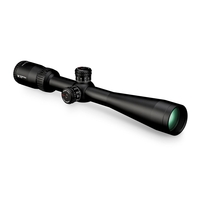
Vortex Diamondback Tactical 4-12x40 Riflescope - VMR-1 Reticle (MOA)
via Uttings
£299.00
Buying Advice
When evaluating any ballistic turret scope or BDC-equipped optic, the first numbers to interrogate are total elevation adjustment and per-revolution values. For a .308 Win firing a 155-grain bullet at roughly 2,950 fps, you need approximately 36–38 MOA (around 10.5 MRAD) of usable elevation above a 100-yard zero to reach 1,000 yards at sea level. A 6.5 Creedmoor 140-grain load at 2,710 fps requires slightly less — typically 32–34 MOA (about 9.3–9.5 MRAD). Always check usable travel, not just the total spec-sheet figure, because some adjustment is consumed by the mounting system and rail cant. A 20-MOA canted base is almost essential for 1,000-yard work with either calibre, effectively giving your turret the headroom it needs. Look for scopes offering a genuine zero-stop mechanism so you can return to your confirmed zero without counting clicks in the field.
Budget tiers in the UK break down roughly as follows. Entry-level long-range scopes — around £300 to £600 — will get you usable glass, basic exposed turrets and either a fixed BDC reticle or a simple mil-dot. They work well to 600 yards but often lack the tracking precision and build quality for consistent 1,000-yard shooting. Mid-range optics — £600 to £1,200 — represent the sweet spot for most UK shooters, offering locking turrets, FFP reticles, quality multi-coated glass and reliable click values. Many excellent scopes sit as a scope under 1000 pounds in this bracket. Premium scopes — £1,200 and above, extending well past £2,500 — deliver superior optical clarity in low light, flawless turret tracking verified by tall-target tests, and advanced features such as integrated ballistic turret systems with custom cam rings for your exact load.
The most common mistake UK buyers make is purchasing a scope with a fixed BDC reticle designed for a cartridge they do not shoot. Many off-the-shelf BDC reticle UK options are calibrated for American hunting loads — typically a .308 with a 168-grain bullet at 2,650 fps — which may not match your specific ammunition or barrel length. If the subtensions do not align with your real-world drop data, holdover marks become misleading rather than helpful. Always verify the manufacturer's stated ballistic profile against a reputable calculator such as Applied Ballistics or Strelok Pro using your actual chronographed muzzle velocity. For maximum flexibility, a Christmas-tree or hashed mil/MOA reticle with known subtensions is far more versatile than a pre-set BDC, because you can generate your own custom drop chart.
UK-specific context matters significantly. Long range shooting in the UK typically takes place on approved ranges — Bisley, Diggle, Sennybridge and numerous club facilities — or on open hill for deer stalking. Our climate means you will frequently shoot in overcast, low-contrast light, so optical clarity and light transmission are more important here than in sunlit Western US conditions. Parallax adjustment down to at least 50 yards (ideally 10 yards) is useful for the varied distances encountered on UK ranges. Legally, any scope can be fitted to an FAC rifle without additional licensing, but remember that thermal and digital night-vision clip-on devices have separate considerations under the Wildlife and Countryside Act regarding species-specific use. Brands like Pard have gained significant UK mindshare for digital night-vision, but for dedicated daylight long-range ballistic work, your primary optic remains a conventional riflescope.
Matching the scope to your specific use case is essential. A best scope for long range hunting application — stalking red deer on a Scottish estate at distances up to 300–400 yards — favours a lighter, compact scope with a reliable BDC or simple dial system, moderate magnification (say 4–16×) and excellent low-light performance. A dedicated target or PRS competitor shooting to 1,000 yards needs maximum elevation travel, an FFP reticle with detailed windage hash marks, high magnification (typically 5–25× or 7–35×) and rock-solid turret repeatability. A dual-purpose shooter might choose a versatile 4–24× or 5–25× FFP scope with both a detailed reticle tree and a locking, zero-stop turret — the most popular configuration in UK long-range circles in 2026.
The brand landscape accessible to UK shooters in 2026 is broad. European manufacturers such as Zeiss, Schmidt & Bender, Swarovski, Kahles and Steiner have long dominated the premium end, with excellent UK dealer networks. Vortex, Nightforce, Athlon and Maven represent strong US-origin options available through UK importers, with Vortex's lifetime warranty being particularly well-honoured in the UK. Japanese-made optics from Nikon (in legacy models), March and Minox continue to offer superb glass quality. At the value end, brands such as Hawke, MTC Optics (a UK company), Element Optics and Primary Arms provide genuinely capable long range scope UK options at accessible price points, many specifically designed with MRAD reticles suited to ballistic holdover work. Whatever your budget, prioritise verified turret tracking, appropriate reticle subtension data and sufficient elevation travel for your calibre and maximum range.
Frequently Asked Questions
How do I match a BDC reticle to my specific calibre and load for UK shooting conditions?
Start by chronographing your exact load to get a true muzzle velocity from your barrel length, then input that data — along with bullet BC, altitude and a typical UK air temperature of around 10–15°C — into a ballistic calculator such as Applied Ballistics, Strelok Pro or the free JBM online calculator. Compare the predicted drop values at each distance to the subtension marks on your chosen reticle, which should be published by the manufacturer in MOA or MRAD. If the marks align closely (within 0.1 MRAD or 0.25 MOA) at your key distances, the reticle is a good match. If they do not, consider a scope with a generic mil or MOA Christmas-tree reticle and create a custom drop chart instead.
What turret adjustment range do I need for shooting at 1,000 yards with a .308 or 6.5 Creedmoor?
For a .308 Winchester with a typical 155-grain match load at around 2,950 fps, you need approximately 36–38 MOA (10.5 MRAD) of elevation above a 100-yard zero to reach 1,000 yards. A 6.5 Creedmoor 140-grain ELD-M at 2,710 fps requires roughly 32–34 MOA (9.3–9.5 MRAD). In practice, you should use a 20-MOA canted rail or mount to shift the scope's adjustment range upward, ensuring you have enough usable travel without exhausting mechanical limits. Always confirm usable elevation with the scope mounted on your rifle, as different ring heights and actions consume varying amounts of the total adjustment.
Is a first focal plane or second focal plane reticle better for ballistic holdovers at long range?
For ballistic holdovers, a first focal plane (FFP) reticle is almost always the better choice because the subtension values remain accurate at every magnification setting. This means your mil or MOA marks correspond to the correct holdover regardless of where you have your zoom ring set, which is critical when you need to make a rapid shot at a non-standard magnification. A second focal plane (SFP) reticle only reads true at one specific magnification — usually the maximum. SFP can work well if you are disciplined about always dialling to that reference magnification before using holdover marks, but this adds a step under pressure and is a common source of error in the field.
How does wind drift affect my scope turret adjustments at 600 yards and beyond?
Wind drift becomes the dominant variable beyond about 400 yards, often exceeding bullet drop as the primary challenge. A 10 mph full-value crosswind will push a .308 155-grain bullet roughly 2.5 MRAD (approximately 1.5 metres) at 600 yards and over 5 MRAD (around 5 metres) at 1,000 yards. Most experienced long-range shooters hold off for wind using the reticle's horizontal hash marks rather than dialling the windage turret, because wind is constantly changing and re-zeroing windage wastes time. This is why a reticle with clearly marked windage subtensions — such as a Christmas-tree or grid-style design — is so valuable for long range shooting in UK conditions, where wind is frequent and often gusting.
What magnification range do I need to read bullet drop corrections accurately at 300–1,000 yards?
For consistent work between 300 and 1,000 yards, a variable scope in the 5–25× or 6–24× range is the most popular and practical choice among UK long-range shooters. At 1,000 yards you will typically want at least 16–20× to resolve fine reticle marks and spot impacts, while lower magnifications of 5–8× are useful for target acquisition and shooting at closer distances where field of view matters. Scopes with higher top-end magnifications of 30× or 35× can be beneficial in calm conditions on known-distance ranges, but mirage distortion in the UK — particularly on warm days over grass — often makes anything above 20–25× counterproductive.
Should I choose MOA or MRAD clicks for long-range ballistic shooting in the UK?
Either system works perfectly well if you learn it thoroughly, but the UK long-range community has largely converged on MRAD (milliradians) in recent years. MRAD is metric-friendly — 0.1 MRAD equals 1 cm at 100 metres — which simplifies mental arithmetic on UK ranges that may mark distances in metres. Most modern tactical and PRS-style reticles are designed in MRAD, and the majority of published UK ballistic data and drop charts now use mils. Ensure your turret clicks and reticle subtensions use the same unit system; mixing MOA turrets with a mil reticle is a recipe for confusion under pressure.
Can I use a long-range BDC scope on an air rifle?
No — long-range BDC and ballistic turret scopes are designed for centrefire rifle trajectories and are entirely unsuitable for air rifles. A sub-12 ft-lb air rifle, which is the legal limit in England and Wales without an FAC, is only effective to approximately 50–75 yards and has a radically different, much more curved trajectory than any centrefire cartridge. The BDC marks on a long-range scope would be meaningless and dangerously misleading at airgun distances. If you need holdover assistance for an air rifle, choose a scope specifically designed for airgun use with appropriate parallax settings and subtensions calibrated for pellet ballistics.
What is zero-stop and why does it matter for long-range turret shooting?
A zero-stop is a mechanical limit built into the elevation turret that prevents you from dialling below your confirmed zero. After you have zeroed your rifle — typically at 100 yards or 100 metres — you set the stop so the turret physically cannot rotate past that point. This is invaluable when you have dialled up several revolutions for a 1,000-yard shot and need to return to zero quickly; you simply spin the turret back until it stops, with no risk of losing track of which revolution you are on. For any scope intended for serious long range shooting, a reliable zero-stop is considered an essential feature rather than a luxury.
Where can I buy quality long-range scopes in the UK and what should I expect to pay?
Reputable UK dealers include Sporting Saint, Scott Country International, Edinburgh Rifles, Optics Warehouse, RUAG UK, and numerous local RFDs with good optics departments. Online retailers such as Uttings, Jackson Rifles and Brownells UK also stock a wide range. For a capable entry-level long range scope UK shooters can trust to 600 yards, expect to spend £300–£600. The mid-range sweet spot of £600–£1,200 covers scopes with FFP reticles, locking turrets and solid tracking — many excellent choices sit comfortably as a scope under 1000 pounds. Premium European and top-tier US optics start from around £1,200 and can exceed £3,000 for flagship models from Schmidt & Bender, Kahles or Nightforce.
Related guides
Expert UK guide to choosing the best scope for .22 long range shooting. Covers magnification, turrets, reticles, budget tiers in GBP…
Best Long-Range Scopes 2026: BDC Reticles vs Exposed TurretsDefinitive UK buyer's guide to the best scopes for long-range shooting in 2026. Compare BDC reticles vs exposed turrets for 300–1,000 yard shots…
Best Long-Range Scopes UK 2026: Mid-Budget Buyer's GuideDiscover the best scopes for long-range shooting in the UK for 2026. Our expert guide covers FFP vs SFP, MOA vs MRAD…
Best Long-Range Rifle Scopes 2026: Match Your Optic to Your CalibreOur 2026 UK guide to the best scopes for long range shooting. Learn how to match reticle, turrets and magnification to your calibre's ballistic profile…
Best Long-Range Scopes Under £1,000 for UK ShootersOur 2026 UK buyer's guide to the best scopes for long-range shooting under £1,000. Expert picks, specs explained…
Best PARD Night Vision Scopes for UK ShootersDefinitive UK buyer's guide to PARD digital night vision scopes for foxing, deer stalking and vermin control.
Best PRS Scopes 2026: FFP, MRAD & Mid-Range BudgetsDefinitive UK buyer's guide to the best scopes for PRS competition in 2026. We cover FFP reticles, MRAD turrets…
Not sure which scope is right for you?
Try our AI-powered scope finder — answer a few questions and get personalised recommendations.
Find My Scope →Get a UK scope tip every day
Follow AiScopes on Facebook for daily buying guides, deals and gear advice.
Follow on Facebook