Best PRS Scopes 2026: FFP, MRAD & Mid-Range Budgets
By Peter Makulek · Senior Optics Editor · · Live prices from UK retailers
Precision Rifle Series competition has exploded in the UK over the past few years, with clubs from Scotland to the south of England now hosting regular matches that test shooters at distances from 200 to well beyond 1,000 yards. Whether you are stepping up from club-level benchrest or entering your first PRS-style event, your scope is arguably the single most important equipment decision you will make. Getting the optic right — the reticle type, the turret system, the magnification range, and the glass quality — can make the difference between cleaning a stage and dropping critical points. This guide is built specifically for UK shooters navigating those choices in 2026.
One of the most common questions we hear is whether a precision rifle scope UK shooters can buy for under £1,500 can genuinely compete against optics costing twice as much. The short answer is yes — but only if you understand which specifications actually matter on the clock and which are marketing fluff. The mid-range segment has improved dramatically, and several manufacturers now deliver first focal plane reticles, reliable MRAD turrets, and excellent glass clarity at price points that were unthinkable five years ago. We will highlight exactly what to look for and what to avoid.
This guide focuses on FFP scopes for PRS because that is the dominant choice among competitive shooters for good reason: the reticle subtensions remain accurate at every magnification, so you can hold windage corrections or estimate range without dialling back to a specific power setting. We also explain why MRAD turrets have become the de facto standard in PRS competition, how to choose the right magnification envelope for UK match distances, and where brands like Pard fit into the evolving landscape of long-range optics available in Britain.
Below you will find our curated product picks — filtered for relevance to PRS and tactical disciplines with a maximum magnification of at least 10× — followed by an in-depth buying advice section covering specs, budget tiers, common mistakes, and UK-specific considerations. We have also compiled a detailed FAQ drawn from real questions UK shooters are asking online right now. Our aim is to make this the most thorough, genuinely useful resource on this topic anywhere on the web.
Top Picks — Live UK Prices

Nikko Stirling Diamond Long Range 30mm Tactical 4-16x50 IR Rifle Scope
via Uttings
£199.00
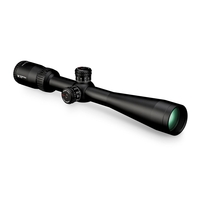
Vortex Diamondback Tactical 4-12x40 Riflescope - VMR-1 Reticle (MOA)
via Uttings
£299.00

Vortex Diamondback Tactical 4-12x40 VMR-1 Riflescope
via BushWear
£315.00
Buying Advice
Start with the specifications that actually win stages. The best scope for PRS will have a first focal plane reticle graduated in milliradians, turrets that click in 0.1 mil increments (each click moving point of impact 1 cm at 100 metres), a total elevation travel of at least 25 mils, and a parallax adjustment that goes down to roughly 10 yards or metres. Objective lens diameter matters less than exit pupil at your preferred magnification: for a 5-25×56, the exit pupil at 25× is only 2.24 mm, which is adequate in daylight but can feel tight in overcast British conditions. Glass quality — specifically edge-to-edge sharpness and chromatic aberration control — is where premium optics justify their price. Do not fixate on a single number; evaluate the whole optical system.
Budget tiers in 2026 break down roughly as follows. Entry-level PRS-capable scopes sit between £400 and £750 and will get you an FFP MIL reticle with exposed turrets, but glass clarity and turret repeatability may lag. The mid-range sweet spot — £750 to £1,500 — is where competition-grade reliability begins: you can expect locking turrets, a zero-stop mechanism, high-quality multi-coated lenses, and robust build quality from reputable manufacturers. Premium optics above £1,500 deliver the finest glass, near-perfect turret tracking, broader zoom ranges and more sophisticated reticle designs, but diminishing returns set in quickly unless you are competing at national or international level.
Common mistakes buyers make include choosing SFP over FFP for PRS (the reticle subtensions only read true at one magnification, making fast holds unreliable), selecting MOA turrets when their entire squad and data books use MRAD, neglecting to verify turret tracking with a box test before a match, and over-spending on magnification they will never use while under-spending on glass quality. Another frequent error is buying an optic without checking the mounting height and rail requirements — a 56 mm objective on a short-action rifle can demand uncomfortably high rings, which affects cheek weld and consistency.
UK-specific context matters more than many guides acknowledge. Firearms legislation means most PRS competitors hold a Section 1 FAC, typically shooting .308 Winchester or 6.5 Creedmoor — both excellent for the 200–1,000 yard stages common on British ranges. VAT at 20% is included in advertised UK retail prices, but importing directly from US vendors may incur additional duty and courier handling fees that erode apparent savings. Reputable UK retailers and distributors such as RUAG, Edgar Brothers, Highland Outdoors, and specialist online dealers stock the major optics brands and offer warranty support without transatlantic shipping headaches. Always buy from a UK-authorised dealer to protect your warranty.
Matching the scope to your use case is essential. If you shoot PRS exclusively, prioritise turret reliability, reticle complexity (a Christmas-tree style reticle with wind dots is ideal for fast holds), and a zoom range of roughly 5-25× or 4-24×. If you also shoot benchrest for group accuracy, you may want a scope benchrest shooters favour — potentially with a finer reticle and higher top-end magnification — but be aware that the best scope benchrest work demands is not always the best scope for PRS, where speed matters as much as precision. Dual-purpose shooters should lean towards a versatile 5-25× FFP with a detailed MIL reticle and worry less about extreme magnification.
The brand landscape in the UK has broadened considerably. Established names in the precision rifle scope UK market include Vortex, Nightforce, Athlon, Bushnell, Maven, Zero Compromise, Kahles, and Schmidt & Bender. Newer entrants like Pard — already well known in the UK for thermal and digital night-vision devices — are expanding into conventional riflescope territory and are worth watching in 2026 as they bring competitive pricing and modern feature sets. When comparing brands, look beyond the name on the tube: check independent tracking tests, long-term user reviews from UK PRS forums, and whether the brand has a UK service centre or distributor for repairs and turret recalibration.
Frequently Asked Questions
What magnification range do I need for PRS competition in the UK?
Most UK PRS competitors use a scope in the 5-25× or 4-24× range. The lower end gives you a wide enough field of view for close barricade stages at 100–200 yards, while 24–25× is sufficient for positive target identification and precise holds out to 1,000 yards and beyond. Very few shooters genuinely benefit from more than 25× in a timed PRS environment, because higher magnification amplifies mirage and reduces field of view, both of which slow you down.
Should I choose MOA or MRAD turrets for precision rifle competition?
MRAD (milliradian) turrets are the overwhelming standard in PRS worldwide, and this holds true in UK competition as well. The key advantage is simplicity: 0.1 mil clicks correspond to 1 cm at 100 metres, making mental arithmetic fast and intuitive on the metric ranges common in Britain. Virtually all PRS data-sharing — wind calls, come-ups, stage cards — is communicated in mils. Choosing MOA is not technically inferior (1 MOA ≈ 1.047 inches at 100 yards), but you will constantly be translating, which wastes time under pressure.
What is the best FFP scope for PRS on a mid-range budget under £1,500?
Several excellent FFP scopes sit below £1,500 in the UK. Look for models with exposed MRAD turrets, a zero-stop, locking elevation and windage adjustments, at least 25 mils of total elevation travel, and high-quality fully multi-coated glass. Brands like Vortex (Viper PST Gen II), Athlon (Ares ETR), and Bushnell (XRS3) are regularly seen on UK PRS firing lines at this price point. The best scope for PRS at this budget is the one that tracks reliably and whose reticle you find fastest to read — always test turret tracking with a tall-target or box test before committing to competition.
Do I need a zero-stop turret for PRS shooting?
A zero-stop is not strictly mandatory, but it is strongly recommended for PRS. It allows you to dial back to your confirmed zero quickly and by feel alone, without counting clicks or overshooting in the heat of a timed stage. In UK matches where you may transition between vastly different distances between stages, the zero-stop ensures you start each engagement from a known baseline. Most mid-range and premium scopes marketed for PRS now include a zero-stop or a rev-stop mechanism as standard.
Which reticle works best for wind holds and ranging in PRS matches?
Christmas-tree or grid-style MIL reticles are the dominant choice for PRS because they provide multiple reference points along both the vertical and horizontal axes. This lets you hold off for wind without dialling the windage turret, saving precious seconds on the clock. Popular designs include the Tremor3, SKMR3, EBR-7C, and Horus H59. The best reticle is one you have practised with enough that subtension spacing becomes instinctive — spend time on a reticle familiarisation target at known distances before match day.
Is there a meaningful difference between a £500 and a £1,200 precision rifle scope for PRS?
Yes, and the differences tend to show up in three areas: turret tracking consistency over multiple revolutions, glass clarity in low light or mirage, and mechanical durability over thousands of rounds of recoil. A £500 scope may track adequately in ideal conditions but can develop small errors that compound at extreme range or after heavy use. At £1,200, you typically get tighter manufacturing tolerances, better lens coatings, and a more robust erector system. For serious competition, the mid-range investment is usually justified.
Can I use the same scope for PRS and benchrest shooting?
You can, though the ideal feature sets differ. The best scope benchrest specialists prefer often has very high magnification (36× or more) and a fine crosshair reticle for group measurement, whereas PRS rewards a busier reticle, faster target acquisition, and robust turrets. A 5-25× FFP MIL scope is a workable compromise for both disciplines. If PRS is your primary focus, optimise for that and accept minor compromises when shooting benchrest groups. If benchrest is your main pursuit, you may find a dedicated SFP high-magnification optic more suitable.
What tube diameter should I look for in a long-range scope UK retailers stock for PRS?
Most modern PRS-oriented scopes use a 34 mm main tube, which provides more internal space for elevation and windage adjustment range than a 30 mm tube. This extra travel is crucial for engaging targets at long range without running out of elevation, particularly if you shoot .308 Winchester with its steeper trajectory compared to 6.5 Creedmoor. Ensure you purchase 34 mm rings or a mount rated for the correct tube diameter and that your rifle's rail provides adequate MOA of cant for the distances you intend to shoot.
Are Pard scopes suitable for PRS competition?
Pard has built a strong reputation in the UK for thermal and digital optics and is expanding into conventional riflescope territory. While their traditional daylight optics range is still maturing for top-tier PRS use, the brand is worth monitoring in 2026 as they bring competitive pricing, modern reticle designs, and strong UK dealer support. If you are considering a Pard scope for PRS, apply the same evaluation criteria as any other brand: verify FFP reticle accuracy, test turret tracking, and confirm that total elevation travel meets your ballistic requirements.
Related guides
Choosing your first precision rifle scope for PRS in the UK? Our 2026 guide covers reticles, turrets, magnification and budget tiers to get you…
Christmas Tree vs Simple Reticles: Which PRS Reticle Is Right for You?Christmas tree reticle or clean holdover design for PRS? Our 2026 UK guide compares Tremor3, EBR-7C, PR2 and more to help you pick the right precision…
Best PRS & Precision Rifle Scopes for UK Competitors in 2026Our expert UK guide to the best scopes for PRS and precision rifle competition in 2026. Covers FFP vs SFP, MRAD turrets, budget tiers…
Best Budget Thermal Scopes for Fox & Deer Shooting in the UKOur 2026 UK buyer's guide to the best thermal scopes under £500 for foxing and deer stalking. Compare PARD, Hikmicro and more — specs…
NV Clip-On vs Thermal Clip-On: Which Suits Your Stalking?Digital night vision or thermal clip-on for UK deer stalking? Our 2026 guide compares detection, ID, legal use…
Not sure which scope is right for you?
Try our AI-powered scope finder — answer a few questions and get personalised recommendations.
Find My Scope →Get a UK scope tip every day
Follow AiScopes on Facebook for daily buying guides, deals and gear advice.
Follow on Facebook