Best PRS Competition Scopes: A UK Beginner's Guide for 2026
By Peter Makulek · Senior Optics Editor · · Live prices from UK retailers
Precision Rifle Series–style competition is booming in the UK. Clubs from Scotland to the south of England now host regular positional and barricade matches that test marksmanship under time pressure at distances from 100 to beyond 1,000 yards. If you are looking for the best scope for PRS UK events in 2026, the choice can feel overwhelming: dozens of brands, competing reticle systems, and price tags that range from a few hundred pounds to well over three thousand. This guide cuts through the noise and gives you a clear framework for your first purchase.
Getting the optic right matters more in PRS than in almost any other shooting discipline. You will be dialling elevation on the clock, reading wind with your reticle, and engaging steel at unknown distances from awkward positions — sometimes all in the same sixty-second stage. A scope that tracks poorly, has stiff turrets, or forces you to guess hold-overs because the reticle is in the wrong focal plane will cost you points before you even press the trigger. Understanding the core specifications is your single biggest competitive advantage as a newcomer.
In this prs reticle turrets guide we break down the three pillars of a competition optic — magnification range, reticle design, and turret mechanics — and explain exactly what matters for UK match conditions. We also cover focal-plane choice, parallax adjustment, budget tiers in GBP, and common beginner mistakes that waste money. Whether you are building a 6.5 Creedmoor bolt gun or mounting glass on a factory .308, the advice here applies equally.
Every recommendation is written with the UK shooter in mind. That means realistic ranging distances for our climate and terrain, awareness of Section 1 FAC requirements, and pricing context that reflects the British retail landscape. We reference products available through established UK dealers and importers so you can buy with confidence and proper after-sales support. Let us get you match-ready.
Top Picks — Live UK Prices
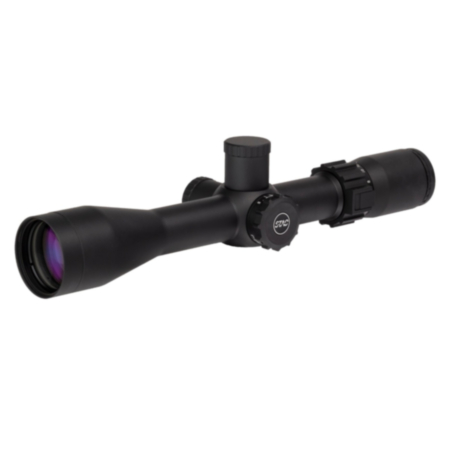
Sightron S-TAC 3-16x42 SFP SF Non IR MOA-3 30mm Rifle Scope
via Optics Warehouse
£369.99
Vortex Diamondback Tactical FFP 4-16x44 Riflescope - MRAD
via Uttings
£429.00
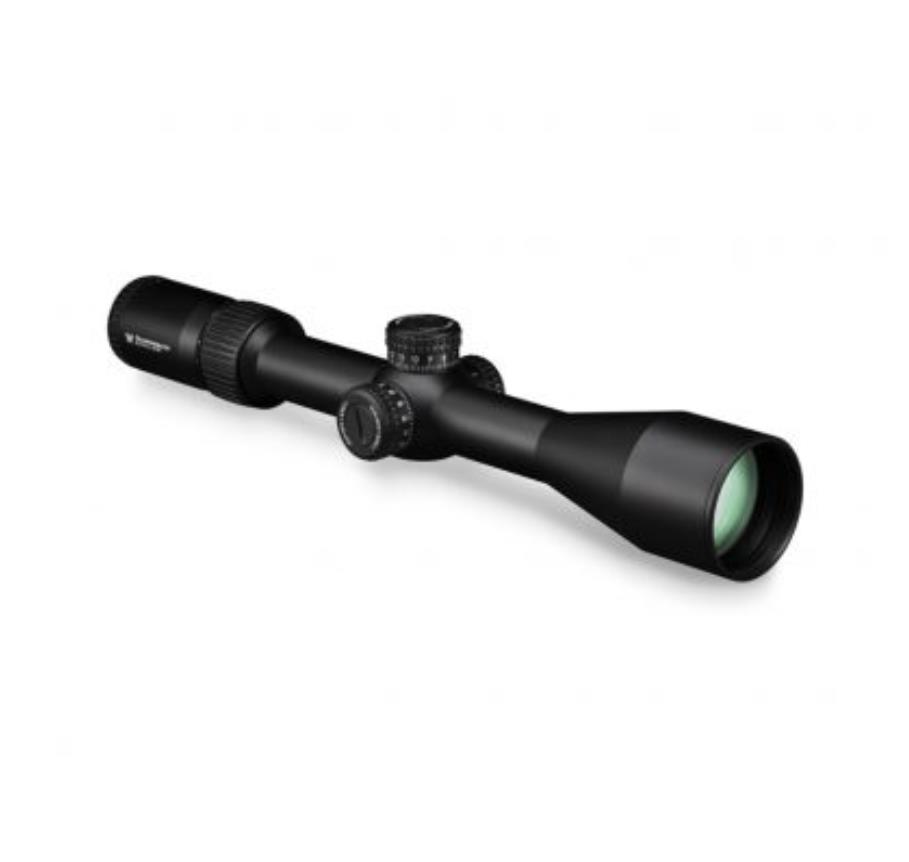
Vortex Diamondback Tactical 6-24x50 FFP MOA Scope
via Livens
£445.00
Buying Advice
When evaluating any precision rifle scope UK retailers stock for PRS, start with the numbers that directly affect stage performance. Total elevation travel should be at least 25 mils (or 80 MOA) to handle drops at extended range in common calibres such as 6.5 Creedmoor or .308 Winchester. Tracking accuracy — meaning the reticle moves exactly 0.1 mil per click and returns to zero — is non-negotiable; even a tiny per-revolution error compounds over large dial-ups. Look for scopes with independently verified tracking data or a strong reputation among PRS shooters. Optical clarity, edge-to-edge sharpness, and a generous eye box also matter hugely when you are contorted behind a barricade trying to spot your own splash.
Budget tiers in the UK PRS market break down roughly as follows. Entry-level competitive scopes — brands such as Athlon Ares ETR, Delta Stryker HD, and certain Bushnell XRS3 models — sit in the £800–£1,400 range and offer genuine match-grade tracking with acceptable glass. Mid-tier options from Vortex (Razor HD Gen III), Nightforce (NX8 and ATACR), and Leupold (Mark 5HD) typically fall between £1,500 and £2,500, delivering superior optical performance, more refined turrets, and lighter weight. Premium scopes from Tangent Theta, Schmidt & Bender, Kahles, and ZCO push beyond £2,500 and offer the absolute best in mechanical repeatability and glass quality. A beginner can absolutely be competitive at the entry tier; upgrade when your skills outgrow your glass.
Common mistakes among UK PRS newcomers include buying too much magnification and too little adjustment range, choosing second focal plane when they intend to hold off at variable power, and neglecting to budget for a quality set of scope rings or a one-piece mount matched to their rifle's rail cant. Another frequent error is selecting MOA purely because it feels familiar from hunting; MRAD is the dominant language on UK PRS firing lines, and using the same system as your squad-mates simplifies wind calls and data sharing. Finally, some beginners overlook parallax adjustment speed — a side-focus knob you can spin quickly is far more practical in competition than a slow, stiff objective-bell ring.
UK-specific context matters. All centrefire rifles used in PRS require a Section 1 Firearm Certificate, and your scope purchase does not need separate licensing, but importing optics with integral laser rangefinders or certain night-vision capabilities can involve additional restrictions. Most UK PRS matches are shot with bolt-action rifles in 6 mm or 6.5 mm calibres, with stages set between 200 and 1,000 yards — occasionally further on MOD ranges. It is worth noting that sub-12 ft/lb air rifles, while great for positional practice in the garden, are only effective to around 50–75 yards and do not replicate the ballistic demands of a PRS stage; do not mount an expensive long-range PRS optic on a springer expecting meaningful crossover. Buy from established UK retailers such as Optics Warehouse, RUAG UK distributors, or authorised dealer networks so you receive a proper UK warranty.
Matching the scope to your specific use case is the final step. If you plan to shoot only UK club-level PRS matches at moderate distances, a 5–25× scope with a simple mil-hash reticle and reliable zero-stop turrets will serve you for years. If you also shoot F-Class or want to use the scope for foxing at dusk, consider whether the reticle is too busy for a calm, slow-fire discipline, or whether the magnification range starts high enough for low-light identification. Think about weight too — a 900 g scope on a 5 kg rifle handles very differently on a barricade stage than a 1.3 kg optic. Write down your must-haves, rank them, and buy the best scope that ticks the top three within your budget.
The brand landscape for PRS competition scopes in 2026 is broader than ever. Vortex and Nightforce dominate the mid-market globally and have strong UK importer networks. European makers like Kahles, Schmidt & Bender, and Steiner offer outstanding engineering with solid EU-to-UK logistics. Tangent Theta, a Canadian firm, has built a cult following for mechanical perfection. Newer entrants such as Zero Compromise Optics (ZCO) and Revic are gaining PRS podium presence. On the more affordable end, brands like Athlon and Element Optics deliver impressive value. Even primarily night-vision brands like Pard, well known in the UK for thermal and digital units, illustrate how rapidly optical technology is advancing across the board. Do your homework, handle scopes at your local dealer or a PRS event, and trust verified user data over marketing claims.
Frequently Asked Questions
What magnification range do I need for PRS-style matches in the UK?
A 5–25× zoom range is the current sweet spot for UK PRS competition and covers everything from close barricade stages at 100–200 yards to long-range steel beyond 800 yards. The low end matters more than many beginners realise: wide field of view at 5× or 6× helps you find targets quickly during positional stages. Some shooters prefer a 4–24× or 3–18× for even faster target acquisition, but 25× top-end magnification is generally considered the minimum for spotting splash at distance in UK conditions.
Which reticle type – MOA or MRAD – is best for PRS competition?
MRAD (milliradian) is the overwhelming standard on the UK and international PRS circuit. The metric-friendly maths — 0.1 mil per click equalling 1 cm at 100 metres — makes mental calculations faster under time pressure. MOA is not inferior in absolute precision (1 MOA ≈ 1.047 inches at 100 yards), but because most UK PRS shooters, squad-mates, and online resources communicate in mils, choosing MRAD from the start avoids constant unit conversion and speeds up your learning curve.
Do I need a first focal plane scope for PRS, or will a second focal plane work?
First focal plane (FFP) is strongly recommended for PRS. In an FFP scope the reticle scales with magnification, so your mil hold-overs and wind holds remain accurate at any power setting. In a second focal plane (SFP) design, the subtensions are only correct at one specific magnification — usually maximum — which means you must remember to set that power before holding off. Under the time pressure of a PRS stage, the mental overhead of SFP is a real disadvantage. Almost all purpose-built PRS competition scopes sold in the UK are FFP.
What turret features matter most for fast positional stages in PRS?
Look for tool-less, exposed turrets with crisp, tactile clicks and a reliable zero-stop mechanism. The zero-stop lets you spin back to your 100-yard zero by feel alone, which is critical when stages require rapid elevation changes. Locking turrets can prevent accidental bumps between stages but must unlock quickly. A rev indicator — a visible or tactile marker showing which revolution you are on — prevents the costly error of being a full turn out. Smooth, consistent click feel with no play or mushiness ensures each 0.1 mil adjustment is decisive.
How much should a UK beginner expect to spend on a competitive PRS scope in 2026?
You can enter UK PRS matches with a genuinely competitive scope starting at roughly £800–£1,200 from brands like Athlon or Bushnell. The mid-range sweet spot is £1,500–£2,500, covering popular models from Vortex, Nightforce, and Kahles that offer excellent tracking and optics. Premium options from Tangent Theta, ZCO, or Schmidt & Bender exceed £2,500. Budget separately for quality mounts (£100–£300) and a sun shade. A beginner's glass does not need to be the most expensive to be competitive — reliable tracking and usable turrets matter far more than boutique branding.
What is a zero-stop and why do PRS shooters consider it essential?
A zero-stop is a mechanical hard stop built into the elevation turret that prevents you from dialling below your chosen zero — typically a 100-yard or 100-metre zero. In PRS competition, you constantly dial up for distant targets and then return to zero between stages. The zero-stop lets you spin the turret back quickly by feel until it physically stops, guaranteeing you are on zero without looking at markings. Without one, you risk overshooting past zero and being an entire revolution off on your next engagement, which can mean a miss on every target in a stage.
Does tube diameter matter when choosing a PRS scope?
Yes, but not for the reason many beginners assume. A 34 mm tube does not inherently produce a brighter image than a 30 mm tube; brightness is determined by objective lens size and glass coatings. What a larger tube diameter does offer is more internal space for the erector assembly to move, which translates to greater total elevation and windage adjustment range. For PRS, where you may need 25+ mils of elevation, a 34 mm or even 36 mm tube gives the mechanical room to achieve that travel. Most dedicated long range PRS optic models now use 34 mm tubes as standard.
Can I use the same scope for PRS and hunting in the UK?
You can, with compromises. A 5–25× FFP MRAD scope works well for both PRS stages and foxing or deer stalking, but the busy tree-style reticles favoured in competition can obscure fine aiming points on small quarry at close range. Weight is another factor: many PRS scopes weigh over a kilogram, which adds up on a stalking rifle carried for miles. If you plan dual use, choose a reticle with a clean centre and moderate subtension density, and ensure the scope's parallax range covers your closest expected hunting shot — typically 50–100 metres for UK deer.
How important is parallax adjustment for PRS competition?
Extremely important. Parallax error causes the reticle to shift relative to the target when your eye is not perfectly centred, and at PRS distances this can translate into significant point-of-impact shift. All serious PRS competition scopes feature a side-mounted parallax knob adjustable from around 10 yards to infinity. Get into the habit of dialling parallax for each target distance: a quick check is to move your head slightly behind the scope — if the reticle appears to drift against the target, parallax is not set correctly. Fast, clearly marked parallax adjustment is a genuine stage-time saver.
Related guides
Definitive UK buyer's guide to the best scopes for PRS competition in 2026. We cover FFP reticles, MRAD turrets…
Christmas Tree vs Simple Reticles: Which PRS Reticle Is Right for You?Christmas tree reticle or clean holdover design for PRS? Our 2026 UK guide compares Tremor3, EBR-7C, PR2 and more to help you pick the right precision…
Best PRS & Precision Rifle Scopes for UK Competitors in 2026Our expert UK guide to the best scopes for PRS and precision rifle competition in 2026. Covers FFP vs SFP, MRAD turrets, budget tiers…
Best Air Rifle Target Shooting Scopes Under £150 (2026)Find the best scope for air rifle target shooting UK shooters can buy under £150 in 2026. Expert advice on HFT, FT and paper-target optics, parallax…
Best Long-Range Rifle Scopes 2026: Match Your Optic to Your CalibreOur 2026 UK guide to the best scopes for long range shooting. Learn how to match reticle, turrets and magnification to your calibre's ballistic profile…
Read next
- budget PRS scopes UK
Best Budget PRS Scopes for UK Shooters in 2026
Not sure which scope is right for you?
Try our AI-powered scope finder — answer a few questions and get personalised recommendations.
Find My Scope →Get a UK scope tip every day
Follow AiScopes on Facebook for daily buying guides, deals and gear advice.
Follow on Facebook