Best PRS & NRL22 Scopes for 2026
By Peter Makulek · Senior Optics Editor · · Live prices from UK retailers
Precision Rifle Series (PRS) and NRL22 have become the two fastest-growing competitive shooting disciplines in the US, and while they look similar on paper — timed stages, positional shooting, steel targets at varying distances — the gear norms diverge in ways that matter when you're picking glass. PRS is shot with centerfire rifles (most commonly 6mm/6.5mm Creedmoor-class cartridges) at distances from 200 out to 1,000+ yards across a single stage, which demands real elevation travel and enough top-end magnification to call your own hits. NRL22 takes the same stage design — barricades, tank traps, ladders, positional shooting under a shot clock — and runs it with rimfire rifles at closer ranges, typically 25 to 200 yards, occasionally further. The scope requirements shift accordingly: less raw magnification, but arguably even more emphasis on turret precision and repeatability, since a rimfire round's more curved trajectory rewards fine, trustworthy clicks over sheer elevation range.
What both disciplines share, and what separates them from general hunting or plinking optics, is the reticle-and-turret standard. A PRS or NRL22 scope is a working tool: you dial or hold corrections under time pressure, compare notes with your squad using a shared unit system, and trust that a box test performed at home actually reflects what the turret does on the clock. That single requirement — first focal plane (FFP), milliradian (MRAD) reticle and turrets — shapes almost every buying decision in this guide, so we address it head-on before getting into specific picks.
If you're coming from hunting or general long-range shooting, the biggest adjustment is mindset: competition scopes are chosen for consistency and speed of use under pressure, not for the widest possible feature list. A scope that tracks perfectly to 0.1 mil every single time beats one with more magnification and a fancier reticle that drifts after 200 rounds of recoil. Below, we break down real, currently-available scopes by budget and use case, followed by an in-depth section on the specs, tiers, and mistakes that actually decide how you shoot on match day.
This guide covers both disciplines together because in practice a huge number of NRL22 shooters are PRS competitors running a rimfire "trainer" rig with a scaled-down version of their centerfire scope philosophy — same FFP MRAD logic, just less magnification and (often) a lighter, cheaper tube. We've separated the picks into PRS-first and NRL22-first sections, but the underlying decision framework — FFP vs SFP, MOA vs MRAD, how much magnification you actually need — is identical, and we cover it once in full below.
Top Picks — Live UK Prices

Nikko Stirling Diamond Long Range 30mm Tactical 4-16x50 IR Rifle Scope
via Uttings
£199.00
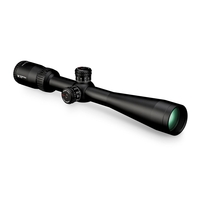
Vortex Diamondback Tactical 4-12x40 Riflescope - VMR-1 Reticle (MOA)
via Uttings
£299.00

Vortex Diamondback Tactical 4-12x40 VMR-1 Riflescope
via BushWear
£315.00
Buying Advice
The Diamondback Tactical line is the scope you'll see mounted on more entry-to-mid PRS rigs at a US club match than almost anything else, and for good reason: it's genuinely FFP with your choice of the EBR-2C MRAD or MOA reticle, a 30mm tube, and a 6-24x zoom range that covers the vast majority of stage distances without feeling underpowered at 800-1,000 yards. It won't out-track a $2,000 scope over thousands of rounds, but it tracks honestly, has real (if not class-leading) glass for the price, and gets a new PRS shooter onto the line with the correct reticle/turret logic from day one rather than compromising on SFP or MOA to save money. A version bundled with a cantilever offset scope mount is also available for around $568 if you need mounting hardware in the same purchase — treat any bundled mount purchase as a separate check against your specific rifle's rail and ring-height needs (see the mounting note below).
Once your budget clears roughly $700-750, the S-TAC brings real competition features to the table: a genuine zero-stop turret (dial back to your confirmed zero by feel, without counting clicks under a shot clock), tactical knobs sized for gloved hands, and an illuminated FFP reticle. The 4-20x zoom is slightly narrower at the top end than a 6-24x, which is a real advantage for the closer, faster transitions common on PRS "speed" stages — you get a wider field of view at the bottom of the zoom range without sacrificing much at distance. Athlon's Midas TAC GEN2 HD 6-24x50 FFP (around $600-700, MOA or MIL reticle) sits in the same tier if you want the wider zoom range instead.
The Viper PST Gen II is one of the most widely used scopes in US PRS competition at this price point, and it earns that reputation on turret consistency rather than any single headline spec. The 5-25x50 FFP MRAD configuration is the classic PRS zoom range: wide enough at 5x for barricade and close-target stages, enough reach at 25x for confident hits and hold calls past 800 yards. If your budget stretches slightly further, the SightMark Latitude 6.5-25x56 PRS (~$840) and Crimson Trace 3 Series 4-20x50 FFP (~$899, illuminated MIL reticle) are worth cross-shopping in the same bracket.
Above $1,500 you're paying for tighter manufacturing tolerances, tougher erector assemblies that hold zero through thousands of rounds of recoil, and genuinely better low-light glass — all things that matter over a full match season rather than on a single practice session. Bushnell's Elite Tactical DMR3 3.5-21x50 FFP MRAD (~$1,600) is the more affordable entry into this bracket and a genuinely strong PRS-proven optic in its own right. Step up again and the XTR III's 5.5-30x56 FFP configuration with an illuminated MIL reticle — currently running roughly $2,300-2,500 — is a proven PRS Pro-Series and club-level favorite. If you want to go further still, Leica's dedicated PRS 5-30x56i FFP line (~$2,850) sits at the top of what most competitors will ever need — beyond this tier you're chasing marginal gains in glass and mechanical polish, not fundamentally new capability.
NRL22 doesn't really have its own separate product category the way, say, air rifle scopes or hunting scopes do — most serious NRL22 competitors run a scaled-down version of the same FFP MRAD logic used in PRS, just with less top-end magnification and (often) a lighter tube to suit a lighter rimfire rifle. The genuinely "rimfire-labeled" scopes you'll find at most retailers are built for squirrel hunting and plinking, not competition — SFP, fixed low-mag, parallax set for 50-75 yards, and no serious turret system. Skip those for NRL22 and look at this instead. The Vortex Diamondback Tactical 4-16x44 FFP MRAD (~$349, Vortex/OPMOD) is the single best entry point into NRL22 on a real budget: genuine FFP MRAD in a lighter, shorter package than the 6-24x50 version, well matched to a 25-200 yard NRL22 course of fire, and light enough not to unbalance a sub-8lb rimfire chassis rifle. The Vortex Viper PST Gen II 3-15x44 FFP (~$799-899, MRAD or MOA) is a common "graduate to serious" pick once you've outgrown a budget scope; the narrower zoom range versus a full PRS 5-25x is arguably an advantage here, since NRL22 rarely needs more than 15-16x, and you gain field of view and a lighter package. The Nightforce Competition 15-55x52 (~$2,400, .125 MOA clicks, second focal plane) is a genuinely aspirational price point most club shooters won't reach, but it's a real, current product worth knowing about because of what it represents: Nightforce's Competition line is built around ultra-fine 1/8-MOA adjustments for exactly the kind of small, repeatable corrections rimfire precision shooting rewards. Most NRL22 shooters don't need this scope; a small number of top competitors run exactly this class of glass. Finally, the Primary Arms Classic 6x32 with ACSS 22LR BDC reticle (~$154) is not a serious NRL22 competition scope — it's fixed-power and SFP — but it's a genuinely useful, purpose-built rimfire option if you're starting out on a tight budget or want a dedicated trainer/practice rig before committing to an FFP MRAD setup.
First focal plane means the reticle grows and shrinks with your magnification, so its subtensions (the spacing between hash marks) read true at any power setting — dial to 8x for a quick barricade shot or 24x for a precise long hold, and your holdover marks are still accurate without doing math. Second focal plane reticles only read true at one magnification (usually max power), which is fine for a hunting scope you set-and-forget, but a real liability when a stage forces you through multiple magnification changes in under a minute. That's why FFP is close to universal in serious PRS and NRL22 circles, even though it costs more to manufacture well.
MRAD (milliradian, often just called "mil") has become the de facto unit in US competition circles for one practical reason: 0.1 mil equals 1cm at 100 meters, and the math scales cleanly and consistently across any distance, making mental correction fast under a shot clock. MOA is not technically worse — 1 MOA is approximately 1.047 inches at 100 yards — and plenty of excellent MOA scopes exist. But if your squad, your ballistic app, and the stage briefing are all speaking mils, running MOA means constantly converting in your head, which costs real seconds. If you want the deeper mechanics — exact click values, ranging formulas, and how the two systems convert into each other — it's worth working through separately once you've settled on a system; for day-to-day competition use, the practical rule above (match your reticle, your turrets, and your squad) is what actually decides the outcome.
For PRS, the 5-25x (or 4-24x/6-24x) range is the practical sweet spot. The low end needs to be wide enough for close barricade and speed stages at 100-200 yards without losing too much field of view; the top end needs enough reach to call your own hits and hold with confidence out past 800-1,000 yards. Very few PRS competitors meaningfully benefit from more than 25-30x — higher magnification amplifies mirage and narrows your field of view, both of which slow you down on the clock rather than helping you.
NRL22's shorter course of fire (mostly 25-200 yards, occasionally further) means you genuinely don't need PRS-level magnification. A 4-16x or 4-20x scope covers the vast majority of NRL22 stages comfortably, and the narrower zoom range typically means a lighter, shorter, better-balanced scope on a rifle that's already lighter than a centerfire PRS rig. Buying more magnification than the discipline calls for just adds weight and cost without adding hits.
Beyond FFP/MRAD, look at total elevation travel (aim for at least 20-25 mils on a PRS scope; NRL22 needs less but still benefits from generous travel for the occasional long stage), turret click value (0.1 mil is standard for PRS; NRL22 shooters increasingly favor even finer clicks where available), a genuine zero-stop mechanism, and parallax adjustment down to a genuinely short distance — some PRS barricade props sit inside 15 yards, and a scope whose parallax only adjusts down to 50 yards will show real parallax error on those targets. Exit pupil matters more than raw objective size: a 5-25x56 scope has only a 2.24mm exit pupil at full power, which is adequate but not generous in low light, so don't assume a bigger objective automatically means a brighter picture at max zoom.
Entry-level FFP MRAD scopes that get you into PRS or NRL22 correctly (not compromising on reticle/turret logic to save money) run roughly $349-600. This tier gets real FFP MRAD glass with usable, if not class-leading, turret repeatability and low-light performance. The $700-1,000 mid-tier is where genuine competition features show up as standard: zero-stop, locking turrets, and noticeably better glass and turret consistency over a full match season. Above $1,500, you're paying for tighter manufacturing tolerances, more durable erector assemblies, and better low-light optical performance — real, measurable gains, but with diminishing returns for anyone below regional or national competitive level.
The most common and costly mistake is buying SFP to save money on a scope you plan to compete with — the reticle only reads true at one power, which undermines fast holds at any other magnification. A close second is picking MOA when your training partners, ballistic app output, and match data all run in mils (or vice versa) — technically fine, practically a constant source of friction and wasted time. Buyers also frequently skip a box test (confirming the turret actually moves point of impact exactly as many clicks as it claims, in both directions, back to zero) before their first match, and are surprised when their dope doesn't match their hits. Finally, over-buying magnification for NRL22 — assuming "more zoom is always better" — adds weight and cost without adding hits, since the discipline's target distances rarely reward it.
If you shoot PRS exclusively, prioritize turret reliability, a busier reticle with wind-hold references (Christmas-tree or grid-style MRAD reticles are the norm), and a 5-25x or similar zoom range. If NRL22 is your primary discipline, prioritize a lighter, shorter scope in the 4-16x to 4-20x range with the finest turret clicks you can afford, since precision at closer, smaller targets matters more than raw reach. Shooters doing both should lean toward a mid-range 5-25x FFP MRAD scope for the centerfire rifle and a dedicated lighter 4-16x FFP MRAD scope for the rimfire trainer, rather than trying to force one scope to do both jobs — the weight and balance differences between a centerfire PRS rifle and a sub-8lb rimfire chassis rifle are significant enough that most serious competitors run separate, purpose-matched glass.
Vortex has the deepest PRS and NRL22 presence at the entry-to-mid price points (Diamondback Tactical, Viper PST Gen II), largely because of consistent turret reliability at accessible prices. Sightron, Athlon, and SightMark compete hard in the same $500-1,000 bracket with genuine FFP MRAD, zero-stop options. Burris, Bushnell, Nightforce, and Leica occupy the premium end, where you're paying for tighter tolerances and best-in-class low-light glass rather than any single dramatic feature. Primary Arms is worth knowing for budget-friendly rimfire-specific reticles (like the ACSS 22LR) even outside true FFP MRAD competition glass. When comparing brands, look past the name on the tube: check independent turret-tracking tests and real match reports from PRS and NRL22 shooters, not just marketing copy.
If your build needs a separate scope mount or ring set — including AR-15-platform gas guns occasionally run in PRS's open/tactical divisions, or AR-pattern rimfire rifles in NRL22 — buy the mount as its own careful decision rather than an afterthought. Check tube diameter (30mm vs 34mm), required ring or mount height for your objective size and cheek weld, and the specific compliance/listing details on whatever platform you're buying from before you buy, since not every mount is compliant with every retailer's current firearm-accessory listing policies. Complete optics are a straightforward purchase; separate mounting hardware is worth the extra five minutes of checking.
Frequently Asked Questions
MOA or MRAD for PRS and NRL22 — which should I choose?
MRAD is the overwhelming standard in both disciplines in the US, mainly because 0.1 mil equals 1cm at 100 meters and the math scales predictably at any distance, which is faster under a shot clock. MOA isn't technically inferior (1 MOA is about 1.047 inches at 100 yards), but if your squad, ballistic app, and match data are speaking mils, running MOA just adds a constant mental-conversion tax. If you're starting from zero with no existing gear or data, choose MRAD.
What's the best magnification for NRL22?
A 4-16x or 4-20x FFP scope covers the vast majority of NRL22 stages, which typically run 25-200 yards. You rarely need more than that, and less magnification usually means a lighter, better-balanced scope on a rimfire rifle that's already lighter than a centerfire PRS build. Save the 25x-plus scopes for centerfire PRS distances.
Do I need an illuminated reticle for PRS?
It's genuinely useful but not mandatory. Illumination helps most in low-light conditions common at early-morning or late-evening match stages, and on darker reticle designs against a dark target background. If you're choosing between two otherwise similar scopes and one has illumination at a similar price, take it — but don't pay a large premium for illumination alone over turret quality or glass clarity.
Is FFP mandatory for PRS and NRL22, or can I use an SFP scope?
FFP is close to universal at the competitive level because the reticle subtensions read accurately at any magnification, which matters when a stage forces you through multiple power changes quickly. An SFP scope will physically work and won't disqualify you from most matches, but you'll be limited to accurate holdovers only at your reticle's calibrated power (usually max), which is a real disadvantage on fast, varied stages.
What's a realistic budget to get started in PRS or NRL22 with the right scope?
For PRS, budget roughly $450-750 for a genuine FFP MRAD scope that won't hold you back on the fundamentals. For NRL22, a genuine FFP MRAD rimfire-appropriate scope starts closer to $349-400. In both cases, spending that minimum to get FFP MRAD right from the start is a better investment than buying a cheaper SFP or MOA scope you'll likely want to replace once you're competing seriously.
How much elevation travel do I actually need?
For PRS, aim for at least 20-25 mils of total elevation travel to comfortably reach out past 800-1,000 yards with your chosen cartridge without running out of adjustment. NRL22's shorter typical distances need less, but generous travel is still worth having for the occasional long stage or steep uphill/downhill target.
Does a zero-stop turret matter for competition?
Yes — it's one of the most practically useful features you can buy. A zero-stop lets you dial back to your confirmed zero by feel alone, without counting clicks or overshooting under time pressure, which matters a lot when you're transitioning between very different stage distances in a single match. Most mid-range and premium PRS and NRL22 scopes now include one as standard.
Can I really use the same scope for both PRS and NRL22?
You can, but it's a compromise. A mid-range 5-25x FFP MRAD scope will technically work on both a centerfire PRS rifle and a rimfire NRL22 rifle, but it adds unnecessary weight and cost to the lighter rimfire build, and you'll be carrying magnification range you rarely use in NRL22. Most serious dual-discipline competitors run two scopes: a 5-25x-class optic on the centerfire rifle and a lighter 4-16x-class optic on the rimfire trainer.
Related guides
Definitive UK buyer's guide to the best scopes for PRS competition in 2026. We cover FFP reticles, MRAD turrets, magnification ranges and mid-range budgets to help you shoot better.
Best PRS Competition Scopes: A UK Beginner's Guide for 2026Choosing your first precision rifle scope for PRS in the UK? Our 2026 guide covers reticles, turrets, magnification and budget tiers to get you match-ready with confidence.
Best PRS & Precision Rifle Scopes for UK Competitors in 2026Our expert UK guide to the best scopes for PRS and precision rifle competition in 2026. Covers FFP vs SFP, MRAD turrets, budget tiers, and what UK shooters actually need.
1-Piece Scope Mounts for PRS & Long-Range: What Actually MattersChoosing a 1-piece scope mount for PRS or long-range competition? Our 2026 guide covers return-to-zero, torque specs, tube diameter matching, and the top-tier brands US shooters trust.
Kahles vs ZCO vs Nightforce ATACR: Premium PRS Optics ComparedKahles K540i, ZCO 5-27x56, or Nightforce ATACR for PRS? We compare glass, turrets, reticles, and service at the $2,500+ tier so you buy the right premium scope.
FFP vs SFP Scopes ExplainedFFP vs SFP explained: how reticle subtensions hold at every magnification, which disciplines favor each, and why FFP costs more. A 2026 buyer's guide.
Vortex vs Leupold vs Nightforce 2026Vortex, Leupold, or Nightforce? We compared real US pricing (from $99 to $4,000+), warranties, and use cases across all three brands so you buy the right one.
Not sure which scope is right for you?
Try our AI-powered scope finder — answer a few questions and get personalised recommendations.
Find My Scope →Get a UK scope tip every day
Follow AiScopes on Facebook for daily buying guides, deals and gear advice.
Follow on Facebook