FFP vs SFP Scopes Explained
By Peter Makulek · Senior Optics Editor · · Live prices from UK retailers
The first real technical fork in the road when buying a rifle scope in the US isn't magnification or objective size — it's whether the reticle sits in the first focal plane (FFP) or the second focal plane (SFP). Get this wrong for your discipline and you'll either overpay for capability you'll never use, or find yourself doing mental math mid-stage that a cheaper scope would have made unnecessary. This guide breaks down exactly what FFP and SFP mean, when each one keeps your holdovers honest, which US shooting disciplines lean which way, and what the price gap between them actually buys you.
In plain terms: a first focal plane reticle is mounted in front of the scope's magnifying lens group, so it grows and shrinks with the image as you zoom. Its subtensions — the spacing between hash marks, in mils or MOA — stay mathematically accurate at any power setting. A second focal plane reticle sits behind that lens group and stays a constant size on your eye regardless of zoom, which means its subtensions are only correct at one specific magnification, almost always the top of the scope's range. Everything else in this guide follows from that one mechanical difference.
Which one you need depends heavily on what you're shooting and how. A PRS or NRL22 rimfire competitor holding wind and elevation corrections off the reticle at whatever magnification a stage dictates needs FFP, full stop. A whitetail hunter running a fixed 9x from a stand rarely dials or holds over at all, so SFP's simpler mechanics and often-cheaper glass are no disadvantage there. An AR-15 owner shopping LPVOs for a 1-6x or 1-8x has a third, different calculus again, because a true 1x FFP reticle can shrink toward near-invisibility at the low end. We'll walk through all three below.
Below, we cover the mechanics in more depth, break down FFP vs SFP by discipline (long-range/PRS, rimfire NRL22, hunting, and AR-15 LPVOs), explain the real reason FFP scopes cost more, and give you a straight buying verdict for your budget.
Top Picks — Live UK Prices
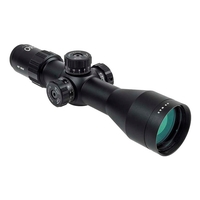
PAO HD MAX 4-16x44 SF FFP Ultra Compact Riflescope
via Uttings
£219.00
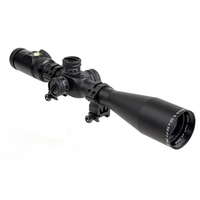
PAO F1 5-20x50 IR SF FFP Rifle Scope
via Uttings
£239.00

Hawke Vantage 30 WA FFP 4-16x50 Rifle Scope
via Uttings
£249.00
Buying Advice
A first focal plane reticle sits ahead of the erector (magnifying) lens assembly, so the reticle image and the target image are magnified together — zoom the scope from 6x to 20x and the reticle grows right along with the target, so a 1-mil hash mark still represents exactly 1 mil of angular measurement (3.6 inches at 100 yards, or 10 cm at 100 meters) no matter what power you're on. A second focal plane reticle sits behind the erector, so only the target image grows with zoom while the reticle stays a fixed apparent size on your eye. That means its 1-mil hash mark is only truly 1 mil at one specific magnification — manufacturers calibrate this almost universally at maximum power, so a 4-16x SFP scope's subtensions read true at 16x and increasingly wrong the lower you zoom out.
For any discipline where you hold or dial corrections at varying magnifications under time pressure, FFP is the practical standard — whether you're running a 6.5 Creedmoor bolt gun at 800 yards or a suppressed 10/22 in an NRL22 rimfire match. PRS stages routinely dictate a magnification for a given target array, and a competitor can't afford to stop and confirm they're at max power before trusting a wind hold. NRL22 has inherited the same culture on a smaller scale — many top rimfire PRS shooters run FFP scopes specifically so a mil hold reads the same at 8x as it does at 20x. If reticle-based holdovers under a shot clock are part of your plan, buy FFP; the field has settled this question.
Hunting is the one discipline where SFP still holds a real, defensible edge for a lot of shooters. Most hunting shots — whitetail deer especially, where the large majority are taken inside 100-150 yards from a stand or blind — don't involve reticle-based holdovers at all; you're zeroed for a given distance and holding dead-on. SFP reticles are typically thinner and cleaner-looking across the whole zoom range, since they never have to shrink down to a usable size at minimum power, which many hunters find easier to pick up quickly in low light at dawn or dusk. That said, FFP hunting scopes have become far more common and are worth considering if you range farther or hunt mountain game like mule deer or elk in open Western terrain, where holdovers at variable power genuinely come into play.
Low power variable optics split the difference in an interesting way. A true 1x setting is the whole point of an LPVO — fast, both-eyes-open target acquisition at close range — and a shrinking FFP reticle at 1x used to be a real liability, which is why a lot of budget and mid-tier 1-6x and 1-8x LPVOs are still built SFP, with illumination doing the work of keeping the dot visible at 1x. But FFP has moved down-market faster than most other optics categories: genuinely capable FFP LPVOs are increasingly available at accessible price points, giving you accurate BDC holdovers at the top of the zoom range for barricade or longer-distance stages, without sacrificing much at 1x if the reticle and illumination are well designed.
The price premium isn't marketing — it's manufacturing. An FFP reticle has to be etched onto glass, with enough precision that it stays legible and functionally accurate across the entire zoom range, including at the smallest, most demanding minimum-power setting, without whiting out or losing fine subtension lines when illuminated. That's a tighter tolerance and a more expensive assembly than an SFP reticle, which only ever has to look right at one fixed size. As a rough rule of thumb, expect to pay somewhere in the region of 20-40% more for an FFP version of a comparable scope from the same product line — though budget FFP LPVOs have narrowed that gap considerably at the entry-level end of the market in recent years.
If you're not sure, default to the discipline, not the price tag. Competing in PRS, NRL22, or any timed discipline with reticle holdovers: buy FFP, budget for it, and treat it as non-negotiable equipment. Hunting whitetail from a stand at typical ranges, or shopping on a tight budget for a general-purpose scope you'll mostly leave at one power: SFP is a completely legitimate choice and will often get you better glass for the same money. Running an AR-15 LPVO: decide based on whether you'll actually use BDC holdovers past your zero distance — if yes, look at the growing crop of accessible-priced FFP options; if you just want a fast, red-dot-style 1x with reach when you need it, a well-reviewed SFP LPVO is simpler and usually cheaper.
Frequently Asked Questions
What is the actual difference between FFP and SFP scopes?
In a first focal plane (FFP) scope, the reticle is mounted in front of the magnifying lens group, so it scales up and down with the image as you zoom — its subtensions (the spacing of hash marks, in mils or MOA) stay accurate at every magnification. In a second focal plane (SFP) scope, the reticle sits behind that lens group and stays the same apparent size no matter the zoom level, so its subtensions are only accurate at one specific magnification — almost always the top of the range. Everything else about focal plane choice follows from that single mechanical difference.
Is FFP always better than SFP?
No. FFP is better specifically for shooters who hold over or range using the reticle at varying magnifications — PRS, NRL22 rimfire, and general long-range work. If you mostly shoot at one power setting, zero for a known distance and hold dead-on, or want the thinnest, cleanest possible reticle at every zoom level, SFP isn't a compromise — it's often the better-suited and cheaper choice for that use case. "Better" depends entirely on whether you actually use reticle subtensions to make corrections.
Why are FFP scopes more expensive than SFP scopes?
FFP reticles have to be etched onto glass with tight enough precision to stay legible and functionally accurate across the entire zoom range, including at minimum magnification where a thin reticle can otherwise shrink toward invisibility. That's a harder, more expensive manufacturing process than an SFP reticle, which only ever needs to look right at one fixed size. As a rough guide, expect an FFP version of a comparable scope to cost somewhere around 20-40% more than its SFP equivalent from the same product line, though budget FFP LPVOs have narrowed that gap considerably in recent years.
Can beginners use an FFP scope?
Yes — there's no learning curve specific to owning an FFP scope, only to using its holdovers, which is the same skill any reticle-based shooter eventually needs regardless of focal plane. The one genuine beginner drawback is that FFP reticles look very fine and thin at minimum magnification, which can be harder to pick up quickly in low light or fast target acquisition. If that describes your shooting, either buy a quality FFP scope with strong illumination, or start with SFP and switch once you're actually using holdovers regularly.
Which is better for hunting, FFP or SFP?
SFP remains the more popular choice for hunting, especially whitetail deer, where most shots are taken inside 100-150 yards from a stand with the shooter simply holding dead-on at a known zero distance rather than dialing or holding for range. SFP reticles also tend to be thinner and cleaner-looking at low-to-mid power, which many hunters prefer in dawn or dusk light. FFP hunting scopes are increasingly available and make more sense if you regularly shoot at varying distances in open country — mule deer or elk hunting out West, for example — where a holdover at whatever magnification you're on genuinely matters.
Which is better for PRS, long-range, or NRL22 rimfire competition?
FFP, without much debate. PRS and NRL22 stages routinely require corrections — wind holds, elevation holds, or range estimation off the reticle — at whatever magnification the stage or target distance calls for, and an SFP reticle's subtensions would only be trustworthy at one specific power. Competitive shooters in both disciplines have settled on FFP as the standard for exactly this reason; running SFP for competition just adds an unnecessary mental step (confirming you're at max power) under time pressure.
Do AR-15 LPVOs come in FFP?
Yes, and increasingly at accessible prices — genuinely capable FFP 1-6x and 1-8x LPVOs exist well below where they used to sit, alongside the SFP options that have traditionally dominated the category. FFP LPVOs give you accurate BDC holdovers at the top of the zoom range for barricade or mid-range stages; the tradeoff is that the reticle has to be well-illuminated and well-designed to stay usable at true 1x, where an FFP reticle is at its smallest. If you never plan to use magnified holdovers, a well-reviewed SFP LPVO remains the simpler, often cheaper choice.
Does focal plane matter if I always shoot at one distance and never dial or hold over?
Honestly, not much. If you zero at a known distance, always shoot at that distance (or close enough that a dead-on hold works), and never use the reticle's hash marks to correct for range or wind, focal plane choice comes down to reticle appearance and price rather than function. In that case SFP is frequently the more cost-effective pick, since you'd be paying for FFP's zoom-range accuracy without ever actually using it.
Related guides
Looking for the best first focal plane (FFP) scope in the UK? We compare top-rated FFP scopes from Hawke, Vortex, Nightforce and more — with live UK prices.
First Focal Plane Reticles: The Long-Range Shooter's GuideUnderstand how first focal plane reticles work for long-range shooting. Expert UK guide covering FFP vs SFP, MRAD holdovers, magnification behaviour and what to look for in 2026.
FFP vs SFP Scopes: Which Suits Your Shooting?Confused by FFP and SFP rifle scopes? Our expert UK guide explains which reticle plane suits your discipline, from HFT to long-range PRS, so you buy with confidence.
Best Scope for Your First Rifle in 2026: A New Shooter's GuideBuying a scope for your first rifle in 2026? Why the cheapest listing is a bad bet, the right magnification, durability basics, and a realistic budget for new shooters.
Zero Stop Turrets Explained for US ShootersHow zero-stop turrets work, which US-market systems (Leupold CDS-ZL, Vortex CRS, Nightforce ZeroStop, Bushnell RevLimiter) to buy, and how to choose by budget and discipline in 2026.
Vortex vs Leupold vs Nightforce 2026Vortex, Leupold, or Nightforce? We compared real US pricing (from $99 to $4,000+), warranties, and use cases across all three brands so you buy the right one.
Best Scopes for the Ruger 10/22 in 2026Find the best scope for a Ruger 10/22 in 2026. Rimfire-specific picks for hunting, plinking, Takedown models, and NRL22 competition — all for US buyers.
Not sure which scope is right for you?
Try our AI-powered scope finder — answer a few questions and get personalised recommendations.
Find My Scope →Get a UK scope tip every day
Follow AiScopes on Facebook for daily buying guides, deals and gear advice.
Follow on Facebook