Best FFP Scopes UK: First Focal Plane Scopes Explained
By Peter Makulek · Senior Optics Editor · · Live prices from UK retailers
First focal plane (FFP) scopes place the reticle in front of the magnification erector, so the subtensions remain accurate at every power setting. That means you can range, holdover, or call wind corrections at 4× just as confidently as at 24×. For practical long-range shooting, PRS competition, and any discipline where you dial or hold corrections at varying magnifications, FFP is the standard.
In the UK market, FFP scopes span from sub-£200 entry-level options from Hawke and Nikko Stirling right through to sub-MOA precision glass from Nightforce, Schmidt & Bender, and March. The sweet spot for most UK shooters sits between £400 and £900 — this range covers quality Japanese or Filippine glass, true zero-stop turrets, and illuminated mil-dot or MRAD reticles suited to practical competition.
Top Picks — Live UK Prices
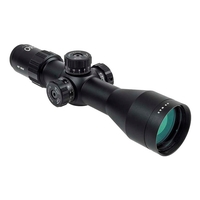
PAO HD MAX 4-16x44 SF FFP Ultra Compact Riflescope
via Uttings
£219.00
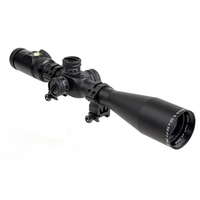
PAO F1 5-20x50 IR SF FFP Rifle Scope
via Uttings
£239.00

Wulf Tornado FFP 6-24x50 W-MIL3 Side Focus Rifle Scope
via BushWear
£249.99
Buying Advice
When comparing FFP scopes, check three things beyond price: turret quality (are they audibly and tactilely clickable, with genuine zero-stop?), reticle clarity at low magnification (FFP reticles thin out as power drops — cheap scopes become unusable below 6×), and the illumination circuit (a dimly lit center dot on a busy reticle is far more useful than a fully-lit grid in daytime conditions).
For PRS and F-Class competition, MRAD (mil) reticles paired with MRAD turrets give the most consistent correction math. For deer stalking or general hunting where quick shots matter, a simpler Christmas-tree or floating-dot FFP reticle keeps the picture clean at lower powers.
Frequently Asked Questions
What is a first focal plane (FFP) scope?
In an FFP scope the reticle sits in front of the magnification erector group. This means the reticle subtensions scale with magnification — holdover marks, ranging scales, and wind correction hashes remain accurate at any zoom level, unlike a second focal plane (SFP) scope where subtensions are only correct at one specific power.
Are FFP scopes better than SFP scopes?
FFP scopes are better for shooters who make corrections at varying magnifications — long-range, PRS competition, tactical use. SFP scopes are better for hunters who always shoot at maximum power, as they tend to have finer reticle lines at low magnification and are often cheaper for the same optical quality.
What magnification range do I need for an FFP scope?
For long-range target shooting or PRS, a 4–24× or 5–25× range covers most UK ranges. For general field use or deer stalking, a 2–12× or 3–18× is more practical — lower minimum magnification helps in woodland. For dedicated 1,000-yard shooting, 6–24× or higher is standard.
What is the best FFP scope under £500 in the UK?
The Hawke Sidewinder 30 SF 6–24×50 FFP and the Vortex Viper PST Gen II 5–25×50 FFP regularly top UK shortlists in this bracket. Both offer tool-free zero-stop turrets, illuminated reticles, and are available from UK retailers with full warranty support.
Do I need an FFP scope for PRS competition?
Most PRS and practical precision shooting competitors use FFP scopes because stage instructions often require corrections at whatever magnification the stage dictates. While an SFP scope can work if you always max out the power, FFP removes that constraint and is the accepted standard at higher levels of competition.
Are FFP scopes legal for deer stalking in the UK?
Yes. There is no legal restriction on reticle type for deer stalking in the UK. Any scope legal for the calibre being used is permitted. Many stalkers prefer SFP for simplicity at close woodland ranges, but FFP is equally legal and practical.
Related guides
Understand how first focal plane reticles work for long-range shooting. Expert UK guide covering FFP vs SFP, MRAD holdovers…
Vortex Razor HD LHT FFP — What UK Shooters Need to KnowComprehensive UK guide to the Vortex Razor HD LHT FFP range. We cover reticle subtension, weight savings, MOA vs MRAD choices…
Element Helix 6-24×50 FFP — Is It Worth It?Element Helix 6-24×50 FFP rifle scope reviewed for UK shooters. We cover FFP reticle benefits, MRAD turrets, parallax setup…
Yishine AIM101: What UK Shooters Need to KnowConsidering the Yishine AIM101 rifle scope? Our UK-focused buying guide covers FFP reticle tech, parallax, magnification…
Best PRS Scopes UK 2026Top-rated scopes for PRS rifles and practical precision shooting in the UK. Compare FFP, MRAD and zero-stop options from Nightforce, Vortex…
Best Deer Stalking Scopes UK 2026Find the best scope for deer stalking in the UK. We cover low-light performance, legal requirements, and top picks from Leupold, Swarovski, Zeiss…
Not sure which scope is right for you?
Try our AI-powered scope finder — answer a few questions and get personalised recommendations.
Find My Scope →Get a UK scope tip every day
Follow AiScopes on Facebook for daily buying guides, deals and gear advice.
Follow on Facebook