Scope for Air Arms S510xs Ultimate Sportster
By Peter Makulek · Senior Optics Editor · · Live prices from UK retailers
The Air Arms S510xs Ultimate Sportster is one of the finest PCP air rifles available in the UK, blending a regulated sidelever action with a walnut stock and genuinely competition-grade accuracy. Choosing the right air rifle scope for it is not an afterthought — it is the single decision most likely to determine whether you shoot to the rifle's potential or leave performance on the table. Because this is a sub-12 ft/lb PCP operating within UK legal limits, your scope requirements differ significantly from centrefire shooting: you need clean optical clarity at modest magnification, precise parallax adjustment for short ranges, and a reticle that lets you hold or dial for pellet drop inside 50 yards.
The S510xs produces virtually zero recoil. That is a huge advantage when selecting optics, because unlike choosing a scope for a springer air rifle, you are not limited by the need for a double-recoil-rated scope. This opens the entire market to you, from premium FFP rifle scope designs originally built for rimfire benchrest to compact SFP hunting optics with generous eye relief. The key is matching the scope to your discipline — whether that is HFT competition, informal plinking, or serious pest control on permission.
UK shooters frequently ask us what the best scope for a PCP air rifle is, and the honest answer is that it depends on how you shoot. A 4-16×44 with a fine mil-dot reticle is the workhorse choice, delivering enough magnification for 50-yard target shooting while remaining usable at 10 yards on a field target course. A 6-24×50 gives you more resolution at distance but adds weight and length to an already well-balanced rifle, which can spoil the handling the Sportster is known for. We will explore these trade-offs in detail below.
Throughout this guide we reference real optical specifications — focal plane, adjustment granularity in MOA or MRAD, parallax range, and field of view — so you can make an informed decision rather than relying on marketing claims. All recommendations assume the UK legal-limit sub-12 ft/lb configuration of the S510xs and typical UK shooting scenarios: garden-length zeroing, permission-based pest control out to roughly 45 yards, and club-level HFT or field target competition. Let us get into the detail.
Top Picks — Live UK Prices
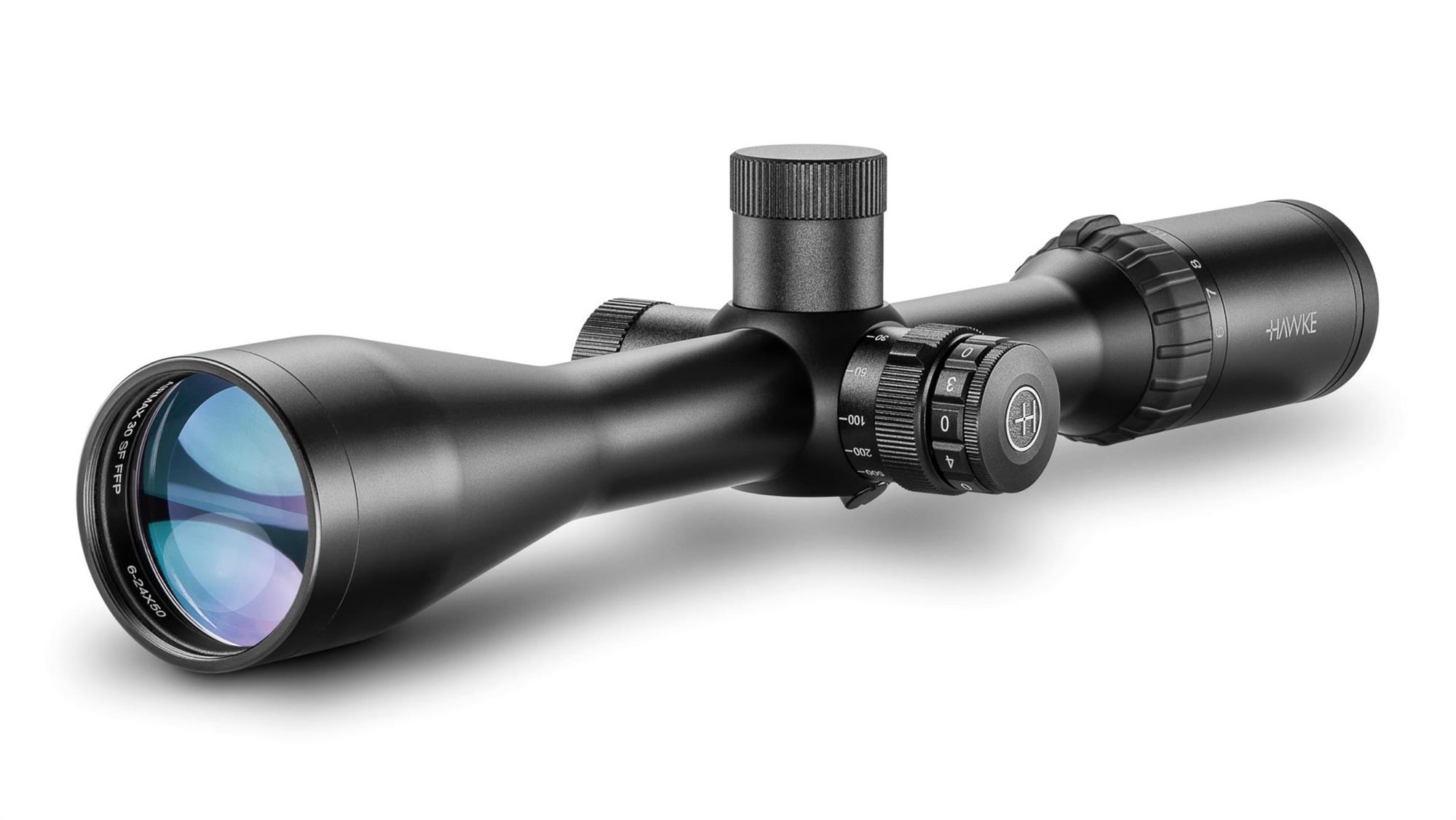
Hawke Airmax 30 FFP 6-24x50 SF (AMX IR)
via Livens
£329.00
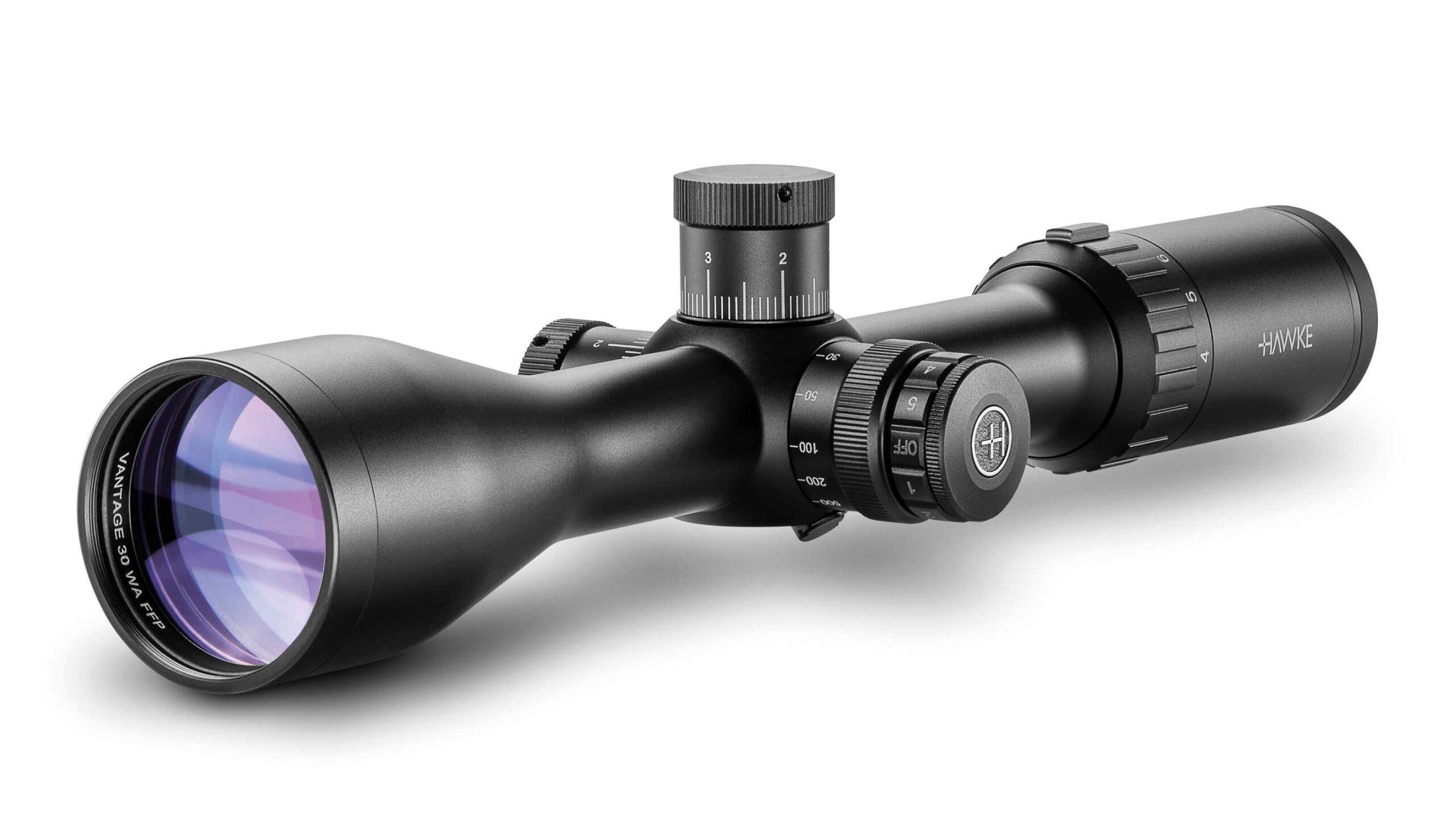
HAWKE VANTAGE 30 WA FFP 4-16X50 IR SF MRAD
via Livens
£329.00
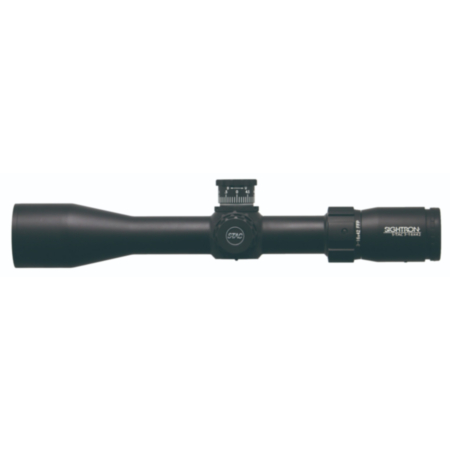
Sightron STAC 3-16x42 FFP IR MH2 SF 0.1 MRAD Zero Stop 30mm Rifle Scope
via Optics Warehouse
£499.99
Buying Advice
Start with the numbers that actually matter. Parallax adjustment range is arguably the most important spec for an air rifle scope because pellet trajectories are steep and engagement distances are short. A scope with a minimum parallax setting of 10 yards (or less) lets you eliminate parallax error on close HFT targets, whereas a centrefire scope bottoming out at 50 yards will show obvious image shift at 15 yards. Look for a side-focus parallax wheel marked down to at least 10 yards. Adjustment granularity matters too: if you choose MRAD, 0.1 mil clicks move your point of impact 1 cm at 100 metres (roughly 0.5 cm at 50 yards). If you prefer MOA, 1⁄4 MOA clicks give you approximately 0.26 inches at 100 yards — fine enough for precise zeroing at airgun distances. Neither system is inherently superior; pick whichever you find more intuitive.
Budget tiers in the UK air rifle scope market break down fairly cleanly. Entry-level optics in the £80–£150 range deliver usable glass and basic turrets, but coatings and mechanical consistency can be hit-or-miss. Mid-range scopes between £150 and £350 are the sweet spot for most S510xs owners: you get fully multi-coated lenses, reliable tracking, side parallax, and often an illuminated reticle. Premium optics above £350 — and sometimes well above £500 — offer demonstrably better edge-to-edge sharpness, tighter manufacturing tolerances, and features like zero-stop turrets or FFP reticles. For a rifle of the Sportster's calibre, we generally recommend at least a mid-range scope to avoid being the weak link in the system.
Common mistakes UK buyers make include over-magnifying, ignoring eye relief, and confusing focal planes. A 10-50×60 target scope sounds impressive, but at 50× the field of view is so narrow that acquiring targets in a hunting scenario is painfully slow, and mirage at UK airgun distances can render the image useless on warm days. Eye relief below 75 mm is rarely a problem on a recoilless PCP, but if you also own a springer air rifle and want to share the scope, ensure it can survive the violent forward-then-backward lurch of a spring-piston powerplant — most standard rifle scopes cannot. On focal planes: an FFP reticle scales with magnification, so your holdover marks remain accurate at every power setting, which is excellent for HFT. An SFP reticle is only dimensionally correct at one magnification (usually the highest), but it stays visually clean at low power — ideal for pest control where speed matters.
UK-specific context shapes your choice more than you might expect. Under current law, no licence is required for a sub-12 ft/lb air rifle in England and Wales (Scotland requires an air weapon certificate). The S510xs in .177 or .22 calibre at legal limit is effective to around 45–50 yards on live quarry, so there is no need for a scope designed to dial hundreds of yards of elevation. Retailers such as Uttings, John Rothery, Solware, and Pellpax stock a wide selection, and buying from a UK dealer means your warranty is straightforward. Keep in mind that thermal scope options exist for night-time pest control, but they are a specialist add-on rather than a primary sighting solution, and they represent a significant additional investment.
Matching the scope to your use case is the final and most important step. If you shoot HFT or field target, prioritise a fine reticle (mil-dot or dedicated FT reticle), an FFP design or a well-marked SFP turret, and parallax focus down to 7–10 yards for close-lane targets. If pest control is your primary discipline, a slightly lower magnification range (3-12× or 4-16×) with a wider field of view and an illuminated reticle for dawn and dusk work will serve you better. For backyard plinking and informal target shooting, almost any decently reviewed scope in the mid-range bracket will deliver satisfaction — just ensure parallax adjustment goes low enough. Whatever you choose, mount it in quality one-piece or two-piece mounts appropriate for the S510xs dovetail rail, and invest ten minutes in proper scope-levelling before you zero. A perfectly good scope on a canted mount will frustrate you at every distance beyond your zero.
Frequently Asked Questions
What is the best scope for a PCP air rifle in the UK?
For UK PCP shooters, a 4-16×44 or 6-24×50 with side-focus parallax adjustable down to 10 yards is the most versatile choice. Because PCPs like the S510xs produce negligible recoil, you are not restricted to springer-rated optics and can choose from a wide range of quality rifle scopes. Prioritise fully multi-coated lenses, reliable click adjustments in either MOA or MRAD, and a reticle style that suits your discipline — mil-dot for holdover shooting, or a fine crosshair for target work.
What is the best scope for a springer air rifle in the UK?
A scope for a springer air rifle must survive the unique double-recoil impulse that spring-piston guns generate, which is more destructive to optics than centrefire recoil. Look for scopes explicitly rated for spring-piston or gas-ram air rifles, typically featuring reinforced erector assemblies. Magnification of 3-9× or 3-12× is usually sufficient since springers at sub-12 ft/lb are realistically effective to about 30–40 yards. A scope rated for springers will also work perfectly on a PCP, though the reverse is not necessarily true.
Is an FFP or SFP scope better for air rifle target shooting in the UK?
FFP (first focal plane) scopes keep the reticle proportional to the target at every magnification, meaning your mil-dot or BDC holdovers remain accurate whether you are at 8× or 16×. This is a genuine advantage in HFT and field target where you shoot at varying distances and magnifications. SFP (second focal plane) scopes are simpler and often cheaper, with the reticle only being dimensionally correct at one magnification — usually the highest. For dedicated target shooting at known distances, SFP is perfectly adequate; for mixed-distance disciplines, FFP offers a meaningful edge.
What magnification range do I need for air rifle shooting?
For sub-12 ft/lb air rifle shooting in the UK, 4-16× covers almost every scenario from 10-yard HFT lanes to 50-yard pest control. Going beyond 20× adds little practical benefit at airgun distances and can introduce mirage issues on warmer days. A lower minimum magnification (3× or 4×) provides a wider field of view for close-range target acquisition, which is particularly valuable during walk-and-stalk pest control.
Does parallax adjustment matter on an air rifle scope?
Yes, parallax adjustment is critically important for air rifle scopes. At the short distances airgunners shoot — sometimes as close as 8 yards on an HFT course — parallax error can shift your point of impact by several millimetres if the scope is set for a longer distance. Choose a scope with side-focus parallax that adjusts down to at least 10 yards. Some dedicated airgun scopes go as low as 3 or 7 yards, which is ideal for field target disciplines where fractions of a millimetre matter.
Should I choose MOA or MRAD for my air rifle scope?
Either system works well for airgun use. MRAD (milliradians) is metric-friendly: 0.1 mil equals exactly 1 cm at 100 metres, scaling linearly at other distances. MOA (minute of angle) is traditional and gives slightly finer clicks in common configurations — 1⁄4 MOA is approximately 0.26 inches at 100 yards (roughly 0.7 cm at 100 metres). If you think in metric, MRAD is more intuitive; if you are comfortable with imperial units, MOA is perfectly serviceable. The important thing is to match your turret units to your reticle: a MRAD turret with a MRAD reticle, or MOA with MOA.
Can I use a thermal scope on the Air Arms S510xs for pest control?
Yes, a thermal scope can be mounted on the S510xs for night-time pest control, and it is a legal and increasingly popular method for controlling rats, rabbits, and squirrels on permission in the UK. However, thermal scopes represent a substantial investment, often exceeding the cost of the rifle itself. Many UK airgunners prefer a quality day scope as their primary optic and add a clip-on thermal or night vision device when required, preserving versatility without committing to thermal-only use.
What is a realistic budget for a good air rifle scope in the UK?
A competent air rifle scope that will do justice to the S510xs Ultimate Sportster typically starts around £150 and the sweet spot sits between £200 and £350. At this level you get reliable tracking, fully multi-coated glass, side-focus parallax, and build quality that will last years of regular use. Budget scopes under £100 can work for casual plinking but often compromise on optical clarity and mechanical consistency. Premium scopes above £400 offer the best edge sharpness and light transmission, but the law of diminishing returns applies.
Do I need a scope rated for springer recoil on the S510xs?
No. The S510xs is a PCP (pre-charged pneumatic) air rifle with virtually zero felt recoil, so springer-rated optics are unnecessary. This is one of the advantages of PCP ownership: you can mount any quality rifle scope without worrying about the destructive double-recoil impulse that spring-piston guns produce. However, if you plan to swap the scope onto a springer air rifle in future, choosing a springer-rated scope from the outset avoids buying twice.
Related guides
Expert UK buyer's guide to the best scopes for the Air Arms S510 and PCP air rifles. Covers magnification, parallax, mounts, sub-12 vs FAC…
Best Scopes for the Air Arms TX200Choosing a scope for the Air Arms TX200? Springer-rated, side-focus options for hunting and field target, 11 mm dovetail tips and live UK prices.
Best Scopes for Deer Stalking in 2026: A UK Beginner's GuideChoosing the best scope for deer stalking in the UK? Our 2026 beginner's guide covers magnification, reticle type…
Best Long-Range Scopes UK 2026: Mid-Budget Buyer's GuideDiscover the best scopes for long-range shooting in the UK for 2026. Our expert guide covers FFP vs SFP, MOA vs MRAD…
Not sure which scope is right for you?
Try our AI-powered scope finder — answer a few questions and get personalised recommendations.
Find My Scope →Get a UK scope tip every day
Follow AiScopes on Facebook for daily buying guides, deals and gear advice.
Follow on Facebook