Fitting a Scope to a Daisy 808: Solving the Rail Mismatch
By Peter Makulek · Senior Optics Editor · · Live prices from UK retailers
If you have dug out a childhood Daisy 808 and eagerly ordered a shiny new rifle scope only to discover it will not mount to the gun, you are far from alone. This is one of the most common beginner mistakes in the air rifle world, and it trips up experienced shooters too when they cross between platforms. The Daisy 808 uses a narrow 3/8-inch (9.5 mm) dovetail rail — the standard on most budget and vintage air rifles — whereas many modern scopes ship with rings designed for Picatinny or Weaver bases, which use a wider 7/8-inch (22 mm) profile. The good news is that this mismatch is cheap and easy to fix, and your scope may well be perfectly usable once mounted correctly.
Before you rush to buy adapters, though, it is worth pausing to ask whether the scope you chose is actually a sensible match for a sub-12 ft/lb air rifle like the Daisy 808. A lot of newcomers grab whatever looks impressive — high magnification, large objective, illuminated reticle — without considering weight, parallax range, or recoil characteristics. A scope built for centrefire hunting at 200-plus yards can be overkill and genuinely counterproductive on a lightweight springer that is only effective out to about 40–50 yards. The wrong scope can shift zero under spring-piston recoil, add unnecessary weight, and leave you chasing your tail on the range.
In this guide we walk you through exactly how to adapt your existing scope to the Daisy 808's dovetail, what to look for if you decide to buy a more suitable optic instead, and the key technical concepts — FFP versus SFP, MOA versus MRAD, parallax adjustment — that will help you make smarter choices going forward. We have also folded in answers to the most common scope questions UK shooters ask, from the best scope for a .22LR rimfire to choosing glass for long-range hunting and foxing, so this page can serve as a proper reference whether you stick with the 808 or move on to bigger things.
Everything here is written for UK shooters. That means sub-12 ft/lb legality for air rifles held without a Firearms Certificate, realistic yard ranges rather than optimistic metre claims, and pricing context in GBP from retailers you can actually buy from. Whether you are plinking in the garden, controlling rabbits on permission, or stepping up to rimfire target shooting, the principles are the same: match the optic to the job, mount it properly, and understand what your reticle is telling you.
Top Picks — Live UK Prices
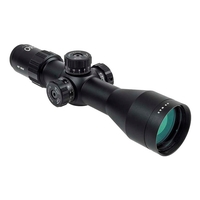
PAO HD MAX 4-16x44 SF FFP Ultra Compact Riflescope
via Uttings
£219.00
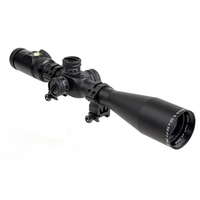
PAO F1 5-20x50 IR SF FFP Rifle Scope
via Uttings
£239.00

Hawke Vantage 30 WA FFP 4-16x50 Rifle Scope
via Uttings
£249.00
Buying Advice
The single most important specification when choosing a scope for the Daisy 808 — or any sub-12 ft/lb springer — is the parallax setting. Most budget rifle scopes are factory-set to be parallax-free at 100 yards or 100 metres, which is fine for centrefire but disastrous at 20–40 yards where an air rifle actually shoots. You need either a scope with an adjustable objective (AO) or side-focus parallax, or one factory-set at a shorter distance (some airgun-specific models are set at 35 yards). If parallax is uncorrected, your point of impact will shift as your eye moves behind the eyepiece, and no amount of shimming or re-zeroing will fix what is fundamentally an optical geometry problem. Check the spec sheet for minimum parallax distance before anything else.
Budget tiers in the UK break down roughly as follows. Entry-level scopes — under about £50 — are perfectly adequate for garden plinking and will usually feature a fixed-parallax or basic AO ring, SFP duplex reticle, and 3–9× magnification. Mid-range glass in the £80–£180 bracket brings noticeably better coatings, more consistent turret clicks (often 1/4 MOA, where 1 MOA equals approximately 1.047 inches at 100 yards or about 2.9 cm at 100 metres), side-focus parallax, and sometimes an MRAD mil-dot reticle. Premium air rifle scopes above £200 start offering fully multi-coated lenses, genuinely repeatable turrets with zero-stop capability, FFP reticles, and build quality that withstands years of springer double-recoil. For a Daisy 808 you emphatically do not need premium glass — a sensible entry or low-mid option is the sweet spot.
The most common mistake beginners make, beyond the rail-mismatch issue, is over-magnifying. A 6–24×50 scope sounds impressive, but on a sub-12 ft/lb air rifle at 30 yards you will see heat shimmer, mirage off the barrel, and a field of view so narrow you struggle to find your target. For springer air rifles in the UK, 3–9×40 or 4–12×40 is the practical maximum. Related errors include fitting scopes that are too heavy for the action (which accelerates stock-screw loosening on springers), ignoring the need for a scope stop or arrestor pin to prevent creep under bidirectional recoil, and choosing MOA turrets when the reticle is marked in MRAD or vice versa, which makes calculating holdover corrections needlessly complicated. Remember that 0.1 MRAD equals 1 cm at 100 metres — keep your turret and reticle in the same system.
UK-specific context matters more than many guides acknowledge. If you are shooting a sub-12 ft/lb air rifle you do not need a Firearms Certificate, but you must be on land where you have permission, and shooting over boundaries is a criminal offence under the Firearms Act 1968. For rimfire .22LR — hugely popular for rabbit and target work — you need a valid FAC, and your certificate may specify conditions about where and what you shoot. The best scope for a .22LR rimfire rifle in a UK context is typically a 3–12× or 4–16× with parallax adjustable down to 10–25 yards, since most rimfire shooting happens inside 100 yards. For scope air rifle use on rabbits or for scope fox and scope foxing duties (the latter usually on centrefire with a thermal scope or a good vision scope for night permissions), the demands on the optic differ radically, so always match glass to the specific discipline and legal framework.
Matching the scope to your use case means being honest about range, target size, and conditions. For the Daisy 808 doing garden plinking or informal target shooting at 10–30 yards, an inexpensive 4×32 fixed-power scope with an airgun-rated parallax setting is arguably the best scope you can fit — simple, light, and effective. If you later graduate to a quality springer for rabbit control, step up to a 3–9×40 AO with a mil-dot or duplex reticle and invest in proper mounts with a scope stop. For long-range hunting on centrefire — where you might stretch out beyond 300 yards on deer — that is where FFP reticles, exposed turrets with zero-stop, and genuine optical quality become worth spending several hundred pounds on. An FFP (first focal plane) reticle scales with magnification, so your holdover marks remain accurate at every power setting; an SFP (second focal plane) reticle is only accurate at one specific magnification, usually the highest. For airgun and rimfire distances, SFP is absolutely fine and often preferred for its cleaner sight picture at low power.
The UK brand landscape for air-rifle and rimfire optics is broad. You will find well-regarded options from dedicated airgun optics lines as well as from mainstream rifle scope manufacturers. Retailers such as Uttings, John Rothery, Solware, and various independent gun shops stock a healthy range, and online buying from UK-based dealers means you avoid import surprises. When browsing, filter by parallax range, reticle type, and tube diameter (most affordable scopes use a 1-inch / 25.4 mm tube; some mid-range and premium models use 30 mm, which requires correspondingly wider rings). Read verified buyer reviews from UK shooters — conditions here differ markedly from the American market where most online reviews originate — and make sure any scope marketed as springer-rated is genuinely tested against bidirectional recoil rather than simply labelled as such.
Frequently Asked Questions
How do I mount a Picatinny/Weaver scope onto the Daisy 808's dovetail rail?
You need 3/8-inch dovetail-to-Weaver/Picatinny adapter bases, sometimes sold as converter rails. These clamp onto the narrow 9.5 mm dovetail and present a standard 22 mm Weaver rail on top, so your existing scope rings can then bolt on normally. They cost only a few pounds from most UK airgun retailers. Alternatively, you can simply buy a set of 3/8-inch dovetail rings in the correct tube diameter and skip the adapter entirely — this is the cleaner, lighter solution.
Is my centrefire-rated scope a bad choice for the Daisy 808?
It depends on two things: parallax setting and weight. If the scope's minimum parallax is 50 yards or higher, it will produce noticeable point-of-impact shift at the 10–40 yard distances you will actually shoot the 808 at. Heavy scopes also upset the balance of a lightweight air rifle and can loosen stock screws over time with springer recoil. If your scope has adjustable parallax that goes down to at least 10–25 yards and weighs under about 500 g, it can work — but a purpose-built airgun scope is usually the smarter and cheaper option.
What is the best scope for a .22LR rimfire rifle in the UK?
The best scope for a .22LR depends on your primary discipline. For general rabbit shooting and informal target work inside 100 yards, a 3–12×40 or 4–16×44 with side-focus parallax adjustable down to 10–25 yards is ideal. An SFP mil-dot or MOA hash-mark reticle gives useful holdover references for rimfire drop without the cost of FFP. Budget around £100–£200 for a rimfire scope that will genuinely serve you well — this is the sweet spot for glass quality, repeatable turrets, and appropriate parallax range.
What is the best scope for a springer air rifle in the UK?
A spring-piston air rifle produces unique bidirectional recoil that can destroy scopes not rated for it, so rule one is to buy a scope explicitly marketed as springer-safe or airgun-rated. A 3–9×40 AO with a parallax range starting at 10 yards covers virtually all sub-12 ft/lb work from plinking to rabbit control. Keep magnification modest — you rarely need more than 12× on an airgun — and fit a scope stop or arrestor pin to prevent the scope creeping forward on the rail under recoil.
What is the best scope for long-range hunting in the UK?
For legal deer calibres in the UK (.243 Win minimum for most deer species in England and Wales, .240 calibre minimum in Scotland), a 4–16× or 5–25× scope with an FFP MRAD reticle and exposed, locking turrets with zero-stop is the gold standard. FFP means your reticle subtensions stay correct at every magnification, which matters when dialling or holding over at varying power. Side-focus parallax adjustable from about 10 yards to infinity, fully multi-coated glass, and a 30 mm or 34 mm tube for greater internal adjustment range are all worthwhile features at this level. Expect to spend £400 and above for optics that genuinely perform at extended range.
What is the difference between FFP and SFP, and which do I need?
In a first focal plane (FFP) scope the reticle sits in front of the magnification erector system, so the reticle markings scale proportionally as you change magnification — your mil-dot or MOA hash spacings remain accurate at every power setting. In a second focal plane (SFP) scope the reticle is behind the erector, so the subtensions are only correct at one specified magnification (usually the highest). For airgun and rimfire work at short range, SFP is perfectly adequate and often preferred because the reticle stays a consistent, readable size at low power. FFP earns its premium on centrefire rifles used at varying distances and magnifications.
MOA or MRAD — which system should I choose?
Both are angular measurement systems and neither is inherently more accurate. MOA (minute of angle) equals approximately 1.047 inches at 100 yards — shooters often round this to 1 inch. MRAD (milliradian) works in metric-friendly increments: 0.1 MRAD equals exactly 1 cm at 100 metres. The critical rule is to match your turret clicks to your reticle system — an MRAD reticle with MOA turrets forces awkward conversions in the field. UK shooters increasingly favour MRAD because ranges here are often measured in metres and the decimal maths is simpler, but MOA remains perfectly valid, especially in disciplines rooted in imperial measurement.
Do I need a scope stop on the Daisy 808?
Yes. Any spring-piston air rifle, including the Daisy 808, produces rearward recoil followed by a sharp forward kick as the piston slams home. This bidirectional force pushes scope rings forward along the rail over time, destroying your zero and potentially damaging the scope's internal adjustments. A scope stop — a small metal pin or block that sits in a transverse slot on the dovetail rail and butts against the rear ring — prevents this creep entirely. They cost very little and should be considered essential, not optional.
Can I use a thermal scope or night-vision scope on my air rifle for foxing or rabbit control?
In England and Wales it is legal to use a thermal scope or night-vision scope on a sub-12 ft/lb air rifle, but practical effectiveness is extremely limited because pellet energy drops sharply beyond about 40 yards. Most foxing with a thermal scope is done on centrefire rifles under FAC, where range and energy make ethical kills possible. For rabbit control at closer range a basic scope with good light transmission (look for fully multi-coated lenses and a larger objective, such as 50 mm) paired with a lamp or NV add-on is a more cost-effective solution for the airgun shooter. Always check local bylaws and permission specifics before shooting at night.
Related guides
Our 2026 UK buyer's guide to the best thermal scopes and clip-ons for foxing under £500. Compare Pard, Hikmicro and more for affordable night-time vermin control.
Best PRS Competition Scopes: A UK Beginner's Guide for 2026Choosing your first precision rifle scope for PRS in the UK? Our 2026 guide covers reticles, turrets, magnification and budget tiers to get you match-ready with confidence.
Not sure which scope is right for you?
Try our AI-powered scope finder — answer a few questions and get personalised recommendations.
Find My Scope →Get a UK scope tip every day
Follow AiScopes on Facebook for daily buying guides, deals and gear advice.
Follow on Facebook