Burris vs Vortex: The UK Shooter's Verdict
By Peter Makulek · Senior Optics Editor · · Live prices from UK retailers
If you spend any time on UK shooting forums or browsing www threads on Reddit, you will have seen the same debate pop up again and again: Burris or Vortex? Both brands sit in the mid-price sweet spot that most UK deer stalkers, target shooters and pest controllers actually buy in, roughly £250–£700 for a serious optic. Both offer lifetime warranties, though the practical experience of claiming in the UK differs. And both now field competitive FFP (first focal plane) models with MRAD reticles — the combination increasingly favoured by UK PRS-style competitors and long-range foxing enthusiasts. So which one deserves your hard-earned cash?
The answer depends on what you shoot and how you shoot it. Vortex has built enormous UK mindshare thanks to aggressive social-media presence and a dealer network that stretches from old-school country gunshops to online megastores. Burris, owned by the same parent com group as Steiner, tends to fly under the radar but punches hard on glass quality per pound. In this guide we strip away the brand loyalty and focus on the optical and mechanical factors that actually matter: reticle plane, adjustment granularity, parallax performance, and real-world durability in British weather.
We will also touch on how these two brands compare to premium European glass from Zeiss and Swarovski, and where thermal-imaging add-ons from Pard, HikMicro and Yukon fit into a modern UK setup. Whether you are a rimfire rabbit shooter or a .308 stalker pushing out to 600 yards, there is a clear buying path here.
Top Picks — Live UK Prices
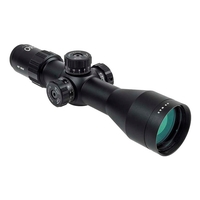
PAO HD MAX 4-16x44 SF FFP Ultra Compact Riflescope
via Uttings
£219.00
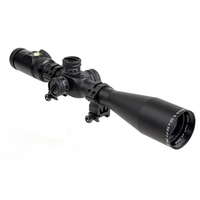
PAO F1 5-20x50 IR SF FFP Rifle Scope
via Uttings
£239.00

Wulf Tornado FFP 6-24x50 W-MIL3 Side Focus Rifle Scope
via BushWear
£249.99
Buying Advice
Start with reticle plane. If you dial your turrets for every shot — common in UK target disciplines — SFP is perfectly fine and often cheaper — just remember the reticle subtensions are only accurate at one specific magnification, usually the maximum setting. If you hold over using your reticle's mil-dot or BDC hash marks at varying magnifications, FFP is essential because the subtensions stay correct throughout the zoom range. Vortex's Diamondback Tactical FFP and Burris's XTR III both offer genuine FFP MRAD options under £600. Remember: 0.1 MRAD (one click on a typical mil turret) moves your point of impact exactly 1 cm at 100 metres, making range estimation and drop compensation straightforward in metric — the system most UK ranges use.
Parallax adjustment is the next priority. For rimfire and sub-12 ft/lb air-rifle work — where you are realistically shooting inside 50–75 yards and target sizes are tiny — a side-parallax knob adjustable down to 10 yards is hugely valuable. Many Vortex Diamondback models bottom out at 50 yards, which is fine for centrefire but leaves an air-rifle shooter with residual parallax error at close range. Several Burris Fullfield and Droptine models still use a fixed 100-yard parallax setting, which is a dealbreaker for HFT or close-range pest control. Check the spec sheet, not the marketing copy.
Finally, consider the warranty logistics for UK buyers. Vortex's VIP warranty is unconditional and lifetime, and they maintain a European service hub, meaning turnaround is typically a few weeks rather than months. Burris's Forever Warranty is similarly generous in wording, but historically UK claims have routed through fewer channels. Ask your dealer about their preview of the returns process before you commit. If you are building a rig that pairs a day scope with a clip-on thermal from HikMicro or Pard, also confirm that the scope's eye relief (ideally 90 mm or more for comfortable use behind a clip-on thermal unit) and objective housing do not foul the thermal unit's auto-alignment sensor.
Frequently Asked Questions
Would I be better investing in a UK or Australian optics brand?
The UK has no major domestic scope manufacturer, so the question is really about where your warranty and service support sits. For UK shooters, buying from brands with established European service centres — Vortex, Zeiss, Swarovski — gives you faster turnaround and no customs headaches. Australian-market scopes can be excellent but importing them privately adds VAT and potentially long return-shipping times, so the value proposition rarely stacks up.
Any love for the old-school long-boy scopes with extended tube lengths?
Absolutely. Old 30 mm and 34 mm tubes with 56 mm objectives still deliver outstanding light transmission for dawn and dusk stalking — exactly the conditions UK deer managers face most often. Burris's XTR III and Vortex's Viper PST Gen II in 5-25×50 are modern takes on that long-body tradition, offering zero-stop turrets (which prevent you dialling below your zero) and, on some models, locking elevation dials to guard against accidental adjustment — features the classic designs lacked.
Any love for semi-autos on here?
Semi-automatic centrefire rifles are essentially prohibited for civilian use in mainland Great Britain under Section 5 of the Firearms Act 1968, so they are not part of the typical UK scope-buying conversation. Semi-auto rimfire (.22 LR) and shotguns are perfectly legal on the correct certificate, and both Burris and Vortex make excellent low-magnification optics suited to fast target acquisition on semi-auto platforms.
Can someone name what equipment is being used in typical UK long-range setups?
A common UK PRS or NRL-style rig pairs a .308 Win or 6.5 Creedmoor bolt-action with a 5-25× FFP MRAD scope — the Vortex Viper PST Gen II or Burris XTR III are popular choices. Add a Pard or HikMicro thermal clip-on for night foxing, a quality bubble level, and a rear bag. Mounts are usually 34 mm Spuhr or Hawkins from the com retailers who stock them.
Any love for the Winchester Model 70 as a scope host?
The Model 70 is a beautifully made rifle and its controlled-round feed action is legendary, but availability in the UK is limited and aftermarket support (bases, rings) is narrower than for Tikka or Remington 700 patterns. If you already own one, both Burris and Vortex scopes mount perfectly well on Weaver or Picatinny bases — just confirm ring height so your objective clears the barrel.
I keep buying scopes — I don't have a problem, this is perfectly normal, right?
Perfectly normal. The roundup of new optics each year, from budget Vortex Crossfire IIs to flagship Swarovski dS models, makes it almost impossible not to upgrade. If your collection is growing faster than your rifle rack, the sensible move is to standardise on one adjustment system — MRAD or MOA — so every scope you own speaks the same language at the range.
Related guides
Comprehensive UK guide to the Vortex Razor HD LHT FFP range. We cover reticle subtension, weight savings, MOA vs MRAD choices…
Weirdly Specific Scope Suggestions You Actually NeedStruggling to find the right scope for your exact UK shooting scenario? Our 2026 guide matches niche requirements to real optics — FFP, SFP, thermal…
Vortex Viper PST Gen I 6–24×50 FFP EBR-1 MOA — Is It Worth £440?Is the Vortex Viper PST Gen I 6–24×50 FFP EBR-1 MOA scope still a smart buy in 2026? UK-focused buying guide covering specs, value, mounts…
Scope Upgrade Ideas & Recommendations 2026Expert scope upgrade recommendations for UK shooters in 2026. Covers rifle, rimfire, thermal and spotting scopes, reticle choices, magnification tiers…
Pard vs Hikmicro: UK Thermal Scope ShowdownPard or Hikmicro – which thermal scope suits UK shooters best in 2026? We compare image quality, features, pricing and real-world performance for night…
Red Dot vs Scope for UK Deer Stalking: The Definitive GuideRed dot sight or rifle scope for deer stalking in the UK? Our 2026 guide covers legality, magnification, brands…
Read next
- Vortex Optics UK
Vortex Optics UK: The Complete Vortex Scopes Guide for 2026
Not sure which scope is right for you?
Try our AI-powered scope finder — answer a few questions and get personalised recommendations.
Find My Scope →Get a UK scope tip every day
Follow AiScopes on Facebook for daily buying guides, deals and gear advice.
Follow on Facebook