Zero Stop Turrets Explained: Do You Really Need One?
By Peter Makulek · Senior Optics Editor · · Live prices from UK retailers
If you have ever dialled elevation for a long shot, fired, and then tried to return your turret to its original zero — only to lose count of the revolutions and end up hopelessly off — you already understand the problem a zero stop solves. A zero stop turret is a mechanical hard stop built into the elevation (and sometimes windage) turret that prevents you from dialling below your chosen zero point. Once set, you can wind the turret back down with confidence, knowing that the moment it stops turning you are back at your confirmed zero. It is a deceptively simple feature, but one that removes a genuine source of error in the field.
The concept matters most on scopes with a large amount of internal elevation travel — typically those designed for long-range centrefire shooting where you might be dialling several milliradians or many MOA of come-up. On a scope with, say, 25 MRAD of total elevation travel spread across multiple turret revolutions, it is remarkably easy to land on the right number but the wrong revolution. A zero stop eliminates that risk entirely. It is worth noting that on a first focal plane (FFP) scope — where the reticle scales correctly at every magnification — you could also use reticle holdovers instead of dialling, but many UK shooters prefer to dial for precision, and a zero stop makes that workflow far more reliable.
So, is it essential for every shooter? Not necessarily. If you shoot a sub-12 ft/lb air rifle at sensible ranges of 50 yards or less, or a rimfire at modest distances, a zero stop is a luxury rather than a necessity because you are unlikely to be dialling large elevation corrections. But for UK deer stalkers taking varied-distance shots, and especially for target or practical rifle shooters engaging steel at 600 yards and beyond, it is one of those features that quietly pays for itself every time you return to zero under pressure.
Top Picks — Live UK Prices
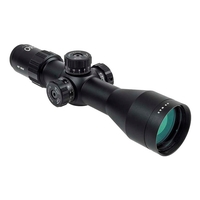
PAO HD MAX 4-16x44 SF FFP Ultra Compact Riflescope
via Uttings
£219.00
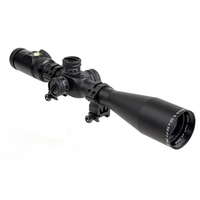
PAO F1 5-20x50 IR SF FFP Rifle Scope
via Uttings
£239.00

Wulf Tornado FFP 6-24x50 W-MIL3 Side Focus Rifle Scope
via BushWear
£249.99
Buying Advice
When evaluating zero stop turrets, the first thing to check is the mechanism type. The most common designs use either a locking ring beneath the turret cap or an internal clutch system. Locking-ring designs — found on many mid-range and premium scopes — let you loosen the ring, set your confirmed zero, and then re-tighten so the turret physically cannot rotate past that point. Clutch-based systems achieve the same result but may allow the turret to slip once it hits the stop, rather than presenting a hard mechanical limit. Both work, but a true hard stop is generally preferred because you get unambiguous tactile feedback. Pay attention to whether the zero stop is user-settable or factory-fixed; you want the former, since your zero will change if you swap ammunition, re-zero at a different range, or adjust for a suppressor shift.
Consider how the zero stop interacts with the scope's total elevation travel. Setting a zero stop effectively caps the usable adjustment range in one direction, so a scope with generous total travel — 30 MRAD or 100 MOA and above — gives you the most come-up after the stop is set. If you shoot a .308 Win or 6.5 Creedmoor out to 1,000 yards, you might need 10–12 MRAD of come-up from a 100-metre zero, so do the maths before buying. Also check that turret clicks are precise and repeatable; a zero stop is pointless if the tracking itself is poor. Look for scopes with independently verified click values — 0.1 MRAD (which moves point of impact 1 cm at 100 metres) or ¼ MOA (roughly 0.72 cm at 100 metres) — and consistent return-to-zero performance.
Finally, think about your turret style preference. Exposed, tool-less turrets with a zero stop are ideal for dial-and-shoot workflows in practical rifle or long-range target disciplines. Capped turrets with a zero stop underneath offer better protection against accidental adjustment — a genuine concern for UK stalkers pushing through dense cover. Budget-wise, zero stop turrets were once confined to scopes costing well north of £1,000, but several manufacturers now offer them in the £400–£800 bracket with credible tracking and build quality. As always, buy from a UK dealer who can support warranty claims and check that any imported scope carries the correct CE/UKCA marking.
Frequently Asked Questions
What exactly does a zero stop turret do?
A zero stop turret provides a mechanical limit that prevents the elevation dial from rotating below your confirmed zero setting. This means that after dialling up for a long shot, you can wind the turret back down until it physically stops, and you will be precisely back at your original zero without needing to count clicks or revolutions.
Do I need a zero stop on a scope for air rifle use?
For sub-12 ft/lb air rifles, which are realistically effective out to around 50 yards, a zero stop is not necessary. You are unlikely to dial significant elevation corrections at those ranges, and most airgun scopes use capped turrets that are set-and-forget. Your budget is better spent on good glass quality and a reliable parallax adjustment.
Does a zero stop work with both MOA and MRAD turrets?
Yes, the zero stop mechanism is independent of the angular measurement system. It works identically whether your turret is calibrated in MOA (where 1 MOA equals approximately 1.047 inches at 100 yards, or roughly 2.9 cm at 100 metres) or MRAD (where 0.1 MRAD equals 1 cm at 100 metres). The choice between MOA and MRAD is about personal preference and reticle matching, not zero stop compatibility.
Can I use holdovers instead of dialling, making a zero stop unnecessary?
You can, particularly with a first focal plane (FFP) scope where the reticle subtensions remain accurate at all magnifications. However, dialling is generally more precise for large corrections, and many UK shooters prefer it for deer stalking or target work. If you primarily use holdovers, a zero stop is less critical but still useful as a safety net for the occasions you do dial.
Will setting a zero stop reduce my available elevation adjustment?
It can, yes. When you set the zero stop at your confirmed zero, you are dedicating all the remaining downward travel to the stop mechanism, which means your usable come-up is whatever elevation travel remains above that point. Scopes with generous total travel — 25 MRAD or more — mitigate this well, but it is always worth calculating your maximum required come-up before buying, especially if you shoot at extended ranges.
Is a zero stop the same as a locking turret?
No. A locking turret simply locks the dial in place to prevent accidental movement — useful for stalking through thick cover. A zero stop specifically prevents the turret from rotating below your set zero point. Some premium scopes offer both features together, which gives you the best of both worlds: a turret that locks against knocks and guarantees a reliable return to zero.
Related guides
Learn how to zero a rifle scope at 100 yards with this UK-focused guide. Covers MOA vs MRAD adjustments, parallax, bore-sighting…
How Much Magnification Do You Really Need?Cut through the hype and find the right scope magnification for your shooting discipline. Practical UK advice covering air rifles, rimfire…
Understanding Parallax and Side Focus on Rifle ScopesLearn what parallax really does to your point of impact, how side-focus turrets correct it, and which scopes suit UK shooting disciplines.
Not sure which scope is right for you?
Try our AI-powered scope finder — answer a few questions and get personalised recommendations.
Find My Scope →Get a UK scope tip every day
Follow AiScopes on Facebook for daily buying guides, deals and gear advice.
Follow on Facebook