How Much Magnification Do You Really Need?
By Peter Makulek · Senior Optics Editor · · Live prices from UK retailers
It is one of the most common questions on UK shooting forums, and for good reason: buying too much magnification is just as costly a mistake as buying too little. A 6-24×50 on a sub-12 ft/lb springer that will never shoot beyond 50 yards adds unnecessary weight, eats up mounting space and often introduces parallax headaches you did not need. Equally, trying to place .308 rounds at 600 yards through a fixed 4× is an exercise in frustration. The right magnification range depends on your quarry, your calibre, your typical engagement distance and—critically—the optical quality you can afford at a given price point.
Before we look at specific magnification brackets, it helps to understand two optical realities. First, higher magnification narrows your field of view and amplifies every wobble in your hold, so unless you are shooting from a solid rest you may actually shoot worse at high power. Second, a scope's usable magnification is limited by its optical quality: a budget 6-24× at 24× will show a noticeably dimmer, softer image than a mid-range 5-15× at 15×. In the UK market, where dawn and dusk permissions are common for pest control, image brightness at your chosen power matters more than bragging rights on the turret.
This guide maps the most popular UK shooting disciplines to sensible magnification ranges, explains how first focal plane (FFP) and second focal plane (SFP) designs interact with your zoom range, and answers the practical questions that trip up first-time buyers.
Top Picks — Live UK Prices
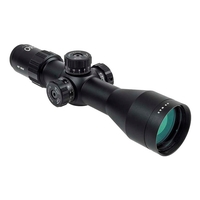
PAO HD MAX 4-16x44 SF FFP Ultra Compact Riflescope
via Uttings
£219.00
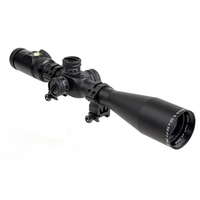
PAO F1 5-20x50 IR SF FFP Rifle Scope
via Uttings
£239.00

Wulf Tornado FFP 6-24x50 W-MIL3 Side Focus Rifle Scope
via BushWear
£249.99
Buying Advice
Start with your maximum realistic shooting distance, then add a small margin. For sub-12 ft/lb air rifles, that ceiling is roughly 50 yards on live quarry—a 3-9× or 4-12× scope covers this comfortably and keeps the package light enough for off-hand shots. Rimfire shooters working steel or rabbits out to 100–150 yards suit 4-16× or 6-18× well. Centrefire stalkers in mixed woodland and open hill ground should look at the versatile 2.5-10× or 3-12× bracket: low enough at the bottom end for snap shots in cover, high enough to confirm a clean hold at 250 yards. Dedicated long-range target shooters pushing past 600 yards are the ones who genuinely benefit from 5-25× or 6-24× glass.
Consider FFP versus SFP in the context of magnification range. On an FFP scope, the reticle scales with the image so your subtension-based holdovers—whether in MRAD (where 0.1 mil equals 1 cm at 100 m) or MOA (where 1 MOA equals approximately 1.047 inches at 100 yards)—remain accurate at every power setting. This is a genuine advantage if you regularly dial through your zoom range and range or holdover at various powers. On an SFP scope, the reticle subtensions are only true at one magnification, usually the highest. For many UK stalkers and pest controllers who set a power and leave it, SFP is perfectly adequate—and often cheaper at equivalent optical quality.
Finally, do not overlook parallax adjustment. Most scopes with magnification above 10× benefit from a side-focus or adjustable objective (AO) parallax dial. At higher powers the parallax error becomes visible sooner: if you are using 16× at 30 yards on an air rifle, a scope with a fixed 100-yard parallax setting will show noticeable reticle shift against the target as your eye moves behind the ocular. Ensure the parallax range on any scope you choose covers your actual shooting distances—many centrefire-oriented models only adjust down to 45 or 50 yards, which is inadequate for close-range airgun work.
Frequently Asked Questions
Is higher magnification always better for accuracy?
No. Higher magnification amplifies shooter wobble, mirage and any optical imperfections. For unsupported field shooting, most UK shooters find they are more accurate at moderate powers—typically 8–12×—than at 20× or above. Reserve the top end of your zoom for confirmed rests or bench work.
What magnification should I use on a sub-12 ft/lb air rifle?
A 3-9× or 4-12× scope is the sweet spot. Sub-12 ft/lb springers and pre-charged pneumatics are realistically effective on live quarry to about 50 yards and on paper to 75 yards at most. Going above 12× adds weight and bulk with very little practical benefit at those distances.
Does choosing FFP or SFP affect what magnification range I need?
Indirectly, yes. With an SFP scope your reticle subtensions are only accurate at one power (usually maximum), so you need to be disciplined about which setting you use for holdover or ranging. An FFP reticle is correct at every magnification, giving you more flexibility to shoot at mid-range zoom settings without recalculating.
Why does my reticle seem to shift on the target at high magnification?
This is parallax error. At higher powers, any mismatch between the focal plane of the target image and the reticle plane becomes more visible. Use your scope's side-focus or AO ring to eliminate the shift at your shooting distance—the target image should stay still relative to the reticle when you move your eye slightly behind the eyepiece.
What magnification range suits UK deer stalking?
For woodland stalking where shots may be as close as 40 yards, a low bottom-end magnification (2× or 3×) is essential for target acquisition. A 2.5-10× or 3-12× scope covers the vast majority of UK stalking scenarios. Hill stalking in Scotland may occasionally stretch beyond 200 yards, but even then 12× is usually ample for a confident shot.
Should I choose MOA or MRAD turrets, and does it depend on magnification?
The choice between MOA and MRAD is about personal preference and the measurement system you think in—not magnification. MOA clicks (commonly 1/4 MOA, roughly 0.7 cm at 100 m) suit shooters comfortable with imperial units. MRAD clicks (commonly 0.1 mil, exactly 1 cm at 100 m) suit metric thinkers. Either system works at any magnification; just ensure your turrets and reticle use the same unit.
Related guides
What is the actual difference between a rimfire scope and a regular centrefire scope? We cover parallax, turrets…
Understanding Parallax and Side Focus on Rifle ScopesLearn what parallax really does to your point of impact, how side-focus turrets correct it, and which scopes suit UK shooting disciplines.
Zeroing Your Rifle Scope at 100 Yards — UK GuideLearn how to zero a rifle scope at 100 yards with this UK-focused guide. Covers MOA vs MRAD adjustments, parallax, bore-sighting…
Not sure which scope is right for you?
Try our AI-powered scope finder — answer a few questions and get personalised recommendations.
Find My Scope →Get a UK scope tip every day
Follow AiScopes on Facebook for daily buying guides, deals and gear advice.
Follow on Facebook