Understanding Parallax and Side Focus on Rifle Scopes
By Peter Makulek · Senior Optics Editor · · Live prices from UK retailers
If you have ever shifted your head slightly behind the scope and watched your reticle appear to drift across the target, you have experienced parallax error. It is one of the most misunderstood optical phenomena in rifle shooting, yet it directly affects point-of-impact accuracy — particularly at the ranges UK centrefire and rimfire shooters commonly work at. In this guide we explain exactly what parallax is, why it matters, and how the adjustment mechanisms on modern scopes eliminate it.
Parallax occurs when the image formed by the objective lens does not fall precisely on the same focal plane as the reticle. The result is that any movement of your eye behind the eyepiece causes the reticle to shift relative to the target image. At shorter distances, the effect is more pronounced because the objective must focus the image further back; at longer distances it diminishes. Most budget scopes are factory-set to be parallax-free at a single distance — typically 100 yards for centrefire models and around 50 yards for dedicated airgun scopes — but that only eliminates error at that one range.
Higher-specification scopes solve this with an adjustable parallax mechanism, usually a side-focus turret (sometimes called a third turret) or, on some older designs, an adjustable objective (AO) ring on the front bell. Both do the same job — they let you move the objective's focal point until the target image sits exactly on the reticle plane — but side focus is far more ergonomic, keeping your shooting position undisturbed. Understanding how and when to use this adjustment is essential whether you are shooting HFT at 45 yards with a sub-12 ft/lb springer or engaging steel out to 1,000 yards with a .308.
Top Picks — Live UK Prices
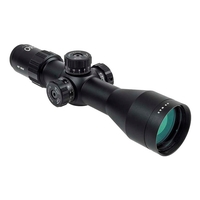
PAO HD MAX 4-16x44 SF FFP Ultra Compact Riflescope
via Uttings
£219.00
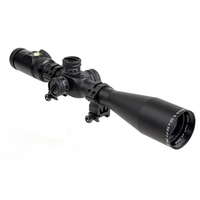
PAO F1 5-20x50 IR SF FFP Rifle Scope
via Uttings
£239.00

Wulf Tornado FFP 6-24x50 W-MIL3 Side Focus Rifle Scope
via BushWear
£249.99
Buying Advice
When choosing a scope with parallax adjustment, first consider the distances you actually shoot. UK air-rifle disciplines — HFT, field target, and plinking — demand precise parallax correction from roughly 8 to 50 yards, so look for a scope whose side-focus turret bottoms out at 10 yards or less. For rimfire and short-to-mid-range centrefire work (100–300 yards), most quality side-focus scopes cover the range comfortably. Long-range centrefire shooters should ensure the parallax dial reaches at least 500 yards and ideally infinity, and that the markings are legible enough to set quickly in the field.
Pay attention to the focus mechanism's feel. A smooth, well-damped side-focus turret with clear yardage markings makes a real difference when you need to remove parallax quickly between shots at varying distances. Some scopes also double as crude rangefinders: once you learn where targets sit on the parallax dial, you can estimate distance — a useful trick in HFT. That said, never rely on parallax markings as a primary rangefinder; they are approximate at best and vary with temperature and individual eyesight.
Finally, consider whether the scope is first focal plane (FFP) or second focal plane (SFP). Both can have parallax adjustment, but it is worth understanding the interaction: in an FFP scope the reticle scales with magnification, so holdover values remain correct at every power setting — but parallax must still be dialled out separately. In an SFP scope the reticle size stays constant, so subtension-based holdovers are only accurate at one magnification (usually maximum). Neither design is inherently better for parallax correction; the adjustment mechanism works identically in both. Choose FFP if you vary magnification mid-course and need consistent mil or MOA references, or SFP if you prefer a finer reticle at high power and always shoot at the same magnification.
Frequently Asked Questions
What exactly is parallax in a rifle scope?
Parallax is the apparent movement of the reticle against the target image when your eye shifts position behind the eyepiece. It happens because the target image formed by the objective lens is not sitting on the same focal plane as the reticle. When parallax is present, even a tiny head movement introduces aiming error.
Do I really need a side-focus parallax turret?
If you shoot at varying distances and demand consistent accuracy, yes. A fixed-parallax scope is only truly parallax-free at one preset range — usually 100 yards on centrefire models or about 50 yards on airgun scopes. At any other distance the error creeps in. A side-focus turret lets you dial it out at every range, which is particularly important for field target, HFT, and precision rimfire shooting.
Is side focus the same as adjustable objective (AO)?
Functionally, yes — both move the objective lens group to place the target image on the reticle plane. The difference is ergonomic: an AO ring sits on the front bell of the scope and requires you to reach forward, while a side-focus turret sits on the left side of the saddle, easily reached without breaking your cheek weld. Side focus is now the dominant design on mid-range and premium scopes.
Does parallax adjustment affect image focus?
Adjusting parallax often sharpens the target image as a secondary effect, because you are aligning the focal planes. However, parallax correction and image focus are not the same thing. Your eyepiece (dioptre) ring focuses the reticle to your eye; the parallax turret focuses the target image onto the reticle plane. Always set your dioptre first, then dial the parallax turret until the target is sharp and the reticle shows zero shift when you move your eye.
At what range does parallax error become significant?
It depends on the scope's factory parallax setting and the magnification you are using. At high magnifications, even small parallax errors become visible. For a centrefire scope set parallax-free at 100 yards, shooting at 25 or 300 yards on high power can introduce enough error to miss small targets. For airgunners shooting sub-12 ft/lb springers — whose effective range is only about 50 to 75 yards — parallax error at close-in HFT distances of 8 to 15 yards can shift the point of impact several millimetres, which matters on small kill zones.
Does parallax adjustment differ between FFP and SFP scopes?
No. The parallax adjustment mechanism works identically in both first focal plane and second focal plane scopes — it moves the objective lens group to align the target image with the reticle plane. The difference between FFP and SFP relates to whether the reticle scales with magnification, which affects holdover subtension accuracy but has no bearing on how you correct parallax.
Related guides
Learn how to zero a rifle scope at 100 yards with this UK-focused guide. Covers MOA vs MRAD adjustments, parallax, bore-sighting…
First Focal Plane Reticles: The Long-Range Shooter's GuideUnderstand how first focal plane reticles work for long-range shooting. Expert UK guide covering FFP vs SFP, MRAD holdovers…
Not sure which scope is right for you?
Try our AI-powered scope finder — answer a few questions and get personalised recommendations.
Find My Scope →Get a UK scope tip every day
Follow AiScopes on Facebook for daily buying guides, deals and gear advice.
Follow on Facebook