Zeroing Your Rifle Scope at 100 Yards — UK Guide
By Peter Makulek · Senior Optics Editor · · Live prices from UK retailers
Zeroing at 100 yards is the most common baseline for centrefire rifles in the UK, whether you are stalking deer across Scottish hillsides, controlling foxes on farmland, or punching paper at your local Home Office–approved range. A solid 100-yard zero gives you a practical reference point from which you can calculate holdover or dial corrections for longer shots, and it keeps your point of impact close to your point of aim inside the distances where most UK shooting actually happens — typically out to around 200–250 yards for stalking, and further for target disciplines.
Getting there reliably, however, depends on understanding your scope's adjustment system, parallax settings, and reticle type. A scope with 1/4 MOA clicks moves point of impact by roughly a quarter of an inch per click at 100 yards (since 1 MOA ≈ 1.047 inches at that distance). A 0.1 MRAD (mil) scope moves point of impact by 1 cm per click at 100 metres — which is effectively 0.36 inches at 100 yards. Knowing which system your turrets use before you start saves ammunition, frustration, and daylight.
This guide walks you through the complete process — from bore-sighting at 25 yards to confirming your group at 100, choosing the right scope features, and avoiding the parallax and FFP/SFP pitfalls that catch out even experienced shooters. We have also picked a handful of scopes that make the zeroing process especially straightforward thanks to features like exposed zero-stop turrets, side-focus parallax, and clearly defined MRAD or MOA reticles.
Top Picks — Live UK Prices
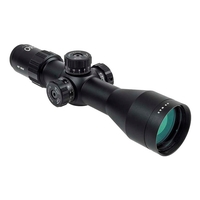
PAO HD MAX 4-16x44 SF FFP Ultra Compact Riflescope
via Uttings
£219.00
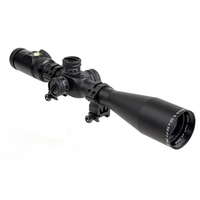
PAO F1 5-20x50 IR SF FFP Rifle Scope
via Uttings
£239.00

Wulf Tornado FFP 6-24x50 W-MIL3 Side Focus Rifle Scope
via BushWear
£249.99
Buying Advice
When choosing a scope with a clean 100-yard zero in mind, prioritise repeatable, tactile turret clicks. Exposed turrets with a zero-stop mechanism let you dial up for longer shots and return to your 100-yard zero by feel alone — invaluable in poor light or when wearing gloves during a winter fox outing. Look for turrets that match the reticle unit: an MRAD reticle paired with MRAD turrets (or MOA with MOA) eliminates on-the-fly conversion maths and reduces the chance of dialling errors.
Parallax matters more than many shooters realise. Most centrefire scopes ship with a fixed parallax set at either 100 or 150 yards, which is fine for zeroing but can introduce apparent point-of-impact shifts if your eye moves off the optical axis at other distances. A side-focus or adjustable-objective parallax knob lets you eliminate parallax error at any range, which is especially useful if you also shoot at 50 or 200 yards. For dedicated 100-yard zeroing and general stalking, a fixed-parallax scope set at 100 yards is perfectly adequate.
Consider whether you need a first focal plane (FFP) or second focal plane (SFP) reticle. FFP reticles scale with magnification, so your mil-dot or Christmas-tree holdover marks are accurate at every power setting — a real advantage if you use the reticle to estimate drop or wind without touching turrets. SFP reticles stay the same visual size regardless of zoom, which many UK stalkers prefer for a cleaner sight picture at low magnification, but the subtension values are only correct at one specific magnification (usually the highest). For zeroing itself either plane works identically; the choice affects how you use the scope afterwards.
Frequently Asked Questions
Why do most UK shooters zero at 100 yards rather than 100 metres?
Tradition and range infrastructure play the biggest roles. Many UK ranges — particularly MoD and Home Office–approved facilities — are marked in yards, and 100 yards has long been the standard zeroing distance for deer-legal calibres. The practical difference between 100 yards (91.44 m) and 100 metres is small enough that ballistic tables can compensate easily, but it is worth knowing which distance your range actually measures.
Can I zero at 25 yards and be on paper at 100?
Yes, and this is the recommended first step. A rough bore-sight or laser bore-sighter gets you on paper at 25 yards, where you fire a group and adjust. Because the bullet's trajectory crosses your line of sight twice (once on the way up and once on the way down), a 25-yard zero for many common calibres like .308 Win or .243 Win will put you within a few inches of zero at 100 yards, saving ammunition and time.
What is the difference between MOA and MRAD adjustments when zeroing?
MOA (minute of angle) scopes typically adjust in 1/4 MOA clicks, with each click shifting impact by approximately 0.26 inches at 100 yards (since 1 MOA ≈ 1.047 inches at 100 yards). MRAD scopes usually adjust in 0.1 mil clicks, with each click moving impact by 1 cm at 100 metres — roughly 0.36 inches at 100 yards. Neither system is more accurate than the other; choose whichever your reticle is calibrated in so the maths stays simple.
How does parallax affect my zero?
Parallax error occurs when the target image does not sit perfectly on the reticle plane inside the scope. If your eye shifts even slightly off the optical axis, the reticle appears to move against the target, creating an apparent point-of-impact shift. At 100 yards most scopes with fixed parallax set at 100–150 yards show negligible error, but it is good practice to centre your eye in the eyepiece and check for reticle movement before each shot, especially during the zeroing process.
Should I zero on an FFP or SFP scope differently?
The zeroing procedure is identical for both. Adjust the turrets until point of impact matches point of aim at 100 yards — the focal plane of the reticle does not change how turret clicks work. The difference matters afterwards: on an FFP scope, your reticle subtensions are valid at any magnification, so you can hold off using mil-dots at any zoom. On an SFP scope, subtension values are only correct at one stated magnification, typically the highest.
Is a 100-yard zero appropriate for air rifles?
No. Sub-12 ft/lb air rifles — the legal limit in England and Wales without a firearms certificate — are only effective to around 50–75 yards due to their low muzzle energy and rainbow-like trajectory. Zeroing a springer or PCP air rifle at 100 yards would place the pellet far too high at practical distances. Most air-rifle shooters zero at 25–30 yards, which keeps the pellet within a useful kill zone out to roughly 40–50 yards depending on calibre and pellet choice.
Related guides
Understand how first focal plane reticles work for long-range shooting. Expert UK guide covering FFP vs SFP, MRAD holdovers…
FFP vs SFP Scopes: Which Suits Your Shooting?Confused by FFP and SFP rifle scopes? Our expert UK guide explains which reticle plane suits your discipline, from HFT to long-range PRS…
Not sure which scope is right for you?
Try our AI-powered scope finder — answer a few questions and get personalised recommendations.
Find My Scope →Get a UK scope tip every day
Follow AiScopes on Facebook for daily buying guides, deals and gear advice.
Follow on Facebook