FFP vs SFP Scopes: Which Suits Your Shooting?
By Peter Makulek · Senior Optics Editor · · Live prices from UK retailers
First focal plane (FFP) and second focal plane (SFP) describe where the reticle sits inside the erector system of a rifle scope, and the difference has a direct, practical impact on how you use your optic in the field. In an FFP scope the reticle scales in size as you change magnification, so the subtensions on the reticle — whether MOA or MRAD — remain accurate at every power setting. In an SFP scope the reticle stays the same apparent size throughout the zoom range, meaning its subtensions are only true at one specific magnification, usually the maximum. Understanding which arrangement you actually need can save you a significant amount of money and, more importantly, prevent errors when ranging or holding over.
UK shooters span an enormous range of disciplines — from sub-12 ft/lb HFT competitors engaging targets between 8 and 55 yards, to deer stalkers taking single, carefully placed shots inside 200 metres, to PRS and long-range target shooters pushing centrefire rifles well beyond 1,000 yards. Each discipline places different demands on the optic, and the FFP-versus-SFP question is not simply a matter of one being better than the other. It is about matching the reticle plane to how you actually use magnification, holdovers, and wind corrections in your chosen shooting context.
In this guide we break down the technical differences, address common misconceptions, and offer honest buying advice so you can make a confident choice. We also cover how the reticle-plane decision interacts with MOA-versus-MRAD units, parallax adjustment, and zero-stop turrets — because these features rarely exist in isolation.
Top Picks — Live UK Prices
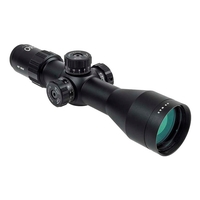
PAO HD MAX 4-16x44 SF FFP Ultra Compact Riflescope
via Uttings
£219.00
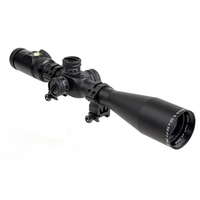
PAO F1 5-20x50 IR SF FFP Rifle Scope
via Uttings
£239.00

Wulf Tornado FFP 6-24x50 W-MIL3 Side Focus Rifle Scope
via BushWear
£249.99
Buying Advice
Start by asking yourself one question: do I routinely change magnification mid-course-of-fire and still need to hold off the reticle for elevation or wind? If the answer is yes — as it often is in PRS, NRL, or practical rifle matches — an FFP scope is the natural choice because your mil or MOA hash marks remain dimensionally correct regardless of the power ring position. This eliminates mental arithmetic under time pressure. Look for a reticle design that is bold enough to read at the lowest magnification you will realistically use; a Christmas-tree pattern that vanishes at 6× on a 6–24× scope is a poor match for rapid target acquisition. Illumination with a daylight-visible centre dot is a practical bonus here.
If you are a deer stalker or an HFT shooter who dials to a single magnification and leaves it there — or who dials turrets rather than holding over — an SFP scope can deliver a finer reticle, a cleaner sight picture, and often better value for money at the same optical quality. Many of the best-selling stalking scopes in the UK are SFP, and for good reason: a thin crosshair that does not thicken at high power keeps the point of aim precise on small kill zones. For sub-12 ft/lb air rifles, which are realistically effective only out to around 50–75 yards, an SFP scope on a modest magnification range (3–12× or 4–16×) with an adjustable objective or side parallax down to 10 yards is usually the most practical and cost-effective setup.
Regardless of reticle plane, pay attention to complementary features. Parallax adjustment should cover your actual shooting distances — 10 yards upward for air rifles, 50 yards or metres upward for centrefire. A zero-stop mechanism is invaluable if you dial elevation regularly, preventing you from losing your zero reference. Match your turret and reticle units: an MRAD reticle paired with MRAD turrets (where 0.1 mil clicks move the point of impact 1 cm at 100 metres) keeps the maths simple, and the same logic applies if you prefer MOA (where 1 MOA ≈ 1.047 inches at 100 yards). Mixing units between reticle and turret is a recipe for confusion. Finally, handle the scope in person if you can — UK retailers and shooting shows are excellent for this — because eye relief, eyebox forgiveness, and image quality matter just as much as the reticle plane.
Frequently Asked Questions
Does FFP or SFP affect accuracy?
Neither reticle plane is inherently more accurate than the other; both allow precise shot placement. The difference is operational: an FFP reticle lets you use holdovers and ranging at any magnification without error, while an SFP reticle requires you to be on the designated magnification (usually maximum) for its subtensions to be correct. If you always dial turrets or shoot at one magnification, SFP is perfectly accurate.
Why are FFP scopes generally more expensive?
Manufacturing an FFP scope requires tighter tolerances because the reticle is placed ahead of the magnification-changing lens group, inside the erector assembly. This makes the etching finer and the assembly more complex. Competition for UK buyers is increasing, however, and several brands now offer quality FFP optics well below the £1,000 mark.
Can I use an FFP scope for HFT or sub-12 ft/lb air-rifle shooting?
You can, but it is rarely the best choice. Sub-12 ft/lb air rifles are effective only to around 50–75 yards, and most HFT shooters set a fixed magnification during a course. An SFP scope with a fine reticle and parallax adjustment down to 10 yards typically gives a cleaner sight picture and costs less for equivalent optical quality.
Should my turrets match my reticle units — MOA or MRAD?
Yes, always. Mixing an MRAD reticle with MOA turrets (or vice versa) forces you to convert units in the field, which is slow and error-prone. With matched units the process is straightforward: spot a miss in the reticle, read the offset, and dial or hold the same value. In MRAD, 0.1 mil equals 1 cm at 100 metres; in MOA, 1 MOA equals approximately 1.047 inches at 100 yards.
At what distances does the FFP advantage really matter?
The FFP advantage becomes most significant when you use reticle holdovers across a wide range of distances and need to change magnification quickly — typically beyond 300 metres in centrefire disciplines. At shorter ranges, or when you dial turrets for every shot, the subtension accuracy at variable magnification is less critical and an SFP scope works just as well.
What is parallax, and does it differ between FFP and SFP scopes?
Parallax is the apparent shift of the reticle against the target when you move your eye off the optical axis. It occurs when the target image does not focus precisely on the reticle plane. Both FFP and SFP scopes can suffer from parallax error, and both can be fitted with adjustable parallax (side focus or adjustable objective). For accurate shooting, always dial out parallax for your target distance before taking the shot.
Related guides
Comprehensive UK guide to the Vortex Razor HD LHT FFP range. We cover reticle subtension, weight savings, MOA vs MRAD choices…
Element Helix 6-24×50 FFP — Is It Worth It?Element Helix 6-24×50 FFP rifle scope reviewed for UK shooters. We cover FFP reticle benefits, MRAD turrets, parallax setup…
Vortex Viper PST Gen I 6–24×50 FFP EBR-1 MOA — Is It Worth £440?Is the Vortex Viper PST Gen I 6–24×50 FFP EBR-1 MOA scope still a smart buy in 2026? UK-focused buying guide covering specs, value, mounts…
Best FFP Scopes UK: First Focal Plane Scopes ExplainedLooking for the best first focal plane (FFP) scope in the UK? We compare top-rated FFP scopes from Hawke, Vortex, Nightforce…
MOA vs MRAD: Which Should UK Shooters Choose?MOA or MRAD? Our expert guide helps UK shooters pick the right angular measurement system for their discipline…
Not sure which scope is right for you?
Try our AI-powered scope finder — answer a few questions and get personalised recommendations.
Find My Scope →Get a UK scope tip every day
Follow AiScopes on Facebook for daily buying guides, deals and gear advice.
Follow on Facebook