MOA vs MRAD: Which Should UK Shooters Choose?
By Peter Makulek · Senior Optics Editor · · Live prices from UK retailers
The MOA-versus-MRAD debate has run for decades, but for UK shooters the answer is increasingly clear-cut — and it hinges on how you actually use your turrets and reticle in the field. Both systems are simply angular measurements: one Minute of Angle (MOA) subtends approximately 1.047 inches at 100 yards (roughly 29 mm at 100 metres), while one milliradian (MRAD or mil) subtends exactly 10 cm at 100 metres. Neither is inherently more accurate; the difference lies in granularity, the maths you do under pressure, and what the rest of your shooting community is using.
In the UK, where most centrefire ranges are marked in metres and ballistic data from Strelok, Applied Ballistics, and similar apps defaults to metric, MRAD has become the dominant choice among precision-rifle, PRS, and tactical shooters. Its base-10 relationship with the metric system — 0.1 mil clicks move your point of impact 1 cm at 100 m — makes corrections almost effortless. MOA still has a loyal following, particularly among stalkers, benchrest shooters, and those with US-sourced optics calibrated in quarter-MOA clicks. Understanding both systems ensures you buy the right scope and avoid a frustrating mismatch between your reticle and your turrets.
Below, we break down the practical differences, highlight the scenarios where each system shines for UK disciplines, and answer the questions our readers ask most often.
Top Picks — Live UK Prices

Nikko Stirling Diamond Long Range 30mm Tactical 4-16x50 IR Rifle Scope
via Uttings
£199.00

Hawke Endurance 30 WA 1-4x24 IR (Tactical Dot 4x) Telescopic Sights
via BushWear
£251.10
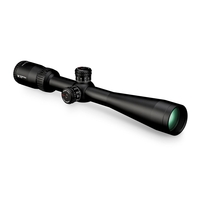
Vortex Diamondback Tactical 4-12x40 Riflescope - VMR-1 Reticle (MOA)
via Uttings
£299.00
Buying Advice
The single most important rule when choosing a scope is to match your reticle and turret units. An MRAD reticle paired with MOA turrets — or vice versa — forces you to convert on the fly, which wastes time and invites errors. Every reputable manufacturer now offers matched configurations, so there is no reason to accept a mismatch. If you are buying your first precision scope, go MRAD-reticle with 0.1-mil clicks; if you already own a quality MOA scope and have your DOPE charts built around it, there is nothing wrong with staying in that system.
Consider your shooting discipline. For PRS, NRL, and any UK club competition shot at metric distances, MRAD is the practical default — your spotting partner will call corrections in mils, and your ballistic solver will output mils. For deer stalking, where shots are seldom dialled and most corrections happen inside the reticle at relatively short range, either system works, but many UK stalkers appreciate the finer 0.25-MOA click (roughly 0.7 cm at 100 m) for precise zeroing. For sub-12 ft-lb air rifles, which are only effective out to around 50–75 yards, the choice barely matters; a simple duplex or mil-dot reticle at second focal plane is more than adequate.
Finally, pay attention to features that matter regardless of angular unit: a reliable zero-stop so you can return to your confirmed zero without counting clicks, a first-focal-plane (FFP) reticle if you dial and hold at varied magnifications, quality glass with minimal parallax error, and turrets with positive, repeatable tracking. Test turret repeatability with a tall-target or box test before trusting any scope on a live-fire detail. A scope that tracks honestly in either MOA or MRAD will always outperform one that drifts, no matter which measurement system it claims to use.
Frequently Asked Questions
Is MRAD more accurate than MOA?
No. Both are simply angular measurement systems and neither is inherently more precise. A standard 0.1-mil click adjusts impact by 1 cm at 100 m, while a 0.25-MOA click adjusts it by roughly 0.7 cm at the same distance. The finer MOA increment can be handy for benchrest zeroing, but in practical field shooting the difference is negligible.
Why do most UK PRS and tactical shooters prefer MRAD?
Because the UK uses the metric system and MRAD scales perfectly with it: 0.1 mil equals 1 cm at 100 m, making mental arithmetic almost instant. Competition spotters call corrections in mils, and most ballistic apps default to MRAD in metric mode. Adopting the same system as your peers speeds up communication on the firing point.
Does it matter for deer stalking in the UK?
For most stalking scenarios — shots inside 200 metres with a well-zeroed rifle — either system works perfectly well. Many stalkers never touch their turrets in the field and simply use a holdover point inside the reticle. If you do plan to dial for longer shots across open hill ground, choose whichever system matches the rest of your setup and DOPE charts.
Should I choose FFP or SFP when buying an MRAD scope?
If you use the reticle subtensions for range estimation or holdover at varying magnifications, first focal plane (FFP) is essential because the reticle markings stay true at every power setting. Second focal plane (SFP) reticles are only dimensionally correct at one specific magnification — usually the maximum. For PRS and precision work, FFP with an MRAD reticle is the standard recommendation.
What about sub-12 ft-lb air rifles — does MOA vs MRAD matter?
Not really. Sub-12 ft-lb air rifles are only effective to roughly 50–75 yards, so you are unlikely to be dialling turrets or making complex holdover calculations. A straightforward mil-dot or duplex reticle at second focal plane is more than sufficient. Spend your budget on clear glass and reliable parallax adjustment rather than worrying about angular-unit choice.
Can I convert between MOA and MRAD easily?
Yes, though it is awkward under time pressure. One mil equals approximately 3.438 MOA. The conversion is simple enough on paper, but in the field — especially during timed competition stages — it adds an unnecessary step. This is exactly why matching your reticle and turret units to a single system, and sticking with it, is so strongly recommended.
Related guides
MOA or MRAD — what is the difference and which should UK shooters choose? Plain-English explanation with click values…
Is MRAD Worth It for UK Shooters?Wondering if MRAD is worth the investment for UK shooting? Our 2026 guide covers mil-rad turrets, reticles, budget tiers in GBP…
Best FFP Scopes UK: First Focal Plane Scopes ExplainedLooking for the best first focal plane (FFP) scope in the UK? We compare top-rated FFP scopes from Hawke, Vortex, Nightforce…
Best PRS Scopes UK 2026Top-rated scopes for PRS rifles and practical precision shooting in the UK. Compare FFP, MRAD and zero-stop options from Nightforce, Vortex…
Read next
- long range rifle scopes UK
Best Long-Range Scopes UK 2026: Mid-Budget Buyer's Guide
Not sure which scope is right for you?
Try our AI-powered scope finder — answer a few questions and get personalised recommendations.
Find My Scope →Get a UK scope tip every day
Follow AiScopes on Facebook for daily buying guides, deals and gear advice.
Follow on Facebook