Best Budget Air Rifle Target Scopes Under £100 (2026)
By Peter Makulek · Senior Optics Editor · · Live prices from UK retailers
Finding the best scope for air rifle target shooting in the UK without breaking the bank has never been more achievable. The sub-£100 bracket in 2026 is packed with optics that would have embarrassed mid-range glass just five years ago, offering adjustable parallax, decent coatings and reliable turrets. Whether you are shooting Hunter Field Target (HFT), full-bore Field Target (FT) or simply plinking at spinners in the garden, the right budget air rifle scope can make the difference between clipping the edge of a kill zone and splitting it dead centre. This guide is built specifically for UK shooters working within the sub-12 ft/lb legal limit.
Air rifle target shooting places unique demands on optics that centrefire shooters rarely face. Engagement distances are short — typically 8 to 55 yards — but kill zones on FT targets can be as small as 15 mm, making precise parallax adjustment and clean magnification far more important than long-range reticle holdovers. A scope under £100 must therefore prioritise optical clarity at moderate powers, a smooth and repeatable side-focus or adjustable objective (AO) parallax wheel, and turrets that actually return to zero. These are the criteria we use when recommending a rifle scope under 100 pounds for UK disciplines.
Springer shooters face an additional challenge: the brutal double recoil of a spring-piston powerplant. The rearward lurch followed by a sharp forward kick can destroy optics designed only for centrefire recoil patterns. If you own a break-barrel or underlever springer, you need a scope that is expressly rated for spring-piston use or has a well-established reputation for surviving it. We factor this into every recommendation, because the best air rifle scope is worthless if it loses zero after fifty shots on your HW95 or TX200.
Throughout this guide we reference UK-relevant disciplines, retailers and price points. We do not invent test data or quote specific prices that may shift between retailers; instead, we explain what to look for so you can make an informed decision whether you buy from a specialist dealer, a major online retailer or your local gun shop. Read on for our product picks, detailed buying advice and a thorough FAQ section designed to answer the exact questions UK air rifle shooters are asking in 2026.
Top Picks — Live UK Prices

Hawke Fast Mount 4-16x50 AO IR SFP Mil Dot Scope
via Sportsman Gun Centre
£100.00
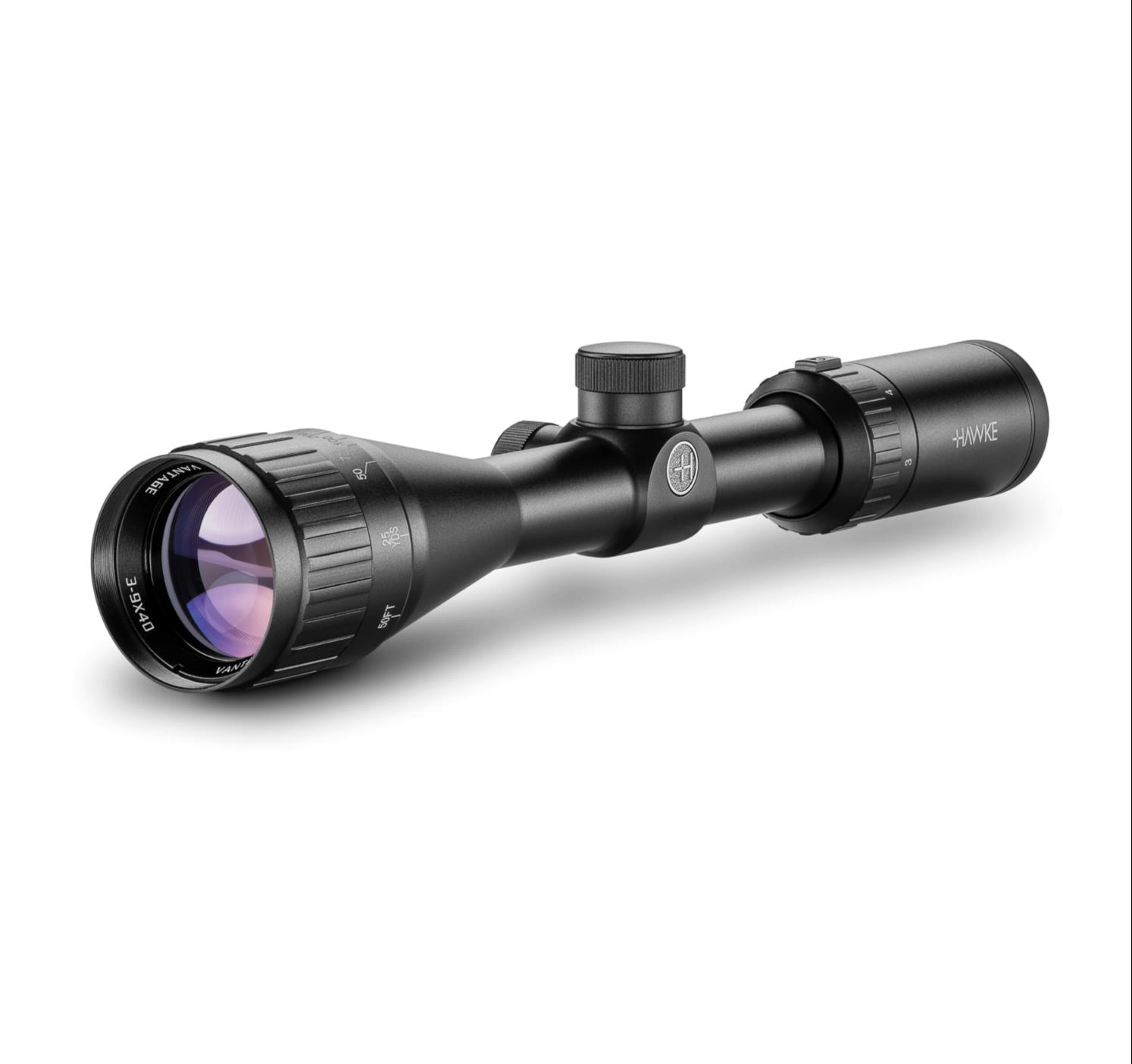
Hawke Vantage 3-9x40 AO Mil Dot
via Livens
£99.00

Nikko Stirling Panamax 3-9x40 AO IR Rifle Scope
via Uttings
£99.00
Buying Advice
Start with the key specifications. Magnification range matters most for target shooting: a 3-12× or 4-16× scope covers every practical air rifle distance, and higher top-end power helps with rangefinding via parallax on FT lanes. Objective lens diameter (typically 40–50 mm at this price point) governs light-gathering ability, though for daytime target shooting even 40 mm is ample. Tube diameter is almost always 1 inch (25.4 mm) in this bracket — 30 mm tubes are rare under £100. Parallax adjustment is non-negotiable for target work: look for a side-focus wheel or AO ring calibrated down to at least 10 yards, ideally 7 yards. The reticle should be SFP (second focal plane), which keeps crosshair size constant regardless of magnification — almost universal under £100 and perfectly adequate for air rifle distances.
Budget tiers within the sub-£100 range are worth understanding. At the entry level (roughly £30–£50) you get basic AO parallax, fully coated (single-layer) lenses and simple duplex reticles. These are fine for garden plinking but often lack the turret precision or coating quality needed for competitive HFT or FT. The mid tier (£50–£75) is the sweet spot for most UK target shooters: expect multi-coated or fully multi-coated lenses, capped finger turrets with ¼ MOA clicks, and a side-focus parallax wheel. At the upper end (£75–£100) you can find scopes with etched glass reticles, illumination, locking turrets and noticeably sharper edge-to-edge clarity. Spending more within this bracket genuinely buys better coatings and more reliable mechanicals.
Common buying mistakes are easy to avoid once you know them. First, over-magnifying: a 6-24×50 might sound impressive, but cheap glass at 24× is dim and soft — you are better off with a sharp 4-12×. Second, ignoring parallax minimums: if a scope only adjusts down to 50 yards, it is useless for FT rangefinding and will show significant parallax error at 20 yards. Third, mounting a non-springer-rated scope on a spring-piston rifle — this is the single fastest way to waste money. Fourth, using the wrong mounts: air rifles with dovetail rails need 9–11 mm dovetail mounts, not Picatinny/Weaver, and springers benefit from a scope-stop pin to prevent creep. Always check compatibility before you buy.
UK-specific context shapes the buying decision. Under current law, air rifles producing under 12 ft/lb (England and Wales) or under 12 ft/lb with a certificate in Scotland do not require a firearms certificate, so the vast majority of UK target shooters are using sub-12 ft/lb rifles in .177 or .22 calibre. Effective range tops out around 50–55 yards for .177 FT use and roughly 35–45 yards for .22 plinking. This short-range envelope means you do not need — and should not pay for — long-range features like zero-stop turrets or complex BDC reticles calibrated for centrefire trajectories. Buy from established UK dealers such as Uttings, John Bull Outdoors, Air Arms dealers or the major online airgun specialists, where you get proper after-sales support and can often try before you buy at shows.
Matching the scope to your use case is critical. HFT competitors need a reliable parallax wheel (for rangefinding within the rules), moderate magnification (typically 10–12× maximum in HFT), and a simple reticle — many HFT rules restrict reticle complexity. FT shooters want the highest usable magnification they can afford, very fine parallax control down to around 7–8 yards, and a mil-dot or similar reticle for holdover. Plinkers can prioritise a wider field of view and a forgiving eye box over ultimate precision, so a 3-9×40 with AO is often plenty. Consider whether you will graduate to competitions later — buying a scope that meets FT or HFT requirements from the start saves upgrading.
The brand landscape at this price point is competitive. Well-known names like Hawke, MTC Optics, Nikko Stirling and Discovery offer proven models under £100 that UK air rifle shooters trust. Bushnell and Mounts Plus have budget lines worth considering. Newer entrants such as PARD, better known for digital night-vision devices, are expanding into conventional optics and may offer interesting value as they build their daylight scope range. Vector Optics and Barska occupy the ultra-budget tier. As a rule, buy the best-established brand you can afford: turret reliability and consistent quality control at this price point correlate strongly with brand reputation and UK dealer support.
Frequently Asked Questions
What magnification do you need for HFT and field target shooting with an air rifle?
For HFT, most competitions cap effective magnification use and many shooters prefer 10–12× for a balance of clarity and field of view. Full-bore FT shooters generally want 12–16× or higher to resolve tiny kill zones at 55 yards, though cheap glass becomes noticeably soft above 16×. A 4-12× or 3-12× variable covers both disciplines well and is the most versatile choice under £100 for UK target shooting.
Can a scope under £100 hold zero on a springer air rifle?
Yes, provided you choose a model specifically rated for spring-piston recoil. The double-recoil cycle of a springer (rearward then sharply forward) is more destructive to optics than centrefire recoil. Brands like Hawke, MTC and Nikko Stirling sell scopes in this bracket that are springer-tested. Pair the scope with proper two-piece mounts and a scope-stop pin to prevent rail creep, and a quality budget air rifle scope will hold zero reliably on rifles like the HW95, TX200 or Diana 34.
What parallax range should a budget air rifle target scope have?
For air rifle target shooting, your scope must adjust down to at least 10 yards, and ideally 7–8 yards, since FT lanes can start as close as 8 yards. Many budget scopes with adjustable objectives (AO) or side-focus wheels are calibrated from 10 yards to infinity. Avoid scopes that only adjust down to 50 yards or are fixed at 100 yards — these are designed for centrefire use and will produce visible parallax error at short air-rifle distances.
Is a fixed-magnification scope better than a variable for air rifle target shooting on a budget?
Fixed-power scopes (e.g. 10×42) are optically simpler, which means fewer internal elements to degrade the image, so a fixed scope at a given price often delivers sharper glass than a variable at the same cost. However, variable scopes offer crucial versatility — lower powers for close targets and wider fields of view, higher powers for resolving distant kill zones. For FT and HFT, a variable is almost essential for parallax rangefinding. For pure plinking, a fixed 4× or 6× is perfectly adequate and can be excellent value.
Which budget scope brands are reliable for UK air rifle target shooting?
Hawke is arguably the most trusted name in UK airgun optics, with several models under £100 that are springer-rated and well supported by UK dealers. MTC Optics offers strong value with good glass and turret feel. Nikko Stirling has a long UK pedigree at the budget end. Discovery Optics has gained a strong following among HFT and FT shooters for punching above its price. PARD is an emerging brand expanding from night-vision into conventional optics. All of these have UK-based customer support, which matters when buying budget glass.
Do I need a mil-dot reticle for air rifle target shooting?
A mil-dot reticle is very useful for FT shooting because the dot spacing gives consistent holdover references for pellet drop at different ranges. In HFT, simpler reticles are often preferred and sometimes mandated by competition rules. For plinking, a standard duplex crosshair is fine. At sub-£100, most variable scopes offer a mil-dot or half-mil-dot option. Ensure it is an etched glass reticle if possible — wire reticles are fragile under springer recoil and can shift over time.
What mounts do I need for an air rifle scope?
Most UK air rifles use an 11 mm dovetail rail, so you need 9–11 mm dovetail mounts, not Weaver or Picatinny. Medium-height mounts suit most objective lenses up to 44 mm; for a 50 mm objective you may need high mounts to clear the barrel. On springer air rifles, always use a scope-stop pin or arrestor block to prevent the scope creeping forward under recoil. Two-piece mounts generally allow more flexible positioning than one-piece units and are widely recommended for target use.
How does pellet drop affect scope choice for air rifles?
At sub-12 ft/lb, a .177 pellet drops significantly beyond 30 yards — roughly 2–3 inches at 40 yards and 5–7 inches at 50 yards depending on pellet weight and muzzle velocity. This means you either dial elevation turret clicks or use reticle holdover marks. A scope with ¼ MOA (roughly 7 mm per click at 40 yards) turrets and a mil-dot reticle gives you both options. For FT, reliable turrets and a reticle with known subtensions are essential for making precise adjustments at each lane.
Can I use a centrefire rifle scope on my air rifle?
You can, but with caveats. Centrefire scopes are designed for rearward-only recoil and may fail on a springer's bidirectional recoil cycle. They also typically have parallax fixed at 100 yards or adjustable only down to 50 yards, which creates significant aiming error at 10–30 yards. If you shoot a PCP (pre-charged pneumatic) air rifle, a centrefire scope with low parallax adjustment can work, but for target shooting you will still benefit from a scope specifically designed for airgun distances and parallax ranges.
Related guides
Find the best scope for air rifle target shooting UK shooters can buy under £150 in 2026. Expert advice on HFT, FT and paper-target optics, parallax…
Best Budget Air Rifle Scopes Under £100 (2026 UK Guide)Our UK experts pick the best air rifle scopes under £100 for springer and PCP shooting in 2026. Covers magnification, recoil resistance, parallax and more.
Best Scopes for the Air Arms S510 & Top PCP Air RiflesExpert UK buyer's guide to the best scopes for the Air Arms S510 and PCP air rifles. Covers magnification, parallax, mounts, sub-12 vs FAC…
Best Scopes for .22LR Target Shooting in 2026Find the best scope for your .22LR rifle in the UK. Our 2026 rimfire optics guide covers HFT, benchrest and plinking – magnification, parallax…
Best Scopes for HFT & Field Target Competition 2026Expert UK buyer's guide to the best scopes for HFT and field target air rifle competition in 2026. High-magnification optics, side focus parallax…
Best Scopes for Foxing Under £500 in 2026Expert UK guide to the best scope for fox shooting under £500 in 2026. Covers day and night-ready optics for .223 and .243, illuminated reticles…
Read next
- air rifle scopes UK
Best Air Rifle Scopes UK 2026
Not sure which scope is right for you?
Try our AI-powered scope finder — answer a few questions and get personalised recommendations.
Find My Scope →Get a UK scope tip every day
Follow AiScopes on Facebook for daily buying guides, deals and gear advice.
Follow on Facebook