Best Budget Bench Rest Scopes Under £500 (UK 2026)
By Peter Makulek · Senior Optics Editor · · Live prices from UK retailers
Bench rest shooting is arguably the most demanding optical discipline in the UK calendar. Whether you compete in UKBRA-sanctioned events or simply chase ever-tighter groups at your club range, the scope sitting on top of your rail has to deliver flawless resolution, rock-solid tracking and near-zero parallax error at the distances you shoot. The good news for 2026 is that manufacturing advances, particularly in lens coatings and turret mechanisms, have pushed genuinely capable precision glass well inside a working budget. In this guide we focus on finding the best scope for bench rest shooting UK shooters can buy for under five hundred pounds.
What makes bench rest different from field or tactical shooting is the sheer intolerance for optical compromise. You are shooting from a solid rest at known distances—typically 100 or 200 yards in UK competition—so every variable except the optic and the ammunition is largely controlled. That means parallax error, chromatic aberration and turret repeatability become the dominant sources of unexplained group spread. A scope that is "good enough" for deer stalking or practical rifle can be woefully inadequate when you are trying to measure dispersion in thousandths of an inch.
This scope review 2025-into-2026 round-up is written specifically for UK buyers. We account for the distances used on British ranges, the calibres most commonly seen on the bench rest line (from .222 Remington through 6mm PPC to .308 Winchester), and the retailers and warranty channels that actually matter when you are based in the UK. We also address a question we hear constantly: can you genuinely get a reliable benchrest scope under 500 pounds, or is that a false economy? The short answer is yes—but only if you know which specifications to prioritise and which marketing claims to ignore.
Below, you will find our curated product picks followed by an in-depth buying-advice section covering magnification, reticle plane, adjustment systems, parallax control and more. We close with a detailed FAQ that folds in the exact questions UK shooters are asking on forums and at club nights right now. Our goal is to make this the single most useful page on the topic of the best budget benchrest scope available in the United Kingdom in 2026.
Top Picks — Live UK Prices

Nikko Stirling Diamond Long Range 30mm Tactical 4-16x50 IR Rifle Scope
via Uttings
£199.00

Hawke Endurance 30 WA 1-4x24 IR (Tactical Dot 4x) Telescopic Sights
via BushWear
£251.10
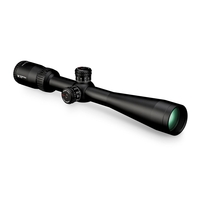
Vortex Diamondback Tactical 4-12x40 Riflescope - VMR-1 Reticle (MOA)
via Uttings
£299.00
Buying Advice
Start with the numbers that actually affect group size. Magnification of 24× or above lets you resolve bullet holes at 100 yards without a spotting scope, and a 40–50 mm objective lens collects enough light for clear imaging even on overcast British mornings. Turret click value is critical: a 1/8 MOA click moves the point of impact roughly 0.131 inches at 100 yards, while a 0.1 MRAD click moves it 1 cm at 100 metres. Both systems are fine for bench rest, but whichever you choose, the clicks must be consistent and repeatable across multiple revolutions. Finally, look for a side-focus parallax knob calibrated down to at least 10 yards; parallax error at 100 yards can shift your apparent point of aim by several MOA if left uncorrected, which is ruinous for group shooting.
The sub-£500 market splits neatly into three tiers. Entry-level scopes around £150–£250 can offer surprisingly good glass and adequate turrets, but may lack zero-stop mechanisms and use softer alloy turret housings that wear over thousands of clicks. Mid-range options between £250 and £400 typically add fully multi-coated ED or HD glass, capped or locking turrets with tool-less zero reset, and tighter quality control on click consistency. At the top end—£400 to £500—you begin to touch scopes with genuinely competition-grade tracking, premium Japanese or German glass elements, and all-metal turret assemblies that will survive seasons of hard use. For most UK bench rest shooters who are not yet competing at national level, the mid tier represents the sweet spot for a precision scope budget UK buyers can justify.
The most common mistake we see is buying on magnification alone. A 32× scope with poor glass and sloppy turrets will lose to a 24× scope with crisp resolution and repeatable clicks every single time. Another frequent error is ignoring tube diameter: a 30 mm tube gives more internal adjustment range than a 1-inch tube, which matters if your rail has any cant or if you need significant elevation for 200-yard stages. Buyers also overlook eye relief; bench rest positions can vary, and anything less than 75 mm of eye relief risks scope-eye even with light-recoiling calibres. Finally, never assume that a scope marketed as "tactical" or "PRS" is automatically suited to bench rest—those disciplines reward speed and versatility, whereas bench rest rewards pure optical precision and tracking fidelity.
UK-specific context matters more than many guides acknowledge. Firstly, bench rest calibres used in UKBRA and club competition are exclusively centrefire; sub-12 ft/lb air rifles, while excellent for plinking and HFT, are effective only to around 50–75 yards and are not part of the bench rest discipline. Secondly, UK retail channels—Optics Warehouse, RUAG, Brownells UK, Uttings and specialist dealers—carry different stock profiles to US retailers, so check actual UK availability before falling in love with a US-market model. Warranty service also matters: brands with a UK distributor or service centre will turn around repairs far faster than those requiring a transatlantic return. Finally, remember that your scope is not a controlled item under UK firearms law, but it must be mounted on a legally held firearm; always buy from a reputable dealer who understands the market.
Matching the scope to your specific use case prevents buyer's remorse. If you shoot exclusively at 100 yards on paper, a second focal plane reticle is perfectly adequate because you will always be dialled to maximum magnification and the subtensions will read true at that one setting. If you also shoot at 200 yards or dabble in F-Class, a first focal plane reticle keeps its subtension accuracy across the zoom range, which is useful when switching between stages. For pure group shooting where you simply want the smallest cluster, fine crosshair or dot reticles are preferable to busy tactical trees that can obscure tiny aiming points. Consider also whether you want an illuminated reticle: it adds cost and battery dependency but can help resolve the crosshair against dark target centres in poor light.
The brand landscape in the UK precision-optics market has widened considerably. Established names like Vortex, Athlon, Element Optics, and Hawke offer strong sub-£500 options with robust UK warranty networks. Newer entrants, including Pard—better known for digital night-vision devices—are beginning to explore the daytime precision segment, and their manufacturing scale could disrupt pricing further. Japanese OEM glass from factories supplying multiple Western brands means that a £350 scope today may use the same optical elements as a £600 scope from five years ago. The key differentiator at this price is no longer raw glass quality but mechanical execution: turret precision, erector-tube spring tension, and quality-control consistency across production batches. Read verified user reviews, check independent box-test data where available, and, if possible, try before you buy at a dealer or club open day.
Frequently Asked Questions
What magnification and objective lens size do you need for bench rest shooting in the UK?
Most UK bench rest shooters use scopes in the 24×–40× range, with 40–50 mm objective lenses. Higher magnification lets you resolve bullet holes at 100 yards without a spotting scope, while a 40 mm or larger objective gathers enough light for clear images on overcast British days. Be cautious above 40× on budget optics, though—poor glass quality is magnified along with the target, and excessive magnification amplifies mirage on warm afternoons.
Is a FFP or SFP reticle better for bench rest at fixed distances?
For bench rest at a single known distance, a second focal plane (SFP) reticle is perfectly adequate because you will almost always shoot at maximum magnification, where the subtensions read true. A first focal plane (FFP) reticle becomes more useful if you also shoot at multiple distances or want accurate hold-overs at any zoom setting. SFP models are often slightly cheaper, which helps when you are hunting the best budget benchrest scope under £500.
MOA or MRAD turrets for bench rest: which gives finer adjustments for group shooting?
Both systems can deliver extremely fine adjustments. A 1/8 MOA click moves the point of impact approximately 0.131 inches at 100 yards, while a 0.1 MRAD click moves it 1 cm at 100 metres (roughly 0.36 inches at 100 yards). If you want the smallest possible per-click shift, 1/8 MOA is finer than 0.1 MRAD. However, MRAD's decimal-metric maths is simpler for range calculations. Choose whichever system matches the rest of your workflow and any turret-mounted data you already use.
Can you get a reliable bench rest scope under £500 in the UK?
Absolutely. The current generation of mid-range optics from brands like Athlon, Element Optics, Vortex, and Hawke includes models with fully multi-coated glass, precise 1/8 MOA or 0.1 MRAD turrets, and side-focus parallax adjustment—all for well under £500. You will not get the exotic ED glass or hand-fitted erector tubes of a £1,500 scope, but for club-level bench rest competition a benchrest scope under 500 pounds can be genuinely competitive if you prioritise tracking consistency and optical clarity over marketing gimmicks.
What parallax and side-focus features matter most for bench rest precision?
A side-mounted parallax knob is effectively essential for bench rest because it allows precise parallax elimination without shifting your head off the stock. Look for a parallax adjustment range that includes your competition distance—most scopes adjustable from 10 yards to infinity will cover 100 and 200 yards easily. The key quality indicator is how finely graduated the parallax dial is around your shooting distance; a scope whose markings jump from 50 yards straight to 150 yards makes fine-tuning at 100 yards unnecessarily difficult.
Do I need an illuminated reticle for bench rest shooting?
In most UK bench rest scenarios an illuminated reticle is a luxury rather than a necessity. Natural light on an outdoor range is usually sufficient to see a fine crosshair against a white target backer. However, illumination can help resolve the reticle against very dark aiming points or in the low-light conditions common at indoor or covered ranges during winter months. If you are on a tight budget, spend the money on better glass rather than illumination—it will contribute more to actual group size reduction.
What tube diameter should I choose for a bench rest scope?
A 30 mm main tube is the most popular choice for UK bench rest scopes under £500. It offers more internal adjustment range than a traditional 1-inch (25.4 mm) tube, which is important if your rail has any cant or if you need significant elevation travel for 200-yard stages. Some premium-tier scopes use 34 mm tubes for even greater adjustment range, but ring and mount options become more expensive and less common in the UK at this price bracket.
Are air-rifle scopes suitable for centrefire bench rest shooting?
Generally, no. Scopes designed specifically for sub-12 ft/lb air rifles are built to handle the unique reverse recoil of spring-powered actions and are typically optimised for ranges of 50–75 yards at most. They usually offer lower magnification, smaller objectives, and turrets not intended for the fine adjustments bench rest demands. Conversely, a quality centrefire-rated scope will handle the modest recoil of bench rest calibres and provide the optical precision and turret resolution the discipline requires.
Where is the best place to buy a bench rest scope in the UK?
Specialist UK optics retailers such as Optics Warehouse, Uttings, RUAG Ammotec UK, and Brownells UK stock the widest range of precision scopes and offer UK-based warranty support. Buying from a UK dealer ensures you receive a scope with a valid UK warranty, correct UK power supply for any illumination unit, and access to knowledgeable staff who understand the benchrest rifle scope UK market. Online forums like TargetShooter and the UKBRA community are also excellent places to find second-hand optics with verified performance histories.
How do I choose between MOA and MRAD turrets for benchrest load development and group analysis?
MOA has traditionally been the benchrest standard, partly because targets and group measurements in the UK and US are often quoted in inches, and 1 MOA equates to roughly 1.047 inches at 100 yards, making mental arithmetic straightforward. MRAD (where 0.1 mil equals 1 cm at 100 metres) is increasingly popular, especially among younger shooters and those who also compete in PRS-style events. For pure benchrest, either system works perfectly well provided the turret clicks are fine enough—typically 0.125 MOA or 0.05 mil—and track repeatably. Choose whichever system you think in naturally.
Which reticles are best for reading wind and making precise holdover corrections at long-range benchrest distances?
For group benchrest, a fine-crosshair or dot reticle is preferred because it obscures the least target area and allows you to aim at a precise point. For F-Class and score benchrest, reticles with graduated windage marks—such as the Nightforce MOAR-T, March FMA-3, or Horus TReMoR—allow you to hold off for wind without dialling the windage turret, which saves time in variable conditions. The key is choosing a reticle fine enough not to cover the target at your magnification setting, yet with enough references to read wind displacement confidently.
Do I need a front-focal-plane scope for long-range benchrest or is second focal plane good enough?
In benchrest shooting you almost always shoot at maximum or near-maximum magnification, which means the reticle subtensions are accurate whether the scope is FFP or SFP. SFP scopes are therefore perfectly suitable and are actually preferred by many benchrest shooters because the reticle remains a consistent, fine size regardless of zoom, avoiding the issue of a thick-appearing reticle at high power that some FFP designs can present. FFP is more advantageous in dynamic disciplines like PRS where magnification changes frequently and holdovers must remain valid at any zoom setting.
What are the best UK-available benchrest scopes under £1,500 that track accurately for 200–1,000 yard shooting?
Several scopes in this bracket have proven themselves among UK benchrest and F-Class shooters. The Sightron SIII 8-32×56 is widely respected for tracking accuracy and glass quality at its price point. The Athlon Ares ETR 4.5-30×56 and Vortex Viper PST Gen II 5-25×50 both offer excellent turret repeatability, zero-stop mechanisms, and ED glass. Bushnell's XRS3 6-36×56 has also earned a strong following for its clarity and reliable adjustments. All are available through UK dealers, and each represents a genuine best scope for benchrest shooting without entering premium pricing.
Related guides
Find the best scope for PRS and precision rifle competition under £500 in the UK. Our 2026 guide covers FFP vs SFP, MRAD turrets…
Best Budget Thermal Scopes for Fox & Deer Shooting in the UKOur 2026 UK buyer's guide to the best thermal scopes under £500 for foxing and deer stalking. Compare PARD, Hikmicro and more — specs…
Best Long-Range Scopes UK 2026: Mid-Budget Buyer's GuideDiscover the best scopes for long-range shooting in the UK for 2026. Our expert guide covers FFP vs SFP, MOA vs MRAD…
Best Long-Range Scopes Under £1,000 for UK ShootersOur 2026 UK buyer's guide to the best scopes for long-range shooting under £1,000. Expert picks, specs explained…
Best Budget Air Rifle Scopes Under £100 (2026 UK Guide)Our UK experts pick the best air rifle scopes under £100 for springer and PCP shooting in 2026. Covers magnification, recoil resistance, parallax and more.
Best Scopes for Deer Stalking in 2026: A UK Buyer's GuideFind the best scope for deer stalking in the UK for 2026. Expert advice on magnification, low-light performance, reticles…
Not sure which scope is right for you?
Try our AI-powered scope finder — answer a few questions and get personalised recommendations.
Find My Scope →Get a UK scope tip every day
Follow AiScopes on Facebook for daily buying guides, deals and gear advice.
Follow on Facebook