Zero Stop Turrets Explained for US Shooters
By Peter Makulek · Senior Optics Editor · · Live prices from UK retailers
A zero stop is one of those features that sounds like a luxury until you need it under pressure — and then it becomes indispensable. Whether you are running a PRS stage against the clock, reaching out past 800 yards on a western mule deer hunt, or ringing steel at an informal long-range session, the ability to dial elevation and then return to your confirmed zero without looking at numbers or counting clicks is a genuine operational advantage. In 2026 the feature has filtered down from flagship tactical scopes into surprisingly affordable mid-tier glass, making the decision less about whether you can afford it and more about which implementation suits your shooting discipline and rifle platform.
At its core a zero-stop mechanism prevents the elevation turret from rotating below your established zero setting. That single sentence, however, hides a surprising amount of engineering variation. Some systems use a physical locking ring that threads against a hard shoulder — Nightforce's ZeroStop is the archetype — while others rely on a clutch plate or friction collar that lets you lift, spin, and re-engage the turret (Leupold's CDS-ZL and Vortex's CRS take different approaches to this idea). Each design creates trade-offs in total available elevation travel above zero, tactile feedback during rapid dialing, and ease of re-zeroing when you swap between loads or barrel lengths.
For US shooters specifically, the zero-stop conversation is shaped by the distances and disciplines common here. PRS and NRL competitors routinely engage targets from 300 to 1,200 yards and need every mil or MOA of upward travel they can get after setting zero. Western big-game hunters glassing across canyon country may need to dial 6–10 MOA of elevation quickly and return to zero when a closer shot presents itself. By contrast, a whitetail hunter on an East Coast stand rarely shoots past 150 yards and may not benefit from zero-stop complexity at all. Understanding the mechanism helps you decide whether the feature justifies its cost in your specific context.
This guide is the US-market companion to AIScopes' existing UK zero-stop explainer. Everything here — budget tiers, worked examples, brand comparisons, and buying advice — is framed in dollars, yards, and the turret systems most commonly stocked by US retailers like Amazon.com and OpticsPlanet. We will walk through how each major mechanism works, what it costs you in usable elevation, and which system best fits PRS competition, long-range recreation, and field hunting.
Top Picks — Live UK Prices
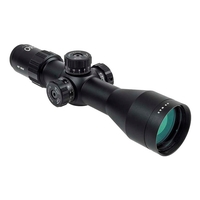
PAO HD MAX 4-16x44 SF FFP Ultra Compact Riflescope
via Uttings
£219.00
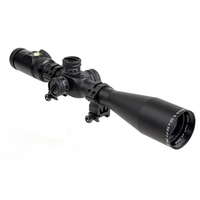
PAO F1 5-20x50 IR SF FFP Rifle Scope
via Uttings
£239.00

Hawke Vantage 30 WA FFP 4-16x50 Rifle Scope
via Uttings
£249.00
Buying Advice
Start with the specs that actually matter for zero-stop performance. Total elevation travel is listed in MOA or MRAD (milliradians) and tells you how much vertical adjustment the erector system can physically move. A scope with 80 MOA of total travel that consumes 20 MOA just to reach a typical 100-yard zero leaves you only 60 MOA of usable 'up' travel — and every zero-stop design eats a small additional slice of that range because the mechanical stop must sit slightly above the erector's true bottom. Look for scopes that publish both total travel and usable travel above zero. In MRAD terms, a scope offering 30 mils total with 24 mils usable above a 100-yard zero is a strong performer; each 0.1 mil click equals 1 cm at 100 meters (roughly 0.36 inches at 100 yards), so 24 mils gives you approximately 86 inches of drop compensation at 1,000 yards — enough for most 6.5 Creedmoor or .308 Win loads.
Budget tiers in 2026 break roughly into three bands. Entry-level zero-stop scopes — think Bushnell's RevLimiter-equipped models and some Athlon or Arken offerings — generally fall in the $300–$600 range. They deliver the core 'hard floor' function reliably, though turret feel and optical quality may lag behind. Mid-tier options from $600–$1,200 include Vortex Viper PST II and select Leupold Mark 5HD configurations with CDS-ZL turrets; here you get noticeably better glass, tighter click tolerances, and more refined turret mechanisms. Premium scopes above $1,200 — Nightforce ATACR and NX8 with ZeroStop, Vortex Razor HD Gen III with CRS, top-shelf Leupold Mark 5HD — deliver the tightest tracking, best optical clarity, and most tactile zero-stop engagement. Each tier is a legitimate choice depending on how often and how far you shoot.
Common mistakes center on three issues. First, buyers confuse a zero stop with a locking turret — a locking turret simply prevents accidental rotation during carry but does not establish a mechanical floor at your zero. Second, shooters sometimes set the zero stop without actually confirming their zero on paper or steel first, which means the 'stop' is at the wrong elevation and every subsequent dial is off. Third, many buyers overweight zero-stop design and underweight optical quality or reticle choice. A first-focal-plane reticle with hash marks in MRAD (or MOA) is far more important for fast follow-up holds than the specific stop mechanism, because in dynamic shooting you will often hold rather than dial. Always confirm that the scope's reticle and focal plane suit your shooting style before obsessing over turret hardware.
US-specific context matters. PRS and NRL competitors overwhelmingly favor MRAD-based FFP scopes with exposed, tool-less zero stops because stages demand rapid dialing and a guaranteed return to zero between positions. Leupold's CDS-ZL system — which uses a clutch-style cap you lift and spin — is popular among western hunters who want a clean custom dial matched to a specific load in MOA but still need a reliable return point. Vortex's CRS, found on the Razor HD Gen III competition line, uses a removable collar approach favored by serious PRS shooters who want maximum upward travel. For general long-range recreation — steel at 600–1,000 yards with a 6.5 Creedmoor or 6mm ARC bolt gun — any of the mid-tier zero-stop scopes available on Amazon.com or OpticsPlanet will serve well. State-level purchase considerations for optics are minimal in the US; unlike firearms, scopes ship freely to all 50 states.
Matching the zero stop to your use case is ultimately about discipline and frequency. If you compete in PRS or NRL, a premium FFP MRAD scope with a locking-ring zero stop (Nightforce ZeroStop or Vortex CRS) is virtually mandatory — the time savings and confidence during rapid stage transitions justify the cost. If you are a western big-game hunter who takes one or two long-range shots per season but needs absolute reliability in cold, dusty, or wet conditions, a Leupold CDS-ZL or Nightforce ZeroStop on a quality hunting scope provides peace of mind. If you are an eastern whitetail hunter shooting inside 150 yards from a treestand, a zero stop is a nice-to-have but not essential; your budget is better spent on superior low-light optical performance. Be honest about your actual shooting distances and cadence before spending extra on turret engineering you may never exploit.
The brand landscape in 2026 is healthier than ever for US buyers. Nightforce remains the benchmark for pure zero-stop mechanical precision and is heavily represented in military and PRS circles. Vortex has pushed hard with the CRS system on competition-oriented Razor models while keeping zero-stop options accessible in the Viper PST II line. Leupold's CDS-ZL is unique in combining a custom ballistic dial with a clutch-type zero stop — a very US-centric approach given the brand's strong domestic manufacturing and custom-shop turret program. Bushnell's RevLimiter has democratized the feature at entry-level price points, making zero-stop accessible to budget-conscious shooters building their first precision rifle. Athlon, Arken, and Maven also offer zero-stop models in various price bands, broadening the competitive field. Whichever system you choose, verify that the turret tracks accurately (box tests at 100 yards are the gold standard) before trusting it in the field.
Frequently Asked Questions
What exactly does a zero stop do, and how is it different from a locking turret?
A zero stop creates a physical barrier that prevents the elevation turret from dialing below your confirmed zero setting. When you dial up for a distant shot and then spin back down, the turret physically stops at zero — you feel and hear it. A locking turret, by contrast, simply locks the turret in its current position to prevent accidental movement during carry or recoil; it does not establish a fixed return point. Many hunting scopes have locking turrets without zero stops, and some premium scopes offer both features together.
How does a locking-ring zero stop (like Nightforce ZeroStop) differ from a clutch-type mechanism (like Leupold CDS-ZL)?
A locking-ring system uses a threaded ring or collar inside the turret housing that physically contacts a hard shoulder when the turret reaches zero — you feel a definitive mechanical stop and cannot rotate further. A clutch-type mechanism lets you lift the turret cap, disengage a friction plate, spin the dial to align the zero mark, and re-engage. The locking-ring approach generally provides a more tactile, positive stop under rapid dialing, while the clutch approach is often simpler to re-zero in the field when switching loads. Both are reliable when properly set.
Does a zero stop reduce my total available elevation travel?
Yes, slightly. Every zero-stop mechanism occupies a small amount of the erector's total mechanical range because the stop hardware must sit just at or slightly above the erector's lowest point. In practice this cost is typically 1–3 MOA (or 0.3–1 mil) of downward travel below your optical center. Since you set your zero above optical center (you dial up from the erector's bottom to reach a 100-yard zero), the real concern is how much upward travel remains above zero. Always check the manufacturer's specification for 'elevation travel available above zero' rather than just total travel.
Do I need a zero stop for PRS or NRL competition?
It is not technically required by rule, but virtually every competitive PRS and NRL shooter uses one. Stages often require rapid transitions between targets at very different distances — you may dial 8 mils up, engage, then need to return to zero or near-zero for the next position. A zero stop lets you spin the turret down without counting clicks or reading numbers, saving critical seconds. At the competitive level, the Nightforce ZeroStop and Vortex CRS are the most common systems, typically on FFP MRAD scopes.
Is a zero stop worth it for whitetail deer hunting east of the Mississippi?
For most eastern whitetail scenarios, probably not. The majority of whitetail deer in the eastern US are taken at distances well under 150 yards from treestands or ground blinds, where you are unlikely to dial elevation at all — a simple holdover with your reticle is faster and sufficient. Your budget would be better allocated toward superior low-light optical performance (larger objective, high-quality lens coatings) rather than turret engineering. A zero stop becomes more valuable for western hunting where longer cross-canyon shots at mule deer, antelope, or elk are realistic.
Can I set a zero stop myself, or does it require a gunsmith?
All four major US-market zero-stop systems — Nightforce ZeroStop, Leupold CDS-ZL, Vortex CRS, and Bushnell RevLimiter — are designed for user setup without special tools. The general process is: confirm your true zero on paper or steel at 100 yards, then follow the manufacturer's procedure to set the stop at that turret position (usually involving loosening a set screw, seating a ring, or lifting and realigning the turret cap). No gunsmith is needed, but you must confirm zero accurately first. If your zero is wrong, the stop will be set at the wrong point, and every subsequent dial will carry that error.
What is the difference between MOA and MRAD turrets, and does it affect zero-stop function?
MOA (minute of angle) turrets typically click in 1/4 MOA increments, where 1 MOA equals approximately 1.047 inches at 100 yards. MRAD (milliradian) turrets typically click in 0.1 mil increments, where 0.1 mil equals 1 cm at 100 meters or roughly 0.36 inches at 100 yards. The zero-stop mechanism itself functions identically regardless of angular unit — it is a mechanical stop, not a measurement system. Choose MOA or MRAD based on your reticle preference, ballistic calculator output, and what your shooting community uses. PRS competitors overwhelmingly use MRAD; many US hunters still prefer MOA.
How do I know if a specific scope has enough elevation travel above zero for my cartridge at long range?
Run your specific load through a ballistic calculator (like the free Hornady 4DOF app or Applied Ballistics solver) to find the elevation adjustment needed at your maximum intended distance. For example, a typical 140-grain 6.5 Creedmoor load at 2,700 fps needs roughly 12.5 mils (about 43 MOA) of elevation to reach 1,000 yards from a 100-yard zero. Then check the scope's published 'elevation available above zero' specification. If the scope offers 24 mils above zero, you have ample margin. If it offers only 14 mils, you are cutting it very close and may run out of travel in high-altitude or high-temperature conditions where velocity shifts alter your drop curve.
Can I use a zero stop with a custom ballistic turret or BDC dial?
Yes — in fact, Leupold's CDS-ZL system is specifically designed to pair a custom ballistic dial (laser-engraved for your exact load and conditions) with a clutch-type zero stop. You dial to the yardage marked on the turret, take the shot, and spin back to the hard stop at zero. Nightforce also offers custom elevation dials compatible with their ZeroStop mechanism. If you use a BDC-style turret, a zero stop is arguably even more useful because the markings only correspond to correct distances when you start from a true zero — the stop guarantees that starting point every time.
Related guides
What is a zero stop turret, how does it work, and do you actually need one on your rifle scope? Our UK expert guide covers the pros, cons, and key buying criteria for 2026.
LPVO Zero Distance: How to Choose & Why It MattersLearn the optimal zero distance for your LPVO rifle scope in 2026. Covers 50 vs 100-yard zero, BDC reticles, FFP vs SFP, and the best scope picks for US hunters and competitors.
Zeroing Your Rifle Scope at 100 Yards — UK GuideLearn how to zero a rifle scope at 100 yards with this UK-focused guide. Covers MOA vs MRAD adjustments, parallax, bore-sighting, and the best scope features for a reliable 100-yard zero.
How to Swap Day and Night Optics on the Same RifleLearn how to swap between a day rifle scope and a night vision scope on the same rifle without losing zero. Covers mounts, reticles, zeroing tips, and top picks for US hunters.
How to Sight In a Rifle Scope: Step-by-Step First-Time GuideFirst time sighting in a rifle scope? Our 2026 step-by-step US guide walks you through mounting, bore-sighting, and dialing in your zero at 25 and 100 yards.
Best Prairie Dog Hunting Scopes for 2026Find the best high-magnification FFP scopes for prairie dog hunting at 200-600+ yards. Expert US buying guide covers turrets, reticles, MOA vs MRAD, and top picks.
Best Scopes for Squirrel & Small-Game Hunting in 2026Find the best scope for squirrel hunting in 2026. We cover .22LR rimfire and PCP/springer air rifles across budget tiers, plus parallax and magnification advice for 15-40 yard shots.
Not sure which scope is right for you?
Try our AI-powered scope finder — answer a few questions and get personalised recommendations.
Find My Scope →Get a UK scope tip every day
Follow AiScopes on Facebook for daily buying guides, deals and gear advice.
Follow on Facebook