How to Swap Day and Night Optics on the Same Rifle
By Peter Makulek · Senior Optics Editor · · Live prices from UK retailers
Running a single rifle for both daytime hunts and nighttime hog control is increasingly common across the US, but it raises a practical problem most optics articles ignore: how do you swap between a day rifle scope and a night vision scope—or a clip-on thermal—without losing your hard-won zero every time you switch? The answer lies in a combination of repeatable mounting systems, compatible reticle choices, and disciplined zeroing protocols. Whether you are running a bolt-action .308 for whitetail by day and feral hogs after dark, or alternating between a precision 6.5 Creedmoor scope and a Pulsar clip-on for predator control, this guide covers the full workflow.
The core challenge is return-to-zero (RTZ). Every time you remove and re-mount an optic, you introduce the possibility of a point-of-impact shift. On a best rifle scope with a premium quick-detach (QD) mount—think American Defense, Bobro, or Scalarworks—you can typically expect RTZ within 0.5 MOA or better, which translates to about half an inch at 100 yards. That is acceptable for most hunting scenarios where whitetail deer are commonly taken under 150 yards from a stand. But if your night hunting setup involves a dedicated night vision scope that sits in a different mount or a clip-on unit that attaches in front of your day optic, the variables multiply and the stakes rise.
US hunters face a unique regulatory patchwork when it comes to hunting night with optics. In Texas, hog hunting at night with thermal or night vision is essentially unrestricted on private land. States like Georgia, Oklahoma, and Arkansas have opened seasons for predator and hog hunting after dark as well. But many states still prohibit the use of night vision or thermal for game animals like deer or elk. Before investing $2,000-plus in a best night vision scope or thermal clip-on, confirm your state's regulations—not just for the species, but for the specific technology (image intensification vs. thermal vs. digital) allowed.
This guide walks through the gear, the technique, and the trade-offs so you can confidently run one rifle across both roles. We cover the best optic choices for day use, the leading night vision and thermal options, the mounting solutions that make swapping practical, and the reticle and adjustment considerations (FFP vs. SFP, MOA vs. MRAD) that matter when your scope changes but your rifle and load do not. The product picks below are chosen for their RTZ-friendly mounting compatibility and real-world performance in both roles.
Top Picks — Live UK Prices
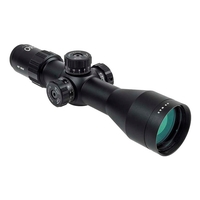
PAO HD MAX 4-16x44 SF FFP Ultra Compact Riflescope
via Uttings
£219.00
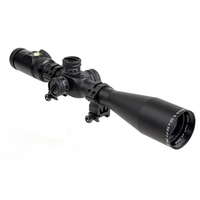
PAO F1 5-20x50 IR SF FFP Rifle Scope
via Uttings
£239.00

Hawke Vantage 30 WA FFP 4-16x50 Rifle Scope
via Uttings
£249.00
Buying Advice
Start with the mount, not the scope. The single most important component in a swap-friendly system is a QD mount with a verified return-to-zero spec. Look for lever-lock or throw-lever designs machined from 7075-T6 aluminum with steel crossbolts and a clamping interface that indexes against a Picatinny rail's cross-slots. American Defense Manufacturing (ADM), Bobro Engineering, and Scalarworks all publish RTZ data under 0.5 MOA. Mount both your day rifle scope and your night optic in the same rail standard (usually Picatinny MIL-STD-1913), and always torque to the manufacturer's spec with a calibrated wrench. If you are running a clip-on night vision unit in front of a day scope—like a Pulsar or AGM model—you avoid the swap problem entirely, but you add weight forward of the action and introduce a second optical path that can affect image quality and parallax behavior.
Reticle and adjustment-system compatibility matters more than most buyers realize. If your day scope is a first-focal-plane (FFP) MRAD optic—common on precision rigs in 6.5 Creedmoor or .308—your holdovers and wind calls are based on milliradian subtensions that remain valid at any magnification. Switching to a night vision scope with a simple duplex reticle or a BDC calibrated in MOA means your ranging and holdover muscle memory does not transfer. Where possible, keep both optics in the same adjustment system (both MRAD or both MOA). Remember: 1 MOA equals approximately 1.047 inches at 100 yards; 0.1 MRAD equals 1 centimeter at 100 meters, or roughly 0.36 inches at 100 yards. Mixing systems is manageable but introduces mental math you do not want under pressure at night.
Budget tiers break down clearly. At the entry level ($150–$400), you can pair a solid SFP hunting scope—like a Vortex Crossfire II or Bushnell Banner 2—with a digital night vision device in the sub-$500 range. Return-to-zero at this tier depends heavily on the mount, so invest the savings into a quality QD base rather than the cheapest rings you find. Mid-tier ($400–$1,200 per optic) opens up FFP rifle scopes from Vortex (Viper PST Gen II, Diamondback Tactical) and Leupold (Mark 5HD, VX-5HD) alongside capable digital night vision scopes from Sightmark or Pulsar's Digex line. Premium setups ($1,200–$3,500+ per optic) pair high-end day glass from Leupold, Nightforce, or Vortex Razor with true Gen 3 image-intensified night vision or thermal clip-ons from Pulsar, FLIR, or L3Harris. At every tier, the mount is the linchpin.
The most common mistake buyers make is assuming that bore-sighting after a swap replaces a live-fire zero confirmation. It does not. A bore sight or laser collimator can get you on paper, but thermal expansion, rail flex under recoil, and micro-variations in lever tension mean you should always confirm zero with at least a three-round group before a hunt. Another frequent error is over-tightening QD levers, which can deform the rail interface over time and degrade RTZ. Follow the mount manufacturer's torque spec exactly. Finally, many hunters buy a night vision scope with a magnification range that does not match their engagement distances—hog hunting at night inside 100 yards rarely needs more than 4–6x, so a bulky 6–24x digital unit adds weight and cost for capability you will not use.
For US-specific context, the calibers and platforms that benefit most from a day/night swap system are the workhorses: bolt-action rifles in .308 Winchester, .30-06 Springfield, .300 Win Mag, and 7mm Rem Mag for hunting, and AR-10/SR-25-pattern rifles in .308 or 6.5 Creedmoor for dual-purpose precision and predator/hog control. The AR-platform rifles often have full-length Picatinny top rails, which simplify clip-on night vision mounting. Bolt guns may need an aftermarket rail (Badger Ordnance, EGW, or Seekins) to get the same indexing repeatability. For purchasing, Amazon.com carries a wide selection of day rifle scopes, mounts, and some digital night vision devices under the aiscopeus-20 tag. OpticsPlanet is another strong option, particularly for thermal clip-ons, Gen 3 night vision, and hard-to-find mounting accessories. Always verify that the optic you are ordering ships to your state—some night vision devices have export or state-level shipping restrictions.
In the brand landscape, Vortex dominates the mid-tier day-scope conversation with aggressive warranties (unlimited, transferable lifetime VIP) and a deep US dealer network. Leupold remains the premium American-made choice, with the VX-6HD and Mark 5HD offering exceptional glass clarity and light transmission that matters at dawn and dusk—the edges of the day/night transition. Bushnell punches above its weight at entry and mid price points, particularly the Engage and Forge lines. For night vision and thermal, Pulsar is the brand with the most mindshare among US hunters, thanks to the Thermion 2, Digex, and Trail series covering both dedicated night vision scopes and clip-on thermal monoculars. Matching a Vortex or Leupold day scope with a Pulsar night device in QD mounts is arguably the most popular and field-proven swap system in the US market today.
Frequently Asked Questions
What is the best scope for deer hunting with a .308?
For whitetail deer with a .308 Winchester, a 3-9x40 or 4-12x44 SFP scope covers the vast majority of stand and blind hunting under 200 yards. The Vortex Viper HS or Leupold VX-3HD in this magnification range offers excellent light transmission for dawn and dusk shots. If you also plan to swap to a night optic on the same rifle for hog control, prioritize a model that fits a QD mount so you can maintain return-to-zero when switching.
What is the best scope for deer hunting with a .30-06?
The .30-06 Springfield is one of America's most versatile deer cartridges, effective from tight timber to open fields. A 3-15x44 or 2.5-10x44 rifle scope balances close-range speed with enough magnification for 300-yard crossings. Leupold's VX-5HD and Vortex's Viper PST Gen II are excellent choices. Both are available in configurations that pair well with QD lever mounts, making them ideal if you intend to swap to a dedicated night optic for after-dark predator work on the same rifle.
What is the best scope for elk hunting with a .300 Win Mag?
Elk hunting in the western US often involves shots from 200 to 400 yards across open basins, so a 4-16x or 5-25x FFP scope with exposed turrets and a zero-stop is ideal on a .300 Win Mag. The Vortex Razor HD LHT, Leupold Mark 5HD, or Bushnell Forge are all proven performers. Choose MRAD turrets if you are comfortable with metric-based corrections, or MOA if you prefer thinking in inches at 100 yards. The .300 Win Mag's recoil demands a scope with robust internal construction.
What is the best scope for elk hunting with a 7mm Rem Mag?
The 7mm Rem Mag shoots flat and hits hard at distance, making it a classic western elk round. A 4-16x50 or 5-25x56 rifle scope gives you the magnification and objective lens diameter for low-light canyon shots at dawn and dusk. Leupold VX-6HD and Vortex Viper PST Gen II are popular among elk hunters. If your 7mm also doubles as a long-range predator rifle, a FFP reticle with mil or MOA hash marks lets your holdovers stay accurate across the entire zoom range.
What is the best scope for hog hunting at night?
For hunting night hogs, most shots happen inside 150 yards over feeders or bait sites. A dedicated digital night vision scope like the Pulsar Digex C50 or Sightmark Wraith 4K offers built-in IR illumination and recording capability without needing ambient starlight. Thermal scopes like the Pulsar Thermion 2 detect body heat through brush and darkness. If you prefer to keep your day scope zeroed and simply add night capability, a clip-on thermal or night vision unit mounted forward of your existing scope avoids the swap-and-rezero problem entirely.
What is the best scope for long range shooting with a .308?
For precision long-range work with a .308 Winchester—whether PRS competition or prairie dog control—a 5-25x56 FFP scope with MRAD turrets, a zero-stop, and a Christmas-tree-style reticle is the standard. The Vortex Viper PST Gen II 5-25x50 and Bushnell XRS3 are strong mid-to-premium options. The .308's practical precision ceiling is roughly 800–1,000 yards depending on load and conditions; beyond that, 6.5 Creedmoor or similar cartridges offer less wind drift. A FFP reticle ensures your subtension-based holdovers are accurate regardless of magnification setting.
Can I use an air rifle scope on a centerfire rifle, or vice versa?
Generally, no. An air rifle scope is designed for the unique double-recoil impulse of spring-piston air rifles but typically lacks the internal robustness to handle centerfire recoil. Conversely, a centerfire rifle scope mounted on a springer air rifle may fail because the reverse recoil shears standard scope internals. If you shoot both platforms, buy dedicated optics for each. For air rifles effective to 50–75 yards at sub-12 ft-lb energy levels, a compact 3-9x or 4-12x air rifle scope with an adjustable objective for parallax correction at short range is the best air rifle optic choice.
Does FFP or SFP matter when swapping between day and night optics?
Yes. If your day scope is FFP, your reticle subtensions are accurate at every magnification, which simplifies holdover shots and ranging. Most dedicated night vision scopes, however, are fixed-magnification or use SFP reticles where subtension values are only correct at one zoom setting. This means your ranging and holdover techniques may differ between your day and night setups. Being aware of this mismatch—and confirming your holds at the magnification you actually use in the field—prevents costly misses, especially on game.
How do I confirm zero after swapping optics back onto my rifle?
After re-mounting an optic in a QD mount, fire a minimum three-round group at 100 yards to confirm point-of-impact has not shifted. A quality QD mount should return within 0.5 MOA, but environmental factors, rail wear, and lever tension variations can introduce small shifts. A bore-sight laser can save ammunition by getting you on paper first, but it is not a substitute for live-fire confirmation. Never head into the field—especially for a night hunt where follow-up opportunities are limited—without a verified zero on whichever optic is currently mounted.
Related guides
Find the best daytime AR-15 scopes for hog hunting in 2026. We compare magnification, reticles, and durability across budget tiers so you pick the right optic fast.
Leupold Mk5HD 3.6-18×44 SPR Optic GuideIs the Leupold Mk5HD 3.6-18×44 the best scope for long range hunting and precision shooting? We break down the SPR reticle, FFP vs SFP, and how it stacks up in 2026.
Zero Stop Turrets Explained: Do You Really Need One?What is a zero stop turret, how does it work, and do you actually need one on your rifle scope? Our UK expert guide covers the pros, cons, and key buying criteria for 2026.
Zero Stop Turrets Explained for US ShootersHow zero-stop turrets work, which US-market systems (Leupold CDS-ZL, Vortex CRS, Nightforce ZeroStop, Bushnell RevLimiter) to buy, and how to choose by budget and discipline in 2026.
Red Dot vs LPVO for Driven Shooting: Which Is Right for You?Choosing the best scope for driven shooting in the UK? We compare red dot sights and low-power variable optics for fast-moving driven game, covering legality, speed, and budget in 2026.
Scoping Your Barrett MRAD — The Definitive 2026 GuidePair your Barrett MRAD with the perfect rifle scope. We cover top optics, caliber choices, reticle systems, and long range setup tips for US shooters in 2026.
The No-Budget PRS Scope Debate SettledEnd the no-budget PRS scope debate. We compare the best scope for PRS competition across every price tier, covering FFP reticles, turret tracking, and glass clarity for US shooters.
Not sure which scope is right for you?
Try our AI-powered scope finder — answer a few questions and get personalised recommendations.
Find My Scope →Get a UK scope tip every day
Follow AiScopes on Facebook for daily buying guides, deals and gear advice.
Follow on Facebook