Leupold Mk5HD 3.6-18×44 SPR Optic Guide
By Peter Makulek · Senior Optics Editor · · Live prices from UK retailers
The Leupold Mark 5HD 3.6-18×44 occupies a coveted sweet spot in the rifle scope world — enough magnification range for legitimate long range precision work out past 800 yards, yet light and compact enough to sit comfortably on a hunting rifle you carry all day in the Rockies or the hardwood ridges of Pennsylvania. Chambered rifles in 6.5 Creedmoor, .308 Winchester, and .300 PRC are the platform of choice for most buyers eyeing this optic, and for good reason: the 5× zoom ratio and 44mm objective keep the package under 23 ounces, which is nearly half a pound lighter than competing 56mm long range scopes from Vortex or Nightforce in similar magnification classes.
The "SPR" in the model name stands for Special Purpose Reticle, a Leupold-designed Christmas-tree style hash-mark system offered in both MRAD and MOA variants. For shooters who need to hold wind and elevation corrections without dialing — common in coyote hunting scenarios where a second shot opportunity vanishes in seconds — the SPR reticle provides intuitive subtension marks at every power setting because the Mk5HD 3.6-18 is a front-focal-plane (FFP) scope. That FFP design means the reticle scales proportionally with magnification, so your holdover references remain accurate whether you are on 3.6× scanning a treeline or on 18× ranging a steel target at distance.
Why does this scope keep surfacing in forums, Reddit threads, and YouTube channels heading into 2026? Three reasons converge: first, Leupold's Twilight Max HD light-management system delivers genuine low-light performance that rivals European glass costing twice as much, a critical factor during the magic-hour windows that define whitetail and elk hunting. Second, the 35mm main tube with a zero-stop elevation turret gives serious competitive shooters the mechanical travel they need — roughly 29 MRAD (100 MOA) of total internal adjustment — without resorting to a canted 20-MOA base in most situations. Third, it is entirely US-assembled in Beaverton, Oregon, which matters to a large segment of American shooters.
In this guide we go deep on the specifications, explain what the numbers actually mean in real-world shooting, compare the Mk5HD 3.6-18 against alternatives from Vortex, Bushnell, and other brands, and answer the most common questions US buyers are asking — from deer hunting with a .30-06 to pushing a 6.5 Creedmoor past 1,000 yards. Whether you are building a do-everything rifle or upgrading the optic on a dedicated precision rig, this is the resource you need before you spend north of a thousand dollars on glass.
Top Picks — Live UK Prices
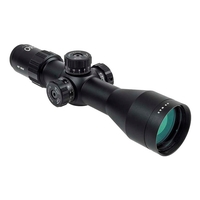
PAO HD MAX 4-16x44 SF FFP Ultra Compact Riflescope
via Uttings
£219.00
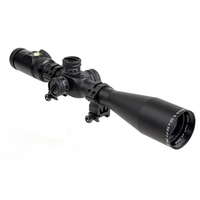
PAO F1 5-20x50 IR SF FFP Rifle Scope
via Uttings
£239.00

Hawke Vantage 30 WA FFP 4-16x50 Rifle Scope
via Uttings
£249.00
Buying Advice
Start with the specs that actually drive real-world performance. The Mk5HD 3.6-18×44 delivers 5× erector ratio, 44mm objective, and a 35mm main tube. The FFP SPR reticle is offered in both MOA and MRAD — remember that 1 MOA equals approximately 1.047 inches at 100 yards while 0.1 MRAD (1 click on most mil turrets) equals 1 centimeter at 100 meters, or roughly 0.36 inches at 100 yards. Parallax is adjustable via a side-focus knob from 50 yards to infinity, which is essential for any scope you intend to use beyond 200 yards. If you have never adjusted parallax before, set it so the reticle does not shift against the target when you move your eye behind the scope — that eliminates aiming error that no amount of good ammunition can fix.
Budget tiers in this magnification class break down clearly. Entry-level options like certain Bushnell Match Pro or Vortex Diamondback Tactical models land in the $300–$500 range and deliver workable FFP reticles with exposed turrets, but glass clarity and mechanical repeatability drop off compared to mid-tier choices. The mid tier — roughly $700–$1,200 — includes scopes like the Vortex Viper PST Gen II 5-25×50 and the Bushnell XRS3, both excellent values. The Mk5HD 3.6-18 sits at the premium tier, generally found between $1,600 and $2,200 depending on reticle and finish, competing with Nightforce NX8 and Vortex Razor HD Gen III. At that price you are paying for lighter weight, superior glass coatings, bombproof mechanicals, and Leupold's lifetime warranty honored domestically.
The most common mistake buyers make is over-scoping their rifle for its actual mission. If you are hunting whitetail deer from a tree stand or ground blind in the Midwest, the vast majority of your shots will be inside 150 yards — you do not need 25× magnification, and a heavy 30-ounce scope on a .308 or .30-06 hunting rifle creates a ponderous, unbalanced package. The Mk5HD 3.6-18 avoids that trap: 3.6× on the low end provides a wide field of view for close-in timber shots, while 18× is more than enough to read wind on a steel plate at 1,000 yards. Conversely, if your primary discipline is PRS competition, you may want more top-end magnification — 25× or even 34× — for target identification at extreme range.
For US-specific context, consider where you will actually shop. Amazon.com carries the Mk5HD line and ships to all 50 states without restriction since complete optics are not classified as firearms or restricted parts. OpticsPlanet is another strong option with frequent coupon codes and financing. Local dealers accessible through tools like our 50-state dealer locator can let you handle the scope before buying, which matters when comparing the feel of Leupold's CDS-ZL2 turrets against a Vortex RevStop or a Nightforce ZeroStop. There are no state-level legal restrictions on purchasing rifle scopes anywhere in the US — scopes are simply accessories. However, if you pair this optic with a night vision clip-on or a thermal scope for coyote hunting at night, note that some states restrict the use of artificial light or electronic sighting devices for hunting certain game species, so always check your state's game regulations.
Matching the Mk5HD 3.6-18 to your use case is straightforward once you are honest about your shooting. For a 6.5 Creedmoor precision build intended for steel out to 1,200 yards, the MRAD SPR reticle with its detailed wind-hold hash marks is ideal — pair it with a quality 20-MOA rail and you will have plenty of elevation travel. For elk hunting in open Western terrain where 400-yard shots are realistic, the scope's light weight and excellent glass make it a better field choice than heavier 5-25× alternatives. For an air rifle or rimfire trainer, this scope is overkill and mismatched; sub-12 ft-lb air rifles are realistically effective to 50–75 yards, and a lighter, cheaper optic in the 3-9× or 4-16× class will serve you far better without wasting money.
The brand landscape in this space is competitive and healthy for the buyer. Leupold remains the benchmark for lightweight, US-made hunting and tactical optics, and the Mk5HD line is their flagship. Vortex offers incredible warranty service and aggressive pricing, making the Razor HD Gen III series a fierce competitor — though it is heavier. Bushnell has surged with the XRS3 and the Elite Tactical line, offering FFP MRAD optics at lower price points. For night vision and thermal applications like dedicated coyote hunting at night, Pulsar dominates the thermal scope market with models like the Thermion 2, which occupies an entirely different category but is worth mentioning since many hunters building a coyote rig consider both a day optic and a thermal scope. Ultimately, the Mk5HD 3.6-18 SPR earns its place as one of the best scopes available when you value the combination of precision-grade internals, hunting-grade weight, and an FFP reticle designed for real-world holdovers.
Frequently Asked Questions
Is the Leupold Mk5HD 3.6-18×44 the best scope for long range shooting with 6.5 Creedmoor?
It is one of the best scopes in its weight class for 6.5 Creedmoor long range work. The FFP SPR reticle provides accurate holdovers at any magnification, and the 35mm tube gives you roughly 29 MRAD of elevation travel — enough to reach 1,200+ yards with a 6.5 CM using a 20-MOA base. If you need more top-end magnification for PRS-style target ID, a 5-25× scope may suit you better, but for a versatile rifle that also hunts, the 3.6-18 is hard to beat.
Is this a good scope for whitetail hunting?
Yes, and arguably better suited to hunting than many heavier precision optics. At under 23 ounces it keeps your rifle balanced for carry and offhand shooting. The 3.6× low end provides a generous field of view for close shots inside 100 yards, which is where most whitetail deer are taken from stands and blinds. Leupold's Twilight Max HD coatings excel in the dawn and dusk windows when mature bucks move. If your rifle is chambered in .308, .30-06, or 6.5 Creedmoor, this scope matches all three platforms perfectly.
What is the best scope for deer hunting with a .308 Winchester?
The Mk5HD 3.6-18 is an outstanding choice for a .308 deer rifle, especially if you also want to shoot targets or compete casually. The .308 is effective on whitetail and mule deer out to 400–500 yards in skilled hands, and 18× is more than enough magnification for that distance. Budget-conscious hunters might consider the Vortex Viper PST Gen II or Bushnell Match Pro, both of which deliver FFP reticles at lower price points, though with heavier weight and slightly less optical clarity.
Can I use the Mk5HD 3.6-18 for elk hunting out West?
Absolutely — this is one of its strongest use cases. Western elk hunts in states like Montana, Colorado, and Idaho often involve long glassing sessions, steep terrain, and shots between 200 and 500 yards. The Mk5HD's light weight means you are not punished during a 10-mile day in the backcountry, and the SPR reticle lets you hold for wind and elevation quickly without dialing. Pair it with a .300 Win Mag, .28 Nosler, or 7mm Rem Mag and you have a capable elk setup.
What is the difference between FFP and SFP, and why does the Mk5HD use FFP?
In a first-focal-plane (FFP) scope like the Mk5HD, the reticle scales with magnification — so the subtension values of holdover marks and windage hashes are accurate at every power setting. In a second-focal-plane (SFP) scope, the reticle stays the same apparent size and is only dimensionally accurate at one specific magnification, usually the highest. FFP is preferred for tactical and precision use because you can make fast holdover corrections without remembering to set a specific power. The tradeoff is that the reticle can appear thin at low magnification, though Leupold's illumination helps mitigate that.
Should I choose MOA or MRAD for the SPR reticle?
Both systems are equally precise — the choice is about familiarity and ecosystem. MRAD (milliradians) is dominant in PRS competition and military applications, with most ballistic solvers defaulting to mils. MOA is traditional in US hunting and benchrest circles and pairs naturally with thinking in inches — 1 MOA ≈ 1.047 inches at 100 yards. If you are building a precision 6.5 Creedmoor and running a Kestrel with Applied Ballistics, MRAD is the more practical choice. If you already think in MOA and your other rifles are set up that way, stay consistent.
Is the Mk5HD 3.6-18 suitable for coyote hunting?
It is excellent for daytime coyote hunting where you are calling predators across open fields or prairie. The 3.6× low end handles the close-in shots when a coyote charges the caller inside 50 yards, and 18× lets you reach out on a runner at 400+. For dedicated nighttime coyote hunting, you would need to add a clip-on night vision device or switch to a standalone thermal scope like a Pulsar Thermion — the Mk5HD is a daylight/low-light optic, not a night vision scope. Check your state regulations before using any electronic sighting aid for hunting at night.
How does the Mk5HD compare to the Vortex Razor HD Gen III 6-36×56?
These are fundamentally different tools. The Razor Gen III is a 40+ ounce competition scope with 6× zoom ratio and massive 56mm objective — it is built for PRS matches and bench shooting. The Mk5HD 3.6-18 weighs roughly 22.5 ounces and is designed for versatility across hunting and precision roles. If you need the best scope for stationary precision work and weight is irrelevant, the Razor Gen III is superb. If you need a rifle scope that does double duty on a backcountry hunt and a range day, the Mk5HD wins on weight and versatility.
Can I use this scope on an air rifle?
You could physically mount it, but it would be a poor match. Sub-12 ft-lb spring-piston air rifles are realistically effective to 50–75 yards, and even high-powered PCP air rifles rarely stretch past 100–150 yards. The Mk5HD's price, weight, and magnification range are all overkill for that application. A quality 3-9×40 or 4-16×44 scope from Vortex or Bushnell in the $150–$300 range is far more appropriate. Also note that spring-piston air rifles produce a unique bi-directional recoil that can damage optics not rated for it — the Mk5HD is not specifically designed for springer recoil.
Related guides
Learn how to swap between a day rifle scope and a night vision scope on the same rifle without losing zero. Covers mounts, reticles, zeroing tips, and top picks for US hunters.
Premium PRS Scopes Compared: ATACR vs Razor Gen 3 vs Mark 5HD vs NX6Nightforce ATACR, Vortex Razor HD Gen III, Leupold Mark 5HD and NX6 compared for UK PRS shooters — real trade-offs and honest opinions at the £1,800+ premium scope tier.
Red Dot vs LPVO for Driven Shooting: Which Is Right for You?Choosing the best scope for driven shooting in the UK? We compare red dot sights and low-power variable optics for fast-moving driven game, covering legality, speed, and budget in 2026.
Zero Stop Turrets Explained for US ShootersHow zero-stop turrets work, which US-market systems (Leupold CDS-ZL, Vortex CRS, Nightforce ZeroStop, Bushnell RevLimiter) to buy, and how to choose by budget and discipline in 2026.
How to Sight In a Rifle Scope: Step-by-Step First-Time GuideFirst time sighting in a rifle scope? Our 2026 step-by-step US guide walks you through mounting, bore-sighting, and dialing in your zero at 25 and 100 yards.
VMR-4 vs EBR-7C: Which Vortex Reticle Is Right for You?Discover the real differences between Vortex VMR-4 and EBR-7C reticles, which scopes use them, and how to pick the right one for hunting or long range shooting in 2026.
Fixing Windage Problems on the Hawke Airmax ScopeStruggling with windage drift or maxed-out adjustments on your Hawke Airmax? Our 2026 guide diagnoses common causes and recommends proven rifle scope upgrades for US shooters.
Not sure which scope is right for you?
Try our AI-powered scope finder — answer a few questions and get personalised recommendations.
Find My Scope →Get a UK scope tip every day
Follow AiScopes on Facebook for daily buying guides, deals and gear advice.
Follow on Facebook