How to Sight In a Rifle Scope: Step-by-Step First-Time Guide
By Peter Makulek · Senior Optics Editor · · Live prices from UK retailers
This guide is for one specific situation: you have a brand-new scope (or a scope that has never been sighted in) and you need to get it on paper for the very first time. It is deliberately a procedural walkthrough — mount, bore-sight, shoot, adjust, confirm — written for a US shooter who has never done this before. If your scope WAS previously zeroed and has since started missing, that is a different problem; AIScopes already publishes 'Scope Not Hitting Where You Aim? Troubleshooting Checklist' for diagnosing drift, loose rings, or turret tracking failures. Bookmark that one for later, but start here first.
Sighting in a rifle scope is not complicated, but it is precise. Every step builds on the last: if the scope is mounted crooked or the rings are torqued unevenly, no amount of careful shooting at 100 yards will produce a reliable zero. The procedure below is caliber-agnostic — it works whether you are mounting a Vortex Diamondback on a .308 bolt gun, a Leupold VX-Freedom on a .30-06 hunting rifle, or a Bushnell AR Optics on an AR-15 in 5.56 NATO. We will call out the few places where platform or cartridge choice changes the steps.
Most US hunters take whitetail deer at distances well under 150 yards from a stand or blind, and most range shooting starts at 100 yards. That means a solid 100-yard zero covers the vast majority of real-world situations. We will walk you through confirming at 25 yards first (to save ammunition and get on paper quickly), then refining at 100, and finally verifying at whatever distance you actually plan to shoot — whether that is 200 yards for Western mule deer or 50 yards for thick-cover Eastern whitetail.
Before you begin, gather everything you will need: the rifle (unloaded), the scope, the correct rings and base or mount for your action, a torque wrench or torque driver with inch-pound bits, blue threadlocker (Loctite 242 or equivalent), a bore-sighter or laser bore-sighter (optional but strongly recommended), a stable bench or rest, targets with a visible grid, and at least 20-30 rounds of the same ammunition you plan to hunt or compete with. Using consistent ammo matters — different loads print to different points of impact, so sight in with what you intend to shoot in the field.
Top Picks — Live UK Prices
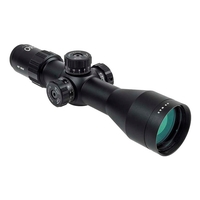
PAO HD MAX 4-16x44 SF FFP Ultra Compact Riflescope
via Uttings
£219.00
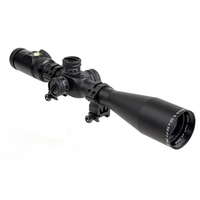
PAO F1 5-20x50 IR SF FFP Rifle Scope
via Uttings
£239.00

Hawke Vantage 30 WA FFP 4-16x50 Rifle Scope
via Uttings
£249.00
Buying Advice
Understanding the key specs on your scope will help you sight in more efficiently. MOA (minute of angle) turrets move your point of impact approximately 1.047 inches per click at 100 yards — most US hunting scopes use 1/4-MOA clicks, so four clicks equal roughly one inch at 100 yards. MRAD (milliradian) turrets move the reticle 0.1 mil per click, which equals 1 centimeter at 100 meters or about 0.36 inches at 100 yards — ten clicks equal 3.6 inches. Either system works; the important thing is knowing which system YOUR scope uses before you start adjusting. Check the turret cap markings or your manual. If you have a first-focal-plane (FFP) scope, the reticle subtensions are accurate at every magnification, which is useful for holdover confirmation at distance. If you have a second-focal-plane (SFP) scope, the subtensions are only accurate at one specific magnification (usually the highest), which matters if you plan to use reticle marks for range estimation rather than dialing the turrets.
Budget tiers in 2026 break down roughly as follows. Entry-level scopes in the $100-$250 range — such as the Vortex Crossfire II, Bushnell Banner 2, or budget Leupold Freedom lines — deliver clear glass and reliable tracking for hunting at moderate distances. Mid-range scopes from $250-$700 — like the Vortex Viper series, Leupold VX-3HD, or Bushnell Nitro — add features like zero-stop turrets, better multi-coated glass, and tighter manufacturing tolerances for more repeatable click tracking. Premium scopes above $700 from Leupold, Vortex Razor, and specialty makers offer top-tier optical clarity, bombproof repeatability, and advanced features like locking turrets and illuminated reticles. For a first-time sighting-in, the scope's price tier does not change the procedure — but it does affect how confidently you can trust each click to land exactly where it should.
The most common mistake beginners make is starting at 100 yards without bore-sighting first. If your scope is significantly off-bore, your first shots at 100 yards may miss the entire target backer, wasting ammunition and causing frustration. Always start at 25 yards after bore-sighting. A second frequent error is over-torquing the ring screws: most aluminum rings need only 15-25 inch-pounds, and steel rings typically 25-35 inch-pounds depending on the manufacturer. Over-tightening can dent the scope tube, crack a ring, or warp the erector assembly inside the scope. Always use a torque wrench and follow the ring manufacturer's specification — not the scope manufacturer's, unless they are the same. A third mistake is adjusting between every single shot instead of firing a group, assessing the center of the group, and then making one calculated correction.
In the US market, Amazon.com carries a wide selection of scopes, rings, mounts, torque wrenches, and laser bore-sighters from Vortex, Leupold, Bushnell, and most other major brands. OpticsPlanet is another strong option with deep inventory and frequent bundle deals on scope-and-mount combinations. When purchasing rings and mounts, match the tube diameter (most hunting scopes are 1-inch or 30mm; some tactical and premium optics are 34mm) and the base style to your rifle's receiver (Picatinny/Weaver rail, Remington 700 two-piece bases, Tikka proprietary rail, etc.). If you are mounting on an AR-15-platform rifle, note that Amazon has specific policies around firearm-related parts and accessories — availability can vary, so verify listings carefully before ordering.
Matching your scope choice and zero distance to your actual use case prevents wasted effort. A hunter sitting in an Eastern treestand at 60-80 yards does not need a 5-25x FFP scope with exposed tactical turrets — a lightweight 3-9x40 SFP with a simple duplex reticle, sighted in at 100 yards, covers that scenario perfectly. A Western hunter taking shots across open sagebrush at 200-400 yards benefits from more magnification (4-16x or 5-25x), an MOA or MRAD reticle with holdover marks, and a 200-yard zero. A rimfire shooter plinking at 25-75 yards needs a parallax-adjustable scope set for short range (many centerfire scopes have a fixed parallax at 100 or 150 yards, which creates parallax error at closer distances). Air-rifle shooters using sub-12 ft-lb springers should stay within 50-75 yards and use scopes rated for springer recoil — standard centerfire scopes can be damaged by the unique reverse-recoil pulse of a spring-piston airgun.
The brand landscape in 2026 remains strong for US buyers. Vortex continues to dominate the value-to-performance conversation with an unconditional lifetime warranty and a lineup spanning every price tier from the Crossfire to the Razor HD Gen III. Leupold, manufactured in Beaverton, Oregon, appeals to hunters who value lightweight American-made glass and the proven CDS (Custom Dial System) turrets for specific cartridge drops. Bushnell offers aggressive pricing and solid performers like the Engage and Nitro lines. Pulsar, primarily known for thermal and digital night-vision optics, is increasingly relevant for US hunters in states that permit thermal-equipped hunting — their Thermion 2 and Merger LRF lines represent a distinct category outside traditional daylight optics. Regardless of brand, the sighting-in procedure below applies universally to any modern riflescope with adjustable turrets.
Frequently Asked Questions
What is the difference between sighting in a scope and troubleshooting a scope that has drifted?
Sighting in is the initial procedure of aligning a scope's point of aim with the rifle's point of impact — it is what you do when a scope has never been zeroed. Troubleshooting applies when a scope WAS zeroed and has since started missing, which can indicate loose rings, a damaged erector assembly, or a shifted base. This guide covers the first-time procedure only. If your scope was previously sighted in and has gone off, see AIScopes' 'Scope Not Hitting Where You Aim? Troubleshooting Checklist' for systematic diagnosis.
Do I really need a torque wrench for mounting scope rings?
Yes, strongly recommended. Most aluminum scope rings require only 15-25 inch-pounds of torque, and exceeding that can dent the scope tube, crack the ring, or damage the erector system inside the scope — any of which can make reliable sighting-in impossible. A basic inch-pound torque wrench or a dedicated scope-mounting torque driver (such as the Wheeler FAT Wrench) costs $30-$50 and is a one-time investment that protects every scope you ever mount. Follow the ring manufacturer's torque specification, not a guess.
Should I bore-sight or laser bore-sight before heading to the range?
Either method works, and both serve the same purpose: getting the scope's crosshair close enough to the bore's axis that your first shots at 25 yards will land on paper. Traditional bore-sighting (removing the bolt and visually aligning through the bore) is free and works well on bolt-action rifles. A laser bore-sighter (a cartridge-shaped laser inserted into the chamber) is faster, works on semi-autos and lever guns where you cannot look through the bore, and typically costs $20-$50. Neither method produces a finished zero — they simply save ammunition and frustration by getting you on paper quickly.
Why start at 25 yards instead of going straight to 100?
At 25 yards, even a significantly misaligned scope will still land shots somewhere on a standard target backer, making it easy to see where you are hitting and make initial corrections. At 100 yards, the same misalignment is magnified by four times, and your shots may miss the entire target — you would waste ammunition and have no feedback to work from. Once you are centered at 25 yards, moving to 100 yards typically puts you within a few inches of your intended point of impact, requiring only fine adjustments.
How many rounds does it typically take to sight in a rifle scope for the first time?
With a bore-sighter and a structured approach, most shooters can complete the entire process in 15-25 rounds: 3-5 rounds at 25 yards to get on paper and make initial corrections, 9-15 rounds at 100 yards to fire groups and refine the setting, and 3-6 rounds at your final confirmation distance. Without bore-sighting, you may need additional rounds at 25 yards to find your initial point of impact. Using the same ammunition throughout is important — switching loads can shift impact by several inches and undermine the entire process.
What does 'adjusting in the direction you want the impact to move' mean in practice?
Scope turrets are labeled with arrows marked 'UP' and 'R' (right). If your group is hitting low and left of your aiming point, you turn the top turret in the 'UP' direction and the side turret in the 'R' direction. The turret moves the reticle inside the scope, which shifts where the bullet impacts relative to the crosshair. For a 1/4-MOA scope, each click moves the point of impact approximately 0.25 inches at 100 yards — so if you are 2 inches low, you dial 8 clicks up.
Does it matter whether my scope is FFP or SFP for the sighting-in process?
For the basic sighting-in procedure — mounting, bore-sighting, and dialing the turrets to center your group — it makes no difference whether the scope is first-focal-plane or second-focal-plane. Both types use identical turret adjustment mechanisms. The distinction matters later if you use the reticle's subtension marks for holdover or range estimation: FFP reticles are accurate at all magnifications, while SFP reticle marks are only accurate at one specific power setting (usually the highest). During sighting-in, simply aim with the center crosshair at whatever magnification gives you the clearest view of the target.
What is parallax and do I need to adjust it when sighting in?
Parallax is an optical effect where the reticle appears to shift against the target when you move your eye slightly off the optical axis. Many hunting scopes have a fixed parallax setting at 100 or 150 yards, meaning parallax error is minimized at that distance but may be noticeable at shorter ranges like 25 yards. If your scope has an adjustable parallax knob (side focus) or adjustable objective (AO ring on the front bell), set it to match your shooting distance at each stage of the sighting-in process. Proper parallax adjustment eliminates a source of apparent aiming error and produces tighter, more honest groups.
I finished sighting in but my scope has started missing after a few range sessions — what now?
If your scope was properly sighted in and has since drifted or started throwing shots inconsistently, the issue is no longer an initial sighting-in problem — it is a troubleshooting situation. Common causes include loose ring screws, a shifting mount or base, a damaged erector spring, or even a change in ammunition lot. AIScopes publishes a dedicated 'Scope Not Hitting Where You Aim? Troubleshooting Checklist' that walks through systematic diagnosis. Start there rather than re-running the full sighting-in procedure, as the root cause may require a repair or component replacement rather than simply re-zeroing.
Related guides
Bought a scope that won't fit your Daisy 808's dovetail rail? Our UK 2026 guide explains adapter rings, mount types, and which optics actually suit budget air rifles.
Zeroing Your Rifle Scope at 100 Yards — UK GuideLearn how to zero a rifle scope at 100 yards with this UK-focused guide. Covers MOA vs MRAD adjustments, parallax, bore-sighting, and the best scope features for a reliable 100-yard zero.
Zero Stop Turrets Explained for US ShootersHow zero-stop turrets work, which US-market systems (Leupold CDS-ZL, Vortex CRS, Nightforce ZeroStop, Bushnell RevLimiter) to buy, and how to choose by budget and discipline in 2026.
How to Zero a Thermal Scope: The Hand-Warmer Method ExplainedLearn the thermal scope hand warmer zeroing method step by step. Fix weak heat contrast, choose the right distance, and get a reliable zero for night hunting in 2026.
Why Isn't My Scope Hitting Where I Aim? A Troubleshooting ChecklistScope not hitting where you aim? Work through this proven troubleshooting checklist — mounts, zero, parallax, ammo — cheapest and most likely causes first. US shooters, all platforms.
Best Scopes for the CZ 457 in 2026Find the best scope for your CZ 457 in 2026. We cover budget, mid-tier, and PRS-rimfire competition optics with adjustable parallax, turret quality, and US buying advice.
Best Daytime Scopes for Hog Hunting in 2026Find the best daytime AR-15 scopes for hog hunting in 2026. We compare magnification, reticles, and durability across budget tiers so you pick the right optic fast.
Not sure which scope is right for you?
Try our AI-powered scope finder — answer a few questions and get personalised recommendations.
Find My Scope →Get a UK scope tip every day
Follow AiScopes on Facebook for daily buying guides, deals and gear advice.
Follow on Facebook