VMR-4 vs EBR-7C: Which Vortex Reticle Is Right for You?
By Peter Makulek · Senior Optics Editor · · Live prices from UK retailers
If you're shopping for a Vortex scope in 2026, chances are you've run into two of the brand's most popular MRAD Christmas-tree reticles — the VMR-4 (Vortex Micro Reticle 4) and the EBR-7C (Enhanced Battle Reticle 7C). Both are hashmark-heavy, MRAD-based designs etched on glass, and both appear across several of Vortex's best-selling optic lines. At first glance they can look nearly identical, which is exactly why forums and social-media groups are flooded with the question: what's the actual, practical difference? This guide exists to give you a clear, technically accurate answer so you can buy with confidence.
Understanding which reticle suits your shooting discipline matters far more than most buyers realize. The reticle is the interface between you and your target — it's how you hold for wind, compensate for bullet drop, and range unknown-distance game. A reticle that's too busy can obscure a coyote's vitals at 400 yards; one that's too sparse leaves you without holdover references when your turret zero is set for 100. For US hunters chasing whitetail from an Eastern hardwood stand or pursuing elk across a Colorado basin, this single spec can make or break your confidence at the moment of truth.
Both the VMR-4 and EBR-7C are MRAD (milliradian) reticles, meaning each hash mark represents a known angular measurement — 0.1 mil clicks move your point of impact 1 centimeter at 100 meters, or roughly 0.36 inches at 100 yards. They're designed for shooters who think in mils rather than MOA, which has become the dominant system in long range precision shooting and is steadily gaining ground in hunting circles. If you're already running a Vortex Diamondback Tactical, Viper PST Gen II, or Razor HD Gen III, one of these two reticles is almost certainly in the eyepiece.
In this guide we'll break down the subtree layout, line thickness, illumination behavior, and scope-model availability for each reticle, then walk you through how to match the right one to your rifle, cartridge, and typical engagement distance. We'll also tackle the most common real-world questions US shooters are asking — from the best scope for deer hunting with a .308 to whether either reticle works on an air rifle or coyote-hunting rig. Let's get into the details.
Top Picks — Live UK Prices
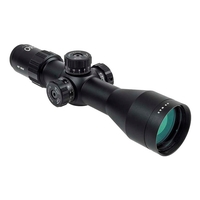
PAO HD MAX 4-16x44 SF FFP Ultra Compact Riflescope
via Uttings
£219.00
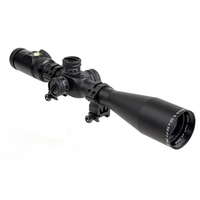
PAO F1 5-20x50 IR SF FFP Rifle Scope
via Uttings
£239.00

Hawke Vantage 30 WA FFP 4-16x50 Rifle Scope
via Uttings
£249.00
Buying Advice
Start with the specs that actually affect your shooting. The VMR-4 features a finer center dot and thinner hashmarks that keep the reticle clean at lower magnifications — ideal in a first focal plane (FFP) scope where the reticle scales with zoom. The EBR-7C uses slightly bolder lines and a more aggressive Christmas-tree pattern with wider spacing between the horizontal wind-hold marks, making it faster to read under stress but occupying more of the target image at high power. In an FFP optic like the Viper PST Gen II, both reticles are dimensionally accurate at every magnification, so your mil holds stay true whether you're at 5x scouting terrain or 25x sending a round downrange. In a second focal plane (SFP) scope, the reticle is only dimensionally correct at one magnification — usually the highest — so keep that in mind if you plan to hold rather than dial.
Budget tiers matter when choosing between these reticles because each one appears in different Vortex product lines. At the entry level ($250–$450), the Diamondback Tactical series offers the EBR-7C in both FFP and SFP configurations — an outstanding value for a first long range or coyote hunting scope. The mid-tier ($600–$1,100) Viper PST Gen II is available with either the VMR-4 (MRAD) or EBR-7C depending on the specific SKU and magnification range, giving you a genuine choice. At the premium end ($1,800+), Razor HD Gen III models tend toward the EBR-7C family, though Vortex periodically introduces limited reticle variants. Across all tiers, these scopes are widely available on Amazon.com and OpticsPlanet, often with free shipping and solid return policies.
The most common mistake buyers make is choosing a reticle based on how it looks in a catalog photo rather than how it performs at the magnification and distance they'll actually use. A reticle that appears beautifully detailed in a marketing render can become an unreadable cluster of lines when you're glassing at 6x in fading light. Conversely, a reticle that seems too simple on paper may be exactly right for fast target acquisition on a coyote at 300 yards. Another frequent error: buying an MRAD reticle but pairing it with MOA turrets — always confirm that both your reticle and your turret adjustments use the same angular system. Mixing units leads to math errors in the field and missed shots.
For US-specific context, consider what you're actually hunting and where. Most whitetail deer in the Eastern US are taken at under 150 yards from a treestand, where either reticle is more than adequate — the VMR-4's cleaner center may even be preferable for quick shots in tight timber. Western elk hunting in states like Colorado, Montana, or Wyoming often involves shots from 200 to 500 yards across open meadows or sagebrush flats, where the EBR-7C's bolder wind-hold marks shine. For prairie-dog or long range coyote hunting, where precise wind calls at 400+ yards are routine, the EBR-7C's wider subtension tree gives you more holdover and wind references without dialing. Caliber choice — whether you're running a .308 Winchester, .30-06 Springfield, 6.5 Creedmoor, or .300 Win Mag — doesn't change which reticle you need, but it does change how many mils of drop you'll reference, so a fuller tree helps flatter-shooting cartridges less than high-drop ones.
Matching the reticle to your use case comes down to three questions. First, do you primarily dial your turrets for elevation and hold for wind, or do you hold for both? If you dial, either reticle works because you'll mostly use the center crosshair; if you hold, the EBR-7C's denser tree gives more reference points. Second, do you shoot in low light — dawn and dusk hunts — where a thinner reticle like the VMR-4 preserves more target detail? Third, are you running a magnification range above 20x where reticle thickness at max zoom could obscure small targets? For precision rifle competition (PRS/NRL), the EBR-7C is slightly more popular because competitors rely heavily on wind holds and rapid corrections. For a general-purpose hunting rifle scope, the VMR-4's subtlety is often the better fit.
In the broader brand landscape, Vortex competes with Leupold's Tremor 3 and Mark 5HD reticles, Bushnell's Deploy MIL reticle in the XRS3, and specialty thermal or night vision optics from Pulsar — which use entirely different aiming solutions. If you're considering a thermal scope or night vision for hog or coyote hunting, understand that traditional glass reticles don't apply; those platforms have digital overlays. For conventional daylight rifle scopes, Vortex's lifetime VIP warranty — unlimited, transferable, no receipt needed — remains one of the strongest in the industry and applies equally to VMR-4 and EBR-7C models. That warranty alone keeps Vortex at the top of many US hunters' shortlists and makes either reticle a low-risk investment.
Frequently Asked Questions
What is the main difference between the Vortex VMR-4 and EBR-7C reticles?
The VMR-4 uses finer crosshair lines and a more compact Christmas-tree subtension pattern, keeping the sight picture cleaner at lower magnifications. The EBR-7C has bolder hashmarks and a wider, more aggressive tree with additional wind-hold references. Both are MRAD-based and designed for FFP or SFP scopes, but the EBR-7C is generally preferred for long range holdover shooting while the VMR-4 is favored for hunting where a less cluttered reticle aids target identification.
What is the best scope for whitetail hunting?
For whitetail hunting, a mid-range Vortex scope like the Viper PST Gen II 2-10x32 or 3-15x44 is an excellent choice because most whitetail shots occur under 150 yards from a stand or blind. A low-power variable with the VMR-4 reticle keeps the sight picture clean in tight timber and low-light conditions. Leupold's VX-6HD and Bushnell's Elite 4500 are also strong contenders in this space if you prefer MOA turrets.
What is the best scope for deer hunting with a .308?
A .308 Winchester is effective for deer out to 400+ yards, but most ethical shots on whitetail or mule deer are taken well inside 300 yards. A Vortex Viper PST Gen II 3-15x44 with either the VMR-4 or EBR-7C reticle pairs beautifully with the cartridge's trajectory. The .308 drops roughly 7–8 mils at 500 yards depending on load, so even the VMR-4's more compact tree covers typical hunting distances comfortably. Look for FFP models if you want your mil holds accurate at any zoom setting.
What is the best scope for deer hunting with a .30-06?
The .30-06 Springfield has a very similar trajectory to the .308 but with slightly more velocity from heavier bullets, making it a classic US deer cartridge. A best Vortex scope option is the Diamondback Tactical 4-16x44 with the EBR-7C — it offers excellent glass quality for the price and enough magnification for cross-canyon shots. For premium builds, the Razor HD LHT 3-15x42 is lighter and optically superb, ideal for mountain hunts where every ounce counts.
What is the best scope for elk hunting in Colorado?
Colorado elk hunting often involves shots across open parks and alpine basins from 200 to 500 yards, so you want a scope with enough magnification and a reticle that supports wind holds. The Vortex Razor HD Gen III 6-36x56 with the EBR-7C is a top-tier choice for dedicated elk rifles in .300 Win Mag or 7mm Rem Mag. If weight matters — and it usually does at 10,000 feet of elevation — the Viper PST Gen II 5-25x50 is significantly lighter while still offering the holdover references you need.
Can I use a VMR-4 or EBR-7C reticle scope on an air rifle?
You can mount a Vortex scope on a PCP air rifle without issue, and the MRAD reticle will function normally for holdovers at short range. However, spring-piston air rifles generate a unique double-recoil that can damage optics not rated for it — Vortex scopes are generally rated for centerfire recoil, not springer recoil patterns. Also remember that sub-12 ft-lb air rifles are only effective to about 50–75 yards, so you won't use much of the Christmas-tree holdover pattern. For air rifle use, a simpler reticle or a dedicated airgun scope may be more practical.
Which reticle is better for coyote hunting?
For coyote hunting, the EBR-7C has a slight edge because coyote shots often happen quickly at 200–400 yards and the bolder hashmarks make it faster to find a wind-hold reference without dialing. Pair it with an FFP scope like the Diamondback Tactical 6-24x50 for an affordable, effective coyote rig. If you hunt coyotes at night, consider supplementing with a thermal scope from Pulsar for detection and using your Vortex rifle scope for the shot — or investing in a dedicated clip-on night vision unit.
Are VMR-4 and EBR-7C reticles available in MOA versions?
No — both the VMR-4 and EBR-7C are MRAD-only reticle designs. Vortex offers separate MOA reticle options (such as the VMR-2 and BDC variants) in some of the same scope families. If you prefer MOA adjustments (1 click = 1/4 MOA = ~0.26 inches at 100 yards), make sure to select a scope SKU explicitly marked as MOA. Mixing an MRAD reticle with MOA turrets, or vice versa, is a common and costly mistake that complicates field corrections.
Does FFP vs SFP matter when choosing between the VMR-4 and EBR-7C?
Absolutely. In a first focal plane (FFP) scope, the reticle scales proportionally with magnification, so your mil-based holdovers are accurate at any zoom level — this is ideal for long range and competition use. In a second focal plane (SFP) scope, the reticle stays the same apparent size regardless of zoom and is only dimensionally correct at one magnification (usually max). If you plan to hold for wind and elevation rather than dialing turrets, an FFP scope with either reticle is strongly recommended to avoid calculation errors.
Related guides
Christmas tree reticles explained for US shooters: real advantages, disadvantages, best FFP scopes for long range, hunting & PRS. Expert 2026 buying guide.
Burris vs Vortex: The UK Shooter's VerdictBurris or Vortex — which scope brand suits UK shooters best? We compare FFP/SFP reticles, MOA vs MRAD turrets, warranties and UK availability to help you decide.
Premium PRS Scopes Compared: ATACR vs Razor Gen 3 vs Mark 5HD vs NX6Nightforce ATACR, Vortex Razor HD Gen III, Leupold Mark 5HD and NX6 compared for UK PRS shooters — real trade-offs and honest opinions at the £1,800+ premium scope tier.
Zero Stop Turrets Explained for US ShootersHow zero-stop turrets work, which US-market systems (Leupold CDS-ZL, Vortex CRS, Nightforce ZeroStop, Bushnell RevLimiter) to buy, and how to choose by budget and discipline in 2026.
How to Sight In a Rifle Scope: Step-by-Step First-Time GuideFirst time sighting in a rifle scope? Our 2026 step-by-step US guide walks you through mounting, bore-sighting, and dialing in your zero at 25 and 100 yards.
Fixing Windage Problems on the Hawke Airmax ScopeStruggling with windage drift or maxed-out adjustments on your Hawke Airmax? Our 2026 guide diagnoses common causes and recommends proven rifle scope upgrades for US shooters.
Why Isn't My Scope Hitting Where I Aim? A Troubleshooting ChecklistScope not hitting where you aim? Work through this proven troubleshooting checklist — mounts, zero, parallax, ammo — cheapest and most likely causes first. US shooters, all platforms.
Not sure which scope is right for you?
Try our AI-powered scope finder — answer a few questions and get personalised recommendations.
Find My Scope →Get a UK scope tip every day
Follow AiScopes on Facebook for daily buying guides, deals and gear advice.
Follow on Facebook