Christmas Tree Reticles: Advantages & Disadvantages
By Peter Makulek · Senior Optics Editor · · Live prices from UK retailers
If you have spent any time shopping for a rifle scope in 2026, you have almost certainly encountered the term "Christmas tree reticle." Named for its shape — a thin crosshair up top that widens into increasingly long hash marks as you move down — this reticle family has exploded in popularity across PRS competition, long range hunting, and even tactical circles. But the design is not universally loved, and plenty of shooters wonder whether a Christmas tree pattern is genuinely useful or just a trend. This guide breaks down the real advantages and disadvantages so you can decide whether one belongs on your next optic.
Christmas tree reticles are almost always paired with first focal plane (FFP) glass and MRAD turrets, though a handful of MOA versions exist. The defining feature is a subtension-rich lower half: dense holdover and windage marks that let you compensate for bullet drop and wind drift without dialing your turrets. That capability matters most at extended range — beyond 400 or 500 yards — where a .308 Win or 6.5 Creedmoor shooter may need 5+ mils of holdover and several mils of wind correction on a single shot.
For US shooters, context matters. Most whitetail deer are harvested inside 150 yards from a treestand or ground blind, where a simple duplex or BDC reticle is perfectly adequate. But western elk hunters in Colorado, long range coyote hunting enthusiasts on the Great Plains, and PRS competitors routinely engage targets beyond 600 yards — exactly the scenario where a Christmas tree reticle earns its keep. Understanding where your shooting actually happens is the single most important factor before committing to this style.
Below, we will walk through the specific advantages and disadvantages, recommend FFP scopes that use Christmas tree reticles well, and answer the most common questions US hunters and competitive shooters are asking right now. Whether you are building a precision 6.5 CM rig or upgrading the glass on a proven .30-06 elk rifle, this guide will help you make the right call.
Top Picks — Live UK Prices
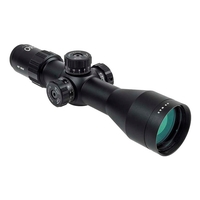
PAO HD MAX 4-16x44 SF FFP Ultra Compact Riflescope
via Uttings
£219.00
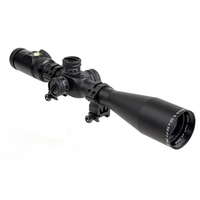
PAO F1 5-20x50 IR SF FFP Rifle Scope
via Uttings
£239.00

Hawke Vantage 30 WA FFP 4-16x50 Rifle Scope
via Uttings
£249.00
Buying Advice
Start with the key specs that actually matter for a Christmas tree reticle scope. Because these reticles are subtension-dense, they only read correctly at one magnification in a second focal plane (SFP) design — which is why almost every quality Christmas tree scope is first focal plane (FFP). Confirm FFP before you buy. Next, check the MRAD or MOA convention: most Christmas tree patterns are MRAD (0.1 mil click = 1 cm at 100 meters), but a few use MOA (1 MOA ≈ 1.047 inches at 100 yards). Make sure turrets, reticle, and your ballistic solver all speak the same language. Parallax adjustment range matters too — look for a side-focus parallax knob that goes down to at least 50 yards if you plan to shoot inside 200, and up to infinity for long range work. Finally, a locking zero-stop turret prevents lost zeros in the field.
Budget tiers in 2026 break down roughly as follows. Entry-level options in the $300–$600 range — think Vortex Diamondback Tactical FFP or certain Bushnell Match Pro models — deliver surprisingly usable Christmas tree reticles with good glass clarity, though edge sharpness and low-light transmission may lag. Mid-tier scopes from $600–$1,200, such as the Vortex Viper PST Gen II or Bushnell Elite Tactical XRS3, offer noticeably better optical quality, more precise turret feel, and tighter quality control. Premium glass from $1,500 and up — Leupold Mark 5HD, Vortex Razor HD Gen III, or comparable lines — delivers elite light transmission, essentially zero chromatic aberration, and bombproof repeatability. For most US hunters and recreational long range shooters, the mid-tier sweet spot delivers 90 percent of the performance at half the cost.
The most common mistake buyers make is choosing a Christmas tree reticle they do not actually need. If your deer hunting is exclusively from a Midwest treestand at 50–120 yards, a complex reticle adds visual clutter without adding capability. Conversely, shooters who do need holdovers often buy a Christmas tree reticle and then never learn to read it — the subtensions are useless if you have not built a drop chart or run a ballistic app like Applied Ballistics or Hornady 4DOF. Another frequent error is mixing MOA turrets with an MRAD reticle (or vice versa), which creates confusion when making corrections. Always verify that reticle and turret units match before checkout.
US-specific context shapes the decision significantly. Western elk hunts in states like Colorado, Montana, and Wyoming frequently involve 300–500-yard shots across open basins, and a Christmas tree reticle gives you fast wind and drop holds without dialing. For coyote hunting across open farmland in the Great Plains or Texas, the same logic applies — predators rarely give you time to dial turrets. Meanwhile, eastern whitetail hunters in dense timber may find a simple Leupold VX-Freedom with a duplex reticle far more practical. You can buy most recommended scopes through Amazon.com (our US affiliate tag aiscopeus-20 is live) or OpticsPlanet, both of which offer competitive pricing and easy returns to all 50 states.
Matching the optic to your specific use case is critical. On a .308 Win deer rifle used in mixed terrain, a mid-magnification FFP scope (3-15× or 4-16×) with a moderately dense Christmas tree reticle strikes a good balance — enough holdover marks for a 400-yard opportunity, but not so busy that close shots are cluttered. For a dedicated long range or PRS rifle in 6.5 Creedmoor or 6.5 PRC, a 5-25× with a very dense tree reticle is ideal. If you are mounting glass on an air rifle for backyard pest control, skip the Christmas tree entirely: sub-12 ft-lb springers are realistically effective to about 50–75 yards, and a simple mil-dot or duplex at moderate magnification is far more appropriate. For night vision or thermal scope setups — think Pulsar Thermion 2 for hog hunting — dedicated digital reticles replace traditional glass reticles altogether, so the Christmas tree debate does not apply.
The brand landscape in 2026 favors a few key players. Vortex dominates the mid-tier Christmas tree segment with the PST Gen II and Razor HD Gen III lines, backed by an unconditional lifetime warranty. Leupold offers the Mark 5HD and Mark 4HD with their Tremor and PR2 reticles — excellent for US military and hunting crossover use. Bushnell's XRS3 provides strong competition at a slightly lower price point. Pulsar leads the thermal scope and night vision scope categories for hog hunting and predator control, though those are digital systems outside the traditional Christmas tree conversation. When choosing between brands, prioritize turret repeatability, warranty support, and US-based service — all four brands listed maintain robust US service centers.
Frequently Asked Questions
What is the best scope for whitetail hunting?
For whitetail deer, most shots occur under 150 yards from a treestand or blind, so a simple, bright optic matters more than a complex reticle. A Leupold VX-3HD or Vortex Viper HD in 3-9× or 2-10× with a duplex or BDC reticle is ideal. If you also want the option for longer cross-field shots, consider a 3-15× FFP scope with a modest Christmas tree reticle, but do not over-scope for close timber hunting.
What is the best scope for deer hunting with a .308?
The .308 Win is effective to around 800 yards ballistically but is most commonly used for deer inside 300 yards. A mid-range FFP scope like the Vortex Viper PST Gen II 3-15×44 or Bushnell Match Pro 6-24×50 pairs well. For shots under 200 yards, a simple SFP 3-9× is lighter and cheaper. If you want a Christmas tree reticle on a .308, choose one with holdover marks out to at least 6 mils — enough for a 500-yard cold-bore hold.
What is the best scope for deer hunting with a .30-06?
The .30-06 Springfield remains one of America's most versatile hunting cartridges. A quality 3-15× or 4-16× scope in the $400–$900 range covers most scenarios. Leupold's VX-5HD and Vortex's Viper PST Gen II are both excellent choices. If you hunt mixed terrain — eastern hardwoods plus occasional western trips — a Christmas tree FFP reticle gives you flexibility without requiring turret dialing for longer shots.
What is the best scope for elk hunting?
Elk hunting often involves glassing across wide basins and taking shots at 200–500 yards in challenging light conditions. Prioritize optical clarity, light transmission, and a reliable zero-stop. A 4-16× or 5-25× FFP scope with a Christmas tree reticle from Leupold (Mark 5HD) or Vortex (Razor HD Gen III) excels here. Weight matters when you are packing into the backcountry, so consider scopes under 30 ounces if possible.
What is the best scope for elk hunting in Colorado?
Colorado elk units vary dramatically — from dense timber in Unit 61 to open alpine basins in Unit 76. A versatile 3-18× or 4-16× FFP scope handles both scenarios well. The Leupold Mark 5HD 3.6-18×44 is a popular choice among Colorado hunters for its light weight and excellent Tremor 3 Christmas tree reticle. Build a ballistic drop chart for your specific load at Colorado's higher elevations (7,000–12,000 feet), where thinner air reduces drag and flattens trajectories noticeably.
Do Christmas tree reticles work in SFP scopes?
Technically yes, but it is not recommended. In a second focal plane scope, the reticle subtensions are only accurate at one specific magnification (usually the highest). At any other power setting, your holdover marks are wrong, which defeats the purpose of a subtension-rich Christmas tree design. This is why nearly all quality Christmas tree reticle scopes are built in first focal plane (FFP) configurations.
Are Christmas tree reticles too busy for hunting?
At low magnification, a well-designed Christmas tree reticle in an FFP scope shrinks to a fine, uncluttered crosshair — perfectly usable for close shots in timber. Visual clutter only appears at higher magnifications, which is exactly when you need the holdover references. The key is choosing a reticle with good contrast (illuminated center dot helps) and practicing enough that the marks become intuitive rather than distracting.
Can I use a Christmas tree reticle scope for coyote hunting?
Absolutely — coyote hunting is one of the best use cases. Predators rarely sit still long enough for you to dial turrets, so fast holdover capability is critical. A 4-16× or 5-25× FFP scope with a Christmas tree reticle on a flat-shooting cartridge like .22-250 or .204 Ruger lets you engage coyotes from 100 to 500+ yards using holds alone. For night coyote hunting where legal, consider pairing a traditional rifle scope with a clip-on night vision device, or switching to a dedicated thermal scope from Pulsar.
What are the main disadvantages of Christmas tree reticles?
The primary drawbacks are visual complexity and a steeper learning curve. Shooters who do not invest time in understanding their reticle subtensions and building accurate drop data will not benefit from the design. In FFP scopes, the reticle can appear very thin and hard to see at low magnification, or very thick and potentially target-obscuring at maximum power on small targets. Additionally, quality Christmas tree reticle scopes tend to cost more than simpler alternatives, and the dense markings are unnecessary for hunters who shoot exclusively inside 200 yards.
Related guides
Christmas tree reticle or clean holdover design for PRS? Our 2026 UK guide compares Tremor3, EBR-7C, PR2 and more to help you pick the right precision rifle reticle.
VMR-4 vs EBR-7C: Which Vortex Reticle Is Right for You?Discover the real differences between Vortex VMR-4 and EBR-7C reticles, which scopes use them, and how to pick the right one for hunting or long range shooting in 2026.
Zero Stop Turrets Explained for US ShootersHow zero-stop turrets work, which US-market systems (Leupold CDS-ZL, Vortex CRS, Nightforce ZeroStop, Bushnell RevLimiter) to buy, and how to choose by budget and discipline in 2026.
How to Sight In a Rifle Scope: Step-by-Step First-Time GuideFirst time sighting in a rifle scope? Our 2026 step-by-step US guide walks you through mounting, bore-sighting, and dialing in your zero at 25 and 100 yards.
How Much Magnification Do You Actually Need for Tree-Stand Whitetail?Discover exactly how much scope magnification you need for tree-stand whitetail hunting. We break down power ranges, FOV, and top US picks so you never over- or under-scope your rifle.
Can You Use a 20 MOA Rail with a Vortex Venom at 100 Yards?Find out if a 20 MOA rail works with the Vortex Venom at 100 yards. We cover zero offset, turret range, and when a canted base actually helps or hurts your setup.
PA GLX 2.5-10×44: Raptor M2 Reticle vs Griffin MilWondering whether the PA GLX 2.5-10×44 with Raptor M2 reticle beats the Griffin Mil version? Our 2026 US buyer's guide breaks down holdovers, subtensions, and real-world use cases.
Not sure which scope is right for you?
Try our AI-powered scope finder — answer a few questions and get personalised recommendations.
Find My Scope →Get a UK scope tip every day
Follow AiScopes on Facebook for daily buying guides, deals and gear advice.
Follow on Facebook