Can You Use a 20 MOA Rail with a Vortex Venom at 100 Yards?
By Peter Makulek · Senior Optics Editor · · Live prices from UK retailers
The question of whether a 20 MOA rail pairs sensibly with a Vortex Venom rifle scope at 100 yards is one that keeps popping up on forums and social media, and the answers are often contradictory or incomplete. The short version: yes, you absolutely can use a 20 MOA rail at 100 yards, but you need to understand what that canted base is doing to your mechanical zero and whether the Venom's turret range can compensate. A 20 MOA rail tilts your scope's optical axis downward relative to the bore, effectively "pre-dialing" about 20 MOA of elevation. That means when you zero at 100 yards, your elevation turret will be roughly 20 MOA lower in its travel than it would be on a flat rail, leaving more upward adjustment available for long range shots.
The Vortex Venom is a solid mid-tier rifle scope that has gained a loyal following among US shooters running bolt guns in calibers like .308 Winchester, 6.5 Creedmoor, and .223 Remington. It offers a generous total elevation adjustment range—typically around 80 to 100 MOA depending on the specific model—making it a capable optic for shooters who want to stretch past 500 yards without spending premium-tier money. In the context of a 20 MOA rail, those numbers matter because the rail eats into your downward adjustment. At 100 yards, you will simply dial your turret down from mechanical center to establish zero, using roughly 20 MOA of your below-center travel. As long as the scope has enough below-center range, you are fine.
Where confusion arises is the difference between total adjustment range and usable adjustment range above and below mechanical center. Most scopes split their travel roughly evenly—so a scope with 90 MOA total has about 45 MOA above and 45 MOA below center. Mount it on a 20 MOA rail and zero at 100 yards, and you have used roughly 20 of those 45 MOA of downward travel. You still have around 25 MOA below your 100-yard zero (more than enough for close-range holdover or zeroing at shorter distances) and a full 65 MOA of upward dial available for long range work. That extra upward travel is the entire point of a canted rail—it lets you reach out farther before you run out of elevation.
For the typical US shooter running a Savage 110 Tactical, Bergara B-14 HMR, or Ruger Precision Rifle in .308 or 6.5 Creedmoor, the combination of a Vortex Venom on a 20 MOA rail is not just viable—it is a smart setup if you plan to shoot beyond 600 yards. At 100 yards, the zero process is no different from any other scope; you simply fire a group, adjust your turret, and confirm. The only practical caveat is that your reticle will appear slightly lower in the tube at mechanical center, but once you dial to your 100-yard zero, the image will look perfectly normal. Let's break down the key factors, the best scope options in this category, and how to avoid the most common mistakes.
Top Picks — Live UK Prices

Nikko Stirling Diamond Long Range 30mm Tactical 4-16x50 IR Rifle Scope
via Uttings
£199.00

Hawke Endurance 30 WA 1-4x24 IR (Tactical Dot 4x) Telescopic Sights
via BushWear
£251.10
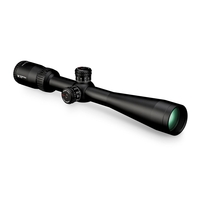
Vortex Diamondback Tactical 4-12x40 Riflescope - VMR-1 Reticle (MOA)
via Uttings
£299.00
Buying Advice
Understanding the key specs starts with total elevation adjustment and how it divides around mechanical center. When shopping for the best vortex scope to pair with a canted rail, look for total elevation travel of at least 80 MOA. The Vortex Venom 5-25x56 FFP, for example, offers roughly 90+ MOA of total elevation. On a 20 MOA rail, that leaves you approximately 65 MOA of usable upward dial from a 100-yard zero—enough to push a .308 Winchester past 1,000 yards in most atmospheric conditions, or a 6.5 Creedmoor well beyond that. Also check the per-revolution value of the turret (typically 10 or 15 MOA per turn) and whether the scope has a reliable zero-stop mechanism so you can return to your 100-yard zero by feel in the field.
Budget tiers matter when selecting a rifle scope for this kind of setup. Entry-level options in the $250–$450 range—like the Bushnell Match Pro or certain Vortex Diamondback Tactical models—offer surprisingly usable turrets and sufficient elevation travel, though glass clarity and coating quality will lag behind pricier options. Mid-tier scopes from $450 to $900, including the Vortex Venom and Leupold Mark 3HD, represent the sweet spot for most US shooters: solid glass, reliable tracking, zero-stops, and enough adjustment range for a 20 MOA rail setup. Premium options above $1,000—like the Vortex Razor HD Gen III or Leupold Mark 5HD—deliver top-shelf glass, rock-solid repeatability, and ultra-precise turrets, but many shooters honestly do not need that level of refinement for practical long range shooting or deer hunting.
Common mistakes buyers make when pairing a 20 MOA rail with a scope include choosing an optic with insufficient total elevation travel, which can leave you unable to zero at 100 yards because the scope literally cannot dial down far enough. Another frequent error is assuming a 20 MOA rail is always necessary. If you are exclusively hunting whitetail deer with a .308 or .30-06 at typical US stand-hunting distances of 50 to 200 yards, a flat (0 MOA) rail is perfectly adequate and keeps your turrets closer to mechanical center, which is optically ideal. The 20 MOA rail earns its keep when you genuinely plan to shoot beyond 600 yards—for PRS competition, long range steel, or western elk hunting across canyons where 400- to 700-yard shots are realistic.
US-specific context is important here. Most whitetail hunters in the East and Midwest take deer well under 200 yards, making a flat rail and a quality 3-15x or 4-16x scope the better choice. Western hunters pursuing elk with a 300 Win Mag or 7mm Rem Mag across open terrain in Montana, Wyoming, or Colorado are the shooters who benefit most from a 20 MOA rail because those cartridges drop significantly past 500 yards and you need every click of elevation you can get. For purchasing, Amazon.com is the easiest route for rails, rings, and many optics, and OpticsPlanet often stocks a wider variety of tactical accessories. Always verify the rail's hole spacing matches your receiver—Remington 700, Savage short action, and Tikka T3x all use different patterns.
Matching the setup to your use case is the final and most important step. If your primary discipline is PRS-style competition or long range target shooting, a first-focal-plane vortex scope like the Venom 5-25x56 FFP on a 20 MOA rail is an excellent combination. If you are a coyote hunter working at night with a thermal scope or dedicated night vision setup on a secondary rifle, the 20 MOA rail is largely irrelevant—most thermal engagements on coyotes happen inside 300 yards. Air rifle shooters should avoid 20 MOA rails entirely; the short effective range of even high-powered air rifles (generally under 100 yards for hunting-class PCPs, and 50–75 yards for sub-12 ft-lb springers) means you will never need that extra elevation, and the rail will just complicate your zero.
The brand landscape in this space is worth understanding. Vortex dominates the mid-tier US market with an unconditional lifetime warranty and a deep product lineup from the Crossfire II through the Razor HD. Leupold remains the go-to for lightweight hunting optics and has a fiercely loyal following among western big-game hunters. Bushnell has made aggressive moves in the tactical and PRS space with the Match Pro series, offering excellent value. Pulsar leads the thermal scope and night vision segment for hog hunting at night and predator control. Each brand has strengths; the best scope for your setup depends on whether you prioritize glass quality, turret feel, weight, reticle design, or warranty support.
Frequently Asked Questions
Will a 20 MOA rail prevent me from zeroing a Vortex Venom at 100 yards?
No, as long as the Vortex Venom model you choose has enough total elevation adjustment—and virtually all current Venom models do. A 20 MOA rail uses roughly 20 MOA of your below-center turret travel to establish a 100-yard zero. With the Venom's 90+ MOA total range, you will still have approximately 25 MOA below zero and 65 MOA above, which is more than sufficient. The zero process itself is identical to zeroing on a flat rail.
What is the best scope for long range shooting with a .308?
For dedicated long range work with a .308 Winchester, a first-focal-plane scope in the 5-25x magnification range with exposed, locking turrets and a zero-stop is ideal. The Vortex Venom 5-25x56 FFP is one of the best values in this category, with strong glass and reliable tracking. The Leupold Mark 5HD 5-25x56 is a premium alternative with exceptional optical clarity and lighter weight. Pair either with a 20 MOA rail if you plan to engage targets beyond 700 yards, where .308 drop exceeds 20 MOA.
What is the best scope for deer hunting with a .308 or .30-06?
Most US whitetail hunters take deer at 50 to 200 yards from a stand or blind, so a lightweight 3-9x40 or 3-15x44 scope with a simple duplex or BDC reticle is ideal. The Vortex Razor HD LHT 3-15x42 offers phenomenal glass in a lightweight package, while the Leupold VX-5HD 3-15x44 is a perennial favorite. For .30-06 specifically, the same recommendations apply—both cartridges have nearly identical trajectories inside 300 yards. A 20 MOA rail is unnecessary for this type of hunting.
What is the best scope for elk hunting with a 300 Win Mag or 7mm Rem Mag?
Elk hunting in the western US often involves longer shots across open basins, so a scope with good low-light performance, moderate magnification range (4-16x or 5-25x), and reliable turrets is important. The Vortex Razor HD LHT 4.5-22x50 and Leupold VX-6HD 4-24x52 are both excellent choices. If you anticipate shots beyond 500 yards—realistic in Montana or Colorado—a 20 MOA rail paired with a scope that has sufficient elevation adjustment ensures you can dial for the considerable drop of these magnum cartridges at extended range.
What is the best scope for hog hunting at night?
Night hog hunting is extremely popular across Texas, the Southeast, and other states that allow it. A dedicated thermal scope like the Pulsar Thermion 2 XP50 Pro gives you the ability to detect hogs at several hundred yards in complete darkness, regardless of vegetation. For a more budget-friendly approach, a clip-on night vision device paired with a standard rifle scope works well. Digital night vision scopes from brands like Sightmark offer entry-level options, though image quality and detection range are noticeably inferior to true thermal optics from Pulsar.
Do I need a 20 MOA rail for coyote hunting?
For the vast majority of coyote hunting scenarios, no. Most coyotes are called in and shot inside 300 yards, and even a flat rail gives you plenty of elevation adjustment for that distance with typical coyote calibers like .223 Remington or .22-250. A good 4-16x or 6-24x rifle scope with a BDC or mil-hash reticle is far more useful than a canted rail. If you hunt coyotes at night using a thermal scope or night vision, engagement distances are typically even shorter, making the 20 MOA rail irrelevant.
Can I use a 20 MOA rail on an air rifle?
You can physically mount one, but it serves no practical purpose and may actually cause problems. Even powerful PCP air rifles are generally limited to effective ranges of about 75 to 100 yards, and sub-12 ft-lb springers top out around 50 yards. At those distances, pellet drop is minimal and easily managed with the scope's existing adjustment range. A 20 MOA rail would force you to use a large portion of your downward turret travel just to zero, potentially pushing you near the limit with no benefit. Stick with a flat rail or rings for any air rifle scope setup.
What is the difference between MOA and MRAD, and which should I choose?
MOA (minute of angle) and MRAD (milliradian) are both angular measurement systems used in rifle scopes. One MOA equals approximately 1.047 inches at 100 yards, while one milliradian equals 10 centimeters at 100 meters (or about 3.6 inches at 100 yards). Turrets typically adjust in 0.25 MOA or 0.1 MRAD clicks—both are precise enough for long range shooting. Choose MRAD if you prefer metric-friendly math or shoot PRS competitions where MRAD dominates; choose MOA if you think in inches and yards, which many US hunters find more intuitive.
How do I verify my scope tracks correctly on a 20 MOA rail?
Perform a tall-target or box test. Zero at 100 yards, then dial exactly 10 MOA up and fire a group—it should land 10.47 inches higher on the target. Dial 10 MOA right, fire again, and confirm the horizontal shift matches. Reverse the process to return to zero. If the groups land where predicted and you return precisely to your original zero, your scope is tracking accurately. This test is just as valid on a 20 MOA rail as on a flat rail, since you are testing relative movement, not absolute position.
Related guides
Discover the best scope for 22lr rifle UK shooters can buy in 2026. Our expert rimfire precision guide covers magnification, FFP vs SFP, parallax, turrets and budget picks for 100 yards and beyond.
Zeroing Your Rifle Scope at 100 Yards — UK GuideLearn how to zero a rifle scope at 100 yards with this UK-focused guide. Covers MOA vs MRAD adjustments, parallax, bore-sighting, and the best scope features for a reliable 100-yard zero.
MOA vs MRAD: Which Should UK Shooters Choose?MOA or MRAD? Our expert guide helps UK shooters pick the right angular measurement system for their discipline, from PRS comps to deer stalking and airgun use.
Fixing Windage Problems on the Hawke Airmax ScopeStruggling with windage drift or maxed-out adjustments on your Hawke Airmax? Our 2026 guide diagnoses common causes and recommends proven rifle scope upgrades for US shooters.
Best Prairie Dog Hunting Scopes for 2026Find the best high-magnification FFP scopes for prairie dog hunting at 200-600+ yards. Expert US buying guide covers turrets, reticles, MOA vs MRAD, and top picks.
PA GLX 2.5-10×44: Raptor M2 Reticle vs Griffin MilWondering whether the PA GLX 2.5-10×44 with Raptor M2 reticle beats the Griffin Mil version? Our 2026 US buyer's guide breaks down holdovers, subtensions, and real-world use cases.
Best PCP Air Rifle Scopes for 2026Find the best scope for your PCP air rifle in 2026. Our US buyer's guide covers magnification, parallax, reticles, and budget picks for hunting and target shooting.
Not sure which scope is right for you?
Try our AI-powered scope finder — answer a few questions and get personalised recommendations.
Find My Scope →Get a UK scope tip every day
Follow AiScopes on Facebook for daily buying guides, deals and gear advice.
Follow on Facebook