PA GLX 2.5-10×44: Raptor M2 Reticle vs Griffin Mil
By Peter Makulek · Senior Optics Editor · · Live prices from UK retailers
Primary Arms' GLX 2.5-10×44 has quietly become one of the most recommended mid-range rifle scopes in the US market, praised for its glass quality, robust build, and — most importantly — its proprietary reticle designs. But when shoppers go to check out, they face a real fork in the road: the Raptor M2 reticle or the Griffin Mil reticle. This is the kind of decision that can genuinely affect how you shoot at distance, how quickly you acquire targets during a coyote hunting session, and whether your holdover math stays intuitive under stress. It is not just an aesthetic choice; it changes how the scope communicates ballistic data to you in the field.
The Griffin Mil reticle has been the established favorite among precision rifle shooters who want a clean, traditional mil-based Christmas tree. Its subtension marks are familiar to anyone who has trained on MRAD-based scopes from Vortex, Leupold, or other brands. The Raptor M2, however, is Primary Arms' more recent innovation — a reticle purpose-built around common intermediate and long range cartridges like 5.56 NATO, .308 Winchester, and 6.5 Creedmoor. It uses caliber-specific BDC-style holdover points married to a mil-based wind hold system, giving shooters a hybrid approach that blends speed with precision.
Why does this comparison matter so much for US buyers in 2026? Because the GLX 2.5-10×44 occupies a sweet spot that is genuinely hard to find: it is powerful enough for long range steel at 600-800 yards with a 6.5 Creedmoor, light enough for a walking deer hunting rifle in .30-06 or .308, and versatile enough for close-range predator work. Your reticle choice determines whether you lean into fast BDC engagements or deliberate mil-based corrections — and neither answer is universally right. It depends on your shooting discipline, your primary cartridge, and how much time you spend behind the glass doing math versus simply placing the right dot on the target.
In this guide, we will break down the optical and ballistic differences between the Raptor M2 and Griffin Mil reticles in the GLX 2.5-10×44 platform, explain who each one is designed for, and help you match the right version to your specific US shooting scenario — whether that is a PRS-style match, a whitetail stand in hardwood timber, a prairie dog town in South Dakota, or a coyote setup in the Texas brush. We will also answer the broader questions US shooters are asking about the best scope choices for common platforms and calibers.
Top Picks — Live UK Prices
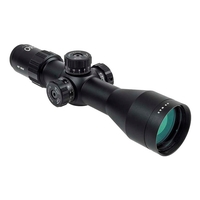
PAO HD MAX 4-16x44 SF FFP Ultra Compact Riflescope
via Uttings
£219.00
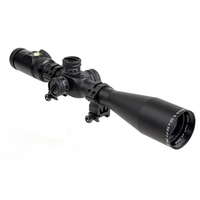
PAO F1 5-20x50 IR SF FFP Rifle Scope
via Uttings
£239.00

Hawke Vantage 30 WA FFP 4-16x50 Rifle Scope
via Uttings
£249.00
Buying Advice
Before committing to either reticle, understand the key specs that define how the GLX 2.5-10×44 performs. This is a first focal plane (FFP) scope, which means the reticle scales proportionally with magnification — your subtension values remain accurate at every power setting, not just at one reference magnification. That is critical for the Raptor M2's BDC holds and equally important for the Griffin Mil's hash-mark ranging. The turrets are MRAD-based in both versions, with 0.1 mil clicks (each click moves point of impact 1 cm at 100 meters, or roughly 0.36 inches at 100 yards). Parallax is adjustable via a side-focus knob, which matters for precision work beyond 200 yards. The 44mm objective provides a good balance between light transmission and mounting height on standard AR-15 and bolt-action platforms.
Budget context matters here. The GLX line sits firmly in the mid-tier price band — above entry-level scopes like the Bushnell Banner 2 or Primary Arms' own SLx series, but well below premium glass from Leupold's Mark 5HD or Vortex's Razor HD Gen III lines. Expect to spend in the $350-$450 range for either reticle variant, which makes it competitive with offerings like the Vortex Diamondback Tactical and Leupold VX-3HD. At this price point, you get fully multi-coated lenses, aircraft-grade aluminum construction, and a lifetime warranty — features that used to require a $600+ investment just a few years ago. Both reticle options are the same price, so this truly is a feature decision, not a budget one.
The most common mistake buyers make is choosing a reticle based on what looks coolest in photographs rather than how it functions in their actual shooting discipline. The Raptor M2 is outstanding for shooters who primarily use one or two cartridges and want speed — the BDC holdover points are calibrated to specific ballistic profiles, meaning you can hold on the correct dot and fire without dialing turrets. But if you switch between rifles chambered in different cartridges, or if you handload to non-standard velocities, those BDC points will be off. The Griffin Mil reticle, by contrast, is cartridge-agnostic: you calculate your own holds based on your specific load data and DOPE card. It demands more skill but rewards you with universal flexibility.
For US-specific use cases, think about your primary shooting scenario. Most whitetail deer in the eastern US are taken under 150 yards from a treestand or ground blind — at those distances, either reticle works fine and the choice is almost irrelevant. But if you are a western hunter taking pronghorn or mule deer at 300-500 yards in open terrain, or a long range competitor engaging steel past 600 yards with a 6.5 Creedmoor, the reticle decision becomes pivotal. Coyote hunting often involves rapid target acquisition at unpredictable distances from 50 to 400 yards, which is where the Raptor M2's speed advantage can genuinely save you a shot. Both versions are readily available on Amazon.com and OpticsPlanet, and neither has import or compliance issues for any US state.
Matching the scope to your use case requires honest self-assessment. If you run a single bolt-action rifle in .308 or 6.5 Creedmoor and want the fastest possible holdover system for hunting or informal long range practice, the Raptor M2 is hard to beat — its caliber-matched BDC dots eliminate mental math in the field. If you compete in PRS or NRL matches, train with a ballistic solver app, or swap the scope between multiple rifles, the Griffin Mil is the more professional choice because its clean mil-based subtensions work with any cartridge and any solver output. For a dedicated 10/22 squirrel hunting setup or an air rifle application, this scope is frankly overkill — a lighter, simpler SFP scope in the $100-$200 range is more appropriate for rimfire and sub-12 ft-lb air rifles effective to 50-75 yards.
The broader brand landscape in 2026 gives this PA scope stiff competition but also validates its niche. Vortex dominates the mid-tier conversation with the Strike Eagle and Diamondback Tactical lines, while Leupold's VX-Freedom and VX-3HD remain popular among traditional hunters. Bushnell has pushed aggressively into the budget-to-mid segment. For dedicated night vision scope or thermal scope users — think Pulsar's Trail 2 LRF or Thermion 2 — the GLX is not the right tool; those are purpose-built digital platforms for a completely different mission set. But for a versatile daylight rifle scope that handles everything from a .30-06 deer rifle to a 6.5 Creedmoor precision rig, the GLX 2.5-10×44 in either reticle remains one of the best values in the US market.
Frequently Asked Questions
What is the main difference between the Raptor M2 and Griffin Mil reticles on the PA GLX 2.5-10×44?
The Raptor M2 uses caliber-specific BDC holdover points combined with mil-based wind holds, designed for speed with specific cartridges like 5.56, .308, and 6.5 Creedmoor. The Griffin Mil is a traditional mil-based Christmas tree reticle with evenly spaced hash marks that work with any cartridge when paired with a DOPE card or ballistic solver. Both are FFP, so subtensions remain accurate across all magnification settings. Choose Raptor M2 for speed with a dedicated rifle, Griffin Mil for universal flexibility.
What is the best scope for long range shooting with a 6.5 Creedmoor?
For long range shooting with a 6.5 Creedmoor, you want an FFP rifle scope with MRAD turrets, adjustable parallax, and a reticle with sufficient holdover and windage marks for engagements past 600 yards. The PA GLX 2.5-10×44 with either reticle handles this well in the mid-tier budget. If you want more magnification for competition, consider stepping up to a 4-16× or 5-25× from Vortex (Viper PST Gen II) or Leupold (Mark 5HD). The Raptor M2 reticle is specifically optimized for 6.5 Creedmoor ballistics, which makes holdovers fast without dialing.
What is the best scope for a 10/22 squirrel hunting setup?
For a Ruger 10/22 used for squirrel hunting, you do not need the magnification range or FFP complexity of the GLX 2.5-10×44. A lightweight SFP scope in the 2-7× or 3-9× range from Leupold (VX-Freedom Rimfire), Vortex (Crossfire II Rimfire), or Bushnell (Banner 2) in the $100-$200 range is ideal. Rimfire and squirrel engagements are almost always under 75 yards, so a simple duplex or BDC reticle and fixed parallax at 50-75 yards keeps things light, simple, and effective. Save your budget for good rings and a solid cheek weld.
What is the best scope for whitetail hunting with a .308 or .30-06?
Most whitetail deer in the US are taken under 150 yards, especially from treestands in wooded terrain, so a 2-10×, 3-9×, or 2.5-10× scope with a simple reticle and generous eye relief is ideal. The PA GLX 2.5-10×44 is an excellent choice if you also want to stretch your .308 or .30-06 past 300 yards on occasion. For pure close-to-mid-range deer hunting, the Leupold VX-3HD 2.5-8×36, Vortex Diamondback HP 2-8×32, or Bushnell Engage 2.5-10×44 are proven performers. Prioritize low-light performance and a wide field of view at low magnification over raw long range capability.
Is the PA GLX 2.5-10×44 a good scope for coyote hunting?
Yes — the GLX 2.5-10×44 is well suited for coyote hunting because coyotes present at highly variable distances (50 to 400+ yards) and often require fast target acquisition. The 2.5× low end gives you a wide field of view for close encounters, while 10× is sufficient for shots past 300 yards. The Raptor M2 reticle is particularly effective here because its BDC holdovers let you shoot quickly without dialing turrets, which matters when a coyote is only in the open for a few seconds. Pair it with a scope-mounted light or a separate night vision setup for legal nighttime predator hunts where your state permits it.
Can I use the PA GLX 2.5-10×44 on an air rifle?
Technically you can mount it, but it is not the best match for most air rifle applications. Sub-12 ft-lb springers and lower-powered PCP air rifles are realistically effective to 50-75 yards, where the GLX's magnification range and FFP reticle complexity are unnecessary. Additionally, spring-piston air rifles produce a unique double-recoil that can damage scopes not rated for it. For air rifle use, look for scopes specifically rated for spring-piston recoil from brands like Bushnell or dedicated airgun optic lines. Save the GLX for a centerfire rifle where its capabilities are fully utilized.
Do I need a night vision scope or thermal scope instead of the GLX for predator hunting?
That depends on your state's regulations and your hunting hours. The PA GLX 2.5-10×44 is a daylight optic only — it has no digital night vision or thermal imaging capability. If you hunt coyotes or hogs at night in states that permit it (like Texas), a dedicated thermal scope from Pulsar (Thermion 2) or a clip-on night vision device is necessary. These are separate, purpose-built tools costing $2,000-$5,000+. Many hunters run the GLX as their primary daylight rifle scope and add a clip-on thermal or best night vision monocular for after-dark work rather than replacing the daylight scope entirely.
Is the GLX 2.5-10×44 FFP or SFP, and why does it matter?
The GLX 2.5-10×44 is a first focal plane (FFP) scope, meaning the reticle enlarges and shrinks as you change magnification. This ensures that all subtension measurements — whether BDC holdover dots on the Raptor M2 or mil hash marks on the Griffin Mil — remain mathematically accurate at every magnification setting. In a second focal plane (SFP) scope, holdovers are only accurate at one specific magnification (usually the highest). FFP is the preferred choice for long range precision shooting and any scenario where you might hold over at varying power settings.
Where can I buy the PA GLX 2.5-10×44 in the US?
Both reticle versions are available directly from Primary Arms' website, on Amazon.com, and through OpticsPlanet. Amazon.com often offers free Prime shipping and easy returns. OpticsPlanet frequently runs discount codes and bundles that include rings or mounts. Primary Arms' own site occasionally has exclusive deals and is the most reliable source for confirming current reticle availability. Check all three for the best current pricing, as street prices in the mid-tier rifle scope market fluctuate seasonally.
Related guides
MOA vs MRAD explained for US shooters. Learn what each system means, which suits hunting or long-range PRS, how to convert between them, and how to avoid costly reticle-turret mismatches.
Zero Stop Turrets Explained for US ShootersHow zero-stop turrets work, which US-market systems (Leupold CDS-ZL, Vortex CRS, Nightforce ZeroStop, Bushnell RevLimiter) to buy, and how to choose by budget and discipline in 2026.
How to Sight In a Rifle Scope: Step-by-Step First-Time GuideFirst time sighting in a rifle scope? Our 2026 step-by-step US guide walks you through mounting, bore-sighting, and dialing in your zero at 25 and 100 yards.
Why Isn't My Scope Hitting Where I Aim? A Troubleshooting ChecklistScope not hitting where you aim? Work through this proven troubleshooting checklist — mounts, zero, parallax, ammo — cheapest and most likely causes first. US shooters, all platforms.
LPVO Zero Distance: How to Choose & Why It MattersLearn the optimal zero distance for your LPVO rifle scope in 2026. Covers 50 vs 100-yard zero, BDC reticles, FFP vs SFP, and the best scope picks for US hunters and competitors.
Best PCP Air Rifle Scopes for 2026Find the best scope for your PCP air rifle in 2026. Our US buyer's guide covers magnification, parallax, reticles, and budget picks for hunting and target shooting.
Best Scopes for .338 Lapua Magnum in 2026Find the best scope for .338 Lapua Magnum in 2026. Our US buyer's guide covers FFP vs SFP, MRAD turrets, magnification, reticles, and top picks for 1,000+ yard shooting.
Not sure which scope is right for you?
Try our AI-powered scope finder — answer a few questions and get personalised recommendations.
Find My Scope →Get a UK scope tip every day
Follow AiScopes on Facebook for daily buying guides, deals and gear advice.
Follow on Facebook