MOA vs MRAD: Which Reticle System Should You Choose?
By Peter Makulek · Senior Optics Editor · · Live prices from UK retailers
Choosing between MOA and MRAD is one of the first real decisions any US shooter faces when buying a riflescope, yet it is also one of the most misunderstood. Forums are full of passionate opinions, but the honest truth is that both systems are mathematically sound and will get you on target at any distance your rifle and cartridge can reach. What actually matters is understanding how each system translates angular measurement into real-world adjustments on paper, steel, or game, and then picking the one that fits the way you already think about distance and drop. This guide is the definitive reference we link from our Ruger 10/22, 6.5 Creedmoor, AR-15 LPVO, and whitetail deer scope guides.
The MOA vs MRAD debate matters most once you start dialing corrections rather than holding over. If you are a whitetail hunter shooting inside 150 yards from a treestand, either system works and you may never touch your turrets after zeroing. But the moment you stretch past 300 yards — whether ringing steel in a prairie-dog field, competing in a Precision Rifle Series match, or reaching across a western canyon for mule deer — the reticle's subtension unit becomes a tool you use constantly. The wrong choice will not ruin your shooting, but the right one can make wind calls and elevation holds noticeably faster under time pressure.
In the US market specifically, MOA has deep cultural roots. Generations of American shooters grew up thinking in inches at 100 yards, and most entry-level hunting scopes still ship with MOA turrets. MRAD (commonly called 'mil') dominates military and competition circles worldwide, and its adoption among US civilian long-range shooters has accelerated sharply over the past decade. Every major US-market brand — Vortex, Leupold, Nightforce, Bushnell, Sig Sauer, Primary Arms, and more — now offers both systems across most of their lineup, so you are rarely locked into one by brand loyalty alone.
This guide covers what MOA and MRAD actually mean in precise terms, how each system fits common US shooting disciplines (from rimfire plinking to PRS gas-gun matches), which brands tend to skew toward which system and why, how to convert between them, and — critically — the single most common purchasing mistake new scope buyers make: mismatching their reticle's subtension unit with their turret's adjustment unit. Read it once, and you will never second-guess a scope spec sheet again.
Top Picks — Live UK Prices
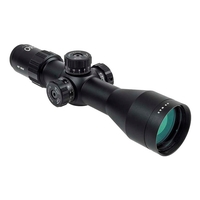
PAO HD MAX 4-16x44 SF FFP Ultra Compact Riflescope
via Uttings
£219.00
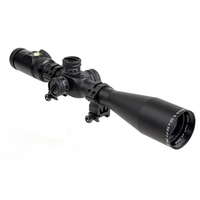
PAO F1 5-20x50 IR SF FFP Rifle Scope
via Uttings
£239.00

Hawke Vantage 30 WA FFP 4-16x50 Rifle Scope
via Uttings
£249.00
Buying Advice
What MOA and MRAD actually mean comes down to angular measurement, not linear distance. MOA stands for Minute of Angle — one-sixtieth of one degree. At 100 yards, 1 MOA subtends 1.047 inches (commonly rounded to 'about 1 inch,' which is acceptable shorthand but technically an approximation that compounds at long range). Most MOA scopes adjust in 1/4-MOA clicks, meaning each click moves impact roughly 0.26 inches at 100 yards. MRAD stands for milliradian — one-thousandth of a radian. At 100 yards, 1 MRAD (1 mil) subtends 3.6 inches; at 100 meters, 0.1 mil equals exactly 1 centimeter. Most MRAD scopes adjust in 0.1-mil clicks, so each click moves impact 0.36 inches at 100 yards. Both are simply different-sized rulers measuring the same angles. Neither is inherently more precise; you can dial either to sub-MOA accuracy if the scope's mechanicals are good.
MOA vs MRAD for hunting is largely a question of how far you plan to shoot and how you learned to think about drop. For the vast majority of US whitetail hunters taking shots inside 200 yards from a blind or treestand, either system is fine and many never dial at all — they zero at 100 or 200 yards and use a BDC or simple duplex reticle. Where the choice starts to matter is western hunting — mule deer, elk, or pronghorn across open sage — where 400-plus-yard shots are realistic. In those scenarios, an MRAD FFP reticle lets you range with mil dots and dial quickly using round numbers, while MOA can feel more intuitive to shooters who already think in 'inches of drop.' If you are buying your first hunting scope and mostly shoot eastern woods or Midwest farm fields, MOA is a perfectly sound default that keeps the mental math simple.
MOA vs MRAD for long-range and PRS competition is where the debate has a clearer practical winner for most shooters: MRAD. Precision Rifle Series, NRL Hunter, and most organized long-range disciplines in the US have tilted heavily toward MRAD over the past decade. The reason is communication and math efficiency. Spotters call corrections in mils ('come left point-two'), ballistic solvers output mil holds natively, and the base-10 nature of 0.1-mil clicks makes mental arithmetic faster under a shot clock. That said, a meaningful minority of top PRS competitors still shoot MOA — the math works just as well once it is internalized. If you are entering your first PRS or NRL match and do not already own a scope, MRAD is the safer community-standard choice. If you already own a quality MOA scope and know your system, there is no ballistic disadvantage to keeping it.
Which system Vortex, Leupold, and Nightforce use is not actually a brand-wide answer — all three offer both MOA and MRAD versions of most scope models, so the real advice is to check the specific SKU before you buy. That said, each brand has tendencies worth knowing. Vortex tends to default its marketing and 'first-listed' SKUs toward MRAD in the Razor HD Gen III and PST Gen II lines, reflecting their strong PRS following, though MOA options exist for every model. Leupold skews slightly toward MOA in its hunting-oriented VX-series but offers MRAD across the Mark 5HD and Mark 4HD competition lines. Nightforce has been MRAD-forward for years in the ATACR and NX8 lines favored by military and PRS shooters but stocks MOA versions as well. Primary Arms and Sig Sauer similarly offer both. The takeaway: never assume — always confirm the reticle AND turret unit on the specific model number you are adding to your cart on Amazon or OpticsPlanet.
How to convert between MOA and MRAD is straightforward once you memorize one number: 1 MRAD equals approximately 3.438 MOA (the exact figure is 3.43775, but 3.44 is close enough for field use). So if a ballistic app gives you a 2.5-mil hold, that is roughly 8.6 MOA. Going the other way, divide MOA by 3.44 to get mils. In practice, you should rarely need this conversion — the better approach is to set your ballistic solver (Kestrel, Applied Ballistics app, Hornady 4DOF) to output in whichever unit your scope uses and leave it there. The conversion matters most when you are reading someone else's data or borrowing a rifle zeroed in the other system. A quick-reference card taped to your stock or data book can save time at a match. The critical purchasing rule, worth repeating, is that your reticle's subtension unit must match your turret's adjustment unit. An MOA reticle paired with MRAD turrets — or vice versa — forces you to convert every single holdover into a different unit for every single dial-up, which is a recipe for blown shots under pressure. This mismatch is more common than you might think, especially when buyers swap turret caps or order the wrong SKU variant. Always verify both reticle and turret designations before checkout.
Frequently Asked Questions
Is MOA or MRAD better for beginners?
For most US beginners, MOA is slightly more intuitive because 1 MOA is roughly 1 inch at 100 yards — a relationship that clicks immediately if you grew up measuring groups in inches. However, MRAD is not harder to learn; it is simply a different scale. If you plan to eventually shoot PRS matches or train alongside military-style shooters, starting with MRAD avoids relearning later. Either system is fine for a first scope as long as you match the reticle unit to the turret unit.
Does it matter whether I choose MOA or MRAD under 300 yards?
Under 300 yards, the practical difference is negligible for most shooting. At that range, typical elevation corrections are small enough that either system handles them easily with a few clicks. Most hunters and recreational shooters inside 300 yards zero their rifle and rarely touch the turrets again, so the subtension system matters less than the reticle's overall design (duplex, BDC, etc.) and glass quality. Choose whichever system you find easier to understand — you can always switch when you move to a longer-range platform.
Is a mil the same thing as an MRAD?
Yes — in the context of modern riflescopes, 'mil' is simply the common shorthand for MRAD (milliradian). When a shooter or spotter says 'hold 1.5 mils,' they mean 1.5 milliradians. Be aware that the old NATO 'mil' (1/6400 of a circle) is a slightly different angular unit, but it is not used in sporting optics. Any scope labeled 'mil' or 'MIL' on the turret or reticle is using the milliradian (1/1000 of a radian), where 1 mil equals 3.6 inches at 100 yards or 10 cm at 100 meters.
Can I use an MOA reticle with MRAD turrets?
Technically you can, but it is strongly discouraged. A mismatched reticle-turret setup forces you to convert units in your head for every holdover-to-dial-up correction, which is slow and error-prone, especially under time pressure or in cold weather. Most reputable manufacturers sell matched configurations, but it is your responsibility to verify both the reticle designation and the turret designation on the specific SKU before purchasing. This is one of the most common and most avoidable mistakes in scope buying.
Which system do military snipers use?
US military and NATO sniper programs have standardized on MRAD for decades. The milliradian system integrates cleanly with metric range estimation (the mil-relation formula) and allows spotters to call corrections using a universal language. This military adoption is a major reason MRAD has become the default in PRS and other long-range competition circuits in the US. However, military use does not make MRAD inherently superior for civilian applications — it simply means MRAD has the larger ecosystem of training resources, data books, and community knowledge for long-range precision work.
Does FFP vs SFP affect whether I should choose MOA or MRAD?
FFP (first focal plane) versus SFP (second focal plane) is a separate decision from MOA versus MRAD, but they interact. In an FFP scope, the reticle subtensions are accurate at every magnification, making mil or MOA holdovers reliable without dialing. In an SFP scope, the subtensions are only accurate at one specific magnification (usually the highest). If you plan to use reticle holdovers frequently — common in PRS and tactical shooting — an FFP scope paired with your preferred unit (MOA or MRAD) is the more versatile setup. SFP scopes are still popular for hunting where holdovers are less common.
How many clicks equal 1 MOA or 1 MRAD?
On the vast majority of scopes, 1 MOA requires 4 clicks (each click is 1/4 MOA, or roughly 0.26 inches at 100 yards) and 1 MRAD requires 10 clicks (each click is 0.1 mil, or 0.36 inches at 100 yards). Some precision scopes offer 1/8-MOA clicks (8 per MOA) for finer adjustments. Always check the spec sheet for your exact model — the click value is usually printed on the turret cap or in the manual. Knowing your click value is essential for accurate zero and field corrections.
Is MRAD only useful with the metric system?
No. While MRAD has an elegant relationship with metric units (0.1 mil = 1 cm at 100 meters), it works perfectly with yards and inches. At 100 yards, 1 mil equals 3.6 inches — not as tidy as the metric shortcut, but ballistic solvers handle the math for you regardless of your unit preference. Many US PRS competitors use MRAD scopes while thinking entirely in yards. The metric convenience of MRAD is a nice bonus, not a requirement, and should not be the sole reason to choose or avoid the system.
Do I need to buy a different ballistic calculator for MOA vs MRAD?
No. Every major ballistic solver — including Kestrel devices, the Applied Ballistics mobile app, Hornady 4DOF, and free tools like Strelok — lets you toggle the output between MOA and MRAD with a single setting change. Enter your cartridge data, muzzle velocity, and environmental conditions once, then select your scope's unit. The solver does all conversions internally. Just make sure the output unit matches your scope's turret and reticle unit so you can dial or hold without any manual conversion.
Related guides
MOA or MRAD? Our expert guide helps UK shooters pick the right angular measurement system for their discipline, from PRS comps to deer stalking and airgun use.
MOA vs MRAD: Which Is Right for You?MOA or MRAD — what is the difference and which should UK shooters choose? Plain-English explanation with click values, ranging maths and UK scope recommendations.
PA GLX 2.5-10×44: Raptor M2 Reticle vs Griffin MilWondering whether the PA GLX 2.5-10×44 with Raptor M2 reticle beats the Griffin Mil version? Our 2026 US buyer's guide breaks down holdovers, subtensions, and real-world use cases.
Zero Stop Turrets Explained for US ShootersHow zero-stop turrets work, which US-market systems (Leupold CDS-ZL, Vortex CRS, Nightforce ZeroStop, Bushnell RevLimiter) to buy, and how to choose by budget and discipline in 2026.
How to Sight In a Rifle Scope: Step-by-Step First-Time GuideFirst time sighting in a rifle scope? Our 2026 step-by-step US guide walks you through mounting, bore-sighting, and dialing in your zero at 25 and 100 yards.
Best Scopes for Elk and Mule Deer HuntingBest scopes for elk and mule deer hunting in 2026 — magnification, BDC and illuminated reticles, and real picks from $299 budget to premium glass.
Best Red Dot Sights for AR-15 Pistol & Home Defense in 2026Best red dot sights for AR-15 pistol and home-defense builds in 2026 — 2 MOA vs 6 MOA dot size, battery life, cowitness height, and real picks from budget to premium.
Not sure which scope is right for you?
Try our AI-powered scope finder — answer a few questions and get personalised recommendations.
Find My Scope →Get a UK scope tip every day
Follow AiScopes on Facebook for daily buying guides, deals and gear advice.
Follow on Facebook