Best Scopes for Elk and Mule Deer Hunting
By Peter Makulek · Senior Optics Editor · · Live prices from UK retailers
Elk and mule deer hunting is a different game than sitting a stand for whitetail. Western public land means open sage flats, high basins, and timber-line glassing points where a shot can come at 60 yards in dark timber or 350+ yards across a canyon — often decided by how fast light is fading and how far you can hold your crosshair without guessing. Choosing a scope for this kind of hunting means thinking less about "what's on sale" and more about magnification range, low-light glass, and a reticle that gives you real holdover information, not just a fine crosshair.
That's the core difference from a whitetail rig. A whitetail hunter shooting from a stand at 80–150 yards can get away with a fixed 3-9x40 and never think about holdover. An elk or mule deer hunter glassing open country needs a scope that performs at both ends of its zoom range — enough magnification to place a precise shot past 300 yards, but still fast and usable if a bull steps out of timber at 40 yards. Add in the fact that elk are most active — and most often shot at — in the low light of first and last hour, and objective lens size and reticle illumination stop being nice-to-haves and start being the difference between a clean shot and passing.
This guide covers real, currently-stocked scopes across the full price range — from a genuinely usable $299 hunting scope to premium glass built for spot-and-stalk mule deer country. All prices below are current US retail snapshots and will drift a little over time (check the live listing before buying), but every scope named here is a real, in-stock product, not a hypothetical pick.
One more western-specific point worth setting expectations on up front: more magnification and a bigger objective lens do not automatically turn a shooter into a 400-yard marksman. The scope only delivers what your rifle, your ammunition, and your practiced skill at range can back up. Everything below assumes you're pairing the glass with honest range-time behind the trigger — not treating a bigger scope as a substitute for it.
Top Picks — Live UK Prices

Vortex Crossfire II 4-12x44 Plex Hunting Riflescope
via BushWear
£180.00

Vortex Diamondback 4-12x40 BDC Hunting Riflescope
via BushWear
£275.00
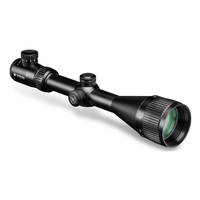
Vortex Crossfire II 3-12x56 AO Hog Hunter Riflescope
via Uttings
£279.00
Buying Advice
The Trijicon Huron 4-16x50mm (BDC Hunter Holds reticle, 30mm tube, SFP) is the strongest all-around pick for elk and mule deer specifically because its reticle is built for exactly this problem. The BDC Hunter Holds reticle gives you calibrated holdover marks instead of a plain duplex, so once you've confirmed your drop at a couple of distances, you have real aiming points out past 300 yards instead of an educated guess. A 50mm objective and 4-16x range covers dark-timber elk at the bottom end and open-basin mule deer at the top, and Trijicon's glass holds up well in the low light both species are most active in. At around $700 it sits at a genuine "buy once" price point without stepping into flagship territory.
If your budget caps out around $300, the Vortex Crossfire II Hog Hunter 3-12x56mm (Red V-Brite illuminated reticle, MOA adjustment, 30mm tube) earns its slot on objective size alone — a 56mm front lens at this price is unusual, and it noticeably extends usable light at dusk over the 40mm scopes most budget optics ship with. The illuminated reticle is a real plus for the last 20 minutes of legal light when elk start moving. It's a second-focal-plane design, so the reticle's holdover marks are only true at 12x — know that limitation and you'll get genuine value for the money. Vortex's VIP warranty (transferable, no receipt needed) is also worth factoring into a budget decision like this one.
The SIG Sauer Whiskey4 5-20x50mm (First Focal Plane, illuminated MOA Milling Hunter 2.0 reticle) is the pick for a hunter who wants first-focal-plane holdover without paying premium-brand prices. Because it's FFP, the milling marks on the reticle are accurate at any magnification, not just at the top of the zoom — genuinely useful if you dial down to 5x for a close timber shot and still need your holds to mean something. A 20x top end and 50mm objective give real reach for mule deer country, and illumination helps the reticle stay visible against dark cover at dawn. At around $450 it undercuts most FFP-illuminated hunting scopes by a wide margin.
Elk and mule deer are both most active — and most often taken — in the first and last legal light of the day, which is exactly where the Leupold VX-5HD Gen 2 3-15x56mm (CDS-ZL2 side-focus, illuminated FireDot Twilight Hunter reticle) is built to perform. The 56mm objective and Leupold's Twilight Max light-management system push usable shooting light meaningfully past what a 40–44mm scope gives you, and the illuminated FireDot center dot stays visible against dark hide and shadowed timber without washing out the rest of the reticle. Side-focus parallax adjustment matters here too — most western shots aren't at a fixed range, and dialing parallax without breaking your cheek weld saves real time when a shot window is closing. This is a genuine step up in cost, but for hunters who consistently hunt the last legal half-hour, it's the category where premium glass earns its price. A lower-cost alternative in the same objective class is the Trijicon Credo HX 2.5-15x56mm BDC (~$1,220) — same 56mm light-gathering advantage and a calibrated BDC Hunter Holds reticle, without illumination.
For the hunter treating this scope as a decade-plus investment, the Leupold VX-6HD Gen 2 3-18x56mm (CDS-ZL2 side-focus, illuminated FireDot Twilight Hunter) is the top of Leupold's dedicated hunting line for a reason — 6x zoom ratio, edge-to-edge clarity that holds up at full power, and a reticle/turret system built around fast, repeatable dialing rather than just holdover guessing. An 18x top end and 56mm objective genuinely suit the long glassing-and-stalk sessions common in open mule deer country, where you might spot a buck a mile out and need to evaluate him clearly before committing to a stalk. For shooters who want to go further still and treat the rifle as a long-range precision tool built around a hunting reticle, the Tangent Theta Long Range Hunter 3-15x50mm (~$4,320, available in MOA or MRAD) is a genuine tactical-grade crossover option — mechanically it's built to the same tracking standard as Tangent Theta's competition scopes, just packaged with a hunting reticle. It's a niche, expensive choice, but a real one.
Most elk are still taken inside 200 yards — a lot of elk hunting happens in or at the edge of timber, where shots are close and fast. But open-country stalking, especially for mule deer glassed across a canyon or basin, regularly produces legitimate 250–400 yard opportunities, and a scope with only 9x or 12x on top starts to feel genuinely limiting for precisely placing a shot into a vital zone at that distance. A 3-15x or 4-16x range is the practical sweet spot for most elk/mule deer hunters: enough magnification on top to see and hold precisely past 300 yards, low enough on the bottom to still be fast and usable if something steps out close. Going much past 18-20x on a hunting scope mostly adds weight and a narrower field of view without adding real capability most hunters will use — that territory belongs to dedicated long-range and PRS optics, not a general elk/mule deer hunting scope.
A calibrated BDC (bullet drop compensating) reticle — like the ones on the Trijicon Huron and Credo HX — gives you real holdover reference points instead of just a fine crosshair, which matters once shots start stretching past your point-blank zero range. It's not a substitute for knowing your actual drop at your actual distances (BDC marks are calibrated to a specific cartridge/load assumption, and yours may not match exactly), but it's a genuinely useful tool when a shot has to happen fast. Illumination is a separate decision, and it's specifically about visibility, not precision — an illuminated center dot or reticle stays visible against dark fur and shadowed cover in the low light both species are most active in, which a black reticle can start to disappear into. If you hunt hard in the first and last legal hour, illumination earns its keep; if you're typically done hunting well before last light, it's a nice-to-have rather than essential.
First focal plane (FFP) reticles grow and shrink with magnification, which means any holdover or ranging marks on the reticle stay accurate at every power setting — genuinely useful if you might dial down for a close shot and still need to hold with the reticle. Second focal plane (SFP) reticles stay a constant size, and their holdover marks are only accurate at one magnification (almost always the top of the zoom range) — simpler and often a bit cheaper, and perfectly fine if you mostly shoot at or near max power anyway. Neither is "wrong" for elk and mule deer; FFP earns its usual small price premium specifically for hunters who realistically expect to take shots across a wide range of magnifications and distances, which describes a lot of western hunting.
Whitetail hunting is a different problem entirely, and the contrast is worth spelling out. Whitetail hunting is overwhelmingly a short-range, single-known-distance game — most deer are taken from a fixed stand or blind under 100–150 yards, so a 3-9x40 with a simple duplex reticle is genuinely sufficient for most whitetail hunters, with mule deer and elk representing more of an upgrade path than the default. Western big game hunting flips that: it's an open-country, variable-distance game, which is exactly why the picks above lean toward more magnification range, bigger objectives, and reticles built for real holdover rather than a single known zero.
Timber elk hunters calling and still-hunting through dark lodgepole country should weight their decision toward the lower end of magnification (a scope that's genuinely fast and bright at 4-6x) and toward illumination, since most shots will be close and light-starved. Open-country mule deer hunters who spend days glassing from a ridge and expect a longer stalk-and-shoot should weight toward top-end magnification and a bigger objective, since the shot — when it comes — is more likely to be at real distance in decent light. A lot of hunters do both in the same season, which is exactly why a 3-15x/4-16x range with a 50mm objective is the most commonly recommended sweet spot rather than either extreme.
The biggest mistake is buying more magnification than you'll use and less objective/glass quality than you need — a 6-24x scope with mediocre glass sees worse in low light than a well-built 4-16x, and dark timber elk hunting punishes that trade badly. The second is ignoring parallax and eye relief: a scope with fixed parallax set for 100 yards will show real focus error at 300+ yards, and cheap eye relief that's too short is a real risk of scope-eye ("Mauser eyebrow") under recoil from a hard-kicking magnum cartridge on an uphill or awkward shot. Third, don't assume a BDC reticle's marks match your specific rifle and load without confirming at the range — treat the marks as a starting point, not gospel, and verify your actual drop before the season, not during it.
Every scope named above is available through Amazon.com (search the model name plus "rifle scope" to find the current listing) or through OpticsPlanet, which stocks the full range from budget to Tangent Theta-level premium glass. As with any online scope purchase, confirm you're buying the exact reticle/turret configuration you want — several of these models (the SIG Whiskey4 and the Tangent Theta, in particular) are sold in multiple reticle and MOA/MRAD variants under similar model names.
Frequently Asked Questions
What magnification do I need for elk hunting at 300 yards?
A scope with at least 12-15x on the top end gives you enough resolution to place a precise shot on an elk-sized vital zone at 300 yards, assuming decent glass and a steady rest. You don't need to run it at max power for the shot itself — many hunters dial to somewhere in the middle for a wider sight picture — but having 15x+ available matters for evaluating the animal and holding precisely once you commit to the shot.
Is an illuminated reticle worth it for elk hunting?
Yes, if you hunt seriously in the first and last hour of legal light, which is when elk are most active and a large share of elk are actually taken. An illuminated center dot or reticle stays visible against dark hide and shadowed timber where a plain black reticle can genuinely disappear. If you're typically hunting mid-morning to mid-afternoon, illumination is a nice-to-have rather than a necessity.
How is a scope for elk or mule deer different from a whitetail deer scope?
Whitetail hunting is mostly a short, fixed-distance game from a stand, so a basic 3-9x40 is genuinely enough for most whitetail hunters. Elk and mule deer hunting in open western country produces a much wider range of realistic shot distances — sometimes under 100 yards in timber, sometimes 300+ yards across open ground — so western hunters benefit from more magnification range, a bigger objective for low light, and a reticle built for real holdover rather than a single known zero.
FFP or SFP — which is better for elk and mule deer hunting?
Either works, but FFP has a genuine edge if you expect to take shots across a wide range of magnifications and distances, since its holdover marks stay accurate no matter what power you're on. SFP is simpler and usually a bit cheaper, and it's perfectly adequate if you mostly shoot near the top of your scope's zoom range anyway — which describes a lot of open-country mule deer shooting.
MOA or MRAD — does it matter for hunting?
Not as much as it does for competition or long-range target shooting. Most US hunters find MOA more intuitive since 1 MOA is close to 1 inch at 100 yards (1.047" exactly), which maps naturally onto how Americans think about drop and group size. MRAD (0.1 mil = 1cm at 100m) is the international long-range/military standard and is common on more tactical-leaning hunting scopes like the Tangent Theta. Pick whichever matches how you already think about distance and stick with it — what matters most is that your reticle and your turrets use the same unit.
What objective lens size do I actually need for elk hunting?
A 44-56mm objective is the practical sweet spot. Below about 40mm, low-light performance starts to noticeably suffer during the dawn/dusk windows elk are most active in. Above about 56mm, you're mostly adding weight and requiring taller scope rings without much further real-world light gain — a well-built 50mm scope from a good brand will usually out-perform a mediocre 56mm in actual low-light conditions.
Do I need a rangefinder in addition to a BDC reticle?
Yes, ideally. A BDC or holdover reticle only helps if you know the actual distance to the animal — guessing range at 300+ yards in open country is one of the most common sources of a missed or wounded shot. A rangefinder pairs with any of the scopes above to make the reticle's holdover marks actually usable at real distance.
Are mule deer and elk scope needs different from each other?
Mostly not — both benefit from the same broad profile (moderate-to-high magnification, 44-56mm objective, a holdover-capable reticle). If anything, mule deer hunting in classic open badlands/sagebrush country sometimes pushes toward slightly more magnification and objective size than elk hunting, which more often includes at least some timber and closer-range opportunities.
What's a reasonable budget for a first elk/mule deer scope?
Plan on $300-700 for a genuinely capable hunting scope that will serve you well for years — that range covers the Vortex Crossfire II Hog Hunter and SIG Whiskey4 on the value end up through the Trijicon Huron. Below $250, glass quality and low-light performance both drop off quickly, which matters more for this kind of hunting than almost any other discipline.
Related guides
Find the best hunting scope for deer under $200 in 2026. We cover top picks for whitetail stands, low-light timber, and Western upgrades — all for US buyers.
Best Daytime Scopes for Hog Hunting in 2026Find the best daytime AR-15 scopes for hog hunting in 2026. We compare magnification, reticles, and durability across budget tiers so you pick the right optic fast.
Best Scopes for .300 Win Mag in 2026Find the best scopes for .300 Win Mag in 2026. Our US buyer's guide covers magnification, reticles, turrets, and top picks for hunting elk, mule deer, and long-range shooting.
Best Deer Stalking Scopes for the Remington 700 in 2026Our 2026 UK buyer's guide to the best rifle scopes for deer stalking with a Remington 700 in .308 or .300 Win Mag. Covers magnification, reticles, turrets, and UK law.
Best Scopes for Highland Red Deer Stalking in 2026Our expert UK buyer's guide to the best scopes for Highland red deer stalking in 2026. Covers magnification, reticles, light transmission, budget tiers and UK-legal context for stalkers.
Best Red Dot Sights for AR-15 Pistol & Home Defense in 2026Best red dot sights for AR-15 pistol and home-defense builds in 2026 — 2 MOA vs 6 MOA dot size, battery life, cowitness height, and real picks from budget to premium.
Best Thermal Scopes for Coyote & Hog HuntingOur 2026 US buyer's guide to the best thermal scopes for coyote and hog hunting. Compare ATN, AGM, and Sig Sauer thermal optics, prices, and specs.
Not sure which scope is right for you?
Try our AI-powered scope finder — answer a few questions and get personalised recommendations.
Find My Scope →Get a UK scope tip every day
Follow AiScopes on Facebook for daily buying guides, deals and gear advice.
Follow on Facebook