Best Thermal Scopes for Coyote & Hog Hunting
By Peter Makulek · Senior Optics Editor · · Live prices from UK retailers
Ten years ago, a genuinely field-capable thermal riflescope cost more than most hunters' trucks. That's no longer true. In 2026, a real predator hunter can put a genuinely usable dedicated thermal scope on the gun for well under $1,000 — a real 256-class sensor good for identifying a coyote out to roughly 150-200 yards at a calling stand, no laser rangefinder — step up to a scope with an integrated laser rangefinder, 50 Hz refresh, and enough resolution to confidently ID a coyote at 300+ yards for roughly $2,000-$3,200, and outfit a serious hog-control rig with a 640×512 sensor and integrated ballistics for $3,000-$4,500. For the huge population of US shooters running night predator programs — coyote calling on cattle ranches, feral hog depredation contracts across the South, or just protecting a hunting lease from year-round hog damage — thermal has gone from a luxury to the standard tool.
Why does the buying decision matter so much? Because coyote calling and hog hunting put very different demands on a thermal scope. A coyote coming to a call in an open pasture at 1 a.m. is a fast-moving, wary, small-body-heat target you may need to identify and engage anywhere from 40 to 400 yards. A sounder of hogs working a corn field or a creek bottom is a slower-moving but often much closer, multi-animal target where you need to sort boars from sows and piglets in low light and put enough energy on target to anchor a 150-plus-pound animal. Neither job is served well by a scope bought purely on a headline "detection range" number.
This guide is built specifically for that decision. We cover the sensor specs that genuinely change your odds in the field (resolution, NETD, refresh rate, pixel pitch), realistic budget tiers from under $1,000 to premium ranch packages, and the practical differences between a dedicated thermal scope and a clip-on unit that rides in front of your existing day optic. Every product referenced below is a real, currently listed thermal scope from AIScopes' own product database, priced in US dollars.
Whether you're outfitting your first AR-15 or bolt gun for night predator work or upgrading from an early-generation 256-class thermal, our goal is to make this the most useful, technically honest resource on the topic for US buyers — not a rehash of manufacturer marketing copy.
Top Picks — Live UK Prices
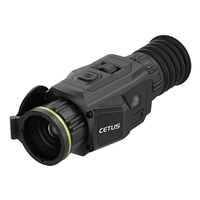
Pixfra Cetus C225 Thermal (256x192) Rifle Scope
via Uttings
£679.95
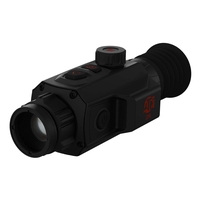
ATN Thor 6 Mini 215 (2-16x) Compact Thermal (256x192) Rifle Scope
via Uttings
£699.00

ATN Mars LTV+ 2-6x (256x192) 19mm Thermal Riflescope
via Uttings
£749.00
Buying Advice
The ATN Thor 5 LRF pairs a 640×480 Gen 5 sensor with a 12-micron pixel pitch, a built-in laser rangefinder, and ATN's Smart HD feature set (onboard recording, Wi-Fi streaming, and a ballistic calculator that can apply holdover automatically once you've ranged your target). The 3-24x magnification range is genuinely versatile — low enough to acquire a coyote breaking cover at 50 yards, high enough to positively identify and place a shot on a hog at 300+ yards across an open field. It's the scope we'd point most serious dual-purpose (coyote and hog) buyers toward first, provided the ~$3,000 price point fits the budget.
At $799.99, the DNT Optics Hydra gives you a real, usable 256×192 thermal sensor rather than a compromised digital-NV substitute. A 256-class sensor won't match a 640 unit for fine detail at range, and this tier has no built-in rangefinder, but for calling stands inside 150-200 yards — the majority of coyote engagements — it's genuinely capable, and it's a sensible way to try thermal hunting before committing to a $3,000+ rig. The 3-12x range is tight enough to stay usable at close range but still gives useful reach for open-field shots.
AGM's "Varmint" line is aimed squarely at predator hunters, and this SKU backs that up: a 50mm objective and 4.5-36x magnification range built for scanning wide-open pasture and picking a coyote out at genuine distance, paired with a built-in laser rangefinder for accurate holdover on longer calling-stand shots. The tradeoff for that reach is a 384×288 sensor rather than the sharper 640-class chip — a deliberate design choice that favors magnification and objective size over raw resolution, which suits open Western and High Plains coyote country better than thick cover.
The same "Varmint V2 LRF" line also ships this variant with a 640×512 sensor — noticeably sharper than its 384-class sibling above — paired with a lower 2-16x magnification range and a smaller 35mm objective. That combination is a better match for hog hunting, where shots often happen at closer range in brush or along field edges and you need enough resolution to sort a boar from a sow in a moving sounder before you commit to a shot. The integrated LRF is genuinely useful here too, since hogs frequently present quartering shots where precise range matters for shot placement.
For landowners and guides running serious, high-volume hog-control operations, the Sig Sauer Echo RV50-LRF steps up to a 640×512 sensor, a 50mm objective, a 50 Hz refresh rate, and a built-in laser rangefinder in one package. Sig's ballistic-integration pedigree (from its BDX line of day optics) carries over here, and the 50mm objective genuinely improves image quality and low-light gathering over the smaller-objective options above. If budget allows, this is the pick for anyone shooting several nights a week rather than the occasional calling stand. Buyers wanting to go even further upmarket should also look at Trijicon's IR-HUNTER line, which pushes into the $6,000+ range with premium glass and thermal-imaging pedigree built originally for military and law-enforcement use.
If the standard Thor 5 LRF's ~$3,079 price tag is a stretch, the ATN OPMOD ThOR 5 3-24x — the same 640×480, 12-micron sensor platform sold through ATN's OPMOD retail partnership — currently lists around $2,225, roughly $850 less than the standard SKU for essentially the same core imaging performance. It's worth cross-shopping before you commit to the full-price model. At the true entry level, the SightMark Shade 256 3.5-28x30 Mini (~$950) is a compact, budget-class 256-sensor option worth a look if you want something lighter than a full-size thermal for a lease rifle that only comes out occasionally.
A thermal clip-on mounts ahead of your existing day scope, letting you keep your familiar reticle, magnification range, and zero — you simply flip the clip-on's power on and see a thermal image through your day glass. That's genuinely valuable if you already run a good LPVO or hunting scope on your rifle and don't want to re-zero every time you switch between day and night hunting. The tradeoffs are real, though: clip-ons add significant length and weight forward of your day scope, require enough eye relief and objective clearance to mount cleanly, and pass the thermal image through an extra optical path, which can cost you some sharpness versus a dedicated unit at the same price. Well-regarded brands like Pulsar build clip-on thermal front modules that pair with existing riflescopes, typically positioned in the $2,000-$5,500+ range depending on sensor class.
A dedicated thermal scope, like every product picked above, is a standalone sighting system: no day optic underneath, one battery to manage, and generally better image quality per dollar since there's no compound optical path. The tradeoff is that you need to re-zero (or run a second rifle/mount) if you also want a conventional day scope, and you lose the ability to hunt during daylight hours on that same setup unless the unit has a digital day mode. For a dedicated night-hunting rig — which describes most serious coyote and hog setups — a dedicated thermal scope is usually the better buy. Reserve clip-ons for hunters who genuinely need one rifle to do both day and night work interchangeably.
Sensor resolution sets the ceiling on how much detail you can resolve at range. At the entry level you'll see 256×192 sensors; the mid tier moves to 384×288; premium units use 640×512 or, on a handful of top-end models, 1280×1024. Going from 256 to 384 is a meaningful jump in image clarity; 384 to 640 is an even bigger one, and it's the difference that lets you confidently sort a boar from a sow at 150 yards rather than guessing. Pixel pitch (commonly 12 or 17 microns in this category) trades sensitivity for compactness — a smaller pitch packs more resolution into a given sensor size but can need slightly better optics to make full use of it. NETD (Noise Equivalent Temperature Difference), measured in millikelvins, tells you how small a temperature difference the sensor can register; under 40 mK is good, under 25 mK is excellent for picking out a coyote against a cool background. Refresh rate matters more for predator hunting than almost any other discipline — a 50 Hz sensor tracks a running coyote or a spooked hog smoothly, while 25-30 Hz visibly stutters when you pan quickly.
Under $1,000, expect a 256-class sensor, a smaller objective (around 25mm), no built-in rangefinder, and genuinely usable performance for calling stands and hog fields inside roughly 150-200 yards — the DNT Optics Hydra and SightMark Shade 256 above are solid examples. From roughly $2,000 to $3,200, you move into 384-to-640-class sensors with integrated laser rangefinders and 50 Hz refresh becoming standard, with confident coyote identification extending out to 300+ yards — this is where most serious dual-purpose coyote/hog hunters land, and where the ATN Thor 5 LRF and both AGM Varmint V2 variants sit. Above $4,000, you're paying for larger 50mm+ objectives, top-tier 640×512 sensors, and glass/build quality aimed at hunters and outfitters running the scope hard, multiple nights a week, year-round — the Sig Sauer Echo RV50-LRF and Trijicon's IR-HUNTER line represent this tier.
The single most common mistake is buying purely on a manufacturer's headline detection-range figure, which measures when a heat signature first appears on screen — not when you can confidently identify what it is. Identification range for a coyote-sized target typically runs at only one-quarter to one-third of the advertised detection distance, so a scope claiming 1,500 yards detection might realistically deliver confident coyote identification closer to 375-500 yards. The second common mistake is under-shopping magnification range for the job: a scope with too little top-end zoom struggles on open-pasture coyote calling, while one with too little bottom-end (a high minimum magnification) makes fast, close shots on hogs breaking from cover genuinely difficult. Third, don't ignore battery life — a cold winter night hunt easily runs four-plus hours, and a scope that dies mid-stand is a real liability; prioritize USB-C charging and carry a spare battery. Finally, remember that a thermal scope is a sighting system, not a substitute for correct caliber and shot placement — thermal helps you find and identify game, it doesn't compensate for an underpowered round on a big boar.
If you primarily call coyotes on open ranchland or ag fields, prioritize magnification reach and a built-in rangefinder — the AGM Varmint V2 4.5-36x50mm or the ATN Thor 5 LRF's 3-24x range both serve that use case well, since most of your engagement decisions happen well past 150 yards. If your work is hog control in thick cover, creek bottoms, or agricultural edges, prioritize sensor resolution and a lower minimum magnification over raw zoom — the 640-class AGM Varmint 2-16x35mm variant is built for exactly that. Hunters doing genuinely mixed work (a lease that runs both coyote calling stands and hog control) should lean toward a 640-class sensor in a moderate 2-16x or 3-24x range, since resolution helps in both scenarios more consistently than magnification alone.
Rules around hunting coyotes and feral hogs at night with thermal optics vary significantly by state, and in some cases by county or specific wildlife management unit — always verify current regulations with your state wildlife agency before hunting. As a general pattern, coyotes are classified as an unprotected or nuisance predator species in most states, and many states permit night hunting of coyotes with thermal or night-vision equipment, sometimes with a permit or during a defined season. Feral hogs are non-native, invasive, and cause severe agricultural damage across much of the South (Texas, Oklahoma, Georgia, Florida, Alabama, Mississippi, Louisiana, and others), and several of these states allow night hunting of hogs with thermal optics on private land with landowner permission and no bag limit or closed season — Texas is the most permissive example. Other states restrict night hunting, artificial light, or thermal-equipped firearms use much more tightly, or require specific depredation permits. Do not assume your home state's rules for one animal apply to the other, and never assume rules transfer across state lines on a hunting trip.
ATN is the highest-volume US thermal-scope brand at the consumer level, with the Thor line spanning entry-level to premium and a strong track record of onboard smart features (ballistic calculators, video recording, app connectivity). AGM Global Vision has built specific credibility with predator hunters through its Varmint-branded line, aimed directly at coyote and hog use cases, alongside a broader thermal and digital-NV catalog. Sig Sauer entered thermal more recently through its Echo line, leaning on the electronics and ballistics-integration reputation it built with day optics like the BDX series, and generally competes at the premium end. Pulsar remains a well-regarded name for both dedicated thermal scopes and clip-on front modules, particularly popular for hunters who want to add thermal capability to an existing day-scope setup. Beyond these established names, a wave of budget-focused newer entrants has moved into the sub-$1,000 thermal space chasing cost-conscious predator hunters who want a lower entry price than the mainstream brands. Treat any specific newer brand as worth researching directly and reading current, dated owner reviews before buying — these companies can move quickly on price and features but generally have a shorter track record for long-term reliability, firmware support, and warranty service than ATN, AGM, Pulsar, or Sig Sauer.
Frequently Asked Questions
What's the difference between detection range and identification range for coyote hunting?
Detection range is the distance at which a thermal scope can register that a heat signature exists at all — essentially, "something is there." Identification range is the much shorter distance at which you can confidently determine what that something actually is (a coyote, not a dog, deer, or livestock) and where its vitals are for an ethical shot. As a rule of thumb, identification range runs at roughly one-quarter to one-third of the advertised detection range, so a scope marketed with a 1,500-yard detection figure typically delivers real-world coyote identification somewhere in the 375-500 yard range, and often less in humid or rainy conditions that degrade thermal contrast.
What's the best thermal magnification for hog hunting?
A lower base magnification in the 2x-4x range serves hog hunting best, because hogs are frequently engaged at closer range in brush, field edges, or creek bottoms where you need to acquire a moving, multi-animal target quickly. A top-end magnification around 12x-16x gives you enough reach to positively sort individual hogs in a sounder before committing to a shot. Very high top-end magnification (20x-36x) matters less for hog hunting than it does for open-pasture coyote calling, where engagement distances run longer.
Do I need a clip-on thermal unit or a dedicated thermal scope?
If you already run a day scope you're happy with and want to add night capability without disturbing your zero, a clip-on mounted ahead of that scope is the better fit. If you're building a rifle dedicated to night predator work, a standalone thermal scope generally delivers better image quality and simpler operation for a comparable price, since the image doesn't pass through an extra optical path. Most serious dedicated coyote/hog rigs use a standalone thermal scope rather than a clip-on.
Is it legal to hunt coyotes and hogs at night with a thermal scope in my state?
It depends entirely on your state, and sometimes your specific county or wildlife management unit — there is no single nationwide rule. Coyotes are generally treated as an unprotected predator species with fairly permissive night-hunting rules in many states, while feral hog regulations are especially permissive in several Southern states with severe hog populations, led by Texas. Always confirm current regulations directly with your state wildlife agency before hunting either species at night, since rules can change between seasons.
How much should I actually budget for a good thermal scope?
For a genuinely usable dedicated thermal scope, budget at least $700-$1,000 for an entry-level 256-class sensor suitable for closer-range calling stands. For a scope capable of confident identification at 300+ yards with a built-in rangefinder — the sweet spot for most serious coyote and hog hunters — plan on roughly $2,000-$3,500. Premium 640-class units with 50mm objectives for high-volume, professional-grade use start around $4,000-$4,500 and climb from there.
Can I use a thermal scope during the day, or only at night?
Thermal imaging works around ambient heat, not visible light, so a thermal scope functions identically in daylight or full darkness — it detects the temperature difference between an animal and its surroundings either way, though very hot summer daytime backgrounds can reduce thermal contrast somewhat. Most dedicated thermal scopes have no separate "day mode" the way digital night-vision units do; they simply work the same way at any hour.
What caliber should I pair with a thermal setup for hog hunting?
A thermal scope is an optic, not a stopping-power solution — caliber selection should be driven by the size of hogs in your area and your typical engagement range, independent of which thermal scope you choose. Popular choices for hog control include .308 Winchester and 6.5 Creedmoor for larger boars at longer range, and .223 Remington/5.56 NATO or the increasingly popular suppressed .300 Blackout for closer-range work on AR-platform rifles, provided shot placement is precise. Whatever caliber you run, make sure your mount and rings provide enough elevation and eye relief clearance for the specific thermal scope's larger body and objective.
Do I need a built-in laser rangefinder on my thermal scope?
A built-in LRF is genuinely useful for both disciplines because thermal images can make range estimation by eye harder than it is through a conventional day scope — there's no foliage, terrain texture, or familiar visual reference to judge distance against. For coyote calling at variable, often-longer ranges, an integrated rangefinder that feeds directly into a ballistic calculator (as on the ATN Thor 5 LRF and both AGM Varmint V2 LRF variants above) meaningfully improves first-shot accuracy. It's less critical for close-range hog work inside 100 yards but still a worthwhile feature if it's within budget.
Should I buy a 256, 384, or 640 resolution thermal scope?
Choose based on your typical engagement distance and budget rather than chasing the highest number available. A 256-class sensor is genuinely capable for calling stands and hog fields inside 150-200 yards and is the most affordable entry point. A 384-class sensor is a solid, more affordable middle option that still improves meaningfully on 256-class image quality and covers most single-purpose coyote or hog use well. If your hunting is genuinely mixed — the same rifle covering open-pasture coyote calling and closer hog work in cover — a 640-class sensor is the stronger pick, since its extra resolution helps you sort animals and identify targets more consistently across both scenarios than magnification alone; it's just not strictly necessary if your hunting stays shorter-range and lower-volume.
Related guides
Find the best daytime AR-15 scopes for hog hunting in 2026. We compare magnification, reticles, and durability across budget tiers so you pick the right optic fast.
Best Thermal Scopes UK 2026Compare the best thermal imaging rifle scopes available in the UK. Top picks from Pulsar, InfiRay, and AGM — with live UK prices and stock status.
Best Prairie Dog Hunting Scopes for 2026Find the best high-magnification FFP scopes for prairie dog hunting at 200-600+ yards. Expert US buying guide covers turrets, reticles, MOA vs MRAD, and top picks.
Best Scopes for Squirrel & Small-Game Hunting in 2026Find the best scope for squirrel hunting in 2026. We cover .22LR rimfire and PCP/springer air rifles across budget tiers, plus parallax and magnification advice for 15-40 yard shots.
Best Scopes for .300 Win Mag in 2026Find the best scopes for .300 Win Mag in 2026. Our US buyer's guide covers magnification, reticles, turrets, and top picks for hunting elk, mule deer, and long-range shooting.
Best PRS & NRL22 Scopes for 2026The 2026 US buyer's guide to PRS and NRL22 scopes: FFP MRAD reticles, magnification ranges, and real product picks by budget, from $349 entry rigs to $3K premium glass.
FFP vs SFP Scopes ExplainedFFP vs SFP explained: how reticle subtensions hold at every magnification, which disciplines favor each, and why FFP costs more. A 2026 buyer's guide.
Not sure which scope is right for you?
Try our AI-powered scope finder — answer a few questions and get personalised recommendations.
Find My Scope →Get a UK scope tip every day
Follow AiScopes on Facebook for daily buying guides, deals and gear advice.
Follow on Facebook