LPVO Zero Distance: How to Choose & Why It Matters
By Peter Makulek · Senior Optics Editor · · Live prices from UK retailers
Choosing the right zero distance for a low-power variable optic (LPVO) is one of the most debated topics among US shooters, and for good reason: it fundamentally changes how your reticle interacts with your point of impact across every distance you might engage a target. Unlike a fixed magnification scope or a long range precision optic dialed to a single known distance, an LPVO is built for speed and versatility. You might be shooting a 3-gun stage at 10 yards one second and engaging steel at 400 the next. That flexibility demands a zero distance that minimizes holdover and holdunder across the widest practical window, which is why most experienced LPVO shooters gravitate toward either a 50-yard or 100-yard zero — each with meaningful tradeoffs.
The core physics are straightforward. A bullet's trajectory is a parabolic arc: it rises above the line of sight after leaving the muzzle, crosses the line of sight at the zero distance, continues to rise slightly, then falls below the line of sight at longer ranges. With a 50-yard zero on a typical 5.56 NATO or .223 Remington AR-15 platform, the bullet stays within roughly plus or minus two inches of the point of aim from the muzzle out to approximately 225 yards. A 100-yard zero, by contrast, keeps the bullet closer to point of aim at exactly 100 yards but rises higher at intermediate distances and drops faster beyond 150. For an LPVO user who needs fast, center-mass hits without dialing, the 50-yard zero often offers a flatter usable window.
However, the optimal zero depends heavily on your caliber, barrel length, and intended use. A .308 Win or .30-06 Springfield in a bolt-action hunting rifle behaves very differently from a 16-inch 5.56 AR-15. Heavier, slower bullets have more pronounced arcs, so a 100-yard zero is often more practical for cartridges like .308 and .30-06 because the mid-range trajectory is already manageable and the 100-yard zero simplifies drop calculations at 200-400 yards using BDC or mil/MOA reticle subtensions. Meanwhile, competitors shooting PCC or .300 Blackout subsonic loads may prefer a 25- or 36-yard zero to keep supersonic and subsonic impacts predictable at close range.
This guide breaks down zero distance selection for LPVOs in the context that matters most to US shooters: common American calibers (.223/5.56, .308 Win, .30-06, 6.5 Creedmoor), typical engagement distances in disciplines from whitetail hunting to 3-gun competition, and how your reticle type (FFP vs. SFP, MOA vs. MRAD, BDC vs. Christmas tree) interacts with your chosen zero. We also recommend the best rifle scope options currently available, covering entry-level through premium tiers from brands like Vortex, Leupold, and Bushnell, so you can pair the right glass with the right zero for your exact shooting scenario.
Top Picks — Live UK Prices
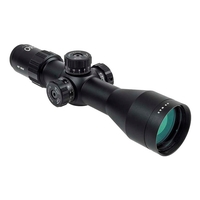
PAO HD MAX 4-16x44 SF FFP Ultra Compact Riflescope
via Uttings
£219.00
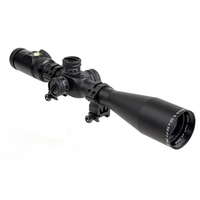
PAO F1 5-20x50 IR SF FFP Rifle Scope
via Uttings
£239.00

Hawke Vantage 30 WA FFP 4-16x50 Rifle Scope
via Uttings
£249.00
Buying Advice
When evaluating an LPVO for zero-distance optimization, the first specs to scrutinize are the reticle plane (FFP or SFP), the subtension system (MOA or MRAD), and whether the reticle includes BDC hashmarks or a full mil/MOA holdover tree. In a first focal plane (FFP) scope, the reticle scales proportionally with magnification, meaning your holdover marks are accurate at every power setting — critical if you plan to use reticle-based holds rather than dialing. In a second focal plane (SFP) optic, the reticle subtensions are only accurate at one specific magnification (usually the highest). If you zero at 100 yards and rely on BDC marks calibrated for a specific cartridge, an SFP scope works fine — but only if you remember to crank to the reference magnification before holding over. For MRAD scopes, remember that 0.1 mil equals 1 cm at 100 meters (or roughly 0.36 inches at 100 yards); for MOA scopes, 1 MOA equals approximately 1.047 inches at 100 yards. These relationships are non-negotiable physics, and misunderstanding them is the fastest way to miss.
Budget tiers for LPVOs in the US market break down predictably. Entry-level options in the $200-$400 range — like certain Vortex Strike Eagle or Bushnell AR Optics models — offer solid glass clarity and reliable 1-6x or 1-8x magnification ranges with SFP BDC reticles. These are excellent for casual 3-gun, home defense setups, and hog hunting at close to moderate distances. Mid-tier scopes in the $500-$1,200 range, including the Vortex Viper PST Gen II and Leupold Mark AR series, step up with FFP reticles, better edge-to-edge clarity, more precise turrets with zero-stop capability, and improved low-light transmission — important for deer hunting during dawn and dusk. Premium LPVOs above $1,500, such as the Vortex Razor Gen III or Leupold Mark 5HD, deliver exceptional glass quality, true daylight-bright illumination, bombproof construction, and the optical fidelity needed for positive target ID at distance. For elk hunting in Colorado's open parks and basins, the premium tier earns its price.
The most common mistake LPVO buyers make regarding zero distance is choosing a zero based on someone else's rifle and cartridge. A 50-yard zero is widely recommended for 5.56 NATO because of that cartridge's specific ballistic profile from a 16-inch barrel, but blindly applying a 50-yard zero to a .308 Win or .30-06 bolt gun produces a significantly different — and often less useful — trajectory curve. Another frequent error is zeroing at 100 yards and then assuming BDC marks will be perfectly accurate without verifying them against your specific load's velocity and ballistic coefficient. Factory BDC reticles are calibrated for one generic load; your handloads or preferred factory ammo will almost certainly differ. Always confirm your actual drops at distance with a ballistic calculator like Hornady 4DOF or Applied Ballistics, then verify on paper or steel at the range.
For US-specific context, consider your primary discipline. Most whitetail deer in the eastern US are taken at distances under 150 yards from a treestand or ground blind — a 100-yard zero with a quality 1-6x LPVO is essentially point-and-shoot inside those distances, making it ideal for fast shots in thick timber. Western hunters pursuing elk or mule deer in states like Colorado, Montana, or Wyoming often face 200-400-yard shots across open terrain, where a 200-yard zero or a 100-yard zero with practiced holdovers becomes essential. Coyote hunting across open agricultural land in the Midwest and Plains states can push shots to 300-plus yards, and predator hunters increasingly pair LPVOs with dedicated coyote hunting rifles in 6.5 Creedmoor or .22-250 for that versatility. You can find nearly all the scopes discussed here on Amazon.com (where our aiscopeus-20 tag supports this site) or through retailers like OpticsPlanet, which often has optics-specific bundle deals.
Matching the right LPVO to your use case means being honest about your typical engagement distances and shooting positions. If you hunt whitetail from a stand with a .30-06, a mid-tier 1-6x SFP scope with a simple duplex or BDC reticle zeroed at 100 yards is all you need — and spending $2,000 on premium glass won't make the deer any closer. If you compete in 3-gun or multigun with an AR-15, a lightweight FFP 1-8x or 1-10x with an MRAD reticle zeroed at 50 yards gives you the most usable envelope from point-blank to 500 yards without dialing. For air rifle shooters, note that sub-12 ft-lb springers and PCP guns are only effective to roughly 50-75 yards, and they benefit from a 25- or 30-yard zero rather than anything discussed here for centerfire platforms — don't over-scope a pellet gun. For night vision or thermal scope users pairing clip-on NV devices with an LPVO for hog hunting, maintaining a standard daytime zero is critical since the clip-on sits in front of the objective and should not shift your zero.
The brand landscape for LPVOs in 2026 is dominated by a few proven players. Vortex offers the widest range from budget to premium, with lifetime no-questions-asked warranties that resonate strongly with US buyers. Leupold, manufactured in Beaverton, Oregon, commands loyalty for its American-made glass and exceptionally lightweight builds — their VX-series remains a staple for western hunters who count every ounce. Bushnell provides aggressive value in the entry and mid tiers, and their LRHS and Elite Tactical lines punch above their weight for the price. Pulsar has carved out a dominant position in the thermal scope and night vision scope market for hog hunting and predator control, though they don't compete in the traditional LPVO space. When choosing between these brands, consider warranty service speed, turret feel, reticle options, and whether FFP or SFP best matches your zero-distance strategy. The best scope is ultimately the one whose reticle system, optical quality, and zero-distance compatibility align precisely with how you actually shoot.
Frequently Asked Questions
What is the best zero distance for an LPVO on an AR-15 in 5.56 NATO?
For most AR-15 shooters running 5.56 NATO or .223 Remington from a 16-inch barrel, a 50-yard zero is widely considered optimal. This keeps the bullet within approximately plus or minus two inches of the point of aim from the muzzle out to roughly 225 yards, giving you an effective point-blank range for center-mass hits without holdover. A 100-yard zero works well too, but you'll experience slightly more rise at 25-50 yards and faster drop beyond 200. Confirm your specific trajectory with a ballistic calculator using your exact load data.
What is the best scope for whitetail hunting?
For whitetail hunting, where most shots occur under 150 yards from a treestand or blind, a quality 1-6x or 1-8x LPVO with excellent low-light transmission is ideal. Look for scopes from Vortex (Viper PST Gen II), Leupold (VX-6HD), or Bushnell (Elite series) with illuminated reticles for dawn and dusk shooting. SFP reticles with simple BDC or duplex designs work perfectly since you rarely need precise long-range holdovers. Pair it with a 100-yard zero for simplicity, and you have a setup that covers virtually every realistic whitetail scenario.
What is the best scope for deer hunting with a .308 or .30-06?
Both .308 Winchester and .30-06 Springfield are moderate-velocity, heavier-bullet cartridges that benefit from a 100-yard zero when paired with an LPVO. A mid-tier 1-6x or 2-10x scope with a BDC reticle calibrated for .308-class ballistics (or better yet, a mil/MOA reticle you can customize) works exceptionally well. Leupold's VX-5HD and Vortex's Viper PST Gen II are popular choices in the $500-$1,000 range. The best rifle scope for these calibers will have at least 90% light transmission for low-light deer hunting conditions and a forgiving eye box for fast shot acquisition.
What is the best scope for elk hunting in Colorado?
Elk hunting in Colorado often involves shots from 100 to 400 yards across open parks, alpine basins, and timber edges. A premium LPVO in the 1-8x or 1-10x range — such as the Vortex Razor Gen III-E or Leupold Mark 5HD — gives you close-range speed in timber and the magnification for precise shot placement at distance. FFP reticles with MRAD subtensions are preferred for on-the-fly holdovers. Zero at 100 yards and know your drops at 200, 300, and 400 yards cold. Weight matters at 10,000 feet of elevation, so Leupold's lighter builds are a strong advantage for backcountry elk hunts.
Should I use a 50-yard or 100-yard zero for coyote hunting with an LPVO?
For coyote hunting, where shots can range from 50 to 350-plus yards across open terrain, a 100-yard zero is generally more practical. Coyote hunting demands precision on a small target, so minimizing guesswork at the distances where you're most likely to shoot matters more than the marginal advantage a 50-yard zero provides at close range. If you're using a dedicated scope coyote setup on a flat-shooting cartridge like .22-250 or 6.5 Creedmoor, a 100-yard zero paired with a mil/MOA reticle lets you hold precisely for 200-400-yard shots without dialing.
Does FFP vs. SFP matter for LPVO zero distance selection?
Your zero distance is independent of whether your scope is FFP or SFP — the bullet doesn't know what reticle plane you're using. However, the reticle plane dramatically affects how you use holdovers beyond your zero. In an FFP scope, your mil or MOA subtensions are accurate at any magnification, so you can hold over at 3x or 8x with equal precision. In an SFP scope, subtensions are only correct at one magnification (typically the highest). This means SFP users must remember to crank to the reference magnification before using BDC marks, which can cost critical seconds in dynamic shooting situations.
Can I use an LPVO for hog hunting at night with a clip-on night vision or thermal device?
Yes, and this is an increasingly popular configuration for hog hunting across Texas, the Southeast, and other states where nighttime take is legal. A clip-on night vision scope or thermal scope device mounts ahead of your LPVO's objective lens, allowing you to use your existing daytime zero. Pulsar and other manufacturers offer dedicated clip-on thermal and best night vision devices designed for this purpose. Your zero distance should remain whatever you've established for daytime shooting — typically 100 yards for .308 or .30-06 hog guns. The best thermal and vision scope clip-ons are passthrough designs that don't shift your zero when attached or removed.
What zero distance should I use for an LPVO on an air rifle?
Air rifles operate in a fundamentally different ballistic realm than centerfire platforms. Sub-12 ft-lb air rifles and springers are realistically effective only to about 50-75 yards, and their pellets have dramatic trajectory arcs compared to bullets. A 25- to 30-yard zero is standard for most air rifle scopes, keeping the pellet within a usable window out to 50 yards. Do not apply centerfire LPVO zero logic to an air rifle — the trajectories are not comparable. A dedicated air rifle scope rated for the unique recoil pattern of spring-piston guns is also essential, as standard rifle scope internals can be damaged by springer recoil.
How do I confirm my LPVO zero matches my ballistic calculator's predictions?
After establishing your zero at the chosen distance (50 or 100 yards), shoot groups at 200 and 300 yards and compare actual impacts to your ballistic calculator's predicted drops. Input your exact muzzle velocity (measured with a chronograph, not the box label), bullet ballistic coefficient (BC), scope height over bore, temperature, and altitude. If actual impacts differ from predictions, adjust your BC or muzzle velocity inputs until the calculator matches reality. This process, called truing your data, is essential for accurate long range holdovers and ensures your reticle subtensions or turret dials produce real-world hits.
Related guides
How zero-stop turrets work, which US-market systems (Leupold CDS-ZL, Vortex CRS, Nightforce ZeroStop, Bushnell RevLimiter) to buy, and how to choose by budget and discipline in 2026.
Zero Stop Turrets Explained: Do You Really Need One?What is a zero stop turret, how does it work, and do you actually need one on your rifle scope? Our UK expert guide covers the pros, cons, and key buying criteria for 2026.
Zeroing Your Rifle Scope at 100 Yards — UK GuideLearn how to zero a rifle scope at 100 yards with this UK-focused guide. Covers MOA vs MRAD adjustments, parallax, bore-sighting, and the best scope features for a reliable 100-yard zero.
Red Dot vs LPVO for Driven Shooting: Which Is Right for You?Choosing the best scope for driven shooting in the UK? We compare red dot sights and low-power variable optics for fast-moving driven game, covering legality, speed, and budget in 2026.
How to Sight In a Rifle Scope: Step-by-Step First-Time GuideFirst time sighting in a rifle scope? Our 2026 step-by-step US guide walks you through mounting, bore-sighting, and dialing in your zero at 25 and 100 yards.
How to Swap Day and Night Optics on the Same RifleLearn how to swap between a day rifle scope and a night vision scope on the same rifle without losing zero. Covers mounts, reticles, zeroing tips, and top picks for US hunters.
Scoping Your Barrett MRAD — The Definitive 2026 GuidePair your Barrett MRAD with the perfect rifle scope. We cover top optics, caliber choices, reticle systems, and long range setup tips for US shooters in 2026.
Not sure which scope is right for you?
Try our AI-powered scope finder — answer a few questions and get personalised recommendations.
Find My Scope →Get a UK scope tip every day
Follow AiScopes on Facebook for daily buying guides, deals and gear advice.
Follow on Facebook