Christmas Tree vs Simple Reticles: Which PRS Reticle Is Right for You?
By Peter Makulek · Senior Optics Editor · · Live prices from UK retailers
Walk into any UK PRS match and you will see an extraordinary variety of reticle designs behind the firing line. Some shooters peer through dense lattices of hash marks and numbered wind dots — the so-called christmas tree reticle — while others favour a far sparser pattern with little more than a crosshair and a few stadia lines. The debate over which approach is genuinely faster on positional stages has been running for years, yet there is still no single authoritative UK-focused guide that explains the trade-offs without tribal bias. That is what this page sets out to be.
At its core the choice comes down to how you prefer to apply corrections for bullet drop and wind drift. A holdover reticle with a dense subtension tree — such as the Nightforce Tremor3 or the Vortex EBR-7C — lets you hold off the centre dot to engage targets at varying distances without ever touching a turret. A cleaner pattern like Leupold's PR2 reticle or the March MPCT-2 gives you a less cluttered sight picture and encourages dialling elevation on the turret, reserving the reticle mainly for wind holds. Neither method is objectively superior; what matters is how each meshes with your shooting style and the stage formats you encounter in the UK.
PRS and NRL-style competition has grown quickly on this side of the Atlantic, with clubs from Diggle to Bisley now running regular precision rifle series. Most UK competitors shoot 6.5 Creedmoor or .308 Win at distances from 100 to roughly 1 000 yards, frequently under time pressure and from awkward positional stages. Those conditions magnify every fraction of a second spent interpreting your reticle or fumbling a turret, so reticle choice is far from cosmetic. Understanding what separates a busy reticle from a purposefully detailed one — and knowing when simplicity genuinely helps — can shave points off your stage times.
In this guide we break down the major reticle families, explain the optical and practical differences, and give honest buying advice for UK shooters at every budget tier. We then answer the most common questions we receive — from beginners wondering whether to start simple, to experienced competitors asking whether reticle clutter really costs them points. If you are spending several hundred to several thousand pounds on a precision rifle optic, the reticle etched into its glass is arguably the single feature you will interact with most, so it pays to choose deliberately.
Top Picks — Live UK Prices
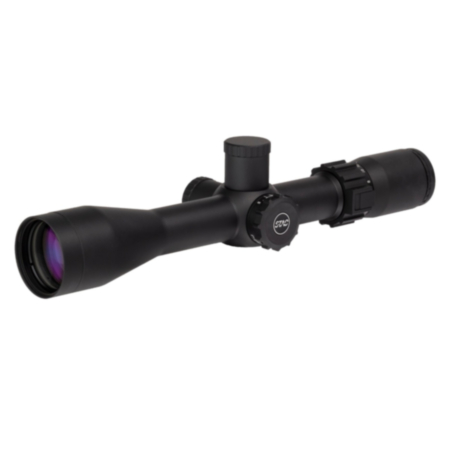
Sightron S-TAC 3-16x42 SFP SF Non IR MOA-3 30mm Rifle Scope
via Optics Warehouse
£369.99
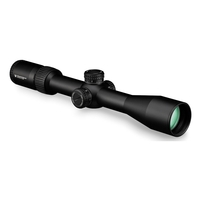
Vortex Diamondback Tactical FFP 4-16x44 Riflescope - MRAD
via Uttings
£429.00
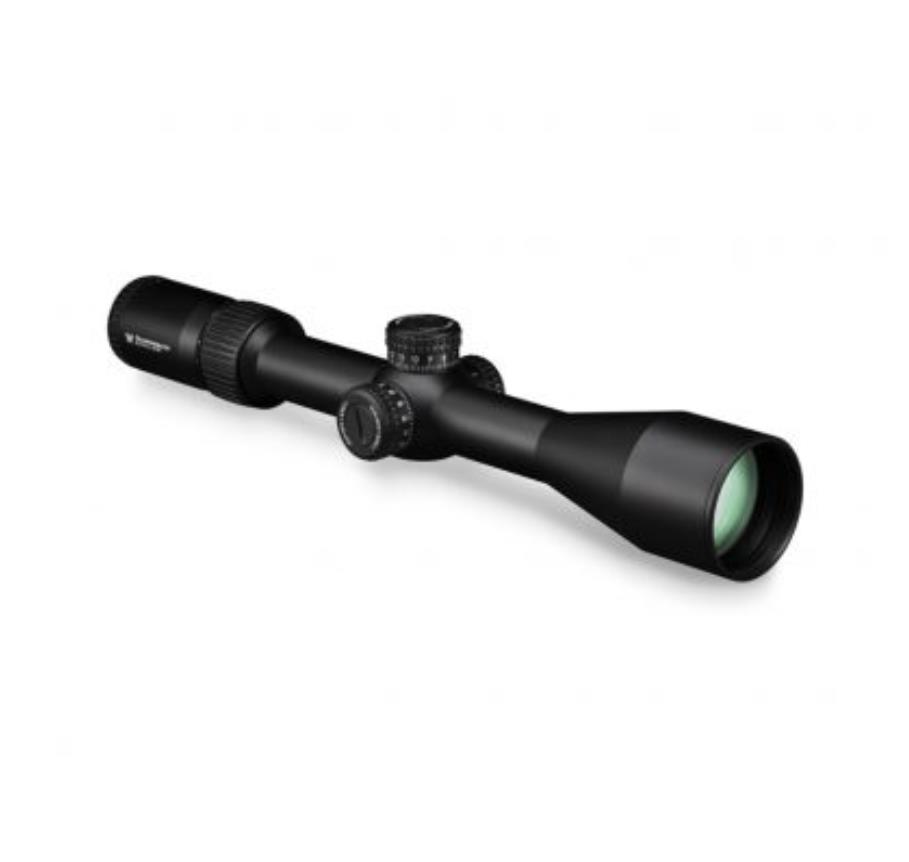
Vortex Diamondback Tactical 6-24x50 FFP MOA Scope
via Livens
£445.00
Buying Advice
The first specs to check are reticle plane and subtension values. For PRS, a first-focal-plane (FFP) reticle is almost mandatory because your holdover values remain correct at every magnification — critical when time pressure means you may not always be on full power. Confirm whether the reticle is calibrated in MRAD or MOA: most UK PRS shooters now favour MRAD because the metric relationship (0.1 mil = 1 cm at 100 m) is intuitive and matches the metric range cards common at British competitions. Ensure the turrets match the reticle unit — an MRAD reticle paired with MOA turrets is a recipe for confusion. Also check total elevation travel and whether a reliable zero-stop is included; you want enough travel to dial to your maximum expected range without running out of adjustment.
At the entry tier — roughly below £600 — scopes like the Athlon Ares ETR and Element Optics Titan offer christmas tree reticle options with surprisingly good glass. You may sacrifice edge-to-edge sharpness and turret repeatability compared to premium models, but for a new PRS shooter learning to read wind holds these scopes are excellent training tools. The mid tier, from around £800 to £1 500, is where options like the Vortex Viper PST Gen II (EBR-7C) and Leupold Mark 5HD (PR2 reticle or Tremor3) sit; these deliver noticeably better optical clarity, more refined turret feel, and often superior illumination systems. At the premium end — £2 000 and above — Nightforce ATACR, Schmidt & Bender PM II, and March Genesis models offer benchmark-level glass, bombproof tracking, and reticle designs refined through years of competitive feedback.
The most common mistake UK buyers make is choosing a reticle based on how it looks in a photograph rather than how it performs at the eyepiece. A christmas tree reticle like the Tremor3 can appear overwhelmingly busy on a computer screen, yet at 25× behind the scope the graduated hash marks sit neatly around a clear central aiming point and are easy to ignore until needed. Conversely, a reticle that looks beautifully clean in a product image — just a dot and thin crosshairs — can leave you desperately short of references when you need a 2.4 mil wind hold on a stage with a 90-second par time. Wherever possible, look through the actual scope at a retailer or club demo day before committing.
UK shooters face a few specific considerations. Firearm certificate conditions mean most PRS competitors own one or two rifles rather than a rack of calibres, so optimising your reticle choice for your primary cartridge makes sense. The 6.5 Creedmoor dominates UK PRS largely because its relatively flat trajectory and mild recoil suit positional shooting; with a typical 140-grain load you might need only 6–7 mils of drop to reach 800 yards, meaning even a modest tree reticle covers you without dialling. For purchasing, reputable UK dealers such as Optics Warehouse, RUAG UK (for Schmidt & Bender), and specialist importers for March and Nightforce offer warranty-backed sales. Always confirm UK stock availability before planning around a specific model, as some reticle variants are US-market exclusives.
Matching the reticle to your personal workflow is the ultimate deciding factor. If you prefer to dial elevation and only hold for wind, a cleaner design like the PR2 reticle, the MPCT-2, or even a simple MOA MRAD grid reticle with floating centre dot will keep your sight picture uncluttered and let you focus on reading mirage. If you favour holding over for both elevation and wind — common on fast-paced stages with multiple targets at different distances — a fuller tree reticle like the EBR-7C or Tremor3 gives you the references to do so without lifting your hand from the rifle. Many top competitors actually use a hybrid approach: dialling rough elevation, then holding fine corrections on the reticle. Whatever your method, practise it extensively in dry-fire and live sessions so the reticle becomes second nature.
A brief brand landscape helps orient new buyers. Nightforce is synonymous with durability and reticle innovation — the Tremor3 remains one of the most data-rich christmas tree reticles available and is widely used in international PRS. Vortex offers exceptional value across its Razor and Viper lines, and the EBR-7C is a well-balanced holdover reticle that avoids excessive clutter. Leupold's Mark 5HD line is lighter than most competitors, a genuine advantage on positional stages, and the PR2 reticle is purpose-built for PRS with a philosophy of deliberate simplicity. Schmidt & Bender and March cater to shooters who demand the very best optical resolution, with March in particular offering an unusually wide range of reticle options including the open, intuitive MPCT-2. Element Optics and Athlon have rapidly gained UK mindshare by delivering FFP MRAD scopes at aggressive price points, making them strong choices for newcomers who want a proper precision rifle reticle without a premium outlay.
Frequently Asked Questions
What is a Christmas tree reticle and how do you use it?
A christmas tree reticle is a holdover reticle whose hash marks widen progressively below the centre crosshair, forming a tree-like shape. The horizontal marks represent wind-hold values in MRAD or MOA at specific drop intervals, so you can aim off-centre to compensate for both bullet drop and wind drift simultaneously. To use one effectively you need a range card or ballistic app telling you how many mils or MOA of drop and wind correction to apply; you then place the appropriate intersection point on the target and fire. In a first-focal-plane scope the subtensions stay true at every magnification, making the tree usable even when you are not at full power.
Why do some experienced PRS shooters dislike Tremor-style reticles?
The main criticism is reticle clutter: the Tremor3 packs a large number of numbered hash marks, wind dots, and moving-target leads into the lower half of the image, which some shooters find distracting when trying to spot trace or read mirage. On high-magnification stages where targets are small and partially obscured, a dense pattern can make it harder to isolate the aiming point quickly. Experienced competitors who habitually dial elevation and only hold for wind argue that much of the tree's detail goes unused and simply adds visual noise. That said, many equally experienced shooters love the Tremor3 precisely because it offers a reference for almost any scenario — the disagreement is genuinely about workflow preference rather than objective quality.
What is the difference between a busy tree reticle and an open one like the EBR-7C or MPCT-2?
A busy reticle such as the Tremor3 includes closely spaced hash marks, numbered rows, and additional features like moving-target leads and ranging stadia. An open christmas tree reticle like the Vortex EBR-7C or the March MPCT-2 retains the widening-tree concept but uses fewer, more widely spaced marks and omits some specialist references. The result is a cleaner sight picture that still offers usable holdover points for elevation and wind holds without overwhelming the shooter. Open designs are often recommended for competitors who want some tree functionality but prioritise target visibility and fast acquisition over having every conceivable subtension etched into the glass.
Is Leupold's PR2 reticle good for PRS?
The PR2 reticle was designed specifically for precision rifle competition and is an excellent choice for shooters who prefer to dial elevation on the turret and use the reticle primarily for wind holds. It features a floating centre dot, fine crosshairs, and a modest set of hash marks — enough to hold moderate corrections without the density of a full christmas tree reticle. Paired with the Mark 5HD's notably light weight and crisp turret feel, the PR2 makes a strong PRS reticle choice, particularly for positional stages where every gram on the rifle matters. Its relative simplicity also means less time interpreting marks and more time watching for splash and mirage.
Should a beginner start with a simple reticle or a Christmas tree reticle?
There is a strong argument for beginners starting with a moderately detailed holdover reticle rather than the absolute simplest option. A mid-complexity design like the EBR-7C gives a new shooter usable holdover references to learn with, while keeping the sight picture open enough to avoid confusion. Starting on a very busy reticle like the Tremor3 can be overwhelming before you have developed the habit of quickly identifying the correct mil value under time pressure. Conversely, an extremely clean reticle with almost no marks demands confident turret work that beginners may not yet possess. A balanced tree reticle paired with dedicated dry-fire practice is usually the fastest route to competence.
Does illumination cover the whole Christmas tree reticle or just the centre?
In most modern designs, illumination lights only the centre dot or a small central section of the crosshair, not the entire tree. This is intentional: illuminating every hash mark would create a glowing mass that washes out fine detail and obscures the target. Centre-only illumination lets you pick up the aiming point quickly in low light or against dark backgrounds while the etched black lines of the tree remain visible through contrast alone. A few reticles offer selectable illumination zones, but for PRS use a single bright centre dot is generally preferred. Check the manufacturer's spec sheet if full-tree illumination matters to you, as it varies by model.
Do I need a tree reticle if I dial my turrets instead of holding over?
Not necessarily. If your standard workflow is to dial elevation for every target and hold only small wind corrections on the reticle, a simpler design like the PR2 reticle or a basic MRAD crosshair with a few wind references will serve you well and keep your sight picture clean. The christmas tree reticle's primary advantage is speed on stages where multiple targets sit at different distances and there is no time to dial between shots. If you always dial, the extra subtensions go largely unused. That said, having tree marks available as a backup — for example if you miscount a dial rotation under pressure — provides a safety net that some dial-first shooters still appreciate.
MRAD or MOA: does it matter for choosing a tree reticle?
Both systems work perfectly well; what matters is internal consistency — your reticle, turrets, and ballistic data should all use the same unit. In the UK PRS scene, MRAD has become the dominant standard because its metric basis (0.1 mil = 1 cm at 100 m) meshes neatly with metric range cards and is quick to communicate between shooter and spotter. Most christmas tree reticles from Nightforce, Vortex, and March are offered in MRAD, and the majority of UK competitors run MRAD setups. MOA reticles remain popular among some shooters — 1 MOA ≈ 1.047 inches at 100 yards — but you may find fewer tree-style MOA options on the UK market.
How do I practise using a Christmas tree reticle before a competition?
Start with dry-fire drills at home: tape small numbered targets to a wall at known simulated distances and practise placing the correct reticle intersection on each target while running a shot timer. This builds the neural pathway of reading your tree quickly without burning ammunition. When you move to live fire, set steel at three or four distances and practise engaging them in sequence using holdovers only, resisting the urge to dial. Record your corrections and compare them to your ballistic solver's predictions. Over several sessions you will develop an instinctive feel for where common hold values sit on your reticle, which is the key to fast, confident wind holds under match pressure.
Related guides
Definitive UK buyer's guide to the best scopes for PRS competition in 2026. We cover FFP reticles, MRAD turrets…
Best PRS Competition Scopes: A UK Beginner's Guide for 2026Choosing your first precision rifle scope for PRS in the UK? Our 2026 guide covers reticles, turrets, magnification and budget tiers to get you…
Budget PRS Scopes Compared: Athlon, Arken, Discovery & Bushnell R7Honest 2026 comparison of Athlon, Arken, Discovery Optics & Bushnell R7 budget PRS scopes under $700.
Length of Pull vs Eye Relief: Choosing a Scope for Prone and BenchMaster the relationship between length of pull and eye relief for prone and bench shooting. UK-focused guide covering eye box forgiveness, chassis LOP…
Read next
- budget PRS scopes UK
Best Budget PRS Scopes for UK Shooters in 2026
Not sure which scope is right for you?
Try our AI-powered scope finder — answer a few questions and get personalised recommendations.
Find My Scope →Get a UK scope tip every day
Follow AiScopes on Facebook for daily buying guides, deals and gear advice.
Follow on Facebook