Length of Pull vs Eye Relief: Choosing a Scope for Prone and Bench
By Peter Makulek · Senior Optics Editor · · Live prices from UK retailers
If you have ever settled into a comfortable prone position behind your PRS rifle only to see a crescent-shaped shadow creeping into the image, or shifted to the bench and found the full field of view has vanished entirely, you have experienced the tension between length of pull and eye relief first-hand. These two dimensions are fundamentally linked: altering one changes the other, and most shooters set them up in isolation rather than as a system. This guide exists to close that gap and give UK precision-rifle shooters a single, definitive reference for getting both right across positions.
Length of pull — the distance from the trigger face to the rearmost point of the buttstock or pad — determines where your eye sits relative to the rear lens of the scope. Eye relief is the distance from that rear lens at which the full, unvignetted image is visible. In a perfect world you would set your LOP once and forget it, but prone and bench positions place your head in fundamentally different locations along the stock. A chassis rifle with an adjustable LOP, such as an MDT ACC or an XLR Element, gives you the mechanical range to compensate, yet many shooters never exploit it because they do not understand the optics side of the equation.
Eye box forgiveness — the three-dimensional volume behind the ocular lens in which you can still see a clean image — is arguably more important than a single eye-relief number printed on the spec sheet. A scope with a generous eye box lets you shift between prone, bench, and even barricade positions without perfectly replicating your cheek weld every time. First-focal-plane designs, which dominate PRS, tend to have slightly tighter eye boxes at the top of the zoom range, which is exactly where you need the image most. Understanding this trade-off before you buy is the purpose of this guide.
We are writing from a UK perspective, where PRS and F-Class disciplines are thriving, .308 Win and 6.5 Creedmoor are the dominant cartridges, and optics are typically purchased from specialist dealers such as RUAG, Sporting Services, or Optics Warehouse. UK shooters also contend with variable weather and often shoot from exposed firing points where rushed position changes demand forgiving optics. Below, we set the context for the key decision factors, recommend scopes that handle the prone-to-bench transition well, and answer the most common questions UK shooters are asking in 2026.
Top Picks — Live UK Prices
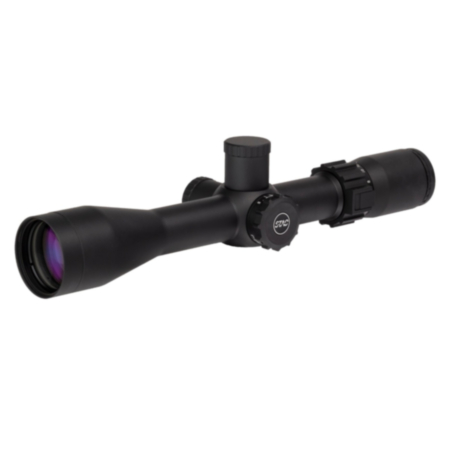
Sightron S-TAC 3-16x42 SFP SF Non IR MOA-3 30mm Rifle Scope
via Optics Warehouse
£369.99
Vortex Diamondback Tactical FFP 4-16x44 Riflescope - MRAD
via Uttings
£429.00
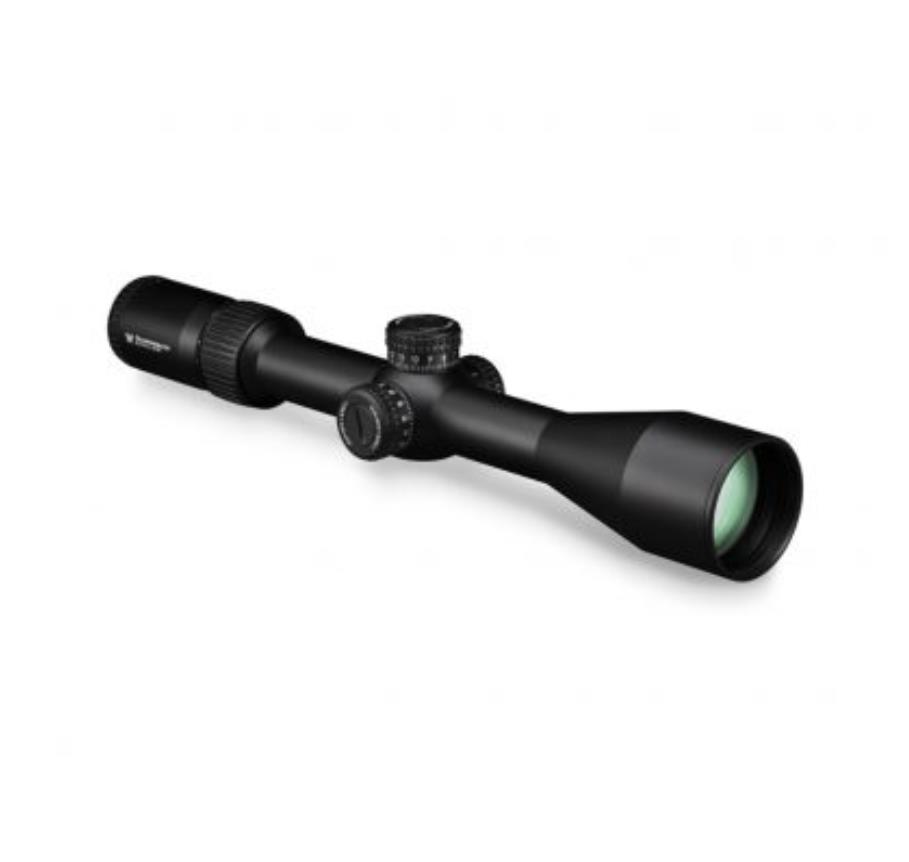
Vortex Diamondback Tactical 6-24x50 FFP MOA Scope
via Livens
£445.00
Buying Advice
Start with the numbers on the spec sheet, but read them critically. Eye relief is usually quoted as a range on the manufacturer's spec sheet — often somewhere between 3 and 4 inches on high-magnification PRS scopes — yet that range corresponds to different magnification settings, and the exact figures vary by model. At lower magnifications the eye relief is typically longer and the eye box more forgiving; as you dial up, the optical path narrows and the usable eye relief shortens. An FFP scope compounds this because the reticle subtension must remain constant across the zoom range, which constrains internal lens movement. Always check whether the manufacturer quotes eye relief at minimum zoom, maximum zoom, or both. If only one figure is given, assume it is the most flattering end. The eye box forgiveness at high magnification is what really determines whether you can maintain a stable image in prone without micro-adjusting your head every shot.
Budget tiers in the UK break down roughly as follows. Entry-level PRS-capable scopes from Arken (EP5 5-25×56) and Vortex (Viper PST Gen II 5-25×50) offer solid FFP reticles with MRAD turrets and eye relief in the 3.4–3.8-inch range, delivering genuine value and enough eye box forgiveness for club-level competition. Mid-tier options — Meopta Optika6 5-30×56, Vortex Razor HD Gen III 6-36×56 — sharpen the glass, tighten tracking repeatability, and often provide a wider usable eye box across the zoom range, which pays dividends when transitioning between prone and bench. Premium glass from Nightforce (ATACR, NX8) and Kahles sits at the top: the optical coatings, mechanical precision, and carefully engineered eye-relief profiles justify the cost for serious competitors who need sub-0.1 MRAD tracking accuracy and an eye box that is still usable at 30× or above.
The most common mistake UK shooters make is treating LOP and scope position as separate problems. They set the chassis rifle LOP to a comfortable standing length — typically 13.5 to 14 inches — then mount the scope to give good eye relief at the bench with their torso upright. When they drop into prone, their body compresses behind the rifle, effectively shortening the distance between their eye and the scope by 15–30 mm. Suddenly the eye relief is too short and they see shadowing. The fix is to set your LOP in prone first, because that is the position with the least room for adjustment, and then accommodate the bench by either extending the buttstock a single click or, more practically, accepting a marginally longer eye relief at the bench, which is almost always more forgiving than one that is too short.
UK-specific context matters here. Under Section 1 FAC conditions, bolt-action rifles chambered in .308 Win, 6.5 Creedmoor, and .223 Rem dominate PRS and practical rifle disciplines. Most UK ranges run to 1,000 yards at best, meaning 25× is more than adequate magnification for the vast majority of stages — yet many shooters default to the maximum zoom of a 5-35× optic and then struggle with a cramped eye box. Dialling back to 20–25× in prone, where natural point of aim is harder to refine, buys back eye box forgiveness with negligible loss of target resolution at typical UK distances. Retailers such as RUAG Ammotec UK, Sporting Services, and Premier Reticle stock the key brands and will often let you handle scopes before purchase — take your chassis along and check the eye relief across the full zoom range before committing.
Matching the scope to your use case means honestly assessing how often you change position mid-stage. If you shoot purely from the bench — load development, group testing, F-Class — you can optimise LOP and scope position for that single posture and tolerate a tighter eye box at high magnification. If you compete in PRS, NRL-style matches, or practical rifle where you transition from prone to bench to barricade within a stage, eye box forgiveness becomes a primary selection criterion, not a secondary one. Look for scopes where the manufacturer explicitly states the eye-relief range across the zoom, and favour models with a wide eye box at 20× and above. Adjustable cheekpiece height on your chassis (MDT, KRG, XLR) complements this by letting you maintain a consistent cheek weld as the stock-to-scope geometry changes with position. A Spuhr mount or comparable one-piece cantilever mount gives you fine fore-aft adjustment during initial setup without resorting to extra scope-ring shims.
The brand landscape in the UK for PRS optics in 2026 is healthier than ever. Nightforce remains the benchmark for mechanical durability and consistent eye relief across the zoom range — the ATACR range is a staple for PRS-length engagements on UK firing lines, while the more compact, lower-magnification NX8 line suits tactical and multi-gun use at a lower price point. Vortex offers the broadest range from entry to premium, and the Razor HD Gen III is exceptionally popular for its optical clarity and a Lifetime VIP warranty that applies in the UK through authorised dealers. Meopta, a Czech manufacturer with a strong European pedigree, delivers superb glass quality in the Optika6 line at a mid-tier price, and their eye-relief figures tend to be conservative (i.e., honest). Arken has gained rapid UK mindshare by offering genuine MRAD FFP reticles and surprisingly forgiving eye boxes at a fraction of the premium price. MDT and Spuhr dominate the chassis and mounting side respectively, and pairing a well-chosen scope with a properly adjustable chassis rifle LOP and a quality one-piece mount is the surest path to a setup that works in every position.
Frequently Asked Questions
Why does eye relief get shorter as magnification increases on a variable scope?
As you increase magnification, the internal erector lens group moves forward to produce a higher-powered image, which shifts the exit pupil closer to the rear (ocular) lens. This physically reduces the distance at which your eye can capture the full, unvignetted field of view. The effect is more pronounced on high-ratio zoom scopes (e.g., 7-35×) because the erector system travels further. This is why eye relief at high magnification — not the headline figure — is the number that matters for prone shooting, where your head is already pressed close to the scope.
What length of pull should I set up for prone shooting versus the bench?
Most UK PRS shooters find a chassis rifle LOP of around 12.75–13.25 inches works well for prone, where the body is compressed behind the rifle and the head naturally sits closer to the scope. At the bench, where the torso is more upright and the head sits further back, an additional 10–20 mm (one or two clicks on most adjustable chassis stocks) brings the eye back into the optimal eye-relief window. If your chassis allows quick LOP changes — as MDT, KRG, and XLR stocks do — it is worth practising the transition so it becomes second nature between stages.
Can I fix inconsistent eye relief without buying a new scope?
Often, yes. First, check your scope-mount position: sliding the scope forward by 5–10 mm in its rings or Spuhr mount can recover lost eye relief in prone without sacrificing bench usability. Second, adjust your cheekpiece height — a higher adjustable cheekpiece drives your eye upward into the optical axis rather than letting it drift fore and aft. Third, confirm your LOP is set for your primary shooting position. These three mechanical adjustments frequently resolve inconsistent eye relief entirely, saving you the cost of a new optic.
What is eye-box forgiveness and why does it matter for position changes?
Eye-box forgiveness describes how large the three-dimensional volume behind the ocular lens is within which you can still see a full, shadow-free image. A forgiving eye box means your eye can be slightly off-centre vertically, laterally, or in distance and still see a clean sight picture. This is critical when transitioning between prone, bench, and barricade positions because your cheek weld — and therefore your eye position — inevitably shifts. Scopes with generous eye-box forgiveness, particularly at higher magnifications, let you acquire the target faster and shoot with less positional fuss.
Should I dial back magnification when moving from the bench to prone?
In most cases, yes. Reducing magnification by a few clicks — say from 30× to 22× — widens the eye box and lengthens the usable eye relief, making it far easier to achieve a clean image in prone where head position is more constrained. At typical UK PRS distances (200–1,000 yards), the resolution difference between 22× and 30× is negligible for spotting impacts. On a first-focal-plane scope, your MRAD reticle remains accurate at any magnification, so there is no holdover penalty for dialling back. It is one of the simplest and most effective tricks for maintaining image quality across positions.
How do I check a scope's eye relief across its whole zoom range before buying?
The best method is to mount the scope on your actual rifle or chassis and cycle through the full zoom range while in both prone and bench positions. Many UK dealers — Sporting Services, RUAG, and others — will let you do this in-store or at a demo day. At each magnification, note whether you see any crescent shadowing at the edges of the image. Pay particular attention to the top third of the zoom range, where the FFP eye relief is tightest. If buying online, look for reviews or manufacturer data that specify eye relief at both minimum and maximum magnification, not just a single headline figure.
Will a shorter LOP chassis setting fix my eye relief problem at the bench?
It can help, but it works in the opposite direction to what most people assume. A shorter LOP moves your shoulder — and therefore your eye — closer to the scope, effectively reducing the eye-relief distance. If your problem at the bench is that you are too far from the scope (i.e., you see a small circle of image surrounded by black), then shortening the LOP will help. However, if you are already too close and seeing crescent shadows, you need a longer LOP at the bench or to slide the scope forward in its mount. Always diagnose whether you are too near or too far before adjusting.
Does scope mount height affect eye relief or eye-box access?
Mount height does not change the optical eye relief, which is fixed by the scope's lens design, but it dramatically affects your ability to access the eye box consistently. If the scope mount height is too low, you must crush your cheek into the stock to align your eye with the optical axis, which pushes your head forward and reduces your effective eye relief. A properly matched scope mount height — combined with an adjustable cheekpiece — lets your head sit naturally behind the scope with minimal strain. Spuhr mounts, for instance, are available in multiple height configurations specifically so you can optimise this geometry for your face and chassis combination.
Are there specific scope features I should prioritise for UK PRS competition?
For UK PRS, prioritise a first-focal-plane MRAD reticle (0.1 mil clicks, where 1 mil = 10 cm at 100 metres) with a zero-stop elevation turret and a side-focus parallax adjustment. Eye-box forgiveness at 20× and above should be a key selection criterion if you shoot positional stages. A locking elevation turret prevents accidental dial shifts during movement. A maximum magnification of 25–35× covers every UK range distance comfortably. Finally, ensure the scope has been tested for tracking accuracy — a tall-target or box test at 100 metres before your first competition is essential to confirm that your turret adjustments are mechanically true.
Related guides
Our expert 2026 guide to the best scope for bench rest shooting UK. Compare precision optics under £500 with the magnification…
Best Long-Range Scopes 2026: BDC Reticles vs Exposed TurretsDefinitive UK buyer's guide to the best scopes for long-range shooting in 2026. Compare BDC reticles vs exposed turrets for 300–1,000 yard shots…
Best Long-Range Scopes UK 2026: Mid-Budget Buyer's GuideDiscover the best scopes for long-range shooting in the UK for 2026. Our expert guide covers FFP vs SFP, MOA vs MRAD…
Not sure which scope is right for you?
Try our AI-powered scope finder — answer a few questions and get personalised recommendations.
Find My Scope →Get a UK scope tip every day
Follow AiScopes on Facebook for daily buying guides, deals and gear advice.
Follow on Facebook