Best Long-Range Scopes 2026: BDC Reticles vs Exposed Turrets
By Peter Makulek · Senior Optics Editor · · Live prices from UK retailers
Choosing the best scope for long-range shooting in the UK has never involved more options — or more confusion. Whether you are competing in PRS-style matches at Diggle or stretching a .308 Win to 1,000 yards on an MOD range day, the optic sitting on top of your rifle is often the factor that separates consistent hits from frustrating misses. In 2026 the market is split between two fundamentally different approaches to solving the problem of bullet drop: hold-over reticles (BDC) and precision-click exposed turrets. Understanding that split is the single most important decision you will make before spending a penny.
Long-range shooting in the UK context carries specific constraints that guides written for the American or even the Ukrainian market rarely address. Our prevailing wind, dense maritime air and the popularity of moderate-velocity calibres like 6.5 Creedmoor, .308 Winchester and .223 Remington mean that ballistic drop and wind drift figures are not identical to those calculated in drier, higher-altitude environments. A long range scope that works superbly in the Nevada desert may track differently in a Scottish glen at sea level in November. UK shooters also face practical realities: import duty on optics, limited dealer networks, and the need to keep setups compliant with the conditions on their firearms certificate.
This guide exists to give you the definitive answer to a question that forums, social-media groups and gun-shop counters revisit every season: should I choose a BDC reticle or exposed turrets for long-range work, and which specific scopes deliver genuine value on a UK rifle? We will walk through the core decision, explain the technical specs that actually matter — FFP versus SFP, MRAD versus MOA, turret travel, parallax adjustment — and then recommend products across entry, mid-range and premium budgets. Every recommendation is based on specifications relevant to UK disciplines and conditions.
Before we get to product picks, a note on terminology. When we say 'long range' in a UK rifle-shooting context we typically mean engagements from roughly 300 yards out to 1,000 yards and occasionally beyond. This is firmly centrefire territory; sub-12 ft/lb air rifles and even FAC-rated airguns are effective only to around 50–75 yards and should never be considered for this discipline. Everything in this guide assumes you hold the appropriate firearms certificate and are shooting on approved land or ranges. With that established, let us get into the detail.
Top Picks — Live UK Prices

Nikko Stirling Diamond Long Range 30mm Tactical 4-16x50 IR Rifle Scope
via Uttings
£199.00

Hawke Sidewinder Tactical 6.5-20x42 - 1/2 Mil Dot | 17 110
via Livens
£372.90
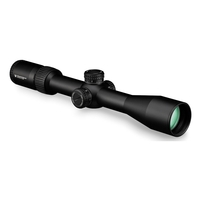
Vortex Diamondback Tactical FFP 4-16x44 Riflescope - MRAD
via Uttings
£429.00
Buying Advice
Start with the numbers that matter. Magnification is important, but it is not the whole story. For shots beyond 500 metres most experienced UK long-range shooters settle on a scope with a maximum magnification of at least 20× and often 25×. More critical is objective lens diameter (which governs light transmission and exit pupil in our typically overcast conditions), the adjustment range of the elevation turret (measured in milliradians or MOA of total travel), and whether the reticle sits in the first focal plane (FFP) or the second (SFP). In an FFP scope the reticle subtensions remain accurate at every magnification — essential if you use a BDC or mil-hash reticle for hold-overs. An SFP reticle is only dimensionally correct at one specific magnification, usually the highest. For serious long-range shooting, FFP is the safer choice.
Budget tiers in the UK break down roughly as follows. Under £500 you can find surprisingly capable scopes from brands like Athlon and Element Optics; expect good glass, acceptable turrets and perhaps a simple BDC or mil-dot reticle, but compromises in turret repeatability and coating consistency. Between £500 and £1,000 the market becomes very competitive: this is where you find scopes that genuinely track well over repeated elevation changes and offer zero-stop mechanisms, locking turrets and illuminated FFP reticles. A good long-range scope for a UK rifle under £1,000 is absolutely achievable in 2026. Above £1,000 you enter premium territory — Nightforce, Vortex Razor, Kahles, Schmidt & Bender — where turret feel, optical clarity at last light and guaranteed tracking over thousands of rounds justify the investment for dedicated competitors.
Common mistakes UK buyers make include over-magnifying at the expense of field of view (a 40× scope is pointless if you cannot find the target), choosing MOA turrets when their ballistic software outputs in MRAD (or vice versa), and neglecting to check that total elevation travel is sufficient for their chosen calibre at distance. For example, a .308 Win firing a 168-grain HPBT (G1 BC ~0.47) at roughly 2,600 fps drops in the region of 36–42 MOA from a 100-yard zero to 1,000 yards at sea level — figures vary significantly with exact BC, muzzle velocity and atmospheric density, so always verify with your specific load data and a validated ballistic calculator rather than relying on a rule of thumb. If your scope only has 60 MOA of total travel and the internal erector starts near the centre, you may run out of usable up-elevation before you reach 1,000. Always check usable elevation from a 100-yard zero, not just the total spec-sheet number. Another frequent error is buying a scope with a side-parallax adjustment but never actually using it — at 600 yards and beyond, uncorrected parallax causes significant point-of-impact shift.
UK-specific context matters. Legally, your scope is a non-controlled accessory under current UK firearms law, but if it incorporates an electronic rangefinder or an active infrared illuminator (as some advanced digital models from PARD and others do), it may be subject to restrictions for certain quarry species under night-shooting conditions — always check with your local police firearms-licensing department and any conditions on your certificate. Popular UK long-range disciplines include F-Class (Open and F/TR), NRL-style PRS matches run by the UK's precision rifle match organisers, and civilian service-rifle competitions. Each has slightly different optimal scope setups: F-Class shooters often prefer very high magnification with fine reticles, while PRS competitors need fast turrets with audible clicks and moderate magnification for positional stages. Purchase options include specialist UK dealers such as Optics Warehouse, Sporting Saint and others who carry verified UK stock with full warranty support.
Matching the scope to your use case comes down to one honest question: will you dial your turrets for every shot, or do you need the speed of holding over on a reticle? If you shoot F-Class from a bench rest at known distances, dialling exposed turrets gives you the most precise elevation correction — one click of a 0.1 MRAD turret moves the point of impact exactly 1 cm at 100 metres, 10 cm at 1,000 metres. If you shoot in PRS where targets appear at varied unknown distances and time is short, a well-designed BDC or Christmas-tree reticle in FFP lets you hold over instantly without touching a turret. Many top PRS shooters actually combine both: they dial coarse elevation and hold fine corrections on the reticle. For UK hunting on open hill ground — red deer stalking in the Highlands, for instance — a BDC reticle is arguably more practical because you may get only one shot opportunity and cannot afford the time to calculate and dial.
Finally, a brief brand landscape for UK buyers in 2026. Vortex remains enormously popular thanks to its no-quibble lifetime warranty, strong dealer network and a range spanning every budget. Nightforce is the benchmark for turret tracking and ruggedness. Kahles and Schmidt & Bender offer exceptional European glass and engineering. Element Optics has disrupted the budget-to-mid segment with FFP MRAD scopes at aggressive price points. PARD is increasingly visible in the UK market, particularly for digital and thermal-overlay models that appeal to night shooters and fox controllers, though their conventional daylight riflescopes are also gaining traction. Athlon and Maven offer strong value in the mid tier. Whatever brand you choose, buy from a UK-based dealer so that warranty claims, zero-stop servicing and any turret re-shimming can be handled without international shipping headaches.
Frequently Asked Questions
What is the best scope for long-range shooting in the UK?
There is no single 'best' — it depends on discipline, budget and personal preference. For PRS-style competition, FFP MRAD scopes with exposed turrets from Nightforce, Vortex Razor or Kahles consistently rank highest among UK competitors. For long-range hunting on open hill ground, a quality FFP BDC reticle scope in the £500–£1,000 bracket from Element Optics or Vortex Viper delivers excellent value. The best scope for long-range on a UK rifle is ultimately the one whose turret travel, reticle style and optical quality match your specific shooting conditions.
Should I choose a BDC reticle or exposed turrets for long-range shooting?
If you engage targets at known, fixed distances (such as F-Class) and have time to dial, exposed turrets with precise click adjustments give the most accurate elevation solution. If you shoot at varied or unknown distances under time pressure — PRS matches or hunting — a BDC or mil-hash Christmas-tree reticle in the first focal plane allows fast hold-over without dialling. Many experienced long-range shooters use a hybrid approach, dialling large elevation corrections and holding finer adjustments on the reticle.
What magnification do I need for shots beyond 500 metres?
Most UK long-range shooters find 18–25× sufficient for 500–1,000 metre engagements. Higher magnification narrows your field of view and amplifies mirage, which is already problematic in the UK's humid atmosphere. A variable scope in the 5–25× or 6–24× range offers flexibility: lower magnification for target acquisition and positional stages, higher magnification for precise aiming on distant targets. Going beyond 30× is rarely beneficial outside bench-rest F-Class shooting.
What is a good long-range scope for a UK rifle under £1,000?
Several excellent options exist in this bracket in 2026. Look for an FFP MRAD scope with at least 25 MRAD (roughly 86 MOA) of total elevation travel, a zero-stop mechanism and quality multi-coated glass. Element Optics, Athlon and certain Vortex models fall comfortably under £1,000 at UK dealers. Prioritise turret tracking consistency and repeatable returns to zero over headline magnification numbers. Reading independent UK-based reviews and checking turret-tracking tests is the best way to validate claims before buying.
How do I match a scope's turret adjustment range to my calibre's ballistic drop at 1,000 yards?
First, use a ballistic calculator (such as Applied Ballistics or Strelok Pro) to determine your exact drop in MRAD or MOA from your chosen zero distance to 1,000 yards, using your bullet's BC, muzzle velocity and UK-typical atmospheric conditions (sea-level pressure, 10–15 °C, 70–80 % humidity). Then check that the scope's usable up-elevation from that zero exceeds your calculated drop by a comfortable margin — ideally 15–20 % extra. For a .308 Win this is typically in the region of 10.5–12 MRAD (approximately 36–42 MOA) from a 100-yard zero; for a 6.5 Creedmoor it is closer to 9.5–10.5 MRAD (approximately 33–36 MOA) depending on bullet weight and muzzle velocity. These are starting estimates only — exact BC, muzzle velocity and atmospheric conditions all shift the real number, so always validate with your specific load data and a ballistic calculator. A 20-mil-per-revolution turret with a zero-stop set at 100 yards should handle most UK long-range calibres.
What is the difference between FFP and SFP for long-range scopes?
In a first-focal-plane (FFP) scope the reticle scales proportionally with magnification, so hold-over values and ranging subtensions are accurate at any power setting. In a second-focal-plane (SFP) scope the reticle stays the same apparent size regardless of zoom, meaning its subtension values are only correct at one specific magnification (usually the highest). For long-range shooting where you may need to hold over or range at varying magnifications, FFP is strongly preferred. SFP scopes can still work well if you always dial your turrets and use the reticle only as an aiming point.
MRAD or MOA — which system should I choose for long-range shooting?
Both systems are mathematically sound and equally capable. MRAD (milliradians) is increasingly the standard in UK PRS and military-influenced disciplines because the metric relationship is intuitive: 0.1 MRAD equals 1 cm at 100 m, 10 cm at 1,000 m. MOA (minutes of angle) is popular in F-Class and among shooters who prefer imperial measurements — 1 MOA is approximately 1.047 inches at 100 yards. The most important thing is to match your turret clicks, reticle subtensions and ballistic calculator output to the same system. Mixing MRAD turrets with an MOA reticle (or vice versa) invites serious errors that will corrupt your firing solution and cause missed shots at distance.
Do I need a zero-stop on my long-range scope?
A zero-stop is not strictly necessary, but it is extremely valuable for any shooting that involves repeated turret dialling. It provides a mechanical reference point so you can quickly return to your confirmed zero without counting clicks, especially useful in PRS stages or when light fades. In 2026 most scopes above about £400 offer some form of zero-stop or revolution indicator. For UK shooters who frequently move between zeroed distances — say a 100-yard zero for competition and a 200-yard zero for deer stalking — a resettable zero-stop adds real practical convenience.
Are PARD scopes suitable for long-range shooting in the UK?
PARD has built its UK reputation primarily in the digital and thermal-overlay night-vision segment, where their products are widely used for fox and pest control. Their conventional daylight riflescope range is growing and some models offer the specifications needed for moderate long-range work. However, for dedicated long-range competition or precision shooting beyond 800 yards, most UK shooters still gravitate toward established optical brands with proven turret-tracking pedigree. PARD's strength lies in versatility and technology integration — if your use case blends night shooting with occasional long-range daytime work, they are worth considering.
Related guides
Discover the best scopes for long-range shooting in the UK for 2026. Our expert guide covers FFP vs SFP, MOA vs MRAD…
.22 Long Range Scope Recommendations for UK ShootersExpert UK guide to choosing the best scope for .22 long range shooting. Covers magnification, turrets, reticles, budget tiers in GBP…
Best Long-Range Rifle Scopes 2026: Match Your Optic to Your CalibreOur 2026 UK guide to the best scopes for long range shooting. Learn how to match reticle, turrets and magnification to your calibre's ballistic profile…
Best Scopes for Ballistics-Matched Long-Range Shooting in 2026Our 2026 UK buyer's guide to the best long-range scopes with BDC reticles, ballistic turrets and calibre pairing for accurate shooting from 300 to 1,000…
Best Long-Range Scopes Under £1,000 for UK ShootersOur 2026 UK buyer's guide to the best scopes for long-range shooting under £1,000. Expert picks, specs explained…
Not sure which scope is right for you?
Try our AI-powered scope finder — answer a few questions and get personalised recommendations.
Find My Scope →Get a UK scope tip every day
Follow AiScopes on Facebook for daily buying guides, deals and gear advice.
Follow on Facebook