Best Budget Thermal Scopes for Fox & Deer Shooting in the UK
By Peter Makulek · Senior Optics Editor · · Live prices from UK retailers
Five years ago, a thermal rifle scope under £500 was essentially a fantasy. The technology existed, but affordable thermal imaging in the UK meant hand-held spotters or heavily compromised clip-on units with blocky, low-resolution sensors. That has changed dramatically. In 2026, several manufacturers — led by PARD, Hikmicro and a handful of newer entrants — offer dedicated thermal scopes with genuine weapon-grade durability, usable detection ranges beyond 1,000 metres, and 50 Hz refresh rates, all for less than half a grand. For the UK fox shooter or deer stalker working at realistic field distances, the performance ceiling of this price bracket has never been higher.
Why does this matter to UK shooters specifically? Foxing at night on farmland has always been the primary driver of thermal adoption in Britain, and demand has surged as more land managers expect pest controllers to operate efficiently after dark. Meanwhile, thermal scope deer stalking — perfectly legal in England and Wales for certain species and seasons — offers an enormous advantage for spotting quarry in thick cover or at dawn and dusk. A budget thermal scope can turn an evening stalk from a frustrating squint through fading light into a confident, ethical shot placement.
Choosing between the growing number of options is not straightforward, though. The specifications that matter most — sensor resolution, NETD sensitivity, pixel pitch, refresh rate and detection range — interact in ways that raw numbers alone do not reveal. A scope with a 384×288 sensor and a 25 mm objective may outperform a 256×192 unit with a 35 mm lens in close woodland work, yet fall short on open arable fields where you need to identify a fox at 250 metres. This guide exists to cut through the jargon and help you match the right thermal scope to your actual shooting.
Below, you will find our curated product picks from the current UK market, followed by in-depth buying advice covering every technical, legal and practical angle we think matters. We have focused exclusively on models available to UK buyers through established dealers, priced under £500 at the time of writing. Whether you are upgrading from a lamp-and-NV setup for foxing or exploring affordable thermal imaging for the first time, this is the most thorough resource we can offer.
Top Picks — Live UK Prices
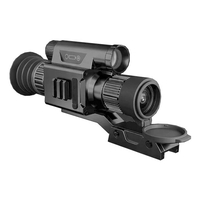
Fuego DS-X7 4K Day & Night Vision Rifle Scope
via Uttings
£299.99
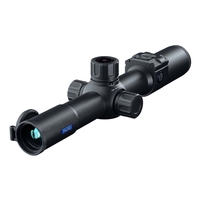
Pard Night Stalker Mini Night Vision Riflescope - 35mm
via Uttings
£339.00
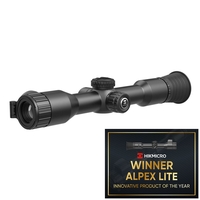
HIKMicro Alpex 4K Lite Digital Day/Night Riflescope
via Uttings
£399.00
Buying Advice
Start with the sensor, because it defines the ceiling of what any thermal scope can show you. At this price point you will encounter two common resolutions: 256×192 and 384×288 pixels. The jump from 256 to 384 horizontal pixels is substantial — roughly 50% more detail across the image, which directly affects your ability to distinguish a fox from a hare at range. Pixel pitch (typically 12 µm or 17 µm at this tier) determines how large each sensing element is; a smaller pitch allows a more compact lens but can reduce sensitivity. NETD (Noise Equivalent Temperature Difference), measured in millikelvins (mK), tells you how subtle a temperature difference the sensor can detect — below 40 mK is good, below 25 mK is excellent. Refresh rate matters too: 50 Hz provides smooth, real-time imagery essential for tracking moving quarry, while 25 Hz can appear jerky when panning. Detection range (the distance at which the scope can register a heat signature) is always higher than recognition or identification range; for foxing, you need reliable identification at 150–250 metres, so look for detection figures of at least 800 m to ensure usable ID range at field distances.
Budget tiers within the sub-£500 bracket break down roughly as follows. At the entry level (around £250–£350), expect a 256×192 sensor, a 25 mm germanium objective, and detection ranges of 600–900 metres — adequate for close-range foxing inside 150 metres and hedgerow scanning. The mid tier (£350–£450) is where the best value currently sits: 384×288 sensors with 25 mm objectives, 50 Hz refresh, onboard recording, and detection ranges nudging 1,200 metres become available. Units from PARD and Hikmicro dominate here, and these scopes are genuinely capable tools for regular foxing and occasional deer work. At the top end (£450–£500), you may find 384-resolution sensors paired with 35 mm objectives, improved NETD figures, and features such as ballistic reticle options, Wi-Fi streaming and picture-in-picture zoom — meaningful upgrades for anyone shooting regularly.
Common mistakes in this category are predictable but worth highlighting. First, buying on detection range alone: a spec sheet claiming 1,500 m detection does not mean you will identify a fox at that distance — identification range is typically one-third to one-quarter of detection range. Second, ignoring eye relief and mounting compatibility: thermal scopes tend to have shorter eye relief than conventional optics, and if you are mounting on a .243 or .308 for deer, you need at least 50 mm of relief to avoid scope-bite under recoil. Third, overlooking battery life: a scope that dies after two hours on a winter foxing session is a liability. Look for at least five hours of continuous use, or choose a model that accepts external USB-C power banks. Finally, do not assume that every thermal scope is waterproof to a meaningful standard — check for an IP rating of at least IP66 if you shoot in typical British conditions.
UK law is critical to understand before you buy a thermal scope for deer stalking. In England and Wales, there is no legal prohibition on using thermal or night-vision sights for deer — however, you may only shoot deer during the open season and during permitted hours (one hour before sunrise to one hour after sunset) unless you hold a specific licence issued by Natural England or Natural Resources Wales to shoot deer at night for crop-protection purposes. In Scotland, the law is stricter: the use of artificial light or night-sighting devices to shoot deer is generally prohibited under the Deer (Scotland) Act 1996, with limited exceptions for authorised night shooting. For fox control across England, Wales and Scotland, thermal scopes are entirely legal and widely used. Always check the most recent BASC or Deer Initiative guidance, and ensure your firearms certificate conditions do not restrict the rifles or calibres you pair with thermal optics. For foxing, .17 HMR, .22-250 and .223 Rem are the most common choices; for deer, legal minimum calibres apply (e.g., .240 calibre and 100-grain bullet with 1,700 ft-lbs muzzle energy for all deer in England and Wales).
Matching a thermal scope to your actual use case is more important than chasing the highest specification. If you shoot foxes on small mixed farms at distances under 150 metres, a 256×192 scope with a 25 mm lens will serve you well and save money for ammunition and a good bipod. If you cover large arable blocks where shots at 200–300 metres are routine, invest in the 384×288 sensor and accept the slightly higher price. For deer stalking, where target identification is an ethical imperative — you must be certain of species, sex and shot placement — a higher-resolution sensor and slower, more deliberate scanning style pay dividends. Also consider whether a dedicated thermal rifle scope or a clip-on thermal add-on suits you better. Clip-ons mount ahead of your existing day scope, preserving your familiar reticle and zero, but they add weight, length and a second battery to manage. Dedicated thermal scopes are lighter, simpler and typically offer better image quality at a given price, but mean re-zeroing when you swap between day and night setups.
The brand landscape at this price point is dominated by two names in the UK: PARD and Hikmicro. PARD has built a loyal following among British fox shooters thanks to competitive pricing, a broad dealer network (including major UK retailers like Optics Warehouse, Thomas Jacks, and county gun shops), and iterative improvements to models like the SA and TA series. Hikmicro, backed by the resources of Hikvision, competes aggressively on sensor quality and software features, and their Thunder and Stellar lines are well represented in the UK. Beyond these two, keep an eye on InfiRay and Pulsar — Pulsar's Axion and Thermion lines occasionally dip near the £500 mark on promotion, and InfiRay's SCL and Tube series offer impressive NETD figures. Whichever brand you choose, buy from an authorised UK dealer to ensure warranty support, firmware updates and access to spare parts such as eyecups, lens covers and battery packs.
Frequently Asked Questions
What is the best thermal scope for foxing under £500 in the UK?
In 2026, the strongest contenders are the PARD TA32 and Hikmicro Thunder TQ35 2.0, both offering 384×288 sensors, 50 Hz refresh rates and detection ranges above 1,000 metres at prices comfortably under £500. For most UK fox shooting scenarios — fields, hedgerows and woodland edges inside 250 metres — either will deliver clear target identification. We recommend handling both at a dealer if possible, as ergonomics and menu navigation differ noticeably between the two brands.
Is PARD or Hikmicro better for budget thermal fox shooting?
Both brands produce excellent budget thermal scopes and share broadly similar sensor specifications at comparable price points. PARD tends to offer slightly more intuitive controls and wider UK dealer support, making spares and service easier to arrange. Hikmicro often edges ahead on image-processing software, colour palettes and app connectivity. In practice, the differences are marginal — your choice may come down to which model fits your rifle's rail setup and which dealer is local to you.
Can I use a thermal scope for deer stalking legally in the UK?
In England and Wales, there is no law preventing you from using a thermal scope on a deer-legal rifle during the open season and permitted shooting hours. However, shooting deer at night requires a specific licence from Natural England or Natural Resources Wales. In Scotland, the use of night-sighting devices for deer is generally prohibited under the Deer (Scotland) Act 1996, with narrow exceptions. Always verify current legislation and consult BASC or your local Deer Management Group before using thermal optics for deer.
What should I look for in a thermal scope under £500 — refresh rate, resolution or detection range?
All three matter, but sensor resolution has the greatest impact on image clarity and target identification at range. Prioritise a 384×288 sensor over a 256×192 one if your budget allows. After that, ensure a 50 Hz refresh rate for smooth tracking of moving foxes. Detection range is important but often overstated in marketing — focus on the identification range, which is typically one-quarter to one-third of the headline detection figure. A scope detecting at 1,200 m will typically let you identify a fox-sized target at roughly 300–400 m.
Are dedicated thermal scopes under £500 better than clip-on thermal add-ons for foxing at night?
At this price point, a dedicated thermal rifle scope generally offers better image quality, lower weight and simpler operation than a clip-on unit of equivalent cost. Clip-ons have the advantage of preserving your existing day-scope zero and reticle, which is valuable if you switch frequently between day and night shooting. However, budget clip-ons can introduce optical distortion and add significant length to your rifle. For a dedicated foxing setup, a purpose-built thermal scope is usually the better investment under £500.
How far can I realistically shoot with a budget thermal scope?
Detection ranges of 800–1,500 metres are common on sub-£500 thermal scopes, but these figures refer to detecting a heat signature, not identifying a target. For foxing, you can expect confident species identification at 150–300 metres with a 384×288 sensor and a 25–35 mm objective. For deer, where you must confirm species, sex and a safe backstop, effective identification distances may be shorter. Always ground-truth your scope's performance at known distances on your own ground before relying on it for ethical shot placement.
Do I need to re-zero my rifle when fitting a thermal scope?
Yes. Thermal scopes use an electronic reticle overlaid on the sensor image, and the zero must be set independently of any day optic you may have used previously. Most budget thermal scopes offer a one-shot or freeze-zero function: you fire a shot at a target, then digitally move the reticle to the point of impact without adjusting the mount. This is quick and effective, but you should always confirm zero with a follow-up group. If you swap between a day scope and a thermal scope on the same rifle, use a quality quick-detach mount with a repeatable return-to-zero.
What battery life should I expect from a thermal scope under £500?
Most current models in this bracket offer between four and eight hours of continuous use on a full internal battery charge, depending on ambient temperature, display brightness and whether Wi-Fi or recording features are active. Cold weather significantly reduces battery performance — you may lose 20–30% of rated life on a freezing January foxing session. Choose a model with USB-C charging so you can top up from a power bank in the field, and always carry a fully charged spare if the scope uses removable cells.
Is a thermal scope suitable for use on an air rifle?
Thermal scopes can be mounted on air rifles, and for ratting or close-range rabbit control inside 30–40 metres they can be very effective. However, remember that a sub-12 ft-lb air rifle — the legal limit without a firearms certificate in the UK — is only reliably effective to around 50 yards on small quarry, and pellet trajectory drops significantly beyond 30 yards. A thermal scope will not extend the ballistic capability of a springer or PCP; it simply lets you see targets in darkness. Ensure the scope you choose can withstand the unique recoil profile of spring-piston air rifles, which generates a sharp forward-then-backward jolt that can damage optics not rated for it.
Related guides
Our 2026 UK buyer's guide to the best thermal scopes and clip-ons for foxing under £500. Compare Pard, Hikmicro and more for affordable night-time vermin…
Best Budget Thermal Scopes Under £1,000 (UK 2026)Our expert guide to the best budget thermal scopes under £1,000 for UK fox and vermin shooting in 2026.
Best Budget Bench Rest Scopes Under £500 (UK 2026)Our expert 2026 guide to the best scope for bench rest shooting UK. Compare precision optics under £500 with the magnification…
Best Budget PRS Scopes Under £500 (UK 2026)Find the best scope for PRS and precision rifle competition under £500 in the UK. Our 2026 guide covers FFP vs SFP, MRAD turrets…
NV Clip-On vs Thermal Clip-On: Which Suits Your Stalking?Digital night vision or thermal clip-on for UK deer stalking? Our 2026 guide compares detection, ID, legal use…
Scope Rings & Mount Heights: One-Piece vs Two-Piece for Air Rifles & RimfireDefinitive UK guide to choosing the right scope ring height and mount type for air rifles and rimfire.
Not sure which scope is right for you?
Try our AI-powered scope finder — answer a few questions and get personalised recommendations.
Find My Scope →Get a UK scope tip every day
Follow AiScopes on Facebook for daily buying guides, deals and gear advice.
Follow on Facebook