Best Budget Night Vision Scopes Under £500 for UK Shooters
By Peter Makulek · Senior Optics Editor · · Live prices from UK retailers
Night-time pest control is a core part of UK land management, and whether you are lamping foxes across open pasture or picking off rabbits at closer range, a capable night vision scope has become an essential tool rather than a luxury. The good news for 2026 is that digital night vision technology has matured rapidly, and there are now genuinely usable options that fall comfortably under the £500 mark. This guide is written specifically for UK shooters who want solid performance without overspending, drawing on the models, brands, and use cases that are most relevant on these shores.
Choosing the best budget night vision scope means understanding the compromises you are making compared with mid-range and premium units. At this price point you are overwhelmingly looking at digital night vision rather than image-intensifier tubes, which means the image is captured by a CMOS sensor, processed electronically, and displayed on a micro screen inside the eyepiece. Digital units offer surprisingly good clarity out to practical UK shooting distances, built-in infrared illuminators, video recording, and — crucially — they are not subject to the same export and import restrictions that affect military-grade Gen 2 and Gen 3 intensifier tubes.
For UK shooters, the practical context matters enormously. Most fox shooting with centrefire rifles such as .223 Remington or .243 Winchester takes place inside 250 metres, often well inside 200 metres when using a lamp or caller. Rabbit shooting with a rimfire .22 LR or a sub-12 ft/lb air rifle is typically inside 100 metres and 50 metres respectively. A budget night vision scope does not need to resolve a target at 600 metres — it needs to deliver a clear, confident sight picture at the ranges UK quarry species are actually engaged, and that is where these units now excel.
In this guide we set out the key decision factors — sensor resolution, IR illuminator wavelength, magnification, mounting options, and recoil rating — before presenting our curated picks from the UK market. Below the product carousel you will find detailed buying advice covering specs, budget tiers, common mistakes, UK legal considerations, and brand context. We have also compiled a thorough FAQ section drawn from the real questions UK shooters are asking online right now. If you are after the best budget night vision scope UK retailers currently stock, read on.
Top Picks — Live UK Prices
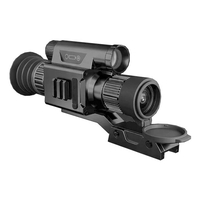
Fuego DS-X7 4K Day & Night Vision Rifle Scope
via Uttings
£299.99
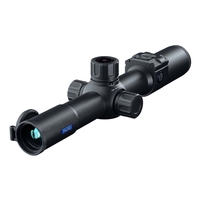
Pard Night Stalker Mini Night Vision Riflescope - 35mm
via Uttings
£339.00
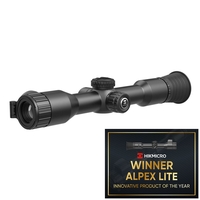
HIKMicro Alpex 4K Lite Digital Day/Night Riflescope
via Uttings
£399.00
Buying Advice
Start with the specification sheet, because the numbers tell you most of what you need to know. Sensor resolution is quoted in pixels (e.g., 1024×768 or 1920×1080); higher resolution means a sharper image, but it also demands a better display to be meaningful. Look for a display resolution that matches or exceeds the sensor. Detection range and recognition range are different things — a unit might detect a deer-sized object at 300 metres but only let you positively identify it at 200 metres, which is the figure that matters for a safe shot. The IR illuminator wavelength is typically 850 nm (faint red glow visible to the eye) or 940 nm (virtually invisible). For fox shooting, 940 nm is strongly preferred because foxes can pick up the 850 nm glow and become lamp-shy. Magnification is listed as optical × digital; rely on the optical figure for image quality, because heavy digital zoom degrades the picture quickly.
Budget tiers within the sub-£500 bracket break down roughly as follows. Entry level, around £150–£250, buys you a basic digital scope or a monocular-style add-on with 640×480 or similar sensor resolution, modest IR range, and plastic-bodied construction — adequate for static rabbit shooting at short range with a rimfire or air rifle but limited in detection distance and build quality. The mid tier, £250–£400, is where the best value sits for most UK hunters: you get 1024×768 or better sensors, longer-range 940 nm IR illuminators, recoil ratings suitable for centrefire calibres, and features like Wi-Fi streaming and onboard recording. The upper end, £400–£500, approaches the territory of units like the PARD NV007V or SA series, where you gain HD sensors, superior glass optics, refined ergonomics, and genuine confidence on foxes out to 200 metres-plus in full darkness.
Common mistakes we see repeatedly include buying a unit with an 850 nm illuminator for fox work and then wondering why foxes spook, choosing a scope with too low a recoil rating for the intended calibre, and neglecting to budget for a good IR torch or spare batteries. Another frequent error is assuming that a higher quoted magnification means a better scope — a 6× digital zoom on a low-resolution sensor produces a blurry, noisy image that is worse than 3× on a sharp sensor. Also beware of unbranded imports sold on marketplace sites with inflated specification claims; stick to established brands with UK warranty support. Finally, remember that a night vision scope under 500 is a tool for practical pest control distances, not a long-range precision optic — set your expectations accordingly and you will be well served.
UK-specific context is critical. There is no law against owning or using night vision equipment in the UK, but you must of course hold the appropriate firearms certificate for the rifle you are using, and you need the landowner's permission to shoot at night. Shooting foxes at night is legal in England and Wales (and Scotland under the appropriate general licence conditions) and is considered best practice for humane pest control. For deer, night shooting is illegal except under a specific licence from Natural England, NatureScot, or Natural Resources Wales — never use a night vision scope for deer unless you hold that licence. When buying, purchase from a reputable UK dealer such as Sporting Saint, EDNL, John Rothery, or Thomas Jacks so you get proper warranty support, UK-spec IR classification, and correct VAT invoicing. Most budget night vision scopes are shipped from UK stock and arrive within a few days.
Matching the right scope to your use case is the single best thing you can do to avoid disappointment. If you are primarily a rabbit shooter using a .22 LR or a sub-12 ft/lb air rifle at ranges inside 50–75 yards, a lightweight, compact digital unit at the entry or mid tier will do the job perfectly — prioritise clarity at low magnification and a broad field of view. Air rifle shooters should note that springers produce a unique double-recoil impulse, so check the manufacturer's recoil compatibility carefully; some digital scopes cope well, others do not. For fox shooting with a .223 or .243, step up to the mid or upper tier, prioritise a 940 nm illuminator, and choose a unit rated for centrefire recoil. If you already own a quality day scope you are reluctant to remove, consider a clip-on night vision add-on that mounts ahead of your existing optic — several PARD models and competitors offer this format and it keeps your existing zero intact.
The brand landscape for budget night vision in the UK is dominated by PARD, the Chinese manufacturer that has built enormous credibility with UK shooters over the past few years. Models such as the PARD NV007 series (clip-on and standalone variants) and the PARD SA series are widely stocked, well-supported, and proven on thousands of UK foxes and rabbits. Other brands worth considering include Sytong, which offers competitive specifications at aggressive price points, and HIKMicro, better known for thermal but increasingly present in digital night vision. European and American brands tend to sit above the £500 mark for standalone scopes, so at this budget you are largely shopping from Far Eastern manufacturers — which is absolutely fine, provided you buy from a UK dealer who handles warranty claims locally. The PARD night vision scope range in particular has a track record of firmware updates and responsive after-sales support through its UK distribution partners, which counts for a great deal when you are relying on the unit in the field.
A word about the word cheap, because a cheap night vision scope is what most people go looking for when they start out, and the honest answer has a floor. Below roughly £250 the UK market is mostly ageing Gen 1 image-intensifier units and very low-resolution digital devices, and at that level you are not buying a compromised version of the scopes above — you are buying something that will not do the job. The failure modes are consistent: a display coarse enough to show that something is there but not what it is, an IR illuminator that runs out of reach past about 75 metres, no dependable return to zero after remounting, and a battery that expires part-way through a night. For a rifle that will be used on live quarry the practical entry point is a digital scope in the £250 to £400 band, where PARD, Sytong and their competitors are genuinely usable to around 100 to 150 metres with a decent 940 nm illuminator. If your budget is below that today, a good lamp on a day scope you already trust will account for more quarry than the cheapest night vision device that will technically switch on.
Frequently Asked Questions
What is the cheapest night vision scope actually worth buying in the UK?
As a practical floor, a digital night vision scope in the £250 to £400 band. Below about £250 the UK market is dominated by ageing Gen 1 image-intensifier units and very low-resolution digital devices, and those compromises are not ones you can shoot around: the image is usually good enough to tell you something is present but not to identify it, the built-in IR illuminator rarely reaches beyond about 75 metres, and return to zero after remounting is unreliable. In the £250 to £400 band, digital scopes from PARD, Sytong and similar brands paired with a decent 940 nm illuminator give usable identification to roughly 100 to 150 metres, which covers most UK fox and rabbit work. If that is above your budget today, a lamp on a day scope you already trust will account for more quarry than the cheapest night vision device on the market.
What is the best budget night vision scope for fox shooting in the UK?
For fox shooting specifically, the best budget night vision scope needs a 940 nm IR illuminator (so the fox cannot see the beam), a sensor resolution of at least 1024×768, and a recoil rating that covers centrefire calibres like .223 Remington or .243 Winchester. Within the sub-£500 bracket, PARD's NV007 and SA-series models are the most proven choices among UK fox shooters. Sytong's HT-60 and HT-77 ranges also offer strong performance at this price point. Whichever you choose, pair it with a good standalone 940 nm IR torch for extra illumination range on dark, moonless nights.
Can you use a budget night vision scope for rabbit shooting?
Absolutely — in fact, rabbit shooting is one of the best applications for a budget night vision scope because engagement distances are short. With a .22 LR rimfire you are typically shooting inside 80–100 metres, and with a sub-12 ft/lb air rifle the effective range is realistically 50–75 yards at most. Even an entry-level digital night vision unit will deliver a clear enough image at those distances. Just make sure the scope is rated for the recoil profile of your rifle; spring-piston air rifles produce a distinctive reverse recoil that can damage electronics not designed for it.
What is the difference between a digital night vision scope and a Gen 1 scope?
A Gen 1 scope uses an image-intensifier tube — a vacuum tube that amplifies ambient light — to produce a green-tinted analogue image. A digital night vision scope uses a CMOS or CCD sensor to capture the scene, processes it electronically, and displays it on a micro LCD or OLED screen. Digital units generally offer better image quality than Gen 1 intensifiers at this price point, plus features like video recording, Wi-Fi streaming, and adjustable colour palettes. Gen 1 tubes also degrade over time with a limited lifespan, whereas digital sensors do not suffer the same wear. For most UK shooters buying under £500, digital is the clear choice in 2026.
Is the PARD a good budget night vision option for UK hunters?
PARD has become the dominant brand in budget night vision among UK shooters, and for good reason. Their products are widely stocked by UK dealers, well-supported with firmware updates, and proven across thousands of hours of real-world fox and rabbit shooting. Models like the NV007V and the SA-series clip-ons offer strong sensor resolution, effective 940 nm IR illumination, and build quality that withstands centrefire recoil. They are not perfect — some users find the menus unintuitive at first, and battery life under heavy IR use can be modest — but overall the PARD night vision scope range offers the best balance of performance, price, and after-sales support under £500.
Do you need a dedicated night vision scope or can you use a clip-on add-on?
A clip-on night vision add-on mounts in front of your existing day scope and projects its image through the day optic's eyepiece. The big advantage is that you keep your existing zero, use your familiar reticle, and only carry one rifle setup. The disadvantage is added length, weight, and sometimes a slight reduction in image quality compared with a purpose-built standalone unit. If you already own a high-quality day scope and do not want to re-zero or swap optics seasonally, a clip-on like the PARD NV007 range is an excellent solution. If you are setting up a dedicated night rifle, a standalone night vision scope is simpler and often produces a cleaner image.
Is night shooting legal in the UK and do I need any special permissions?
Night shooting of foxes and rabbits is legal in England, Wales, and Scotland, provided you hold a valid firearms certificate for the rifle you are using and have the landowner's written permission to shoot on that land. Night shooting of deer is illegal in the UK unless you hold a specific licence issued by Natural England, NatureScot, or Natural Resources Wales — these are granted only in limited circumstances. There is no licence requirement to own or use night vision equipment itself, but responsible use and clear identification of your target before firing is paramount.
What IR illuminator wavelength should I choose — 850 nm or 940 nm?
For most UK hunting purposes, 940 nm is the better choice. An 850 nm illuminator emits a faint red glow that is visible to the naked eye and can be noticed by some quarry species — foxes in particular can become wary of it. A 940 nm illuminator is virtually invisible to both human and animal eyes. The trade-off is that 940 nm illuminators are slightly less powerful at equivalent wattage, so detection range may be marginally shorter, but for UK shooting distances this is rarely a practical issue. If you shoot only static targets or rabbits at very short range, 850 nm is fine; for fox shooting, 940 nm is strongly recommended.
Can I use a night vision scope on a sub-12 ft/lb air rifle?
Yes, many digital night vision scopes are compatible with sub-12 ft/lb air rifles, and night-time rabbit shooting with an air rifle is a popular and effective form of pest control. However, be aware that spring-piston (springer) air rifles produce a sharp reverse recoil followed by a forward recoil that is harsher on optics than the simple rearward recoil of a firearm. Check that your chosen scope is explicitly rated for spring-piston recoil. PCP (pre-charged pneumatic) air rifles produce negligible recoil and are compatible with virtually any night vision optic. Remember that a sub-12 ft/lb air rifle is only effective to around 50–75 yards, so you do not need extreme detection range.
How does a budget night vision scope compare with a thermal scope?
Night vision and thermal are fundamentally different technologies. A night vision scope amplifies or captures reflected light (including infrared) to produce a recognisable image of the scene, whereas a thermal scope detects heat radiation and displays temperature differences. Thermal is superior for detection — a warm fox stands out instantly against a cold field — but budget thermal scopes under £500 generally have lower resolution and less detailed images than their night vision equivalents. Night vision gives a more natural, detailed picture that many shooters find easier to aim with. For UK pest control under £500, a digital night vision scope typically offers the better balance of image quality and affordability.
Related guides
Our in-depth UK guide to the HIKMICRO Alpex A50T digital night vision scope. Covers specs, performance, price bands, legal context…
TKN-1 Night Vision Periscope: Your Questions AnsweredExplore the TKN-1 night vision periscope with real pictures, technical breakdown, and UK-relevant buying advice.
Trading a PVS-14 for Thermal & LPVO: Is It Worth It?Should you swap a used PVS-14 for a thermal scope and LPVO? We break down the trade-offs, UK legalities, top picks and budget tiers for night vision…
Best PARD Night Vision Scopes for UK ShootersDefinitive UK buyer's guide to PARD digital night vision scopes for foxing, deer stalking and vermin control.
Best Scopes for Springer Air Rifles in 2026Find the best scope for a springer air rifle in the UK for 2026. Expert advice on springer-rated optics, magnification…
Best Thermal Rifle Scopes in the UK (2026 Buyer's Guide)The best thermal rifle scope UK buyers can get in 2026: 384 vs 640 sensors, NETD and refresh rate explained, real UK prices, the law, and where to buy.
Read next
- best night vision rifle scope UK
Best Night Vision Scopes UK 2026
- best night vision for foxing
Best Night Vision for Foxing in the UK (2026 Guide)
Not sure which scope is right for you?
Try our AI-powered scope finder — answer a few questions and get personalised recommendations.
Find My Scope →Get a UK scope tip every day
Follow AiScopes on Facebook for daily buying guides, deals and gear advice.
Follow on Facebook