3-15x Scopes: Versatile Enough or a Compromise?
By Peter Makulek · Senior Optics Editor · · Live prices from UK retailers
The 3-15x magnification range is one of the most hotly debated zoom envelopes in the rifle scope world, and for good reason. It sits right in a sweet spot that appeals to hunters chasing whitetail from a treestand, AR-15 owners running hogs in Texas brush country, and even competitors dabbling in precision rifle series (PRS) style matches. But the nagging question remains: will you hit a ceiling when you really need more reach, or is 15x genuinely enough? The answer depends less on raw magnification and more on what you actually do behind the rifle — and that is exactly what this guide unpacks for US shooters in 2026.
Understanding why this question keeps surfacing requires a look at how the market has evolved. A decade ago, a 3-9x scope was the default hunting optic and anything above 10x was considered specialized. Today, long range shooting culture, YouTube ballistics content, and accessible .308 Win and 6.5 Creedmoor bolt guns have pushed expectations higher. Shooters now routinely want to ring steel at 800 yards on Saturday and still have a usable field of view for a coyote that appears at 40 yards on Sunday morning. The 3-15x range scope promises to do both — but does it deliver without compromise?
One critical factor US buyers overlook is that magnification is only part of the equation. Reticle plane (FFP vs SFP), turret quality, parallax adjustment range, and optical clarity at max power all determine whether 15x feels limiting or liberating. A mediocre 3-15x scope with poor edge-to-edge sharpness at 15x will leave you frustrated at 600 yards, while a premium 3-15x with excellent glass and a well-designed FFP reticle can punch far above its magnification class. We will walk through every variable so you can make a confident decision.
This guide is written for shooters across the US — whether you are running an AR-15 platform on a prairie dog shoot in South Dakota, glassing a ridgeline for elk in Montana, or building a do-everything .308 bolt gun for mixed use. We will address specific caliber pairings, common US hunting and competition scenarios, and honest limitations so you know exactly where a 3-15x scope shines and where you might genuinely want more. After the product picks, we go deep on specs, budget tiers, mistakes to avoid, and brand considerations.
Top Picks — Live UK Prices
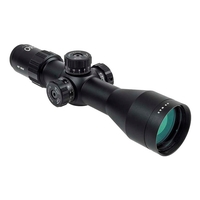
PAO HD MAX 4-16x44 SF FFP Ultra Compact Riflescope
via Uttings
£219.00
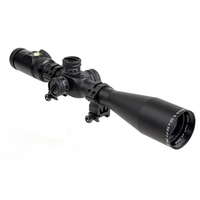
PAO F1 5-20x50 IR SF FFP Rifle Scope
via Uttings
£239.00

Hawke Vantage 30 WA FFP 4-16x50 Rifle Scope
via Uttings
£249.00
Buying Advice
When evaluating a 3-15x rifle scope, the first specs to scrutinize are objective lens diameter, reticle plane, and adjustment granularity. Most 3-15x scopes ship with a 44mm or 50mm objective. The larger objective gathers more light at max magnification — meaningful for dawn and dusk whitetail hunts — but adds weight and requires higher rings. FFP (first focal plane) reticles scale with magnification, so your holdover marks remain accurate at any power; this matters enormously if you plan to use the reticle for range estimation or wind holds at varying zoom levels. SFP reticles are subtended correctly only at one magnification (usually max), but many hunters prefer their thinner appearance at low power. For adjustment, MRAD turrets move in 0.1-mil clicks (each click shifts impact 1 cm at 100 meters, or roughly 0.36 inches at 100 yards), while MOA turrets click in fractions of a minute of angle (1 MOA equals approximately 1.047 inches at 100 yards). Neither system is inherently superior, but consistency — matching your turret unit to your reticle unit — is essential.
Budget tiers for 3-15x scopes in the US market break down clearly. Entry-level options in the $250–$450 band, such as models from Bushnell and the Vortex Diamondback Tactical line, offer solid performance for new shooters and deliver reliable tracking and adequate glass clarity for hunting inside 500 yards. Mid-tier scopes from $500–$900, including Vortex Viper PST Gen II and select Leupold VX-3HD or Mark 5HD models, bring noticeably better glass, more repeatable turrets, and features like zero-stop and locking adjustments. Premium glass from $1,000–$2,000-plus — think Leupold Mark 5HD 3.6-18x44 (close cousin to the 3-15 concept), high-end Vortex Razor HD Gen III, or comparable European optics — delivers edge-to-edge clarity, virtually zero chromatic aberration, and bombproof construction. Most US hunters and recreational long range shooters find the mid-tier sweet spot entirely adequate for a 3-15x scope.
Common mistakes buyers make when choosing a 3-15x scope include over-indexing on magnification alone, mismatching reticle and turret units, and ignoring parallax adjustment range. Many shooters assume they need 20x or 25x for long range work, but in reality 15x is enough to reliably identify and engage targets to 800 yards with a quality FFP reticle — PRS competitors frequently shoot entire stages at 12–15x. Another frequent error is buying an MOA-reticle scope with MRAD turrets (or vice versa), which creates confusion during holdover calculations. Finally, some budget 3-15x scopes have a fixed parallax setting at 100 or 150 yards; if you plan to shoot beyond 300 yards or use the scope on a rimfire at 50 yards, you need a side-focus parallax knob adjustable from at least 10 or 15 yards out to infinity. Overlooking this leads to apparent reticle shift and reduced precision at longer distances.
For US-specific use cases, consider how a 3-15x scope maps to common disciplines. Hog hunting from an AR-15 at night often pairs better with a dedicated thermal scope or a vision scope like those from Pulsar, but a quality 3-15x daylight optic remains the backbone for legal-light hog hunts across Texas, Oklahoma, and the Southeast. Coyote hunters running AR-15 platforms in open Western terrain will appreciate the low-end 3x for scanning and the 15x for positive ID before a shot — critical since many states require species confirmation. For whitetail, most shots are taken inside 150 yards from a stand, making the 3x low end far more important than the 15x ceiling; a wide field of view at 3x lets you track a deer through timber. Prairie dog shooters and PRS competitors are the groups most likely to feel a genuine limitation at 15x — if you are regularly engaging small targets beyond 600 yards, a scope with 18x, 20x, or even 25x max will make target acquisition faster and mitigate mirage reading challenges. For a general-purpose .308 or 6.5 Creedmoor bolt gun, a 3-15x is arguably the ideal range scope, pairing realistic cartridge capability (ethical hunting range, typical steel engagement distances) with optical versatility.
Matching the scope to your specific use case means being honest about your shooting. If 90% of your shooting is hunting elk, whitetail, or hogs inside 400 yards with occasional range days to 600, a 3-15x scope is not a limitation — it is an advantage because you avoid carrying unnecessary weight and maintain a generous field of view at low power. If you are building a dedicated PRS or ELR (extreme long range) rig for 1,000-yard-plus work, you will eventually want more magnification, and a 5-25x or 7-35x becomes the better tool. The 3-15x excels as a do-everything optic for shooters who own one or two rifles and need a single scope that handles both close brush encounters and moderate long range sessions. It is also outstanding on a scope for 22LR trainers and rimfire scope applications where 15x is more than enough for 100–200 yard rimfire precision matches.
The brand landscape for 3-15x scopes in the US is competitive and buyer-friendly. Vortex dominates the mid-tier conversation with aggressive warranty support (their unconditional lifetime guarantee resonates with American buyers) and wide availability on Amazon.com and OpticsPlanet. Leupold, an American-made brand based in Oregon, commands loyalty among traditional hunters and offers some of the lightest scopes in the category — a real advantage on mountain hunts. Bushnell provides excellent entry-level value, particularly in their Match Pro and Engage lines. For thermal or digital night vision scope needs, Pulsar leads the US market with clip-on and standalone units that complement a daylight 3-15x setup. When purchasing, Amazon.com offers fast shipping, easy returns, and competitive pricing across all these brands; OpticsPlanet frequently runs bundle deals with rings and mounts included. Whichever brand you choose, buy from an authorized dealer to ensure warranty coverage — gray-market scopes can void manufacturer support.
Frequently Asked Questions
What is the best scope for hog hunting on an AR-15?
For daylight hog hunting on an AR-15, a 3-15x FFP scope with an illuminated reticle works extremely well because most hog engagements happen between 50 and 300 yards, often in low light at dawn or dusk. Models from Vortex (Viper PST Gen II) and Leupold (VX-3HD or Mark 5HD) are popular choices. If you hunt hogs at night where legal, pairing your daylight scope with a clip-on thermal scope from Pulsar or a standalone thermal vision scope gives you capability that a standard rifle scope alone cannot match.
Is a 3-15x scope enough for long range shooting with a .308?
Yes, for most practical purposes. A .308 Winchester remains supersonic to roughly 800–900 yards depending on bullet selection, and 15x magnification is sufficient to identify and engage steel targets out to that distance with a quality FFP reticle. Where you may feel limited is in reading mirage or spotting trace at extreme distances, tasks that benefit from 20x or higher. For a dedicated range scope on a .308, a 3-15x is an excellent all-rounder, but a serious PRS competitor may prefer 5-25x for the extra identification margin.
What is the best scope for coyote hunting on an AR-15?
Coyote hunters need quick target acquisition at close range and enough magnification to confirm species identity at distance — a 3-15x scope delivers both. An illuminated FFP reticle helps in pre-dawn calling setups, and a side-focus parallax knob lets you dial out parallax error at varying distances. Vortex Strike Eagle and Viper PST II models are widely used by AR-15 coyote hunters. In open Western terrain, 15x is comfortable for shots to 400–500 yards, which covers the vast majority of called coyote engagements.
Can I use a 3-15x scope for prairie dog hunting on an AR-15?
You can, but prairie dog hunting is arguably the discipline where a 3-15x scope feels the most limiting. Prairie dogs are small targets often engaged between 200 and 500 yards, and the extra magnification of a 5-25x scope makes target acquisition noticeably faster at the upper end of that range. That said, many shooters successfully use 15x for prairie dog work, especially with a fine-reticle FFP scope and a fast cartridge like .223 Remington or .204 Ruger. If prairie dogs are your primary pursuit, consider stepping up to 18x or 20x maximum magnification.
Is a 3-15x scope good for whitetail hunting?
A 3-15x scope is outstanding for whitetail hunting. The majority of whitetail deer in the US are harvested at distances under 150 yards from treestands, ground blinds, or field edges, where the 3x low end provides a wide field of view critical for tracking moving deer in timber. The 15x top end gives you ample magnification for longer shots across food plots or agricultural fields. Leupold and Vortex both offer lightweight 3-15x options well suited to carrying all day on a whitetail hunt.
FFP or SFP — which is better in a 3-15x scope?
FFP (first focal plane) is generally the better choice if you plan to use your reticle for holdovers or range estimation at varying magnification levels, which is common in tactical and PRS shooting. SFP (second focal plane) reticles appear the same size regardless of magnification, which some hunters prefer because the reticle stays thin and unobtrusive at low power. For a versatile 3-15x scope used across hunting and range work, FFP offers more flexibility, but an SFP model is perfectly adequate if you always dial your turrets rather than holding off the reticle.
Will a 3-15x scope work on a rimfire or .22 LR rifle?
Absolutely. A 3-15x scope is actually ideal for rimfire precision shooting and .22 LR competitions, where targets are typically set between 25 and 200 yards. The 15x top end provides plenty of magnification for small steel or paper targets at those distances. Ensure the scope has a parallax adjustment that goes down to at least 25 yards (ideally 10 yards), since standard 100-yard parallax settings will introduce noticeable error at close rimfire distances. Many rimfire scope setups use budget-friendly 3-15x models for this exact reason.
Is 15x magnification enough for PRS competition?
Many PRS competitors shoot stages entirely at 12–15x, even on scopes capable of higher magnification, because it provides a wider field of view that helps with target transitions. However, most top-tier PRS shooters choose scopes with at least 20–25x maximum so they have the option for small or distant targets and for reading wind mirage. If PRS is your primary focus, a dedicated scope with a higher ceiling (5-25x or 7-35x) is the more competitive tool. A 3-15x scope PRS setup works well for local matches and training but may feel limiting at major competitions.
Do I need a separate thermal or night vision scope for night hunting?
Yes, a standard 3-15x rifle scope cannot see in darkness. For legal nighttime hog or predator hunting (regulations vary by state), you need either a dedicated thermal scope, a clip-on thermal or night vision unit that mounts ahead of your daylight scope, or a standalone digital vision scope. Pulsar offers well-regarded options in all three categories. A quality daylight 3-15x scope paired with a clip-on thermal device gives you 24-hour capability without re-zeroing, making it a popular combination among serious hog hunters in the South.
Related guides
How zero-stop turrets work, which US-market systems (Leupold CDS-ZL, Vortex CRS, Nightforce ZeroStop, Bushnell RevLimiter) to buy, and how to choose by budget and discipline in 2026.
How to Sight In a Rifle Scope: Step-by-Step First-Time GuideFirst time sighting in a rifle scope? Our 2026 step-by-step US guide walks you through mounting, bore-sighting, and dialing in your zero at 25 and 100 yards.
Why Isn't My Scope Hitting Where I Aim? A Troubleshooting ChecklistScope not hitting where you aim? Work through this proven troubleshooting checklist — mounts, zero, parallax, ammo — cheapest and most likely causes first. US shooters, all platforms.
LPVO Zero Distance: How to Choose & Why It MattersLearn the optimal zero distance for your LPVO rifle scope in 2026. Covers 50 vs 100-yard zero, BDC reticles, FFP vs SFP, and the best scope picks for US hunters and competitors.
How to Swap Day and Night Optics on the Same RifleLearn how to swap between a day rifle scope and a night vision scope on the same rifle without losing zero. Covers mounts, reticles, zeroing tips, and top picks for US hunters.
BDC Reticle Help: How to Choose & Use Bullet Drop ReticlesMaster BDC reticles for deer, elk, and coyote hunting. Learn how bullet drop compensating scopes work, which rifle scope fits your caliber, and avoid costly mistakes.
Leupold Mk5HD 3.6-18×44 SPR Optic GuideIs the Leupold Mk5HD 3.6-18×44 the best scope for long range hunting and precision shooting? We break down the SPR reticle, FFP vs SFP, and how it stacks up in 2026.
Not sure which scope is right for you?
Try our AI-powered scope finder — answer a few questions and get personalised recommendations.
Find My Scope →Get a UK scope tip every day
Follow AiScopes on Facebook for daily buying guides, deals and gear advice.
Follow on Facebook