Thermal vs Night Vision: Which Should You Buy First?
By Peter Makulek · Senior Optics Editor · · Live prices from UK retailers
If you are weighing thermal vs night vision and trying to decide which to buy first, you are far from alone — it is the single most common question we hear from US hunters, ranchers, and property owners heading into 2026. Both technologies let you operate effectively in the dark, but they solve fundamentally different problems. One detects heat; the other amplifies light. Understanding that core distinction is what separates a smart first purchase from an expensive shelf ornament. This guide is built specifically for US buyers dealing with real American terrain, game species, and budgets, and it will give you a clear, no-nonsense framework for making your decision.
The US night-capable optics market has matured dramatically over the past three years. Digital night vision has gotten sharper and cheaper, entry-level thermal monoculars have dropped below the $2,000 mark, and dual-use clip-on devices are more practical than ever. That expanded landscape makes the thermal vs night vision choice both easier (more options at every price) and harder (more ways to spend money on the wrong tool). Whether you are calling coyotes in west Texas brushland, running hogs off a Louisiana lease, or monitoring a rural homestead in the Ozarks, the right first device depends on your primary mission, your environment, and what you can realistically spend once.
This guide is structured as a genuine decision matrix, not a simple product roundup. We will walk through how thermal imaging and night vision actually work, lay out realistic 2026 US price tiers so you know what your dollar buys, compare each technology for the two most common US civilian use cases — hunting and predator control, and property security and home defense — and then give you a plain-language buy-this-first recommendation based on your situation. Every claim is technically grounded: we do not exaggerate what either technology can or cannot do.
A quick note on safety and legality before we dive in. Night hunting regulations vary by state, and some states restrict the use of thermal or night-vision scopes on firearms for certain game species. Always check your state's current fish and game regulations before heading afield. Regardless of the technology you use, the foundational rule never changes: positively identify your target and what is beyond it before taking any shot. No optic replaces that responsibility.
Top Picks — Live UK Prices

ATN X-Celsior-NV 3-9x Day/Night Hunting Riflescope
via Uttings
£499.00

ATN X-Celsior-NV 5-15x Day/Night Hunting Riflescope
via Uttings
£549.00
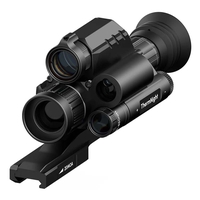
DNT Optics Thermnight Thermal (256x192) & Night Vision Multispectral Riflescope - 25mm with LRF
via Uttings
£999.99
Buying Advice
How thermal and night vision actually differ comes down to one core principle: heat detection versus light amplification. A thermal imager reads differences in infrared heat radiation emitted by every object in its field of view, then renders those temperature differences as a false-color or grayscale image on its display. It works in total darkness with zero ambient light, and it makes warm-blooded animals or people stand out sharply against a cooler background — a coyote in a field or a person crossing a fence line practically glows. However, thermal cannot see through glass, does not produce enough fine detail to read facial features or distinguish antler tines at distance, and heavy rain or very dense fog will meaningfully reduce its effective detection range. Night vision — whether a Gen 2 or Gen 3 image-intensifier tube or a modern digital sensor — amplifies existing ambient light (moonlight, starlight, even the faint glow of an IR illuminator) into a recognizable visual image. This means it shows genuine visual detail: textures, shapes, species features, and faces. The trade-off is that NV needs some photon source to work with — on a pitch-black, overcast night under tree canopy, a passive NV device without an IR illuminator may produce a nearly unusable image, while thermal will still see every warm body in the scene. Night vision also cannot see through smoke, fog, or brush the way thermal can.
Realistic price tiers for each technology in 2026 are important to understand because thermal has historically been significantly more expensive, though the gap is narrowing. For night vision, entry-level digital NV monoculars and clip-on devices typically start in the $150 to $400 range — adequate for casual observation or basic property checks but limited in sensor resolution and range. Solid mid-tier digital or Gen 2 analog-hybrid night-vision units run roughly $600 to $1,500, offering noticeably better image clarity, longer detection range, and features like onboard recording. True Gen 3 mil-spec image-intensifier devices — the gold standard for military and serious civilian use — commonly fall in the $2,500 to $4,000-plus bracket and deliver exceptional low-light performance with long tube life. On the thermal side, entry-level monoculars and weapon-mountable scopes start around $1,500 to $2,500, which gets you a usable 12-micron or 17-micron sensor with moderate resolution. Better mid-tier thermal with higher-resolution sensors and improved refresh rates runs $2,500 to $5,000. Premium thermal units with larger-format sensors, 50 Hz or 60 Hz refresh rates, and detection ranges beyond 1,500 yards push well above $5,000. The bottom line: night vision generally offers a lower entry price, making it more accessible if your budget is tight, while thermal commands a premium for its unique detection capability.
For hunting and predator control — the number-one reason most US civilians buy night-capable optics — thermal is generally the stronger pure detection tool and often the better first purchase for this specific mission. When you are scanning an open cotton field for hogs at 2 a.m. or glassing a brushy draw for coyotes responding to a call, a thermal monocular lets you spot every warm-bodied animal in the scene almost instantly, regardless of ambient light conditions. A hog bedded in tall grass that would be invisible to the naked eye or even to night vision without a powerful IR illuminator will show up unmistakably as a bright heat signature on thermal. Thermal also excels at tracking wounded game in the dark by following residual body heat or blood-trail warmth. The main limitation is identification at distance — thermal can tell you something warm and roughly deer-sized is at 300 yards, but it may not clearly show you whether it is a buck or a doe, or distinguish a calf from a mature hog. This is why many experienced night hunters pair a thermal scanner for detection with a weapon-mounted night-vision scope or a white light for final target identification before taking a shot. Always positively ID your target and ensure a safe backstop before pulling the trigger, as required by state hunting regulations.
For property security and home defense, night vision often edges out thermal as the more practical first purchase. The reason is identification over detection. In a home-defense or property-monitoring scenario, knowing that a warm shape is standing near your barn is less useful than being able to see that it is a person — and ideally identifying who that person is. Night vision, especially a quality Gen 2 or Gen 3 unit, provides genuine visual detail in environments where some ambient light already exists: porch lights, streetlights, security floods, or even a partial moon over a rural homestead. You can read body language, see whether someone is carrying something, distinguish a neighbor's dog from a threat, and navigate structures and terrain with natural depth perception. Thermal, by contrast, will detect a warm body behind a fence or in a tree line that NV might miss entirely, but it will not show you a face or let you read a license plate. For dedicated property security in truly remote, pitch-black environments with no ambient light, a digital NV device with a built-in IR illuminator is typically sufficient and far more budget-friendly than thermal. If budget allows, a handheld thermal monocular for initial detection paired with a NV device or weapon light for identification is an excellent two-tool setup.
Buy this first if your primary goal is clear — here is the decision matrix that ties everything together. Buy thermal first if your main use case is spotting and engaging animals in open fields, brush country, or wooded edges at night. Thermal is unmatched for raw detection of warm-bodied game, works in total darkness without any illuminator, and sees through light fog, smoke, and sparse foliage gaps. If you can only buy one device and your top priority is hog control, coyote calling, or predator management, thermal gives you the biggest capability advantage over the naked eye. Buy night vision first if your primary need is identifying who or what you are looking at, especially around a property that already has some ambient light. Night vision is also the better first buy if you want to navigate terrain, clear structures, or maintain situational awareness in and around buildings. It generally costs less at every tier, so it is also the practical choice if budget is a hard constraint. If your budget eventually allows for both — and many serious hog and predator hunters in the US end up there — the ideal workflow is thermal to detect and locate, then night vision or a white light to positively identify before taking any shot. This two-tool approach is the gold standard for safe, effective night operations. No matter which technology you start with, remember that no optic replaces positive target identification and adherence to your state's specific night-hunting regulations.
Frequently Asked Questions
Is thermal or night vision better for hunting hogs or coyotes?
For pure detection of hogs and coyotes, thermal is generally the better tool. Hogs rooting in tall grass or coyotes approaching a call stand out immediately as bright heat signatures on a thermal imager, even in total darkness or through light brush. However, many experienced night hunters use thermal to locate the animal and then switch to a night-vision weapon scope or white light for positive species identification before taking the shot. If you can only buy one device for hog or coyote work, thermal typically gives you the greater tactical advantage.
Can night vision see in complete darkness with no light at all?
Traditional image-intensifier night vision (Gen 2, Gen 3) cannot produce a usable image in absolute zero-light conditions because it works by amplifying existing ambient photons — moonlight, starlight, or artificial light. In truly pitch-black environments, you need to pair it with an infrared (IR) illuminator, which acts like an invisible flashlight for the NV device. Most modern digital NV monoculars and scopes include a built-in IR illuminator for exactly this reason, making them functional even on overcast, moonless nights, though detection range may be reduced compared to starlit conditions.
Does thermal work through fog, rain, or heavy brush?
Thermal does work through light fog, smoke, and sparse foliage gaps better than night vision because it reads heat radiation rather than reflected light. However, it is not magic — heavy rain significantly scatters infrared energy and can reduce your effective detection range substantially, and very dense fog has a similar degrading effect. Solid objects like thick walls, glass windows, and dense brush canopy will block thermal signatures entirely. Think of thermal's penetration ability as best in light atmospheric interference, not as true see-through-anything capability.
Is night vision cheaper than thermal, and why?
Yes, night vision is generally less expensive at comparable quality tiers. Entry-level digital NV devices start around $150 to $400, while entry-level thermal monoculars typically begin at $1,500 to $2,500. The price difference comes down to sensor technology: thermal requires a specialized microbolometer sensor cooled or uncooled to detect infrared radiation, along with germanium optics that are inherently expensive to manufacture. Night-vision image intensifier tubes and digital CMOS sensors benefit from more mature, higher-volume manufacturing processes, which keeps costs lower.
Can I use night vision and thermal together?
Absolutely, and many serious night hunters and tactical users do exactly this. The most common setup is a handheld thermal monocular for scanning and detecting warm targets, paired with a helmet-mounted or weapon-mounted night-vision device for navigation, identification, and shot placement. Some manufacturers also produce thermal clip-on units that mount in front of a night-vision or daytime scope, effectively giving you thermal detection through your existing optic. Using both technologies together combines thermal's superior detection capability with night vision's superior identification detail.
What is the best budget entry point for thermal in 2026?
In 2026, the most accessible thermal devices for US buyers are entry-level handheld thermal monoculars in the $1,500 to $2,500 price band. These typically use a 256x192 or 384x288 resolution sensor with a 12-micron or 17-micron pixel pitch. While they will not match the range or image clarity of $5,000-plus premium units, they are fully capable of detecting a coyote-sized animal at several hundred yards and a hog or deer-sized animal even farther. Look for models with at least a 25mm objective lens and a refresh rate of 30 Hz or higher for a smooth, usable image. Many are available on Amazon.
Do I need thermal if my property already has security lights?
If your property has existing ambient lighting — security floods, porch lights, streetlights — a quality night-vision device will leverage that light to produce a detailed, high-contrast image that lets you identify people, animals, and objects effectively. Thermal would add the ability to detect warm bodies in the unlit areas beyond your light coverage, such as tree lines, fence rows, or outbuildings. For most homeowners with some existing lighting, night vision is the more practical and cost-effective first purchase. Thermal becomes a valuable addition if you have large acreage with significant dark zones.
Is it legal to hunt with thermal or night vision in the US?
Legality varies significantly by state and by species. Many states now permit the use of thermal and night-vision optics for hunting non-game animals and predators like hogs, coyotes, and raccoons, especially on private land with landowner permission. However, some states restrict or prohibit their use on game animals like deer or turkey, and a few states have additional permitting requirements for any night hunting. Always consult your specific state's fish and game department regulations before using thermal or NV devices while hunting — rules can change annually.
How far can thermal and night vision see at night?
Effective range depends heavily on the specific device, sensor resolution, lens size, and atmospheric conditions, so be cautious of any single number. As a general guide, entry-level thermal monoculars can typically detect a human-sized heat signature at 500 to 1,000 yards, while premium units with larger sensors and lenses can push detection past 2,000 yards. Gen 3 night-vision devices under good starlight can identify a person at roughly 300 to 500 yards, with recognition range decreasing significantly in lower ambient light. In both cases, detection range (noticing something is there) is always longer than identification range (knowing what it is).
Related guides
Definitive UK buyer's guide to PARD digital night vision scopes for foxing, deer stalking and vermin control. Budget tiers, key specs, legal context and model picks for 2026.
Best Night Vision Clip-Ons & Add-Ons for UK Shooters in 2026Our 2026 buyer's guide to the best night vision clip-on scopes for UK foxing and pest control. Covers budget to premium add-ons, PARD models, IR illuminators, law and mounting tips.
Best Budget Night Vision Scopes Under £500 for UK ShootersOur 2026 buyer's guide to the best budget night vision scopes under £500 for UK hunters. Covers digital vs Gen 1, clip-ons, fox and rabbit shooting, plus PARD picks.
Best Night Vision Scopes for UK Hunting in 2026Our expert UK guide to the best night vision scopes for hunting in 2026. Covers digital vs intensifier, legality in England, Scotland and Wales, top picks, and clip-on options.
Best Night Vision Scopes UK 2026Compare the best night vision scopes in the UK for foxing, rabbit control and pest management. Digital NV vs image intensifier vs thermal — live UK prices.
Best Scopes for AR-10 & .308 Win Under $2,000Expert-picked best scopes for AR-10 and .308 Win under $2,000 in 2026. FFP vs SFP, magnification, mounts, and 5 real picks from $700 to $1,900 for US precision shooters.
LPVO Zero Distance: How to Choose & Why It MattersLearn the optimal zero distance for your LPVO rifle scope in 2026. Covers 50 vs 100-yard zero, BDC reticles, FFP vs SFP, and the best scope picks for US hunters and competitors.
Not sure which scope is right for you?
Try our AI-powered scope finder — answer a few questions and get personalised recommendations.
Find My Scope →Get a UK scope tip every day
Follow AiScopes on Facebook for daily buying guides, deals and gear advice.
Follow on Facebook