Best Scopes for AR-10 & .308 Win Under $2,000
By Peter Makulek · Senior Optics Editor · · Live prices from UK retailers
Finding the best scope for an AR-10 under $2,000 is one of the most common questions on forums like r/longrange and r/AR10, and for good reason: the AR-10 platform in .308 Win occupies a unique middle ground between lightweight patrol carbines and heavy bolt-action precision rigs. It demands an optic that can handle a sharper recoil impulse than a bolt gun, track reliably across hundreds of yards of elevation adjustment, and still offer enough optical clarity to exploit the cartridge's effective supersonic envelope. In 2026, the US market finally has enough genuinely excellent options in this price band that you no longer have to compromise on glass quality or turret reliability to stay under two grand.
The .308 Winchester from a 16- to 20-inch AR-10 barrel is realistically supersonic out to roughly 800 to 1,000 yards depending on barrel length, load selection, and atmospheric conditions. That said, most AR-10 shooters in the US spend the vast majority of their range time and practical engagements inside 300 to 600 yards — steel matches, hunting applications, and practical rifle courses. Your scope choice should be optimized for that realistic working envelope first, with enough top-end magnification and turret travel to reach out further when conditions and skill allow. Overbuying magnification at the expense of glass quality or mechanical reliability is one of the most frequent mistakes in this category.
The US market for precision optics in this tier has matured significantly. Brands like Vortex, Primary Arms, Leupold, Athlon, and Nightforce all offer compelling options below $2,000, and several Japanese- and Philippine-made scopes in the $700 to $1,200 range now deliver optical performance that would have required a $2,500 budget just five years ago. Competition from the PRS and NRL community has driven real innovation in turret feel, zero-stop mechanisms, and reticle design at every price tier. This guide draws on that real-world competitive feedback and the most common questions US buyers are actually asking right now.
This guide is specifically written for the US market. All prices are in US dollars, all product availability references reflect US retail channels including Amazon.com and OpticsPlanet, and we address US-specific considerations like the prevalence of AR-10 platforms from Aero Precision, DPMS-pattern builds, and SR-25 variants. Whether you are building a 16-inch gas gun for practical rifle matches or topping a 20-inch heavy-barrel for steel at distance, this is the definitive breakdown of what to look for, what to avoid, and which specific optics earn your money in 2026.
Top Picks — Live UK Prices

Nikko Stirling Diamond Long Range 30mm Tactical 4-16x50 IR Rifle Scope
via Uttings
£199.00

Hawke Endurance 30 WA 1-4x24 IR (Tactical Dot 4x) Telescopic Sights
via BushWear
£251.10
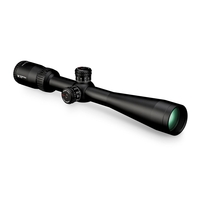
Vortex Diamondback Tactical 4-12x40 Riflescope - VMR-1 Reticle (MOA)
via Uttings
£299.00
Buying Advice
For the best overall pick under $2,000, it is very hard to beat a top-tier 5-25x or 4-16x FFP scope from Vortex's Razor HD Gen III line (in 1-10x or the Gen II 4.5-27x depending on configuration and current street pricing) which regularly lands in the high $1,700 to $1,900 price band on the US market. These scopes deliver ED glass with excellent color fidelity and resolution, hardened and repeatable turret systems with genuine zero-stops, and proven durability under semi-auto recoil. The Vortex Razor HD Gen II 4.5-27x56 in particular has become a PRS workhorse and handles AR-10 recoil without complaint. For shooters who want a slightly different reticle ecosystem, the Nightforce ATACR 5-25x56 F1 sometimes dips just under $2,000 on sale — an exceptional optic if you can catch it at that price, and Nightforce's NX8 series is worth cross-shopping in the same tier depending on current-year configuration availability. At this near-top-of-budget tier, you are getting glass and mechanics that genuinely compete with scopes costing $2,500 or more.
For the best value under $1,000, several scopes punch dramatically above their weight. The Athlon Ares ETR 4.5-30x56 FFP and the Primary Arms GLx 6-24x50 FFP both sit in the $700 to $900 range and offer surprisingly good glass clarity, solid turret tracking, and illuminated MRAD reticles well-suited to .308 ballistics. The Vortex Diamondback Tactical 6-24x50 FFP is another strong contender in the low-$400 to mid-$500 band if your budget is tighter, though you will notice the step down in edge sharpness and turret feel compared to the $800+ options. Athlon's Helos BTR Gen 2 6-24x56 FFP is worth a look in the $600 to $800 range as well. At this tier, turret repeatability and return-to-zero reliability are the specs to scrutinize most closely in reviews — glass quality is generally good across the board, but cheaper turret internals can show tracking errors over many revolutions of adjustment, which matters for .308 at distance.
Magnification range is one of the decisions that generates the most confusion among AR-10 buyers, and the answer depends on your realistic shooting distances. A 4-16x, 5-25x, or 6-24x scope covers the .308 Win's practical envelope extremely well. At the low end, 4x to 6x gives you enough field of view for faster target acquisition at 100 to 300 yards, positional shooting, and transitions in practical rifle matches. At the high end, 20x to 25x is more than sufficient for precise hold-overs or dialed shots at 800 to 1,000 yards — you do not need 30x or higher unless you are spotting trace or shooting in competition formats that specifically reward it. The sweet spot for most US AR-10 shooters is a 5-25x56 FFP: it offers a wide zoom range, a 56mm objective gathers enough light for dawn and dusk shooting, and the 5x low end keeps the scope usable for closer work. If your shooting is primarily inside 600 yards, a 4-16x44 is lighter, shorter, and arguably a better fit for a semi-auto gas gun where overall rifle weight and balance matter.
FFP versus SFP is a genuine decision point at this price tier, not just a spec-sheet checkbox. For anyone using holdovers or wind holds at varying magnifications — which describes most PRS and practical rifle shooters — FFP is the stronger recommendation because the reticle subtensions (whether in MRAD or MOA) remain accurate at every magnification setting. This matters when you are engaging targets at 300 yards on 10x and then shifting to a 700-yard target on 18x without re-dialing: your hold-off values stay true. SFP scopes are not inferior optics — they simply require you to use holdovers only at the designated magnification (almost always maximum power) for the subtensions to be correct. If you always dial your turrets to the correct elevation and only use the reticle for wind holds at max magnification, an SFP scope works perfectly well and can sometimes offer a slightly thinner reticle at low power for a cleaner sight picture. But at the sub-$2,000 price point in 2026, FFP options are so good and so widely available that there is little reason to compromise unless you have a specific preference for SFP reticle aesthetics.
Mounts and rings for an AR-10 deserve more attention than most buyers give them, because the platform's sharper, faster recoil impulse compared to a bolt-action .308 is the number-one cause of scope-related failures. The issue is almost never the scope itself breaking — it is the mount or rings loosening or shifting because they were not properly torqued, not matched to the scope's main tube diameter, or not designed for semi-auto recoil. Use a quality one-piece cantilever mount or a matched two-piece ring set in the correct diameter for your scope's main tube (30mm and 34mm are the two dominant tube diameters in this category). Ensure the mount's clamping surface matches your AR-10's top rail — most AR-10 uppers use a Picatinny (MIL-STD-1913) rail, but rail length varies by manufacturer and will determine whether you need a cantilevered mount to achieve proper eye relief. Torque rings and mount bolts to the manufacturer's specification using an inch-pound torque wrench — 15 to 18 inch-pounds is typical for ring cap screws, though base-to-rail clamp bolt torque varies significantly by mount design (anywhere from roughly 15 up to 65-plus inch-pounds depending on the specific mount) — always check and follow that mount's own documented torque spec rather than assuming a generic figure. Mount height should provide adequate clearance between the objective bell and the top rail or any folding front sight; medium-height rings work for most 44mm objectives on AR-10 platforms, while a 56mm objective typically requires a high or extra-high mount. When purchasing mounts and rings online, note that some firearm-adjacent accessories may have restricted listing status on certain retailers — check the listing's own compliance and shipping eligibility before ordering separate mount or ring hardware.
Frequently Asked Questions
What magnification do I need for an AR-10 in .308 Win?
For most AR-10 shooters working inside 300 to 600 yards, a 4-16x scope is ideal — light, compact, and offers enough top-end for precise shots. If you regularly shoot out to 800 to 1,000 yards, a 5-25x or 6-24x gives you the extra magnification for positive target identification and precise holdovers at distance without being excessively heavy. Avoid going above 30x unless you have a specific competitive reason, as the extra magnification adds weight and length without meaningfully improving practical accuracy from a semi-auto gas gun.
Do I need FFP or is SFP fine for an AR-10 precision build?
FFP is the stronger recommendation for precision work because the reticle subtensions stay correct at every magnification, which is critical if you use holdovers at varying zoom levels. SFP is perfectly acceptable if you discipline yourself to always dial your turrets for elevation and only use reticle-based wind holds at maximum magnification. At the sub-$2,000 price point in 2026, excellent FFP options are widely available, so there is less reason than ever to default to SFP unless you specifically prefer the thinner reticle appearance SFP offers at lower magnifications.
What mount height and ring diameter should I use on an AR-10?
Ring diameter must match your scope's main tube — 30mm and 34mm are the standard sizes in this category (never guess; check the scope's spec sheet). Mount height depends on your objective lens diameter and whether you have a fixed front sight or backup iron sights you want to co-witness or clear. A 44mm objective typically works with medium-height rings on an AR-10, while a 50mm or 56mm objective usually requires high or extra-high mounts. A one-piece cantilever mount is a popular and practical choice for AR-10s because it handles recoil well and provides built-in forward offset for proper eye relief.
Is a $2,000 budget enough to get a genuinely good long-range scope for .308?
Absolutely. The sub-$2,000 tier in 2026 includes scopes like the Vortex Razor HD Gen II 4.5-27x56 and the Nightforce NX8 series, which are proven PRS competition optics with outstanding glass clarity, reliable turret tracking, and robust construction. Even at the $700 to $900 price point, scopes like the Athlon Ares ETR and Primary Arms GLx offer genuinely competitive optical performance and mechanical reliability. You do not need to spend $2,500 or more to get a scope that will outperform most shooters' ability behind an AR-10 in .308.
Does an AR-10's recoil impulse require a different scope spec than a bolt gun in .308?
The scope itself does not necessarily need to be different — most quality scopes rated for centerfire rifle use handle .308 recoil fine regardless of platform. What changes is the recoil character: an AR-10 gas gun delivers a sharper, faster impulse than a bolt-action because the bolt carrier group cycles rearward under gas pressure. This makes proper mounting absolutely critical. Use a high-quality mount rated for semi-auto use, torque all fasteners to the manufacturer's specification, and periodically verify your zero has not shifted. The most common failure mode is not scope damage but scope movement in under-torqued or mismatched rings.
Should I choose MRAD or MOA for a .308 AR-10 scope?
Both systems work equally well for .308 ballistics — the choice is primarily about personal preference and which system you are already comfortable with. MRAD (milliradians) is the more common choice in PRS and precision rifle communities because the math for range estimation and wind holds is slightly simpler in base-10 increments (0.1 mil clicks). MOA is more intuitive if you think in inches at 100 yards (1 MOA is approximately 1.047 inches at 100 yards). Whichever you choose, ensure your turrets and reticle are in the same unit system — mixing an MOA reticle with MRAD turrets creates unnecessary confusion.
How much elevation travel do I need in a .308 scope for an AR-10?
A .308 Win with a 100-yard zero requires roughly 30 to 36 MOA (approximately 8.5 to 10.5 MRAD) of elevation adjustment to reach 1,000 yards, depending on barrel length, muzzle velocity, and ammunition. Most quality scopes in this price tier offer 80 to 120 MOA or more of total elevation travel, so usable travel is rarely the limiting factor. What matters more is having a reliable zero-stop mechanism so you can quickly return to your confirmed zero after dialing for distance — virtually every scope worth buying above $700 in 2026 includes this feature.
Do I need a side-focus parallax adjustment for an AR-10 precision scope?
Yes, a side-focus (or adjustable objective) parallax knob is strongly recommended for any scope intended for precision work beyond 200 yards. Parallax error occurs when the reticle and the target image are not on the same focal plane, causing the point of aim to shift as your eye moves behind the scope. At 400 to 800 yards, uncorrected parallax can introduce several inches of apparent point-of-aim error. Nearly all precision scopes in the $700 to $2,000 range include a side-focus parallax adjustment as standard, typically adjustable from 25 or 50 yards out to infinity.
What is the best barrel length for maximizing scope and cartridge performance on an AR-10?
Barrel length affects muzzle velocity, which in turn affects the .308's supersonic range and how much elevation you need to dial. A 20-inch barrel typically yields 2,650 to 2,800 fps with 168-grain match ammunition, keeping the bullet supersonic past 900 yards in favorable conditions. A 16-inch barrel drops velocity by roughly 100 to 150 fps, reducing that envelope somewhat. Your scope choice does not change based on barrel length, but a shorter barrel means you will use more of your scope's elevation travel to reach the same distance, making total available travel and a reliable zero-stop slightly more important.
Related guides
Our 2026 UK buyer's guide to the best scopes for long-range shooting under £1,000. Expert picks, specs explained, and FAQs for reaching 1,000 yards on a budget.
Best LPVO for AR-15 Under $300 in 2026Find the best LPVO for the money in 2026. Our US buyer's guide compares top 1-6x and 1-8x scopes under $300 for AR-15 rifles, with mounting tips and real FAQ answers.
Best 6.5 Creedmoor Scopes Under $500 in 2026Find the best scope for 6.5 Creedmoor under $500 in 2026. We cover FFP vs SFP, MOA vs MRAD, long-range picks, and ideal pairings for Tikka, Savage, and Bergara rifles.
Best Budget PRS Scopes Under £500 (UK 2026)Find the best scope for PRS and precision rifle competition under £500 in the UK. Our 2026 guide covers FFP vs SFP, MRAD turrets, top brands and real buying advice.
Best Budget Bench Rest Scopes Under £500 (UK 2026)Our expert 2026 guide to the best scope for bench rest shooting UK. Compare precision optics under £500 with the magnification, turrets and parallax features that matter for group shooting.
LPVO Zero Distance: How to Choose & Why It MattersLearn the optimal zero distance for your LPVO rifle scope in 2026. Covers 50 vs 100-yard zero, BDC reticles, FFP vs SFP, and the best scope picks for US hunters and competitors.
How to Swap Day and Night Optics on the Same RifleLearn how to swap between a day rifle scope and a night vision scope on the same rifle without losing zero. Covers mounts, reticles, zeroing tips, and top picks for US hunters.
Not sure which scope is right for you?
Try our AI-powered scope finder — answer a few questions and get personalised recommendations.
Find My Scope →Get a UK scope tip every day
Follow AiScopes on Facebook for daily buying guides, deals and gear advice.
Follow on Facebook