Best 6.5 Creedmoor Scopes Under $500 in 2026
By Peter Makulek · Senior Optics Editor · · Live prices from UK retailers
The 6.5 Creedmoor has cemented itself as the most popular long-range cartridge in the US for good reason: its high ballistic coefficient projectiles, flat trajectory, and remarkably mild recoil make it accessible to shooters who want to ring steel at 800 yards on Saturday and fill a deer tag on Sunday. That versatility, however, puts real demands on the optic sitting on top. A scope that merely magnifies isn't enough — you need reliable turret tracking, quality glass that resolves mirage and target detail at distance, and a reticle system that actually helps you correct for wind and elevation instead of guessing. The good news is that the sub-$500 segment in 2026 is the strongest it has ever been for US buyers.
Finding the best scope for 6.5 Creedmoor under $500 means understanding how the cartridge is actually used across the country. Western hunters in open sage flats or mountain basins may take pronghorn or mule deer shots beyond 400 yards, while Midwestern and Eastern whitetail hunters rarely shoot past 200 yards from a treestand. Meanwhile, PRS-style competitors and recreational long-range shooters push the round well past 1,000 yards at matches and public-land steel ranges from Texas to Utah. A single scope recommendation can't serve all of those missions equally, so this guide breaks recommendations down by realistic use case rather than offering one generic pick.
The rifles most commonly chambered in 6.5 Creedmoor in the US market — the Tikka T3x, Savage 110 series, and Bergara B14 — each have different action lengths, stock ergonomics, and intended roles that influence which scope features matter most. A lightweight Tikka T3x Lite built for backcountry hunts benefits from a compact, lighter optic in the 3-15x range, while a heavier Bergara B14 HMR set up for precision work at range can justify a longer, heavier 5-25x or 6-24x tactical tube. We will walk through how to match scope weight, magnification range, turret style, and reticle type to the rifle and shooting discipline you actually have.
Before diving into specific picks and the product grid below, it is worth setting realistic expectations about what sub-$500 glass can and cannot do. At this price tier you can absolutely get clear, repeatable optics capable of consistent 1,000-yard shooting — but turret tracking precision, edge-to-edge sharpness, and coating quality will not match a $1,500 Vortex Razor or a Nightforce NX8. The practical differences show up most in extreme low light, heavy mirage, and when you are dialing dozens of MOA or mils repeatedly without a zero-stop resetting cleanly. We will be honest about those trade-offs so you spend your money wisely and know exactly what you are getting.
Top Picks — Live UK Prices

Nikko Stirling Diamond Long Range 30mm Tactical 4-16x50 IR Rifle Scope
via Uttings
£199.00

Hawke Endurance 30 WA 1-4x24 IR (Tactical Dot 4x) Telescopic Sights
via BushWear
£251.10
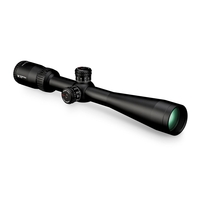
Vortex Diamondback Tactical 4-12x40 Riflescope - VMR-1 Reticle (MOA)
via Uttings
£299.00
Buying Advice
For the best overall pick under $500, look for a scope that balances optical clarity, turret reliability, and versatile magnification without forcing you into a narrow use case. In 2026 the sweet spot sits in the 4-16x to 5-25x magnification range with a 44mm or 50mm objective, first focal plane reticle, and exposed elevation turret with a zero-stop or at least a reliable return-to-zero mechanism. Brands like Vortex (Diamondback Tactical and PST Gen II at the top end of the budget), Primary Arms (GLx and PLx lines), Athlon (Argos BTR Gen II and Midas TAC), and Arken (EP5 and SH4 Gen II) all offer models that hit these marks and fall within or near the $500 ceiling depending on configuration. Prioritize glass clarity and turret repeatability over raw magnification numbers — a sharp, reliable 4-16x will outperform a muddy 6-24x every time in practical shooting.
For long-range shooting at 500 yards and beyond, turret tracking consistency matters more than maximum magnification. A scope that tracks precisely in 0.1 MRAD or 0.25 MOA clicks lets you dial your DOPE with confidence, and that repeatability is what separates a scope you can trust at 800-1,000 yards from one that leaves you chasing misses. Look for scopes with capped or locking turrets that resist accidental bumping, a side-focus parallax knob adjustable from roughly 10 yards to infinity, and an etched glass reticle with wind-hold hashmarks or a Christmas-tree-style BDC grid. At this price tier the Vortex Diamondback Tactical 6-24x50 FFP offers honest tracking in either MOA or MRAD, while the Primary Arms GLx 4-16x50 FFP with the company's ACSS reticle gives genuine holdover utility without dialing. Do not assume that buying a 6-24x scope alone guarantees hits at 1,000 yards — your ammunition consistency, rifle accuracy, wind-reading skill, and a quality bipod or rear bag contribute at least as much as the optic.
When pairing a scope with a Tikka T3x, Savage 110, or Bergara B14, match the optic's weight and profile to the rifle's intended mission. The Tikka T3x Lite or Superlite in 6.5 Creedmoor is built for backcountry hunting where every ounce matters, so a compact 3-15x42 or 4-16x44 scope in the 20-24 oz range keeps the total package under eight pounds and handy for off-hand or kneeling shots. The Savage 110 Tactical or Precision, on the other hand, already wears a heavier chassis stock and is designed for prone or bench shooting, making a full-size 5-25x50 or 6-24x50 FFP tactical scope a natural fit — the extra weight is irrelevant on a bipod and the higher magnification aids target identification at distance. The Bergara B14 HMR occupies a middle ground: heavy enough for range work but still field-portable, so a 4-16x or 5-25x FFP scope with a well-damped zero-stop turret covers both competition and the occasional hunting trip. In every case, ensure the scope's tube diameter (30mm is standard at this price) matches the rings or mount you select, and use a quality torque wrench to spec when mounting.
The FFP versus SFP decision for 6.5 Creedmoor shooters hinges on how you use your reticle at different magnification settings. In a first focal plane scope the reticle subtensions are accurate at every magnification — if a hash mark equals 1 mil at 10x, it still equals 1 mil at 20x. This is critical for PRS-style shooting, holdover corrections, and rapid wind calls where you may not always be on max power. Second focal plane scopes keep the reticle the same visual size regardless of magnification, which many hunters prefer because the crosshair stays at a comfortable, designed size at low power -- unlike an FFP reticle, which shrinks at lower magnifications and can become hard to see quickly in thick timber or low light. The trade-off is that holdover values are only correct at one designated magnification (usually the maximum). For a 6.5 Creedmoor primarily used at long range with dialed turrets, FFP is the stronger choice under $500; for a hunting-focused rifle where most shots are under 300 yards and quick target acquisition matters more than mil-based holds, an SFP scope with a simple duplex or BDC reticle is perfectly appropriate and often offers better optical quality per dollar because fewer manufacturing compromises are needed.
Beyond the headline features, a few key specs deserve careful attention before you buy. First, verify that the scope's total elevation adjustment range can handle the drop you will actually dial: 6.5 Creedmoor with a 140-grain match bullet drops roughly 12.5 mils (about 43 MOA) at 1,000 yards from a 100-yard zero, so you need enough internal adjustment above your zero to get there — many sub-$500 scopes offer 25-30 mils or 80-100 MOA total travel, which is sufficient if your mount provides 20 MOA of built-in cant. Second, check the parallax adjustment range: a side-focus knob adjustable down to at least 50 yards is important if you also shoot at shorter distances during hunting season. Third, look for fully multi-coated lenses (all air-to-glass surfaces coated) rather than merely "coated" or "multi-coated" glass, as this meaningfully affects light transmission at dawn and dusk. Finally, buy from a retailer with a solid return policy — products are available on Amazon and OpticsPlanet among other dealers — so you can verify turret tracking with a box test or tall-target test before committing.
A common mistake in the sub-$500 tier is over-buying magnification at the expense of glass quality and mechanical reliability. A 10-40x scope sounds impressive on paper, but if the coatings are mediocre, the turrets have slop, and the eyebox is so tight that you struggle to get a clean sight picture from field positions, you have gained nothing useful. The brands that dominate positive user feedback in this segment — Vortex, Primary Arms, Athlon, Arken, and to some extent Leupold with their VX-3HD and Mark 3HD lines — earn that reputation by optimizing the balance between magnification range, mechanical precision, coating quality, and warranty support rather than chasing spec-sheet numbers. Set a realistic ceiling: 4-16x is genuinely versatile for hunting and mid-range precision, 5-25x covers nearly every practical 6.5 Creedmoor scenario, and anything beyond that magnification range at this price usually involves unacceptable trade-offs.
Frequently Asked Questions
What magnification do I need for 6.5 Creedmoor at 1,000 yards?
Most experienced long-range shooters find 16x to 20x sufficient for engaging IPSC-size steel or similar targets at 1,000 yards in typical conditions. Higher magnification (22-25x) can help with target identification and spotting trace, but it also amplifies mirage and narrows the eyebox, making it harder to maintain a stable sight picture from field positions. A quality 5-25x or 4-16x scope covers the vast majority of realistic 6.5 Creedmoor scenarios; if you are shooting tiny groups on paper at 1,000 yards from a bench, you may benefit from 25x, but for steel or hunting you rarely need more than 18x.
Should I choose MOA or MRAD for 6.5 Creedmoor?
Either system works perfectly — the key is to match your turrets and reticle to the same unit so you are not mentally converting between the two. MRAD (mil-radian) has become the dominant standard in PRS competition and tactical shooting because the math for range estimation and wind correction uses clean decimal increments (0.1 mil per click). MOA remains popular among hunters and benchrest shooters, especially those who think naturally in inches (1 MOA ≈ 1.047 inches at 100 yards). If you plan to attend PRS matches or use community-shared DOPE cards, MRAD is the more practical choice; if you shoot alone and prefer inches, MOA is equally precise.
Is a hunting scope or a long-range target scope better for 6.5 Creedmoor?
It depends entirely on your primary use. A hunting scope typically features a wider field of view, a generous eyebox for fast target acquisition, capped turrets that resist accidental adjustment, and lighter weight — all ideal for shots under 400 yards in field conditions. A long-range target or tactical scope prioritizes exposed locking turrets for quick dialing, a first focal plane reticle with detailed subtension marks, higher maximum magnification, and a side-focus parallax knob. If you hunt and shoot long range, a mid-range tactical scope like a 4-16x FFP with locking turrets is the best compromise under $500.
Do I need a 20 MOA rail or mount for 6.5 Creedmoor?
If you intend to shoot beyond 600 yards regularly, a 20 MOA canted base or mount is strongly recommended. It tilts the scope's internal adjustment range downward, giving you more available "up" elevation to dial for long-range drop without running out of travel. A 140-grain 6.5 Creedmoor bullet drops roughly 43 MOA at 1,000 yards from a 100-yard zero; without a canted mount, many sub-$500 scopes simply do not have enough internal elevation to reach that far. For hunting at distances under 500 yards, a standard flat mount is fine.
What is a zero-stop and do I need one on a sub-$500 scope?
A zero-stop is a mechanical feature that prevents the elevation turret from rotating below your established zero, so you can quickly dial back to your baseline after making a long-range correction. It is extremely useful for any scenario where you dial up for a shot and need a fast, confident return — common in PRS matches and hunting situations where a follow-up shot at closer range might be needed. Several sub-$500 scopes now include zero-stops or re-zero indicators; it is not strictly mandatory, but it adds a meaningful layer of confidence and speed to your workflow.
Can a sub-$500 scope really handle 1,000-yard shooting with 6.5 Creedmoor?
Yes, but with realistic expectations. Several scopes in the $300-$500 range from Vortex, Athlon, Primary Arms, and Arken track reliably enough for consistent hits on torso-size steel at 1,000 yards when paired with quality match ammunition and a properly built rifle. Where they fall short compared to premium optics is in extreme low-light clarity, edge-to-edge resolution, and long-term mechanical endurance after thousands of turret rotations. Your ammunition consistency, wind-reading ability, and shooting fundamentals will be the limiting factors long before a well-chosen sub-$500 scope becomes the weak link.
What reticle style is best for 6.5 Creedmoor long-range shooting?
A reticle with clearly marked windage and elevation subtensions — often called a Christmas-tree, Horus-style, or mil-hash reticle — gives you the most flexibility at distance. These reticles allow holdover and wind-hold corrections without dialing the turrets, which is faster in dynamic shooting. Primary Arms's ACSS Athena and ACSS HUD DMR, Vortex's EBR-7C and EBR-2C, and Athlon's APLR reticles are all strong options available in sub-$500 scopes. For pure hunting, a simpler duplex or BDC reticle is less cluttered and faster to use on game at moderate ranges.
How heavy should my scope be if I am hunting with a 6.5 Creedmoor rifle?
For backcountry or spot-and-stalk hunting where you carry the rifle all day, aim for a scope under 22 ounces to keep total rifle weight manageable. A 3-15x42 or 4-16x44 scope in a 1-inch or 30mm tube typically hits this mark. For stand hunting or vehicle-accessible hunts where weight matters less, a 24-28 oz tactical scope in the 5-25x range is perfectly acceptable and gives you more magnification for longer shots across open terrain. Always factor in the weight of rings or a one-piece mount, which can add 4-8 ounces depending on construction.
Should I buy FFP or SFP if I mostly hunt whitetail under 300 yards?
For whitetail hunting at typical Eastern and Midwestern distances under 300 yards, a second focal plane scope is usually the better choice. The reticle stays the same comfortable size at low magnification, making fast target acquisition easier in thick cover at dawn or dusk. You rarely need to use reticle holdovers at these distances — a simple zero and a known point-of-impact shift at 200-300 yards is sufficient. An SFP scope also tends to offer slightly better optical quality at a given price point because the manufacturing tolerances for the reticle are less demanding than FFP designs.
Related guides
Find the best scope for PRS and precision rifle competition under £500 in the UK. Our 2026 guide covers FFP vs SFP, MRAD turrets, top brands and real buying advice.
Best Budget Bench Rest Scopes Under £500 (UK 2026)Our expert 2026 guide to the best scope for bench rest shooting UK. Compare precision optics under £500 with the magnification, turrets and parallax features that matter for group shooting.
Best Scopes for AR-10 & .308 Win Under $2,000Expert-picked best scopes for AR-10 and .308 Win under $2,000 in 2026. FFP vs SFP, magnification, mounts, and 5 real picks from $700 to $1,900 for US precision shooters.
Best LPVO for AR-15 Under $300 in 2026Find the best LPVO for the money in 2026. Our US buyer's guide compares top 1-6x and 1-8x scopes under $300 for AR-15 rifles, with mounting tips and real FAQ answers.
Best Budget Thermal Scopes for Fox & Deer Shooting in the UKOur 2026 UK buyer's guide to the best thermal scopes under £500 for foxing and deer stalking. Compare PARD, Hikmicro and more — specs, legality and real-world advice.
Best Scopes for Highland Red Deer Stalking in 2026Our expert UK buyer's guide to the best scopes for Highland red deer stalking in 2026. Covers magnification, reticles, light transmission, budget tiers and UK-legal context for stalkers.
Best Scopes for .22LR Target Shooting in 2026Find the best scope for your .22LR rifle in the UK. Our 2026 rimfire optics guide covers HFT, benchrest and plinking – magnification, parallax, budget tiers and top picks.
Not sure which scope is right for you?
Try our AI-powered scope finder — answer a few questions and get personalised recommendations.
Find My Scope →Get a UK scope tip every day
Follow AiScopes on Facebook for daily buying guides, deals and gear advice.
Follow on Facebook