Pulsar TELOS LRF XT50: A UK Buying Guide

By Peter Makulek · Senior Optics Editor · · UK prices at time of writing

At a glance

Detect

  • Sensor: 1280 x 1024 thermal, 12 µm
  • Detection range: 2,300 m for deer-sized objects

Measure

  • Rangefinder: built-in laser, up to 1,200 m

Record and power

  • Battery: up to 8 hours at 22 C
  • Memory and rating: 128 GB built-in; IPX7
  • Connectivity: Wi-Fi, Bluetooth and the Stream Vision 2 app

Manufacturer figures per Pulsar; detection range is for deer-sized objects; actual performance varies with conditions and target.

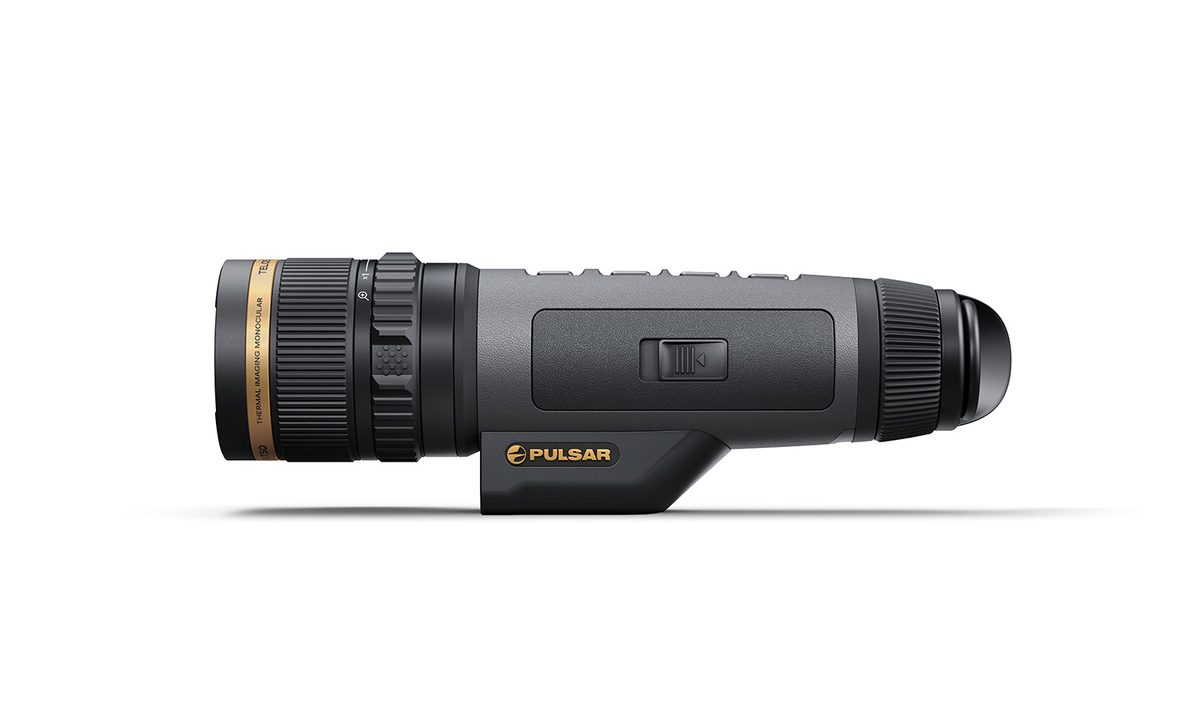
Pulsar TELOS LRF XT50 thermal monocular, three-quarter front view showing the lens and control buttons (official Pulsar render)

Image: Pulsar

£3,849.95 at each of three UK dealers named by Pulsar (listed price, checked 23 Oct 2026)

Dealer links on this page are sponsored links.

Read the full guide ↓

This is an advertisement feature: Pulsar (through Yukon Advanced Optics Worldwide) paid AIScopes to write it. Pulsar checked the facts before publication, but the opinions and conclusions are ours and nothing here was bought, scored or ranked for them. We have not tested the Pulsar TELOS LRF XT50. We have no unit, so everything below is based on Pulsar's published specifications, its manual and its product footage. Where a figure is Pulsar's claim, we say so.

The Pulsar TELOS LRF XT50 is a handheld thermal monocular with a laser rangefinder built in. Pulsar describes it as the top model in its upgradeable Telos range, aimed at hunters and professional users who spend long periods in the field. That makes it a different tool from a thermal weapon sight. You use it to find something, work out what it is and measure how far away it is, then decide what to do next. It does not mount on a rifle.

Money is the first thing to settle. At the three UK dealers we checked on 2026-10-23, the listed price was £3,849.95 at each of them. That is a serious outlay for a spotting tool, so the rest of this guide is about working out whether the things Pulsar says it does well are the things you would actually use.

We cover who it is likely to suit, what the main features mean in practice, how a thermal monocular differs from other ways of seeing in the dark, what to check before paying, and where to buy. The spec table and dealer links also sit on a separate, factual product listing that carries no verdict.

Pulsar TELOS LRF XT50 thermal monocular, three-quarter front view showing the lens and control buttons (official Pulsar render)
Image: Pulsar
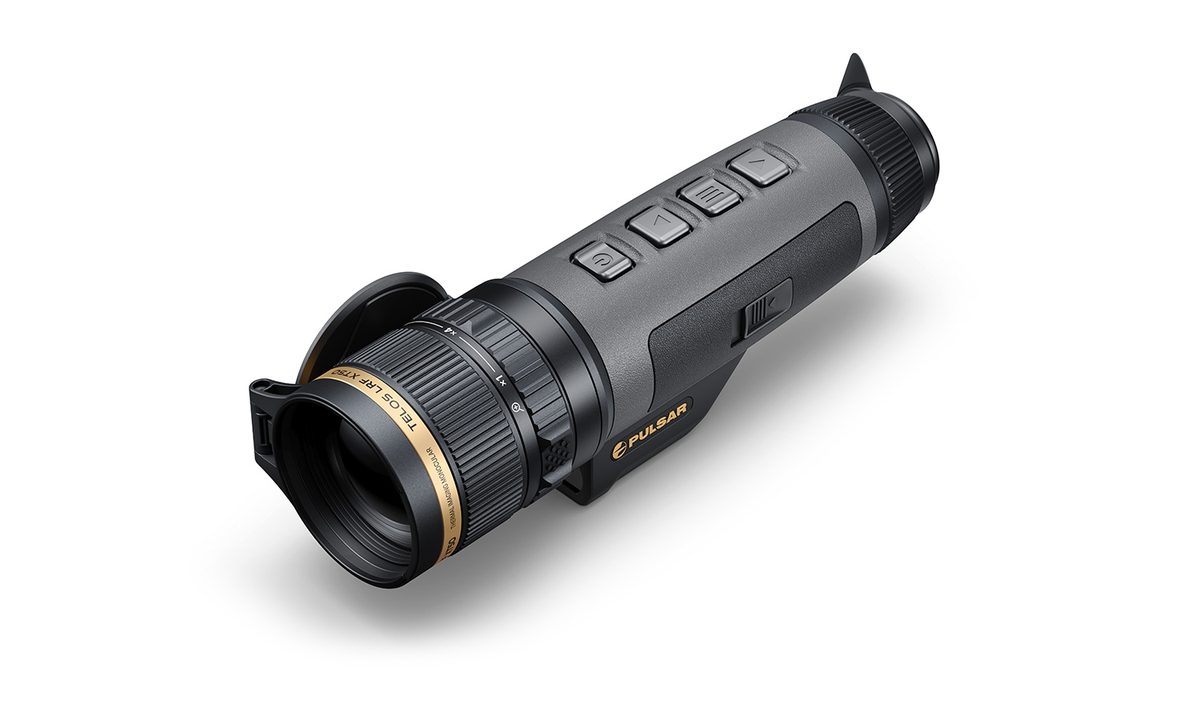
Pulsar TELOS LRF XT50 three-quarter view from the lens side, with the TELOS LRF XT50 badge on the body (official Pulsar render)
Image: Pulsar
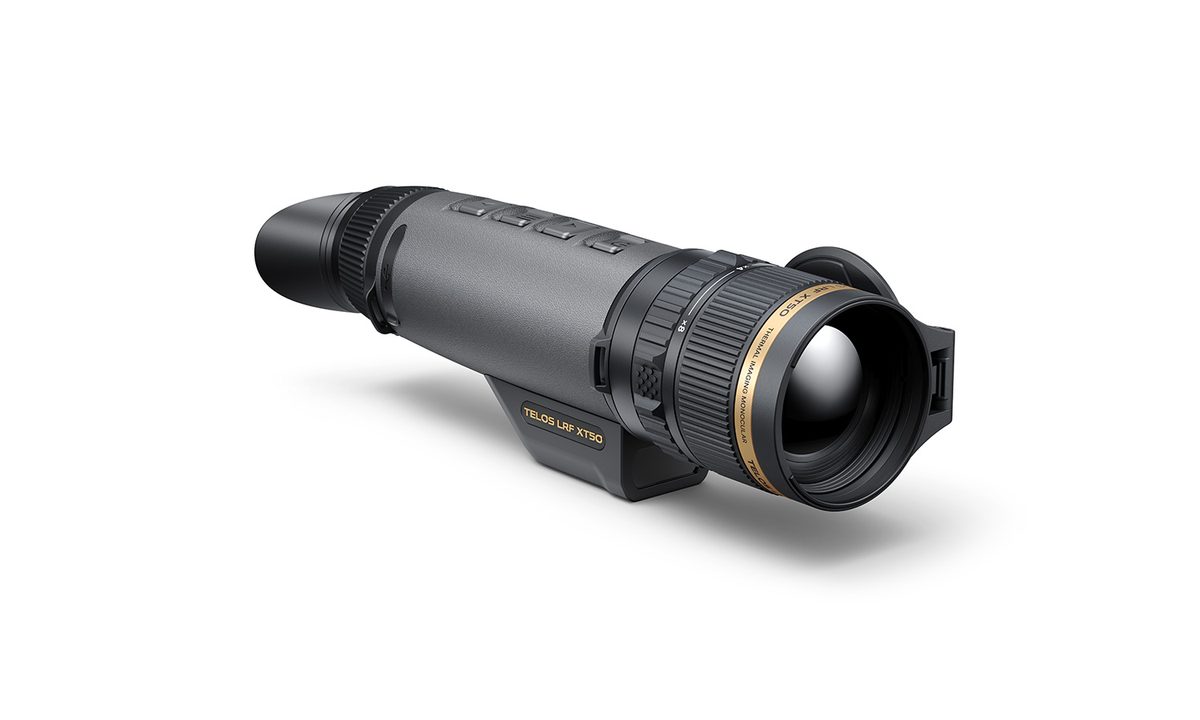
Pulsar TELOS LRF XT50 side profile with the Pulsar logo (official Pulsar render)
Image: Pulsar
Pulsar Telos LRF XT50 | Field Footage Across Species and Distances · Video: Pulsar Vision (YouTube)

Where to buy: UK dealers named by Pulsar (same price, not a ranking)

Advertisement feature — paid for by Pulsar. Dealer links on this page are sponsored links. Prices come from each dealer’s listing on the day this guide was written; prices change, so check the current price before you buy.

Pulsar TELOS LRF XT50 Thermal Monocular at TJ Focus

Best for: Buyers who want to check availability and terms with the dealer before ordering.

TJ Focus listed the TELOS LRF XT50 at £3,849.95 on 2026-10-23, with an add to basket button and no stock wording on the page. Because we could not see a stock note, confirm availability with the shop before you rely on a delivery date. Dealer text on the page says IP67, but Pulsar's own documents say IPX7, so go by the manufacturer. The order of these three dealers is not a ranking.

  • Thermal sensor: 1280 x 1024, 12 µm (per Pulsar)
  • Field of view: 17.5° horizontal, 30.7 m at 100 m (per Pulsar)
  • Magnification: 2-16x, up to 24x with Zoom Boost (per Pulsar)
  • Detection range: 2,300 m for deer-sized objects (per Pulsar; actual performance varies with conditions and target)
  • Laser rangefinder: up to 1,200 m, accuracy 1 m, 905 nm (per Pulsar; actual performance varies with conditions and target)
  • Display: AMOLED, 1920 x 1080
  • Battery: LPS 7i, up to 8 hours at 22 C (per Pulsar)
  • 128 GB memory, Wi-Fi, Stream Vision 2 app
  • IPX7; 242 x 72 x 77 mm; 0.73 kg with battery
Check price at TJ Focus →Listed price £3,849.95 on 2026-10-23

Pulsar TELOS LRF XT50 Thermal Monocular at BushWear

Best for: Buyers who want a stated dispatch window on the page.

BushWear listed the same £3,849.95 on 2026-10-23 and said 'Dispatches within 5 working days'. That helps if you are planning around a particular trip, though it is the dealer's statement and we have not tested it. The page text says IP67 where Pulsar says IPX7. Compare delivery and returns terms with the other two before deciding.

  • Thermal sensor: 1280 x 1024, 12 µm (per Pulsar)
  • Field of view: 17.5° horizontal, 30.7 m at 100 m (per Pulsar)
  • Magnification: 2-16x, up to 24x with Zoom Boost (per Pulsar)
  • Detection range: 2,300 m for deer-sized objects (per Pulsar; actual performance varies with conditions and target)
  • Laser rangefinder: up to 1,200 m, accuracy 1 m, 905 nm (per Pulsar; actual performance varies with conditions and target)
  • Display: AMOLED, 1920 x 1080
  • Battery: LPS 7i, up to 8 hours at 22 C (per Pulsar)
  • 128 GB memory, Wi-Fi, Stream Vision 2 app
  • IPX7; 242 x 72 x 77 mm; 0.73 kg with battery
Check price at BushWear →Listed price £3,849.95 on 2026-10-23

Pulsar TELOS LRF XT50 Thermal Monocular at Blackwood Outdoors

Best for: Buyers who want an in-stock note and the ex-VAT figure shown on the page.

Blackwood Outdoors listed £3,849.95 including VAT (£3,208.29 ex VAT) on 2026-10-23 and marked the unit 'in stock - fast shipping'. Its specification table gives IPX7, in line with Pulsar. As with the others, stock and price can change, so check the page on the day you buy.

  • Thermal sensor: 1280 x 1024, 12 µm (per Pulsar)
  • Field of view: 17.5° horizontal, 30.7 m at 100 m (per Pulsar)
  • Magnification: 2-16x, up to 24x with Zoom Boost (per Pulsar)
  • Detection range: 2,300 m for deer-sized objects (per Pulsar; actual performance varies with conditions and target)
  • Laser rangefinder: up to 1,200 m, accuracy 1 m, 905 nm (per Pulsar; actual performance varies with conditions and target)
  • Display: AMOLED, 1920 x 1080
  • Battery: LPS 7i, up to 8 hours at 22 C (per Pulsar)
  • 128 GB memory, Wi-Fi, Stream Vision 2 app
  • IPX7; 242 x 72 x 77 mm; 0.73 kg with battery
Check price at Blackwood Outdoors →Listed price £3,849.95 on 2026-10-23

See the factual product listing (spec table and dealer links, no verdict) →

Buying Advice

Who it suits. Pulsar's brief points the TELOS LRF XT50 at professional hunters, people who scan large forests, fields and hillsides, and wildlife, forestry and search and rescue users. Our reading is narrower. It makes most sense if you spend long sessions glassing open ground, you want to know what you are looking at before any decision is made, and you would like to drop a separate rangefinder from your kit. If your night work is mostly short-range pest control from a fixed position, a handheld at this price is hard to justify, and a cheaper thermal spotter or a weapon sight may do more of what you need.

Image detail and field of view. Pulsar quotes a 1280 x 1024 sensor with a 12 micron pixel pitch and a 17.5 degree horizontal field of view, which is 30.7 m wide at 100 m. A higher-resolution sensor gives the processor more to work with when you zoom in on something distant, which matters when the question is whether that is a fox or a roe deer, and whether there is another animal behind it. A wide field of view lets you sweep a field faster before you zoom in. Pulsar quotes 2-16x magnification, extending to 24x with Zoom Boost. Digital magnification enlarges the image rather than adding detail, so expect it to soften as you push it. We cannot tell you where that point falls without a unit in hand.

Detection range versus identification. Pulsar quotes a detection distance of 2,300 m. Its manual gives that figure for deer-sized objects, and actual performance varies with conditions and target. Detection means seeing that something warm is there. Identification, knowing what it is, needs a much shorter distance with any thermal device. When you compare models, look at the sensor and lens as well as the detection figure.

Rangefinder. Pulsar says the built-in laser rangefinder measures up to 1,200 m with a stated accuracy of 1 m, in single-shot or scan mode. Its manual adds that results depend on how reflective the target is and on the weather, and lists low-reflectivity targets such as tree leaves as a cause of failed readings. Treat 1,200 m as a ceiling. The manual also says image stabilisation switches off automatically while the laser is measuring, so hold the unit steady for the reading. Pulsar lists a built-in ballistic calculator, set up through its Stream Vision Ballistics app. Check how that fits your own rifle and ammunition before counting it as a reason to buy.

Battery and cold. Pulsar gives up to 8 hours of battery run time at 22 C for the replaceable LPS 7i pack (6,400 mAh), which can be charged over USB-C. Its manual says actual time depends on use of Wi-Fi, Bluetooth, the recorder and the rangefinder, and that charging from an external source below 0 C can shorten battery life. A British winter night is rarely 22 C, so plan on a spare pack or a power bank for long sessions. Pulsar rates the unit for -25 to +40 C.

Build and handling. The manual gives 242 x 72 x 77 mm and 0.73 kg with the battery fitted. Pulsar rates the TELOS LRF XT50 IPX7, which its brief describes as protection against up to 1 m of water for 30 minutes. A few dealer descriptions say IP67, which is a different rating. The manufacturer's documents say IPX7, so that is what we use. Pulsar also lists a rubber-coated body and haptic button feedback, which it says helps when wearing gloves. Both are worth checking in your own hand, because we have not held one.

How it compares with other options, in principle. A thermal monocular shows heat rather than light, so it needs no illumination and, according to Pulsar's manual, works by day or night and in fog or rain. A digital night-vision monocular depends on available light or an infrared illuminator. A thermal weapon sight puts the reticle in the device you shoot through, which is convenient but means shouldering the rifle to look around. A thermal binocular lets you view with both eyes, which many people find more comfortable over long sessions. Within thermal monoculars the practical differences are sensor resolution, lens, field of view, battery, software and whether a rangefinder is included. We are not ranking the TELOS LRF XT50 against any of these. We have not tested it beside anything, and how you will use it matters more than any league table.

What to check before you buy. First, confirm the exact model: the TELOS LRF XT50 is SKU 77524 (TJ Focus and Blackwood Outdoors show it as PUL-77524; BushWear uses its own code, S189642), and Pulsar sells other Telos models with different specifications. Second, check delivery and stock on the dealer page on the day, because BushWear showed 'Dispatches within 5 working days' on 2026-10-23. Third, ask the dealer for warranty and returns terms in writing, since we have not verified them. Fourth, check the app: Stream Vision 2 handles live view, file transfer and firmware updates over Wi-Fi, so make sure it works with your phone. Finally, handle one before you commit if you can. At this price, an hour with the unit tells you more than any spec sheet.

Where to buy. Pulsar named three UK dealers for this guide: TJ Focus, BushWear and Blackwood Outdoors. All three listed the same price, £3,849.95, on 2026-10-23, so price will not separate them. Blackwood Outdoors also shows £3,208.29 excluding VAT. The order they appear in is not a ranking. Choose on delivery, support and who you already trust. Prices and stock change, so check the dealer page before you order. The dealer links are sponsored.
Frequently Asked Questions

What is the Pulsar TELOS LRF XT50?

It is a handheld thermal imaging monocular made by Pulsar with a built-in laser rangefinder. Pulsar describes it as the top model of its upgradeable Telos range. It is for observing, identifying and ranging, and it does not attach to a rifle. This guide is an advertisement feature and is based on Pulsar's specifications and footage, not our own testing.

How much does the Pulsar TELOS LRF XT50 cost in the UK?

The listed price at TJ Focus, BushWear and Blackwood Outdoors on 2026-10-23 was £3,849.95 at each. Blackwood Outdoors also shows £3,208.29 excluding VAT. We have not checked for promotions or price changes at checkout, so confirm on the dealer page.

How long does the battery last?

Pulsar says up to 8 hours at 22 C for the LPS 7i battery. Its manual says actual run time depends on how much you use Wi-Fi, Bluetooth, the video recorder and the rangefinder, and that charging from an external source below 0 C can reduce battery life. Treat 8 hours as a best case and carry a spare for long winter sessions.

What is the detection range?

Pulsar quotes 2,300 m (2,515 yards) for deer-sized objects. This is the manufacturer's figure, and actual performance varies with conditions and target. Recognising what you are looking at needs a much shorter distance than simply detecting a warm shape.

How far can the rangefinder measure?

Pulsar quotes up to 1,200 m with an accuracy of 1 m, using a 905 nm laser. The manual says results depend on how reflective the target is and on the weather, and that low-reflectivity targets such as leaves can fail to return a reading. Actual performance varies with conditions and target.

Is it waterproof?

Pulsar rates it IPX7, which its brief describes as protection against immersion in up to 1 m of water for 30 minutes. Some dealer descriptions say IP67, but Pulsar's manual says IPX7.

How big and heavy is it?

The manual gives 242 x 72 x 77 mm and 0.73 kg with the battery fitted. Think about how you will carry it on a long walk-in, and whether you want it on a lanyard or in a chest pouch.

Can I fit it to a rifle?

No. It is a handheld monocular. Pulsar lists a 1/4 inch tripod thread, so you can steady it on a tripod. If you want a thermal sight to shoot through, you need a different product category.

Does it record video and connect to a phone?

Pulsar says it records MP4 video with sound and JPEG photos to 128 GB of built-in memory, and connects to the free Stream Vision 2 app over Wi-Fi for live view, remote control, file transfer and firmware updates. It also lists USB-C video output so the unit can work as a UVC camera.

Is the TELOS LRF XT50 worth buying?

That depends on how you will use it. On paper it is a high-specification handheld thermal with a rangefinder, and the price reflects that. It suits someone who glasses large areas often and wants one device for finding, identifying and ranging. For occasional or short-range use it is likely more than you need. We have not tested it, so we are not giving it a score.

Is this guide independent?

No. It is an advertisement feature paid for by Pulsar, who checked the facts before publication. The opinions are ours. Other AIScopes guides that mention Pulsar are independent, are not advertisement features, and were not approved by Pulsar.

Related guides

Not sure which scope is right for you?

Try our AI-powered scope finder — answer a few questions and get personalised recommendations.

Find My Scope →

Get a UK scope tip every day

Follow AiScopes on Facebook for daily buying guides, deals and gear advice.

Follow on Facebook