Thermal Spotting Scopes: What to Buy and What the Law Says
By Peter Makulek · Senior Optics Editor · · Live prices from UK retailers
A thermal spotting scope, also sold as a thermal spotter scope, thermal spotter, thermal monocular or handheld thermal imager, is something you look through to find warm animals, not something you aim with. It has no reticle, no zero and no place on a rifle. People searching for one are usually trying to answer two questions: will it find the fox or deer I am looking for, and do I need any paperwork to own it?
The short answers. In the dark and against clutter, a thermal spotter will find a warm animal well beyond what binoculars can, but it shows far less detail than good glass in daylight, so confirming species, sex and what lies behind the animal is the hard part. And a handheld thermal is not a firearm or part of one, so owning it needs no certificate in England, Wales or Scotland. What the law does restrict is shooting at night, covered below.
A spotter also keeps your rifle out of the scanning job. You sweep with the thermal, identify the animal and what is behind it, and only then bring the rifle up. That is good practice with any optic, and it is the main reason to buy the spotter before a thermal sight.
Top Picks — Live UK Prices
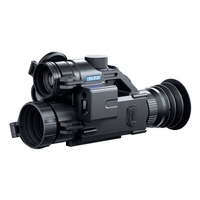
Pard Landsat 256 Mini Mulit-Spectral LRF Thermal/Night Vision Scope
via Uttings
£599.00
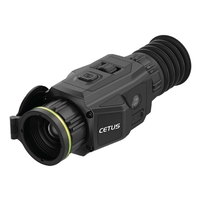
Pixfra Cetus C225 Thermal (256x192) Rifle Scope
via Uttings
£679.95
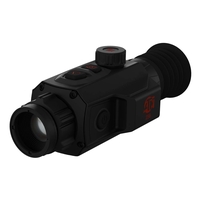
ATN Thor 6 Mini 215 (2-16x) Compact Thermal (256x192) Rifle Scope
via Uttings
£699.00
Buying Advice
Resolution, pixel pitch and lens. Three numbers on the spec sheet matter most. Sensor resolution is the pixel count: a 640x512 sensor has 327,680 pixels, nearly three times the 110,592 of a 384x288 sensor, so it draws a more detailed picture of the same view. Pixel pitch, usually 12 or 17 micrometres, is the size of each pixel; a smaller pitch lets a maker fit a smaller, lighter lens for the same field of view. Lens focal length sets how much of the scene you see and how big a distant animal looks.
Lens and field of view in practice. HIKMICRO's FALCON 2.0 monoculars share a 640x512, 12 micrometre sensor. The FALCON FQ35 2.0 has a 35 mm F1.0 lens and a 12.5 by 10.0 degree field of view, 21.9 m by 17.5 m at 100 m. The FALCON FQ50 2.0 has a 50 mm F0.9 lens and an 8.8 by 7.0 degree view, 15.4 m by 12.2 m at 100 m. The longer lens shows more of a distant animal but covers less ground at once, so a hedge line takes longer to sweep. Neither is better. Woodland rides and close ground suit the wider view; open fields and long sight lines suit the narrower one.
Detection is not identification. HIKMICRO quotes a detection range of 1,800 m for the FQ35 2.0. The FQ50 2.0 is quoted at 2,600 m. Those figures are the distance at which the unit can pick up a warm target of the size the maker assumes. They do not tell you how far you can recognise a fox rather than a badger, or a roe doe rather than a muntjac, and the recognition and identification distances are far shorter. Treat the headline range as a ceiling in good conditions. Work out how far you need to identify quarry and its surroundings for a safe shot, and buy for that.
Sensitivity and British weather. NETD, in millikelvin, is the smallest temperature difference the sensor can show, and lower is better. Both FALCON 2.0 models list less than 15 mK. It matters most on warm, damp nights when a fox is only a few degrees warmer than wet grass. Thermal works in total darkness, but rain, fog and humidity absorb infrared and cut range, so expect less than the spec sheet on a drizzly night. Both models are rated IP67, which means dust-tight and protected against temporary immersion.
Refresh rate, weight and battery. A 50 Hz refresh rate, as on the FALCON 2.0 pair, pans smoothly; lower rates smear when you sweep across a field. The FQ35 2.0 is listed at 485.5 g with battery, which matters on a long walk-in with the unit around your neck. Its replaceable 21700 battery is listed at 6.5 hours or more at 25 degrees C with Wi-Fi and the zoom feature on. A winter night is colder than that test, so carry a spare cell.
Handheld thermal or thermal sight. A handheld thermal does not replace a thermal sight, but it makes one more useful. It tells you something warm is there. Telling a roe buck from a doe, or checking an animal is the one you intend to cull, often needs daylight glass or a closer look. If you already own a quality day scope and plan to shoot at night, a front clip-on is the other route; our night vision add-on guide covers how those fit.
Air rifles. A thermal spotter finds the quarry; it does not extend the rifle. Sub-12 ft/lb air rifles, springers included, are effective only to about 50-75 yards on small quarry such as rats and rabbits, however far the spotter can see.
UK law, checked 5 November 2026. Owning one: the Home Office licensing guide lists the component parts of a firearm that need a certificate as a barrel, chamber or cylinder; a frame, body or receiver; and a breech block, bolt or similar mechanism at the rear of the chamber. Optics are not on that list, so you do not need a firearm or shotgun certificate to buy or own a thermal spotter in England, Wales or Scotland, or to use it for watching wildlife.
Deer at night. The night-shooting offence concerns taking or killing deer, not watching them. In England and Wales, section 3 of the Deer Act 1991 makes it an offence to take or intentionally kill a deer between the end of the first hour after sunset and the start of the last hour before sunrise. The exceptions include a licence from Natural England or Natural Resources Wales for public health or safety, conserving the natural heritage or preventing serious damage to property; a notice under section 98 of the Agriculture Act 1947; and killing a deer at night to prevent the suffering of an injured or diseased animal (section 6(2)), which is where a thermal spotter helps with finding a deer after a shot. In Scotland, section 18 of the Deer (Scotland) Act 1996 makes it an offence to take or wilfully kill or injure deer at night, with night shooting allowed only under NatureScot authorisation.
Other quarry. Rabbits, hares, foxes and wild birds each have their own rules for night shooting, and section 5 of the Wildlife and Countryside Act 1981 bars "any sighting device for night shooting" for killing or taking wild birds, so a thermal sight is a different matter from a spotter. Our night vision add-on guide goes through the quarry rules. Northern Ireland has separate legislation and is not covered here. None of this is legal advice: for your own case, ask BASC or your force's firearms licensing department.
Frequently Asked Questions
Do I need a licence to own a thermal spotting scope in the UK?
No firearm or shotgun certificate is needed to buy or own a handheld thermal in England, Wales or Scotland, because optics are not among the component parts of a firearm that fall under certificate control. Your certificate and the law still govern what you do with a rifle. Position checked 5 November 2026.
Can I use a thermal spotter to find deer at night?
Using one to watch or locate deer is not what the night-shooting offence covers: in England and Wales section 3 of the Deer Act 1991 is about taking or intentionally killing deer at night, and in Scotland section 18 of the Deer (Scotland) Act 1996 is about taking, killing or injuring them. Shooting deer at night needs a licence or authorisation, or must fall within a statutory exception such as preventing the suffering of an injured animal.
What is the difference between a thermal spotter and a thermal scope?
A spotter is a handheld viewer for finding and identifying animals. It has no reticle and no zero and is not fitted to a rifle. A thermal scope or clip-on is a sight, with a reticle and a zero, and the rules on shooting at night apply to it.
How far can a thermal spotter see?
The maker's detection range is the distance at which a warm target of the maker's standard size can be picked out; HIKMICRO quotes 1,800 m for the FALCON FQ35 2.0, for example. Recognising and identifying an animal needs a much shorter distance, and rain, fog and humidity reduce both.
Related guides
Our expert-tested guide to the best thermal spotter monoculars under £1,000 for UK deer stalking and foxing.
Night Vision Add-Ons and Scope Adapters: What Fits Your Day ScopeHow to choose a night vision add-on for your rifle scope: front or rear, eyepiece and objective adapters, zero, battery and the UK law on night shooting.
NV Clip-On vs Thermal Clip-On: Which Suits Your Stalking?Digital night vision or thermal clip-on for UK deer stalking? Our 2026 guide compares detection, identification and legal use.
Buying a Second-Hand Thermal Scope in the UK: What to CheckBuying a used thermal scope in the UK? What to check before you pay: dead pixels, battery health, warranty and receipt, firmware, the rangefinder and zero.
Best Thermal Rifle Scopes in the UK (2026 Buyer's Guide)Best thermal scope UK 2026: budget to premium options, 384 vs 640 sensors, NETD and refresh rate explained, UK law and where to buy.
Not sure which scope is right for you?
Try our AI-powered scope finder — answer a few questions and get personalised recommendations.
Find My Scope →Get a UK scope tip every day
Follow AiScopes on Facebook for daily buying guides, deals and gear advice.
Follow on Facebook